A teacher's guide to emoji pattern bundles
A single pattern page is a lovely small thing: a few rows of friendly icons, a rule to find, a box to fill. But a child does not learn a pattern from one page. They learn it from seeing it again and again in new pictures, until the rule stands out from the icons. That is what a bundle is for. It collects ten worksheets for one pattern into a single PDF, so a teacher or parent can hand a child a short, coherent run of practice with one download.
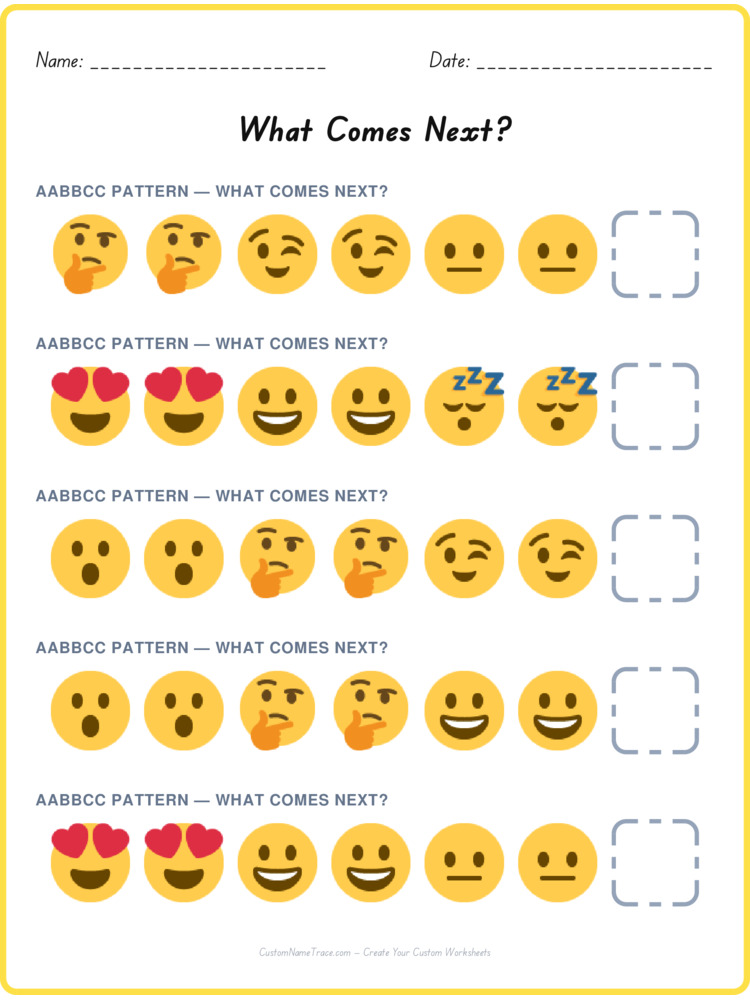
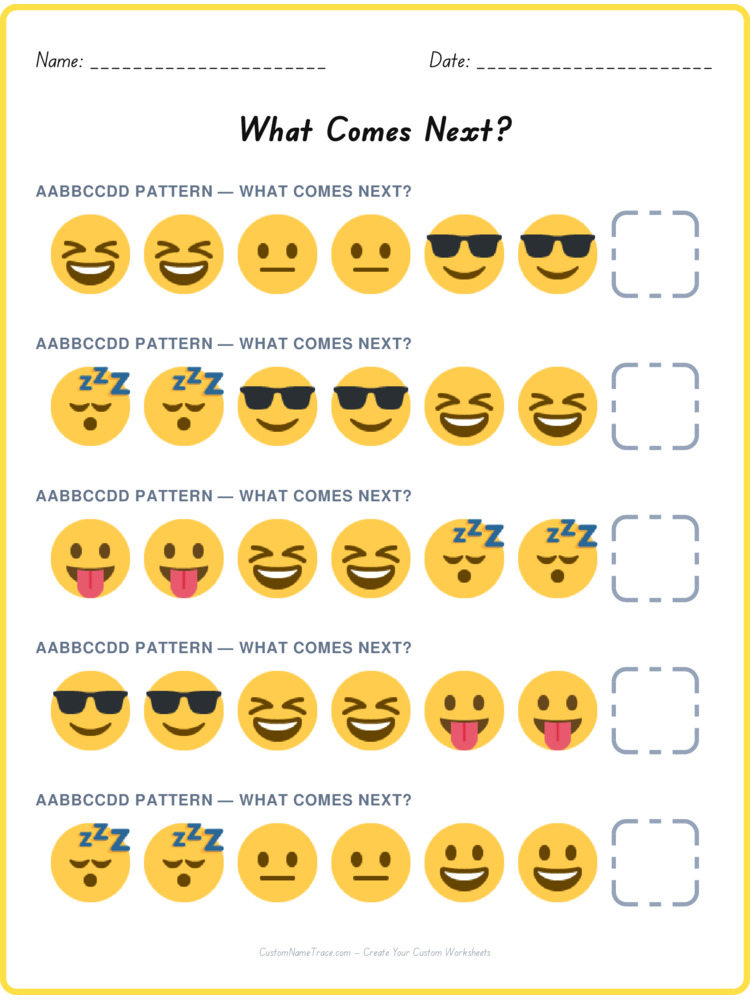
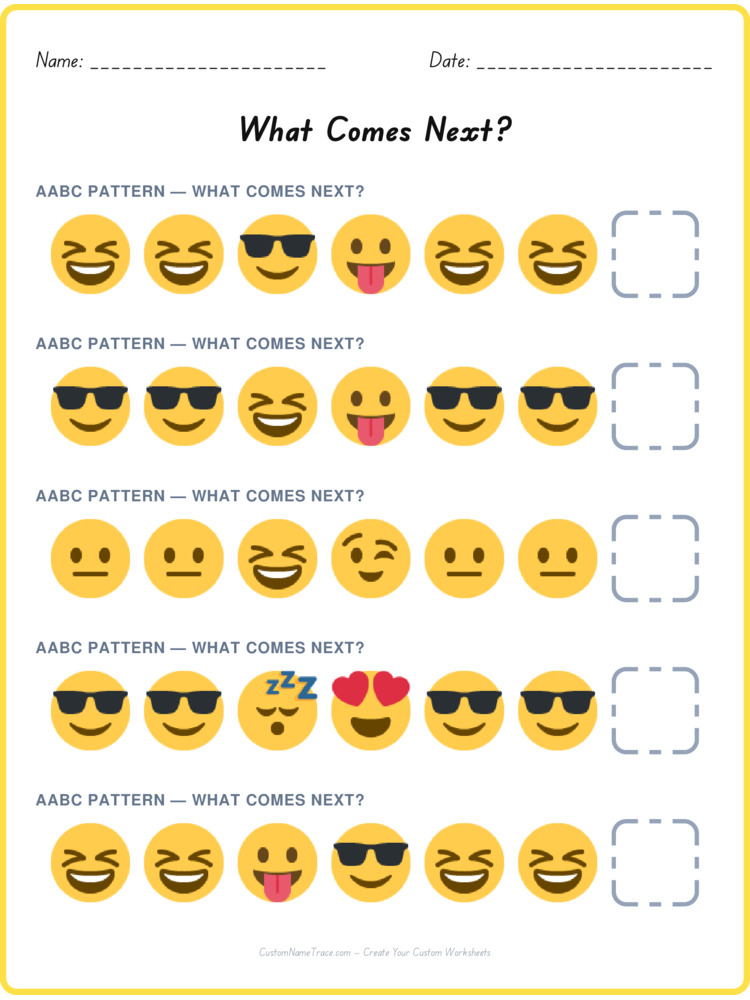
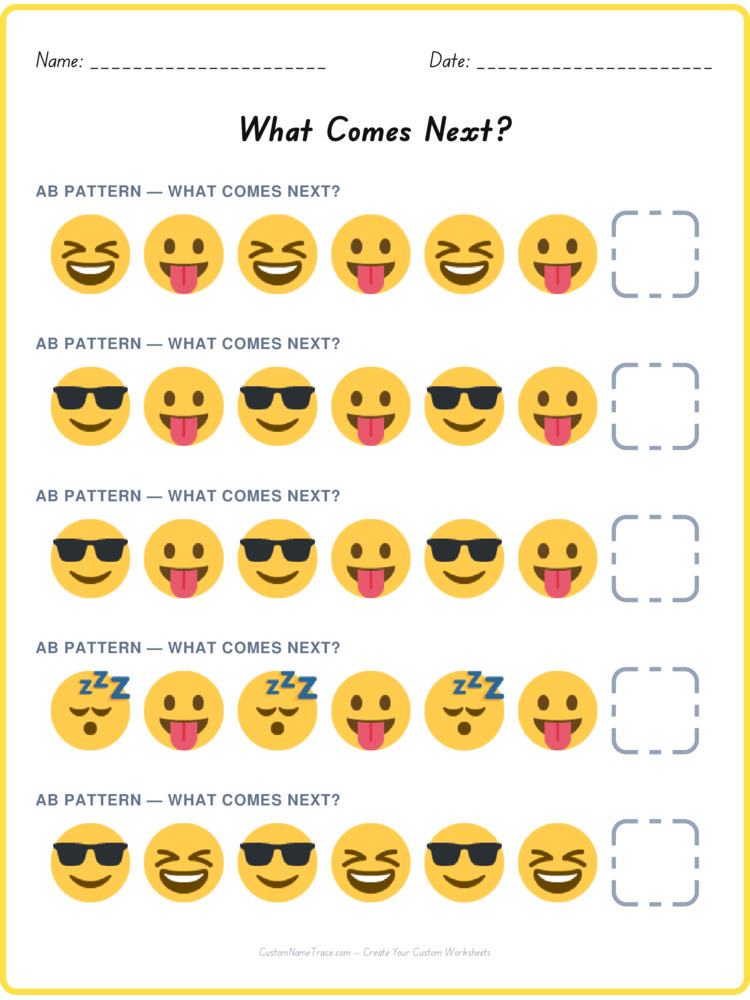
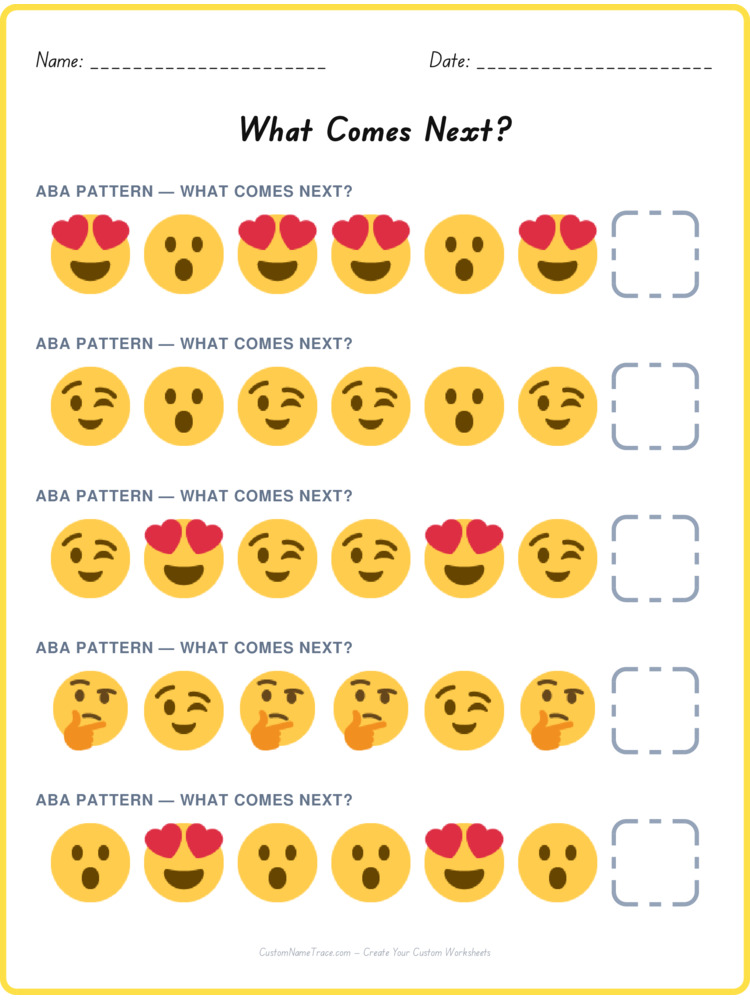
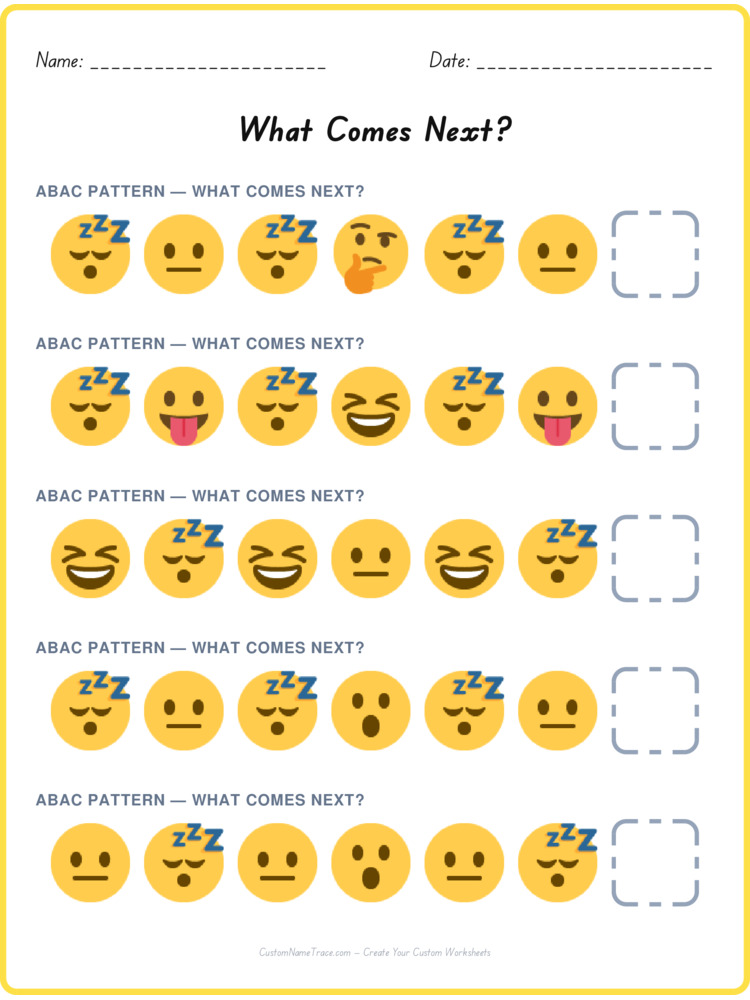
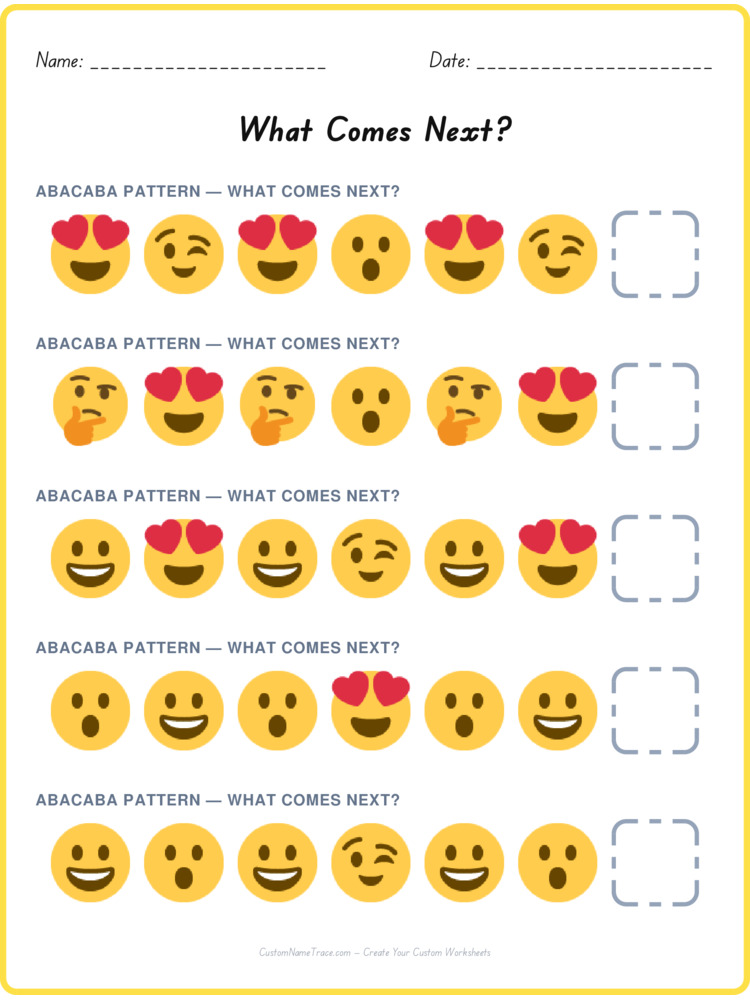
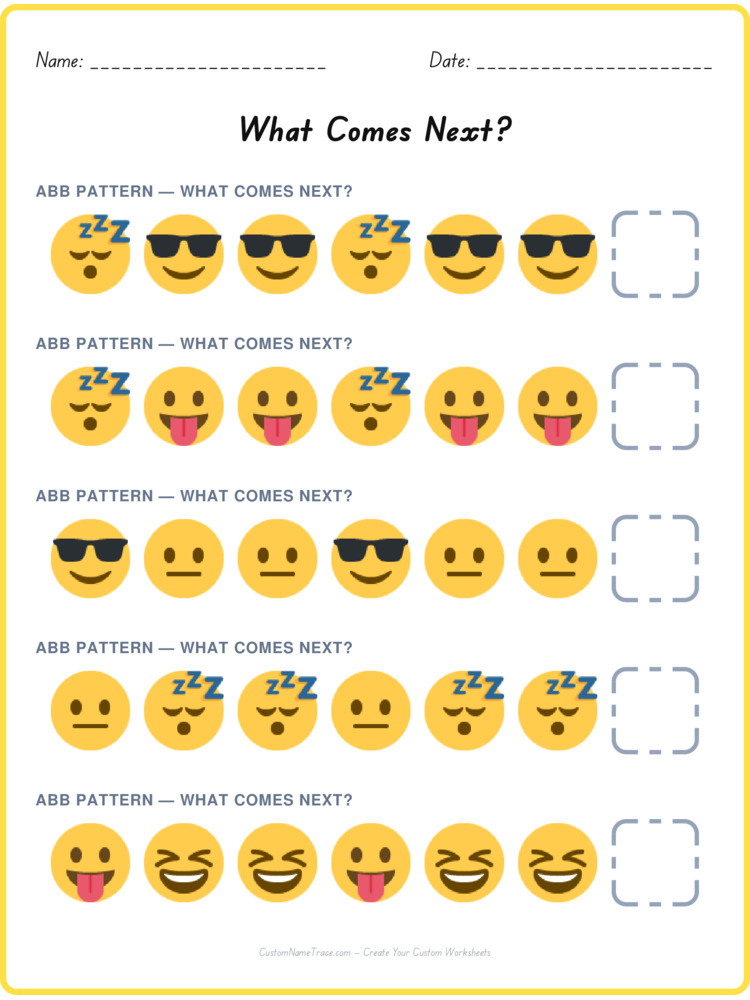
This section holds twenty-one emoji pattern bundles: one for the youngest children, and twenty for the advanced level, one for each of the nineteen patterns from AB to ABACABA, plus a mixed-review bundle. Each is ten worksheets, in Letter and A4 sizes. This guide explains what is in a bundle, how the two levels differ, how to choose, how to run ten pages so that the thinking stays alive, and how to connect pattern work to the real world. For the teaching ideas behind patterns themselves, see the emoji patterns guide, the beginner guide and the advanced guide.
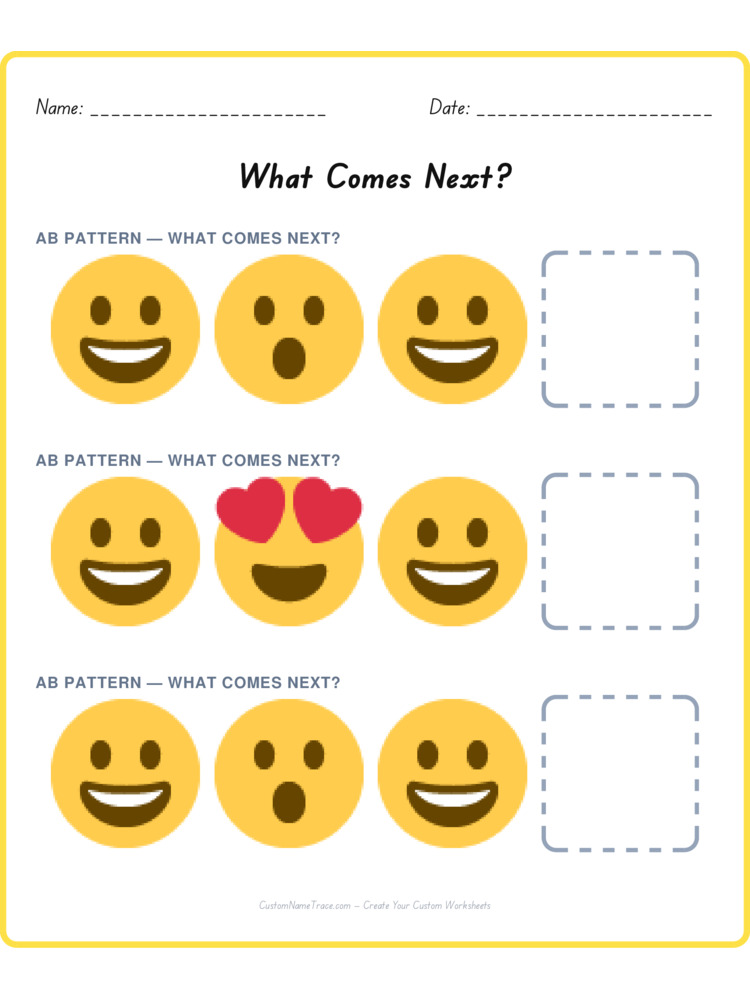 A bundle cover shows its first page. This is the Beginner bundle: three big icons in each row, and a box for the next.
What a bundle is
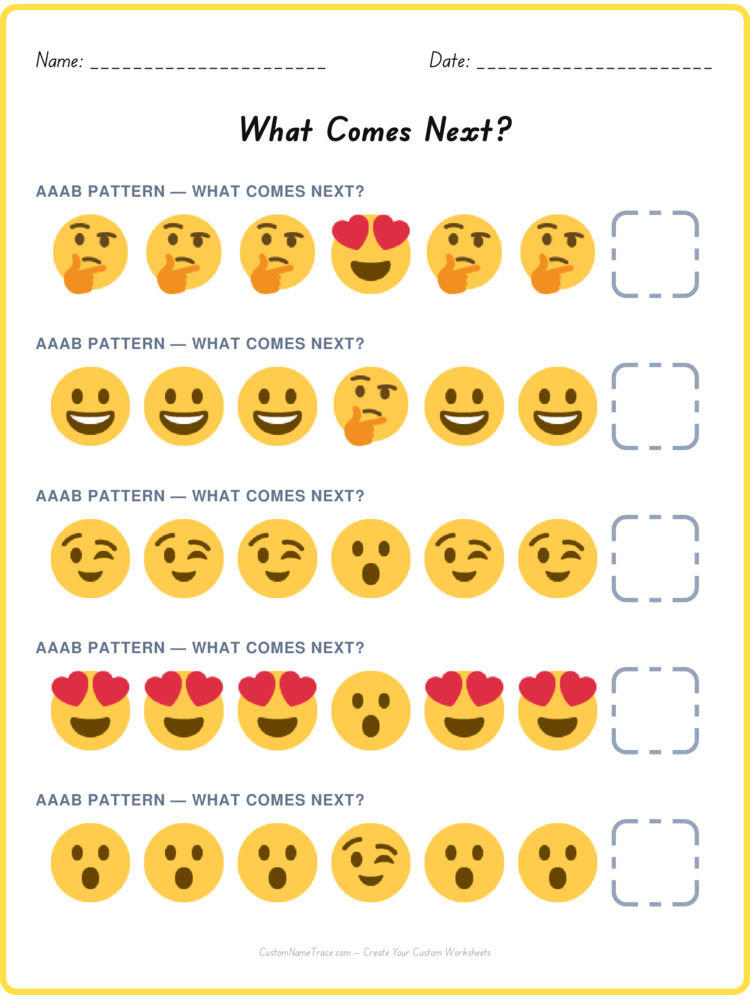
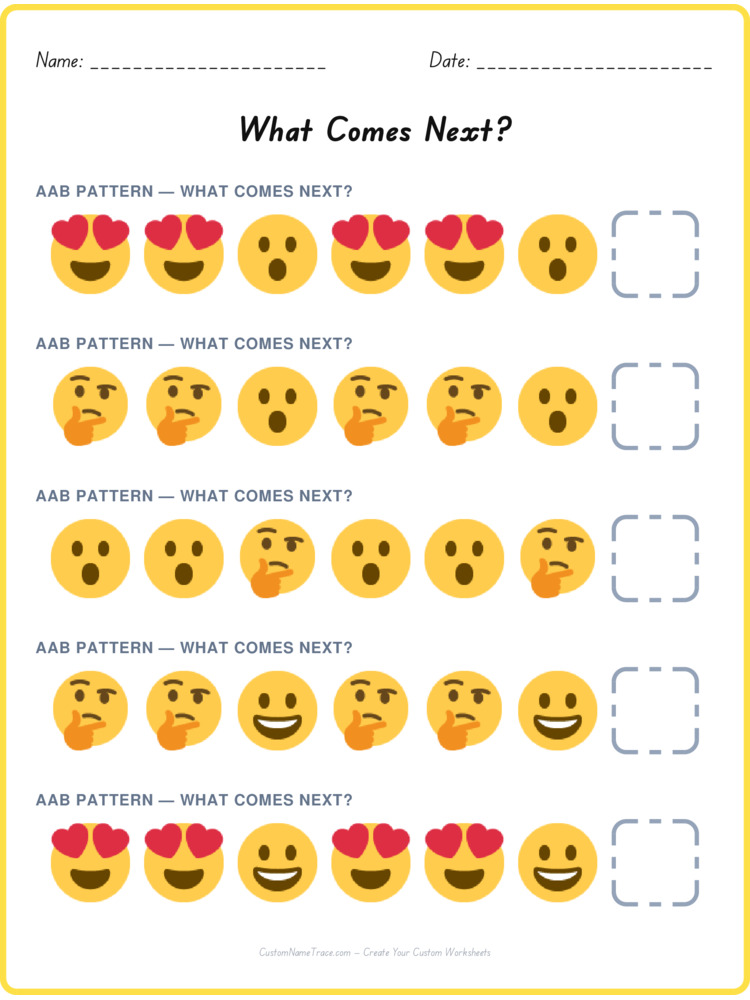
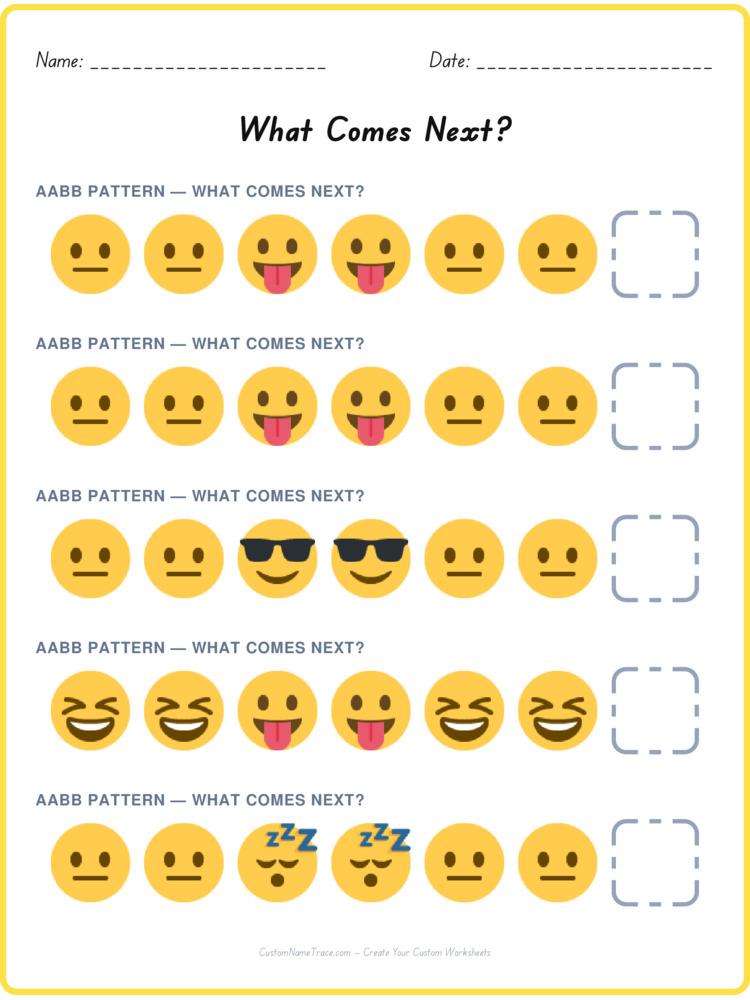
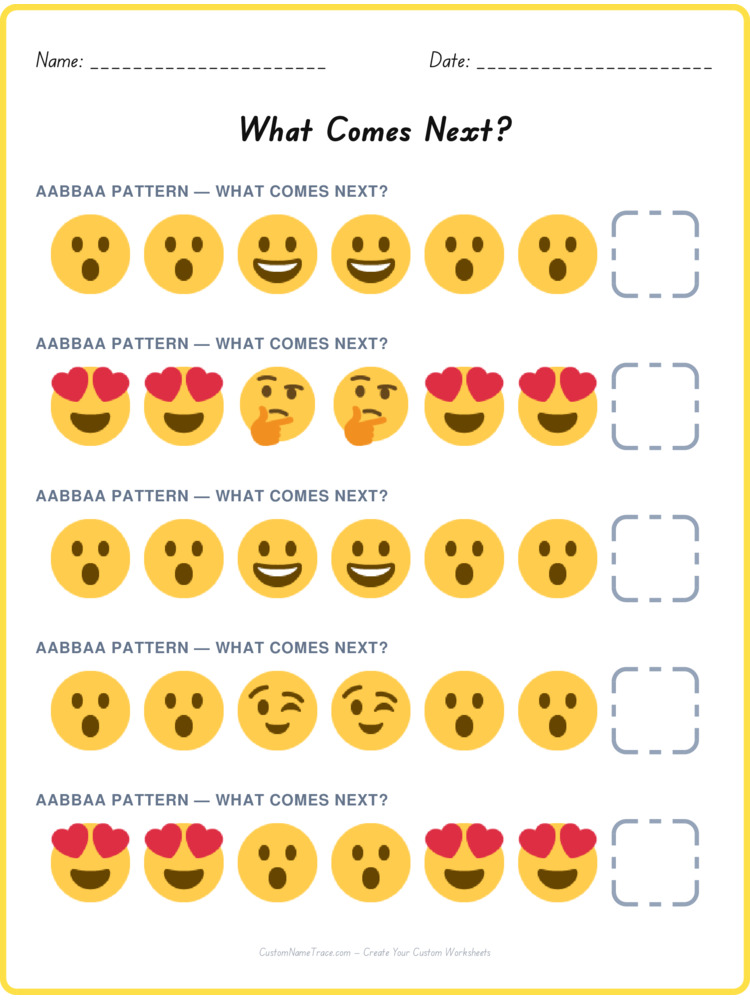
An emoji bundle is ten numbered worksheets for one pattern, at one level, combined into a single file. The ten pages follow the same rule, with different icons on each, so a child sees the same structure in many forms. The AAAB bundle, for example, has ten pages in which every row follows an AAAB rule: three of one icon, then one of another, repeating.
A bundle's own page shows a preview of each worksheet, so you can flip through "1 of 10" to "10 of 10" before printing, and a short list of what is inside.
The key features are these.
- One pattern. A child practices one rule at a time, which is how a rule becomes familiar.
- Ten different pages. The icons change, so the pattern is the thing that stays constant.
- Both sizes. Letter and A4.
- Print once. One PDF for the whole set.
- Free. No account, nothing saved.
Two levels
The bundles are grouped into two levels, matching the worksheets themselves.
Beginner is for the youngest children, around Pre-K3 and Pre-K4. There is one bundle, and every page uses plain AB alternation with three large icons before the blank.
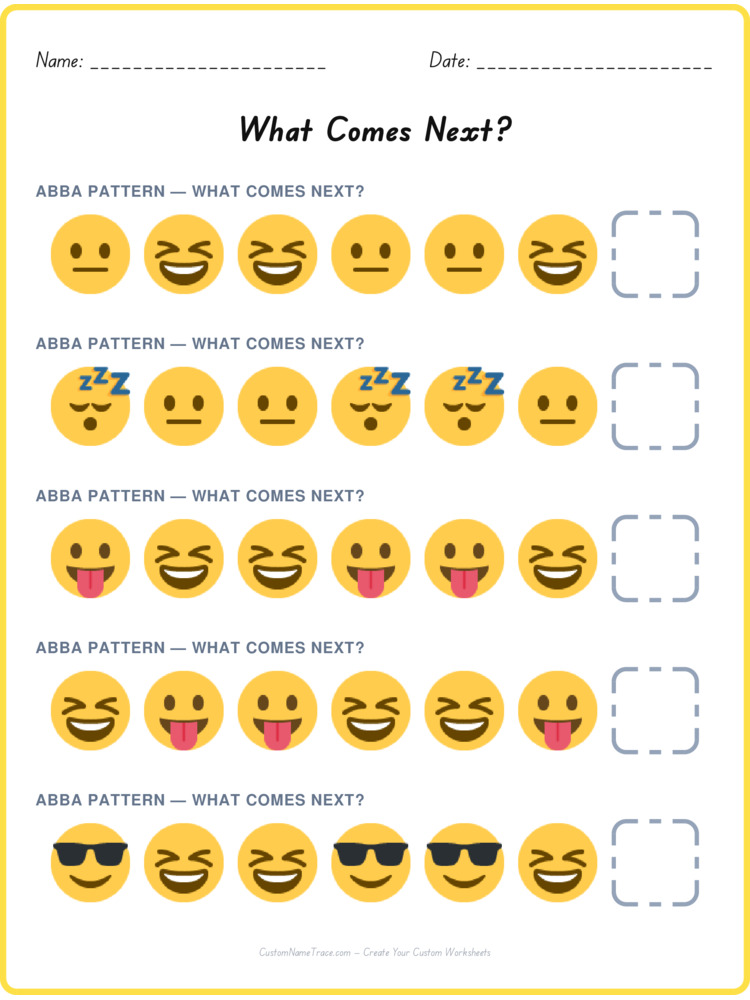
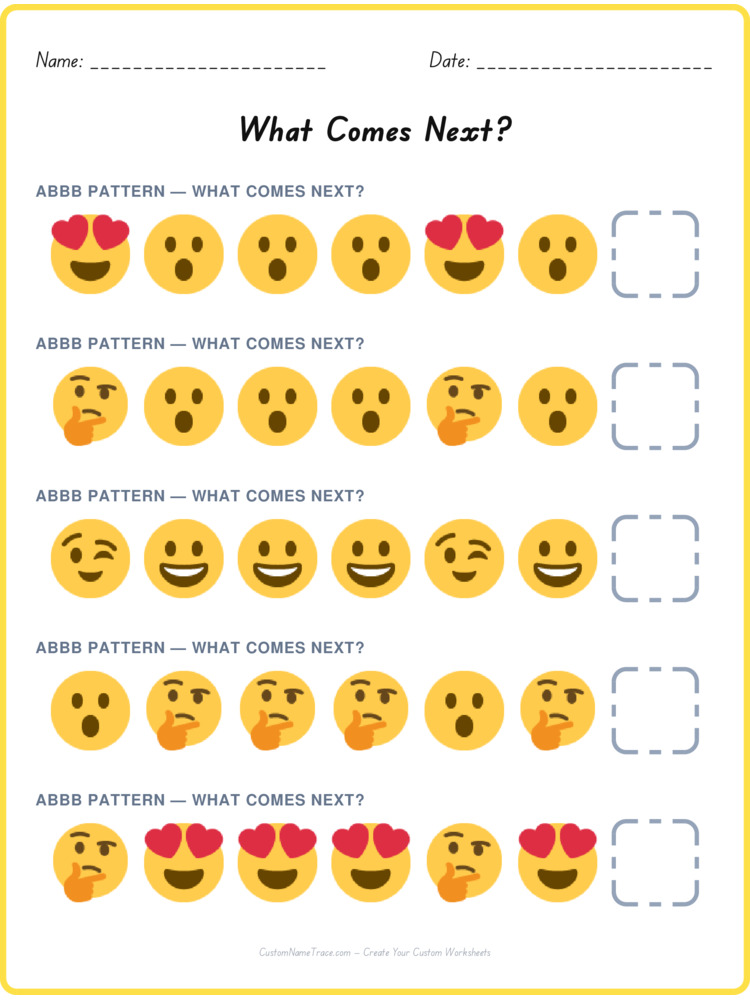
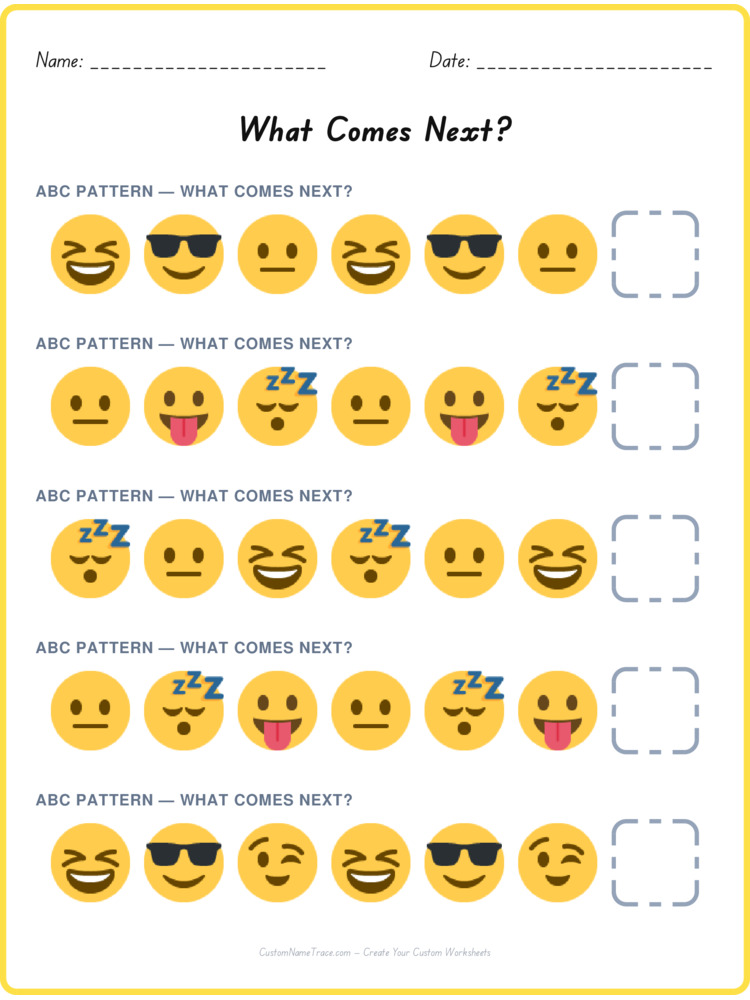
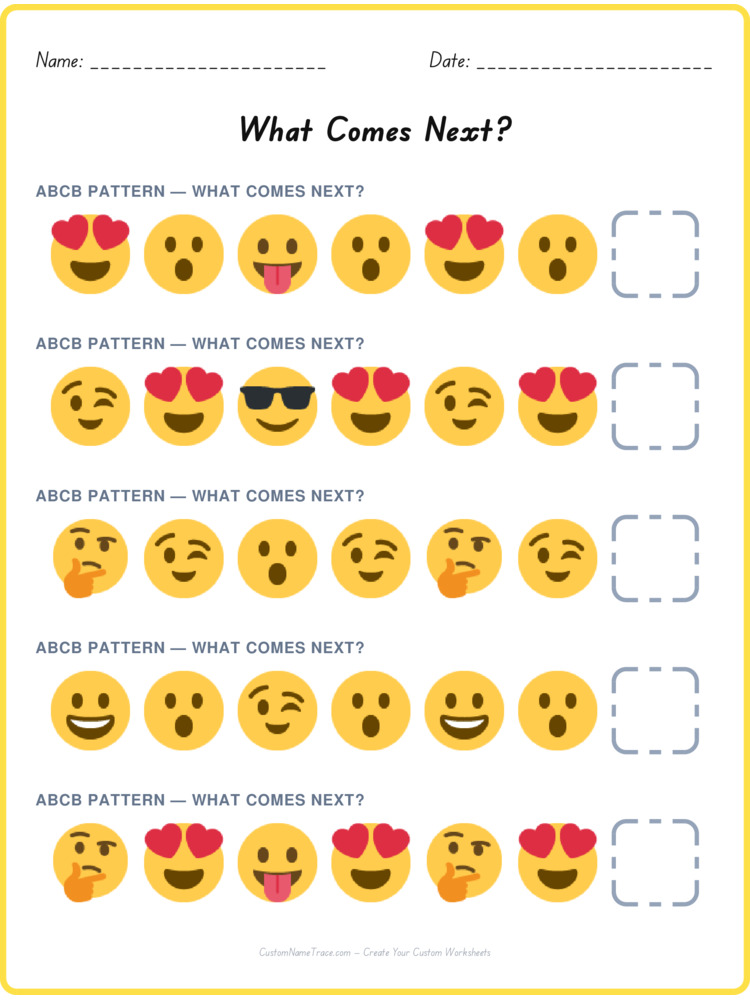
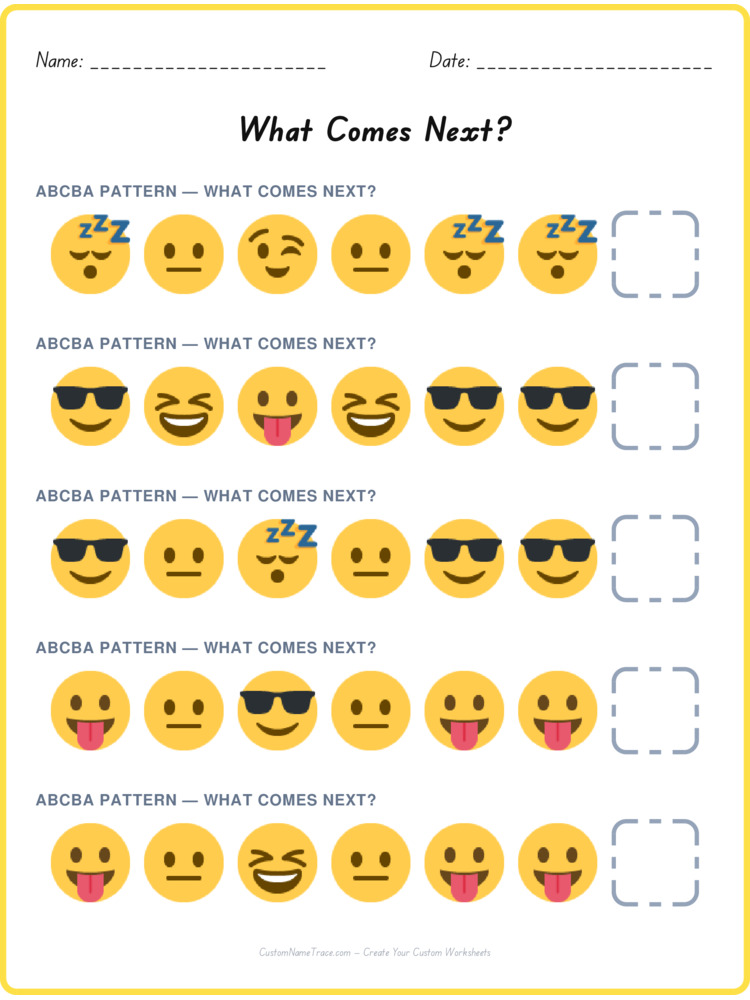
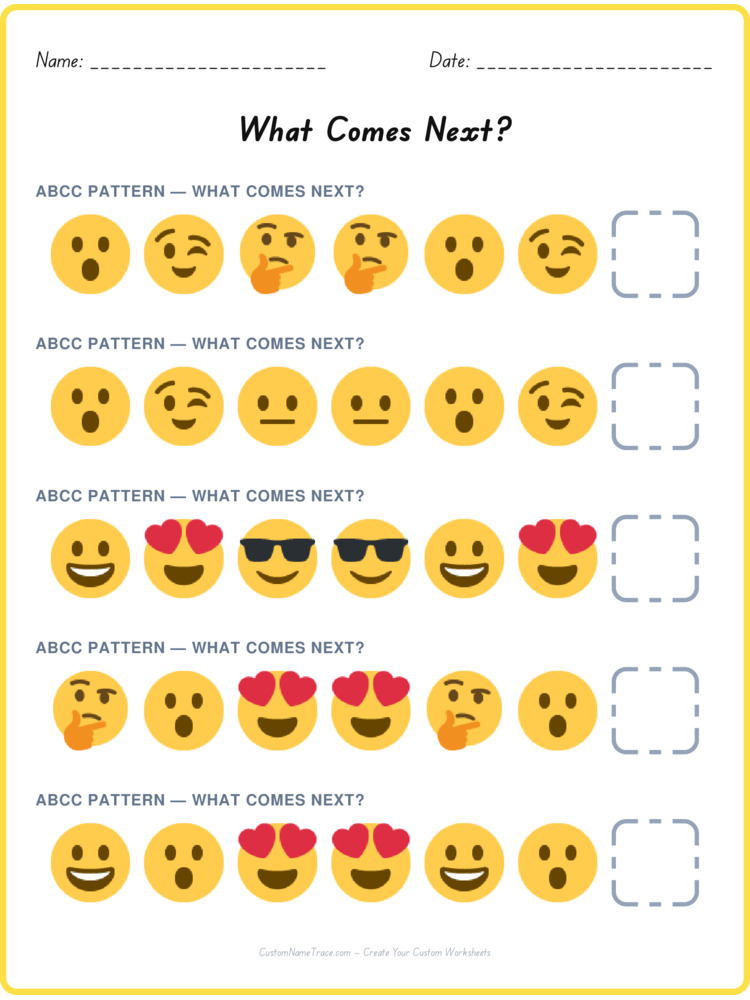
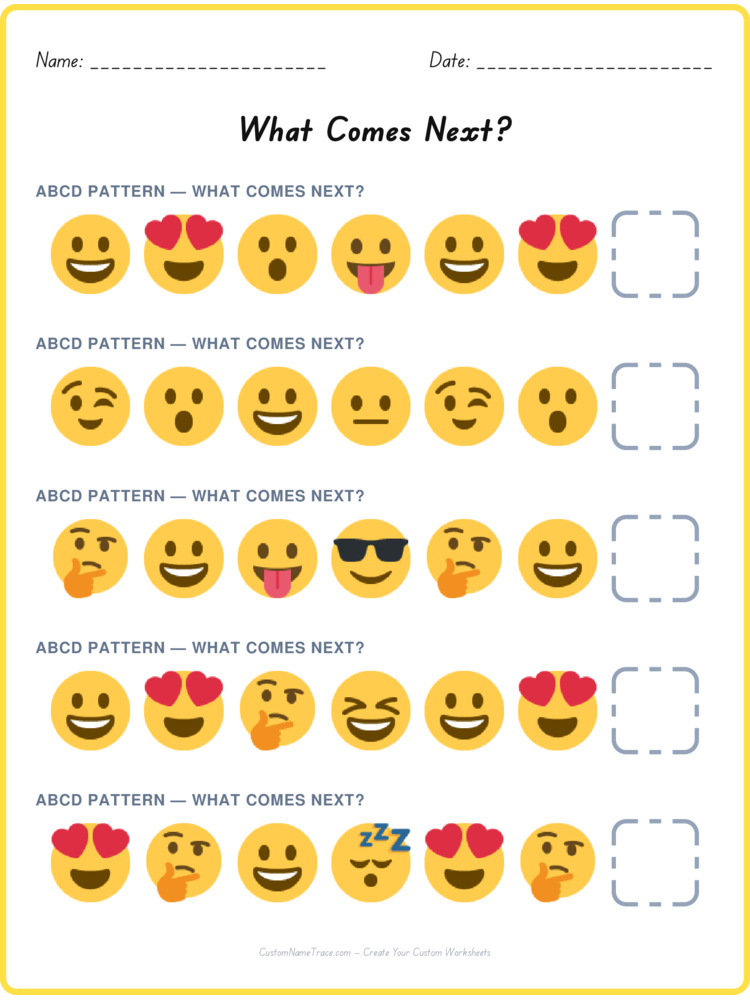
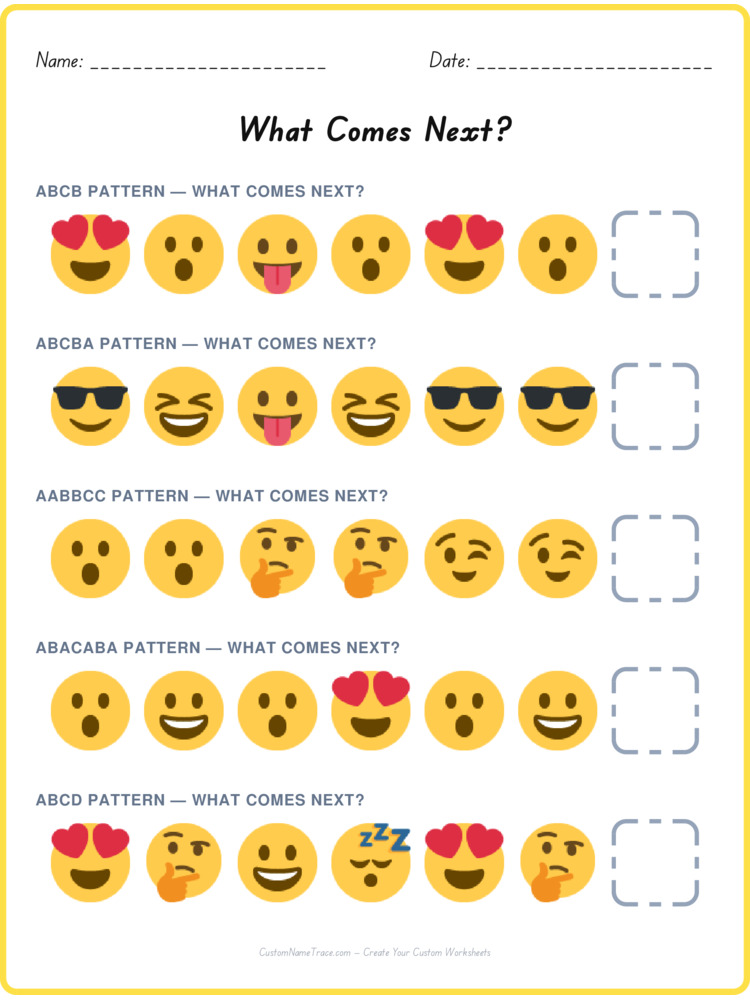
Advanced is for Kindergarten and up. There are twenty bundles, one for each of nineteen patterns, plus a mixed-review bundle. Each row shows six icons before the blank, and each row is labeled with its pattern's name.
The levels describe a skill stage, not a school grade, and a child can move between them as they are ready.
Why a bundle helps with patterns
Patterns are a particular kind of learning. A child who sees one AAB row may or may not see the rule. A child who has seen ten, in different pictures, usually does. There are several reasons bundles suit pattern work.
- Repetition with variation is the whole point. The same rule, in new clothes.
- Generalizing needs many examples. A child abstracts the rule by seeing what stays the same.
- Confidence grows with success. Ten pages of the same type give a child the experience of getting it right.
- Trends are easy to see. Page 1 and page 10 show the growth.
- A run of pages makes a nice small project. "We're doing the AAB pages this week."
A bundle also keeps a child on one pattern long enough to master it, rather than skipping around.
Choosing a bundle
The right bundle is one that is just a little beyond comfortable. A few guidelines.
- Start from the simplest. If a child has never done a pattern page, start with the Beginner bundle, whatever their age.
- Check AB first. The AB bundle in the Advanced level is a good gateway for a child who has outgrown Beginner.
- Use a diagnostic page. Print one worksheet from a pattern's own page, and see how the child does.
- Choose by ability. A child who finds AB easy is ready for AAB or ABB.
- Mix in review. A mixed-review bundle checks several patterns at once.
The Advanced bundles guide lists all twenty, with an order for working through them.
A ten-page run, step by step
Ten pages is a nice amount for a week or two. Here is how to run a bundle so the thinking stays alive.
Page 1: Cold. Let the child try without help. Notice what they do. Do they look at the whole row? Do they say the pattern? Do they guess?
Pages 2 to 4: Name the rule. Before each row, say the pattern's name and the rule in words. "This is an AAB pattern. Two of one, then one of another." Ask the child to say the unit.
Pages 5 to 7: Explain. For each row, ask, "How do you know?" Listen for a reason.
Pages 8 and 9: Create. After each page, ask the child to make a new row of their own, with blocks or drawings.
Page 10: Cold again. Do it under the same conditions as page 1, and compare.
At the end, look at pages 1 and 10 together. The comparison is a lovely moment, and it often shows more than any score.
What to watch for
Patterns are about thinking, and the best evidence of thinking is what the child says. Over ten pages, watch for these signs.
| What you see |
What it suggests |
What to do |
| Answers quickly and explains |
The rule is clear |
Move on |
| Answers quickly, cannot explain |
Intuition, not yet articulated |
Ask "how do you know?" regularly |
| Copies the last icon |
Not yet looking at the whole row |
Cover the end, say the row from the start |
| Gets some rows, not others |
The rule is partly learned |
Practice with real objects |
| Right icon, wrong place in the unit |
Losing count of repeats |
Chant the pattern, and tap |
| Gives up quickly |
Frustration or fatigue |
Shorten the session, return to an easier pattern |
| Asks for more |
Ready |
Offer a harder pattern or let them create |
Using bundles with real materials
A bundle is paper, but the thinking should not stay on paper. A few simple additions bring pages to life.
- Blocks beside the page. Let the child build each row with blocks before answering.
- Translating. After a page, make the same pattern with claps and stomps.
- Pattern hunts. Look for the pattern's structure in the room: stripes, tiles, floor boards.
- Making. Thread beads, snap cubes or stack cups in the pattern's rule.
- Story. "Once upon a time there was a heart, a heart, and a moon..."
- Songs. Many songs follow a pattern. Clap AAB while singing.
A child who has made the pattern with their hands and said it with their voice will find the page a relief.
A four-week plan for a first-time pattern learner
Here is a gentle path for a child who is just starting, using the Beginner bundle and then the first Advanced bundles. It takes about four weeks at three short sessions a week, and any part can be repeated.
Week 1: Patterns with the body and with objects. No paper yet. Clap and stomp. Line up toys: bear, rabbit, bear, rabbit. Thread beads. Say "red, blue, red, blue" and ask what comes next. The goal is to get the idea of "what comes next" into the child's hands and voice.
Week 2: The Beginner bundle, pages 1 to 5. One row at a time, with blocks beside the page. Say each row aloud. Draw or color the answer. Stop after a row or two if the child tires.
Week 3: The Beginner bundle, pages 6 to 10. Let the child do a little more on their own. Ask "how do you know?" Do page 10 under the same conditions as page 1, and compare.
Week 4: The first Advanced bundle, AB. The icons are smaller and there are six before the blank. For a child who is ready, this is a mild step, and it introduces the row labels.
At the end, the child will have seen about twenty pattern pages, and will have played with patterns in many other ways. That is a very good start.
A pathway through the Advanced bundles
The Advanced level has twenty bundles, and there is no single right order. But a path with a clear logic is worth having. Here is one, grouped into stages of about two bundles a fortnight.
Stage 1: Two icons. AB, then AAB, then ABB. Three bundles, about three weeks.
Stage 2: Longer runs. AABB, AAAB, ABBB. The child counts runs of two or three.
Stage 3: Mirrors. ABA, then ABBA, then AABBAA. A first look at symmetry.
Stage 4: Three icons. ABC, then AABC, ABCC, ABAC and ABCB. A big step, and worth several weeks.
Stage 5: Long mirrors and big units. ABCBA, AABBCC, ABCD, then ABACABA and AABBCCDD.
Stage 6: Mixed review. The mixed bundle, as a check, and again at the end.
A class that follows this path over a term, with one bundle every week or two, will have covered the whole of the advanced pattern work with time to spare for games and creating.
A simple record sheet
A short record makes the ten pages easy to read. Draw a table with one row for each page.
| Page |
Rows right |
Said the rule? |
Needed help? |
Notes |
| 1 |
|
|
|
|
| 2 |
|
|
|
|
| ... |
|
|
|
|
| 10 |
|
|
|
|
Under Said the rule? write yes, a little or no. This column is the most revealing. A child who can say "two stars and then a moon" has the rule. A child who can only point has a feeling for it, but not yet words.
After ten pages, look at the columns. If Rows right is rising and Said the rule? is moving from "no" to "yes," the bundle has done its job.
A short glossary for adults
A few words come up often in pattern work. It helps to use them consistently.
- Pattern. Something that repeats in a predictable way.
- Unit or core. The part that repeats.
- Extend. To continue a pattern.
- Rule. The instruction that makes the pattern.
- Mirror (symmetrical). A unit that reads the same forward and backward.
- Translate. To make the same pattern with different materials.
- Abstract. To see the pattern without being distracted by the pictures.
- Create. To make up a pattern of your own.
- Predict. To say what comes next, or what the twentieth item will be.
A child who hears these words in context will start to use them, and that is a good sign.
Twelve quick activities to pair with a bundle
A page is more powerful when it is surrounded by play. Here are twelve ideas, each needing almost nothing.
- Pattern bracelet. Thread beads in the pattern from the page.
- Sound pattern. Clap, stomp, snap, in the rule's shape.
- Fruit skewer. Grape, strawberry, grape, strawberry.
- Block towers. Build the rule with colored blocks.
- Shape stamping. Use stamps or sponges to make a row.
- Stair patterns. Step on dark, light, dark, light tiles.
- Dress-up pattern. Hat, no hat, hat, no hat, in a line of children.
- Pattern snake. A long paper strip where each child adds a piece.
- Mystery bag. Pull objects from a bag, and guess the next.
- Pattern in the kitchen. Spoons and forks on a tray: spoon, fork, fork, spoon, fork, fork.
- Draw a pattern strip for a family member to continue.
- Pattern hunt. Look around for patterns and name them with letters.
A page and one of these a day make a very good week.
From bundle to confidence
Ten pages may seem a small thing, but there is a lot in them. A child who completes a bundle has:
- seen a rule in ten different sets of pictures;
- extended it dozens of times, three rows to a beginner page and five to an advanced one;
- had ten chances to explain;
- done a before and after comparison;
- built a small pile of finished work to be proud of.
That is the real purpose of a bundle: not to test, but to give a child a run of success. And a child who has had a run of success at patterns is a child who will approach number patterns, algebra and puzzles with a little more courage.
What comes after
When a child has worked through the pattern bundles, the natural next steps are number patterns and logic puzzles.
A child who loves patterns will find plenty of ways to go further.
Beginner or the first Advanced bundle?
A common question is where a child should start when they are somewhere between the two levels. A few simple tests will tell you.
- Give a Beginner page. If the child fills in all three rows correctly and says why, they are ready to move on.
- Give the AB Advanced page. If the child can do the six-icon rows without hesitating, they are ready for AAB.
- If both are easy, go straight to AAB or ABB.
- If the Beginner page is hard, stay with it, and add more play with real objects.
The two levels differ in several ways at once, which is worth remembering. The Beginner page has three icons, larger boxes and one rule. The Advanced page has six icons, a label on each row and many rules. A child who is comfortable with Beginner may still find the busier look of Advanced a little daunting at first, and a minute of looking at the page together before starting is time well spent.
Questions to ask after each page
The most valuable part of any pattern session is the conversation. A short list of questions, used again and again, helps.
- "What is the rule?" The child says it in their own words.
- "What is the part that repeats?" The unit.
- "How do you know the next one?" The reason.
- "What would come after that?" One step beyond the blank.
- "What would the tenth one be?" A prediction.
- "Can you make one like it?" Creating.
- "What was the tricky row?" Reflection.
Even three of these in a session turns a page into a rich conversation, and the child learns that the thinking is the point, not just the answer.
Pattern bundles and children with different needs
Patterns are a useful activity for many kinds of learners, and bundles make it easy to adapt.
- Children who need movement. Walk, hop or clap the patterns before sitting down.
- Children who need less visual clutter. Cover all but one row of the page with a sheet of paper.
- Children who find fine motor tasks difficult. Point, place a sticker, or use a large crayon.
- Children who are learning English. Pattern work needs very little language, and shapes are universal. Use the child's home language for naming.
- Children who need a challenge. Ask for the twentieth item, or have them create harder patterns.
- Children who are anxious. Keep sessions very short, and begin with a row the child can do.
A bundle is flexible, and a thoughtful adult can shape it to the child.
For teachers
A bundle is an easy resource to build into a Pre-K or Kindergarten day.
- Center. A bundle, some crayons and a basket of blocks make a self-explanatory station.
- Small group. Work through a page with three or four children, and let them explain.
- Morning work. One page on each desk, different pages for different children.
- Assessment. Pages 1 and 10 give a before and after.
- Home connection. Send a few pages home with a note about the pattern's name.
- Class book. Each child makes their own pattern page, and the class binds them.
Because each bundle holds ten distinct pages, a class of twenty can share two copies, or each child can have a different page on the same day.
For parents
You do not need to be a teacher.
- Print one bundle at a time. Ten pages is plenty for a fortnight.
- Do one or two rows at a time. A full page can wait.
- Say the pattern aloud. The voice helps.
- Ask, "How do you know?"
- Play with objects from around the house.
- Praise looking and thinking.
Printing and organizing
- Print only what you need. A child who finishes three pages can stop.
- Choose black and white. The icons were checked in grayscale, so pages read clearly without color.
- Use a folder. Label it with the pattern's name.
- Keep a record. A simple tick sheet shows pages done.
- Keep the PDF. Save it on your device.
Questions that come up
Is a bundle the same as the individual pages? It is ten of the numbered worksheets for one pattern, combined into one file.
Do I need all ten pages? No. Use as many as help.
My child finds the bundle too easy. Move to a more complex pattern, or ask them to create their own.
My child finds it too hard. Go back to real objects, or an easier pattern.
Can I mix bundles? Yes. A mixed-review bundle is made for it, and you can also alternate two patterns on alternate days.
What age are the bundles for? The Beginner bundle suits around ages three to four, and the Advanced bundles suit Kindergarten and up, but readiness matters more than age.
A bundle of pattern pages is a modest thing, ten sheets in a folder. But ten sheets of the same idea, in ten different pictures, is exactly how a child comes to see that a rule can be found, and that is a lesson with a very long reach.