A teacher's guide to name missing-letter worksheets
A missing-letter name page is titled "I Know My Name!" and it asks a child to prove it. The first row shows the full name in solid letters, as a model. The rows below show the same name with gaps in it, written as underscores, and the child fills in each gap. One row is missing the first letter and the last. Another is missing a letter in the middle. By the bottom of the page the child has put back every letter that was taken away.
This is a different kind of work from tracing. When a child traces, the letters are already there, and the pencil follows a path. When a child fills in a missing letter, nothing is there to follow. The child has to remember what comes next. That small shift, from following to remembering, is what makes this page valuable, and it is the subject of this guide.
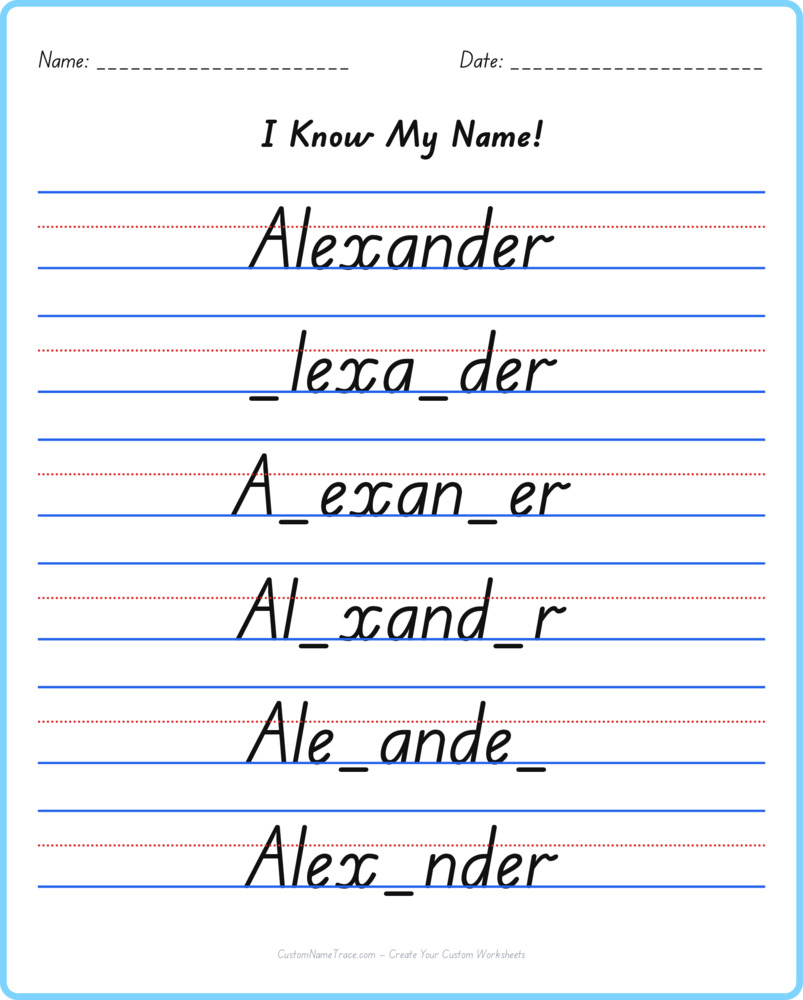 The first row is the model. In the rows below, the child fills in the blanks from memory.
Recall practice, not tracing practice
Tracing is a wonderful way to begin. It builds the shape of each letter into the hand, and it gives a nervous child an easy first success. But tracing has a limit. A child can trace a name perfectly and still be unable to write it on a blank page, because following a line and producing a letter from memory are not the same skill.
Teachers have long noticed that trying to remember something strengthens memory more than simply looking at it again. This is often called retrieval practice, and it is one of the most widely recommended habits in teaching. You do not need a research paper to see it at work: a child who has been asked to produce a letter, even imperfectly, usually holds on to it better than a child who has only copied it.
A missing-letter page is retrieval practice in its gentlest form. It is gentle for three reasons.
- There is a model on the page. The first row is always visible, so a child who is stuck can look up and check.
- Most of the name is already there. The child is not recalling the whole name, only a letter or two. The surrounding letters act as clues.
- The blank is exactly where the letter belongs. The child does not have to decide where to write, only what.
That is the quality teachers call scaffolding: enough support that the task is possible, and not so much that nothing is learned.
What the child has to do
Look at the sample page. The name is Alexander. The rows below the model read:
_lexa_derA_exan_erAl_xand_rAle_ande_Alex_nder
To fill the first row, the child must know that the name begins with an A. In the second row, the child has to know that after the A comes an l, and that after the n comes a d. In the third row, the missing letters are in the middle of the name, where it is easiest to lose one's place. And so on.
Several skills are working at once.
Letter knowledge. The child has to know the letter, and its name, and what it looks like.
Letter order. The child has to know where the letter belongs in the sequence.
Using context. The letters around the gap are clues. A child who sees Ale_ande_ can use "Ale" and "ande" to work out what is missing.
Listening to the name. Saying the name aloud and listening for the missing sound is a powerful strategy. The child says "Al-ex-an-d..." and the missing sound is almost there.
Handwriting. The letter still has to be written, on the guide lines, at the right size.
Self-checking. When the row is complete, the child can compare it to the model at the top. Checking one's own work is an important habit, and a missing-letter page teaches it in a very natural way.
Why it follows the pyramid
On the names gallery the child traces the whole name. On the name pyramid the child watches the name grow, one letter at a time, and learns its order. The missing-letter page is the third step.
- Names. Learn the shapes of the letters by tracing.
- Name Pyramid. Learn the order of the letters by building the name.
- Name Missing Letter (this page). Recall the letters with less and less support.
Each step asks a little more of the child. A child who goes through them in order is rarely overwhelmed, because the support is withdrawn gradually, and at a speed the child can manage. After the third step, the final step is the natural one: writing the whole name, from memory, on a blank page.
How to use a missing-letter page
- Say the name together and look at the model. Point to the first row, and read it letter by letter. "A, l, e, x, a, n, d, e, r."
- Cover the model, if the child is ready. For a more confident child, a sheet of paper over the first row turns the page into a true test of memory. For a hesitant child, leave it visible.
- Start with the first row of blanks. Ask, "What is missing?" Let the child say the letter before writing it.
- Write the letter in the gap. Look at the size and position. The letter should sit on the guide line.
- Read the completed row aloud. "A-l-e-x-a-n-d-e-r." This confirms the work and ties the shape to the sound.
- Check against the model. Ask the child to tick the row if it matches. A child can find their own mistake more easily than they can accept someone else's correction.
- Move to the next row. The gaps change, so the child must think again.
- Finish with the name on a blank line. Write the whole name once more, with no support.
Reading the mistakes
A wrong letter in a gap is not a failure. It is information. Look at what the child wrote, and ask why.
- A letter that looks like the right one (b for d, or p for q). This is a visual confusion, common in the early years. Go back to tracing those two letters side by side.
- A letter that sounds like the right one. The child has listened to the name and made a reasonable guess. Praise the listening, and point to the model.
- A letter from another name. The child may be thinking of a sibling or friend. Gently bring them back.
- A repeated letter. In a name with a double letter, such as "Hannah," the child may write one letter where there should be two. This is a prediction about the pattern, and it is worth discussing.
- A letter in the wrong place. The child knows the letters but not the order. This is a reason to return to the pyramid page.
- A blank left empty. The child may be unsure. Offer a choice of two letters, or let them look at the model, rather than leaving them stuck.
A calm response matters. If every error is met with a frown, a child learns to avoid the risk of guessing. If errors are met with curiosity, a child learns that a wrong guess is a step toward the right answer.
Making the blanks easier or harder
The blanks can be adjusted, either on the page or by hand, to match the child.
Easier
- Leave the first and last letters visible, so the child only has to supply the middle.
- Fill one blank at a time.
- Leave the model visible and close by.
- Offer letter tiles to choose from, instead of writing from scratch.
On level
- Two or three blanks in each row, as in the sample.
- A different blank position in each row.
- The model visible at the top.
Harder
- Cover the model and work from memory.
- More blanks per row.
- Include the first letter in the blanks. Many children can fill in a middle letter but forget how the name begins.
- Ask the child to say the missing letter before looking.
- Time the child, kindly, and let them beat their own previous time.
The aim is for the child to feel stretched, not stuck. A task that is too easy is boring, and a task that is too hard is discouraging. Somewhere in between is a child who is thinking.
A sample fifteen-minute session
Here is a realistic session with a six-year-old and the name "Elizabeth."
- Minute 0 to 2. Say the name together. Clap the four beats: "E-liz-a-beth." Ask who else has a name that starts with an E.
- Minute 2 to 4. Look at the model row. Spell the name aloud, touching each letter.
- Minute 4 to 10. Work through the first three rows of blanks. For each, say the missing letter before writing.
- Minute 10 to 12. Check the rows against the model, and tick the correct ones.
- Minute 12 to 14. Cover the model and fill in one more row from memory.
- Minute 14 to 15. Write "Elizabeth" on a blank line. Smile, regardless of the result.
If the name is long, as this one is, it is perfectly fine to do half the page one day and half the next.
A progression across a month
For a child learning their name, a month might look like this. It is a suggestion, and every child will move at their own speed.
- Week 1: Tracing. Use the names gallery. Trace the name on several pages. Notice the shapes.
- Week 2: Building. Use the name pyramid. Watch the name grow, and say each row.
- Week 3: Filling in. Use this page, with the model visible. Fill the blanks, and check.
- Week 4: Recalling. Cover the model, and try again. End each session by writing the whole name.
At the end of the month, a child who can write their name from memory, with the letters in the right order, has done something meaningful. It is the beginning of independent writing.
Why the blanks move
On the sample page the gaps do not stay in one place. The first row loses its first and a late letter, the next row loses letters near the start, and so on, until the gaps have visited every part of the name. That is deliberate, and it matters for learning.
If the same letter were missing every time, a child could learn that one spot and ignore the rest. By moving the gaps, the page makes sure that every letter in the name is eventually asked for. By the last row the child has been tested on the beginning, the middle and the end, and has had to think about the name as a whole, not as a string of separate pieces.
You can see the same principle in how teachers hide words in a story or numbers in a pattern: the variety is what turns repetition into understanding.
Supporting children who are learning English
For a child who is learning English, a name is often the first written word that feels truly their own, and a missing-letter page can be a warm place to practice. A few ideas help.
- Say the name the way the family says it. Do not anglicize it. The child should see and hear their own name correctly.
- Use the sounds that carry over. If the child's home language has a clear letter-sound match for a letter, point that out.
- Pair with a picture. A small drawing of the child next to the name makes the page personal.
- Allow some talk in the home language. A child who can explain the task in the language they know best will understand it faster.
- Be patient with letters that look unfamiliar. Some letters, and some letter shapes, differ between writing systems.
The goal is not just correct spelling. It is the feeling that the child's name belongs in the classroom.
Making your own version by hand
You do not need a printed page to use this idea. Anyone can make a missing-letter row in half a minute.
- Write the name clearly at the top of a sheet of paper.
- Underneath, write it again, replacing one letter with a line.
- Write it again, replacing a different letter with a line.
- Keep going until every letter has been hidden once.
- Hand the sheet to the child, and ask them to fill in the lines.
A strip of paper with a hidden letter under a flap is even more fun. A child can lift the flap to check their guess. Folded paper, sticky notes and index cards all do the job, and a child who makes their own puzzle for someone else is learning even more than one who solves it.
When it is not going well
Sometimes a session stalls. A few common patterns, and what to try, are listed here.
The child fills the blanks randomly. This usually means the task is too hard. Go back a step, to the pyramid, or leave only one blank in each row.
The child copies the model letter by letter. That is a fine start. Cover the model for the last row, and see what happens.
The child gets frustrated. Stop, take a break, and return to something they can do well. End on a success, even a small one.
The child writes the right letters but in poor shape. That is a handwriting issue, not a memory one. Go back to tracing the letters that need work.
The child knows the letters but loses track of the row. Use a finger or a ruler to mark where they are.
The child is not interested. Make it a game. Let them hide the letters for you. A child who sets the puzzle for an adult is often delighted to do so, and they will study the name closely in order to do it.
A page that does not work today may work in a week. Children's readiness changes quickly, and patience is the single most useful tool.
Beyond names
The same idea works for any word, and teachers use it all the time. It is sometimes called a cloze activity, from the idea of "closing" a gap, and it appears in every grade, from the first letters to the last.
- Spelling words. Write the word with one or two letters missing, and the child fills them in. Fr_end. Bec_use. Th_ught.
- Sight words. Hide a letter in a tricky word, such as wa , and have the child complete it.
- Family names. Parents, siblings, grandparents, pets.
- Days and months. Mon_ay, Tues_ay, Sept_mber.
- Theme words. Animals, colors, shapes, the names of classroom objects.
- Sentences. A word missing from a sentence tests meaning as well as spelling.
For these, the sight word, days of the week and months generators give clean models to work from, and the name tracing generator can produce a missing-letter page for any name. Teachers who want a page for every child at once can use Batch / Teacher Mode.
Games that use the same idea
A missing-letter page does not have to be a worksheet. A few quick games cover the same skills, with no paper at all.
- Hangman, softly. Draw blanks for the letters in a name. The child guesses letters. Skip the drawing, and just fill in the letters.
- The magic eraser. Write a name on a whiteboard. Rub out one letter. The child puts it back.
- Tile tray. Lay out letter tiles for a name. Remove one, mix it into a pile, and let the child find it.
- What's missing? Say the name aloud with a pause for one sound. "Al-ex-an... der." Which sound did I skip?
- Name detective. Hide a letter under a sticky note. The child guesses what is underneath, then lifts the note to check.
- Partner swap. Two children make missing-letter rows for each other's names, then exchange and fill them in.
Each game takes a minute or two, and each reinforces the same habit: look at the letters, think about what comes next, and check.
What to watch for
A missing-letter page is also a gentle assessment. While the child works, a teacher or parent can observe a good deal.
- Which positions are hardest? Many children find the first and last letters easy and the middle ones hard.
- Which letters cause trouble? A particular letter that the child gets wrong more than once deserves extra attention.
- Does the child say the name? A child who whispers the sounds is using a strong strategy.
- Does the child look up at the model? That is a good habit, not a failure.
- How is the handwriting? Letters written into blanks are a quick sample of the child's real writing, without a model to copy.
- Is the child confident? A child who writes quickly and certainly is ready for the next step. A child who hesitates may need another pyramid.
A few notes, kept over several weeks, make progress visible. They are also helpful to share with parents.
For teachers
A missing-letter page is easy to run. A child can do it independently, once they have seen it modeled, and it produces a result that is easy to check. A few suggestions follow.
- Use it as a check-in. A page done in September and again in December shows growth.
- Differentiate. Give some children the model, and some not. Give some more blanks, and some fewer.
- Pair children. One reads the letters aloud while the other writes.
- Use the class list. Make a page for every child, so each works on their own name. Batch / Teacher Mode can build a whole class set in one PDF.
- Celebrate the end of the sequence. When a child writes their name from memory, make a small occasion of it.
- Send a page home. A completed page is a lovely thing for a parent to see.
For parents
You do not need any special training to use these pages well. A few simple habits help.
- Keep it short. Ten minutes is plenty.
- Say the letters aloud together. The voice and the hand support each other.
- Let the child try first. Resist the urge to point out the answer.
- Praise the thinking. "You listened carefully to find that letter" is better than "Correct."
- Return to it. A few short sessions across a week are better than one long one.
- Use the child's real name. A page about their own name is far more interesting than one about a stranger's.
Questions that come up
Is a missing-letter page too hard for a four-year-old? Often, yes. Start with tracing and the pyramid, and come back to this page when the child can recognize most of the letters in their name.
What if the child fills in a letter and it is wrong? Say, "Let's check." Look at the model together. Let the child fix the letter themselves.
Should the child use pencil or pen? Pencil is better. It can be erased, which lowers the stakes.
Can the page be used for a surname? Yes. A surname is often a harder test, because it is less familiar. Use the generator to make a last name page.
What comes next? Writing the name on a blank line with no model, then writing other words from memory. After that, the child is ready to move to sentences.
How many pages should a child do? One or two a week is plenty. The quality of attention matters more than the number of pages.