A teacher's guide to Grade 1 math bundles
First grade is a year of big changes in arithmetic. Children move from numbers within 10 to numbers within 20, from counting to knowing, and from "what is the answer?" to "what number is missing?" That is a lot to practice, and it is more effective when the practice is organized: one skill at a time, in a set of pages that all ask the same kind of question.
This page gathers the five Grade 1 math bundles. Each is ten worksheets, packaged as one PDF in Letter and A4 sizes. This guide explains what is in each bundle, what page one asks and what page ten should look like, how to sequence the five across a term, and how to read the results. For the thinking and teaching behind each skill, see the Grade 1 math guide. This page concentrates on how to use the bundles.
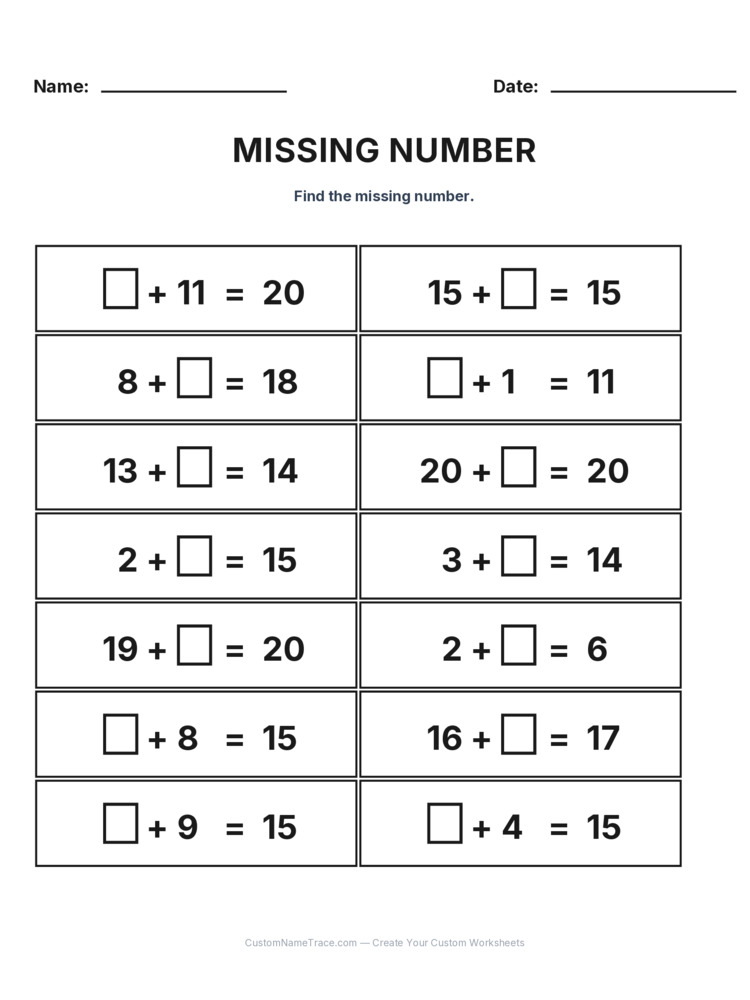
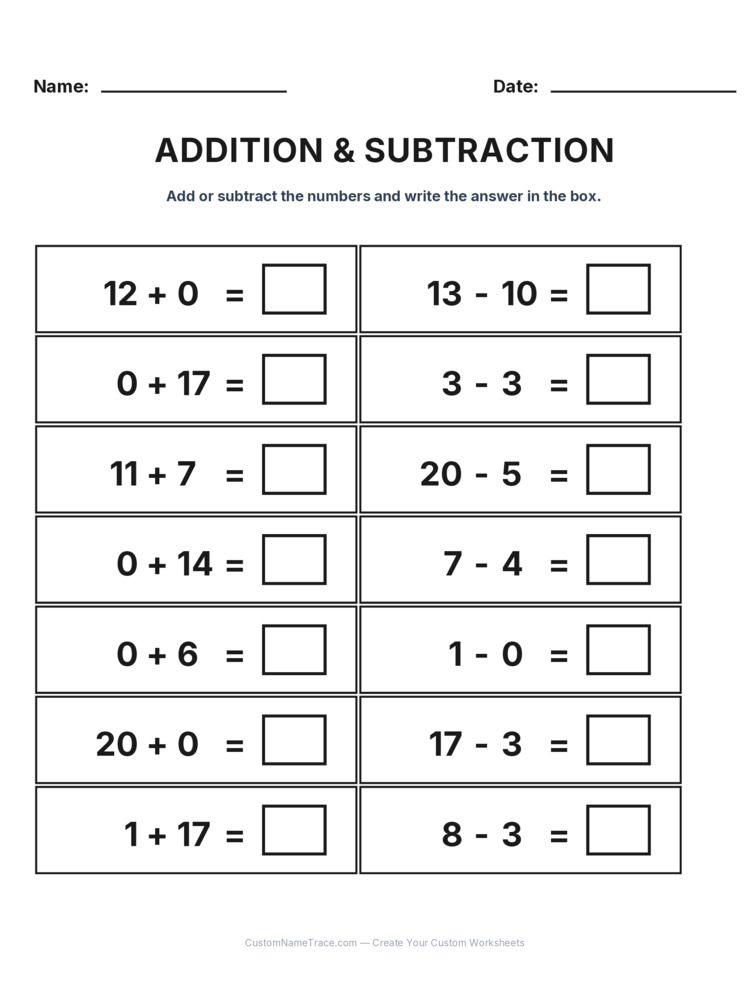
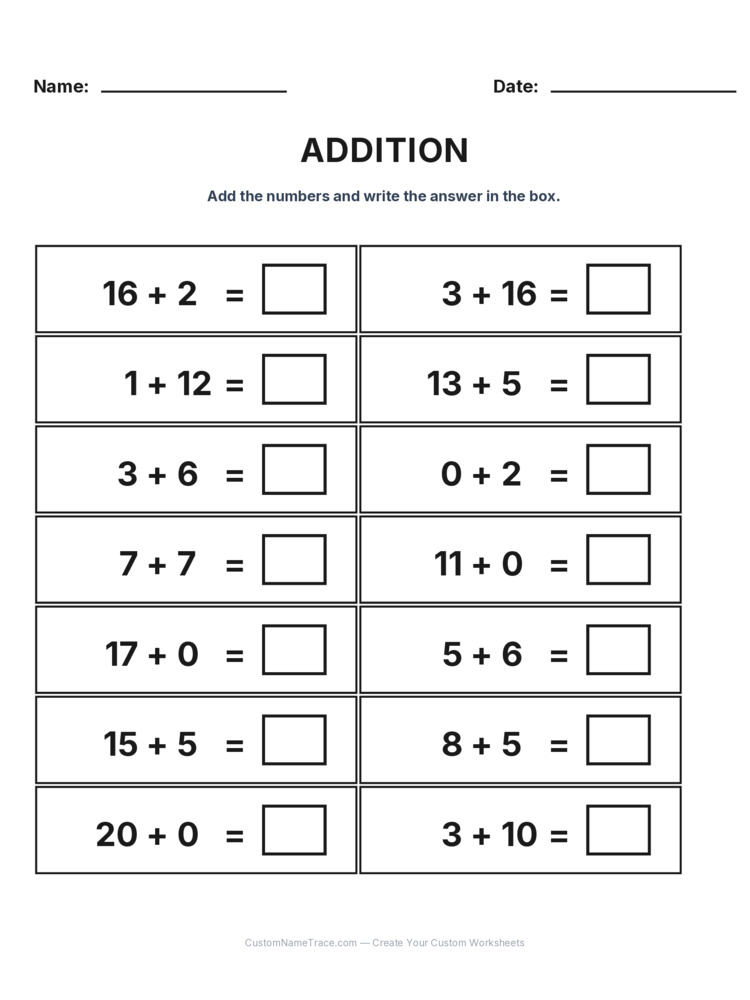 A bundle cover shows its first page. This one is Grade 1 Addition Within 20, and the bundle holds ten pages with new numbers on each.
The five bundles
Each bundle is the first ten worksheets of its skill. You can preview every page in the bundle's viewer, from "1 of 10" to "10 of 10," before printing.
A suggested order
The five bundles can be taken in several orders, but this one has a good logic.
- Addition within 20. The base skill. The "make ten" idea gets its first full workout.
- Subtraction within 20. The reverse. Easier once the addition facts are in place.
- Mixed review. A check that the child can tell the operations apart.
- Addition missing number. The first step into thinking about the equals sign.
- Subtraction missing number. The harder cousin of the fourth, which asks a child to work backward.
For a class, this makes a ten-week sequence at one bundle every two weeks. For a family, it might be slower: a bundle a month is plenty, with games and talk in between.
Bundle 1: Addition within 20
What is on the pages. Fourteen horizontal addition facts per page, in two columns, with a box for each answer. The numbers range up to 20, and the problems include small facts such as 3 + 6, zero facts such as 17 + 0, doubles such as 7 + 7 and facts that cross ten such as 8 + 5.
Before you start. A child should have solid addition within 10, and some familiarity with counting on. Ten-frames and counters are helpful.
How to run the ten pages.
- Page 1: Do cold. Notice which problems the child does instantly, which they count, and which they skip.
- Pages 2 to 4: Teach the "make ten" move, using a ten-frame. Practice with half a page each day.
- Pages 5 to 7: Teach doubles and near doubles. Ask the child to say which strategy they used.
- Pages 8 and 9: Mix everything. Time is not important, but fluency is a goal.
- Page 10: Do under the same conditions as page 1.
What to look for.
- Do they still count from 1? Show counting on.
- Do they avoid facts that cross ten? Go back to the ten-frame.
- Do they get zero facts right? These should be instant.
- Can they explain how they did 8 + 5?
What a good page 10 looks like. Most facts within 10 are answered at once. Facts across ten are answered in a few seconds, using a strategy. The child can explain at least one.
Bundle 2: Subtraction within 20
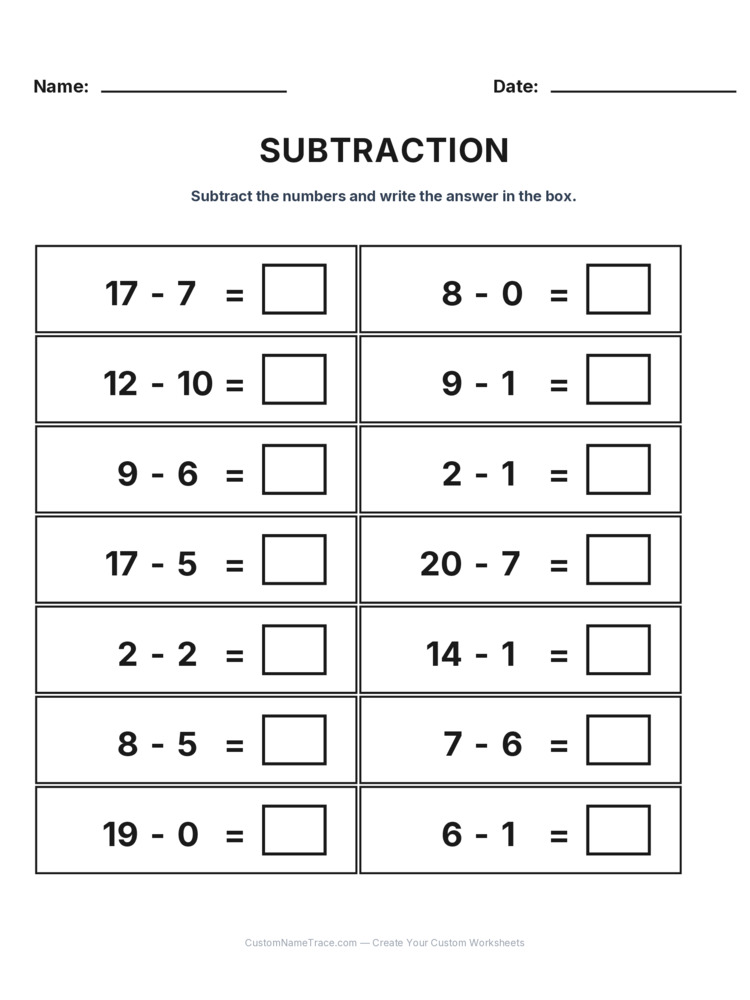
What is on the pages. Fourteen subtraction facts per page, with numbers up to 20. Because subtraction is harder than addition for most children, the bundle is best taken after addition is secure.
Before you start. The child should know addition within 20 well enough to use it as a tool ("what plus 9 makes 15?").
How to run the ten pages.
- Page 1: Do cold. Watch for counting back, which is slow and error-prone.
- Pages 2 to 4: Teach "think addition." For 15 − 9, ask "9 plus what makes 15?" Practice with a number line.
- Pages 5 to 7: Teach "down through ten." For 14 − 8, take 4 to reach 10, then 4 more.
- Pages 8 and 9: Mix strategies. Let the child choose.
- Page 10: Do under the same conditions as page 1.
What to look for.
- Do they subtract the smaller number from the larger without regard to order? That is a sign of not understanding the operation.
- Do they count back by ones for large numbers? Show a better way.
- Do they check with addition?
- Can they explain a strategy?
What a good page 10 looks like. The child uses addition to find differences, and answers most within-10 facts instantly.
Bundle 3: Addition and subtraction mixed review
What is on the pages. Addition and subtraction on the same page, within 20. The child must read each sign.
Before you start. Both separate bundles should be reasonably secure. Mixed review is a check, not a first lesson.
How to run the ten pages.
- Page 1: Do cold, and watch whether the child reads the sign.
- Pages 2 to 5: Ask the child to underline or circle the sign before solving.
- Pages 6 to 8: Remove the support, and see whether the habit holds.
- Pages 9 and 10: Do quickly, and compare with page 1.
What to look for.
- Do they add when they should subtract? That is a reading error, not a math one.
- Are they slower on one operation? That tells you which separate bundle needs another visit.
- Do they use fact families to check?
What a good page 10 looks like. The child glances at the sign, selects a method and does the page without any added slips.
Bundle 4: Addition missing number
What is on the pages. Equations in which a box stands for an unknown, such as 8 + ▢ = 18 or ▢ + 11 = 20. The box can sit in either position on the left-hand side.
Before you start. The child should have addition within 20 and some idea of what the equals sign means. A balance scale or a number line helps.
How to run the ten pages.
- Page 1: Do cold. Notice whether the child understands the question.
- Pages 2 to 4: Teach with objects. Make 8 counters, and add until there are 18. Count what was added.
- Pages 5 to 7: Teach the connection to subtraction. "8 plus what is 18? That is 18 minus 8."
- Pages 8 and 9: Mix it up. Use words: "Eight and how many make eighteen?"
- Page 10: Do under the same conditions as page 1.
What to look for.
- Do they write the total in the box? That shows the equals-sign misunderstanding.
- Do they count up or subtract? Both are good.
- Do they check by putting the answer in the box and reading the equation?
What a good page 10 looks like. The child solves the unknowns with a method, and checks by reading the completed equation.
Bundle 5: Subtraction missing number
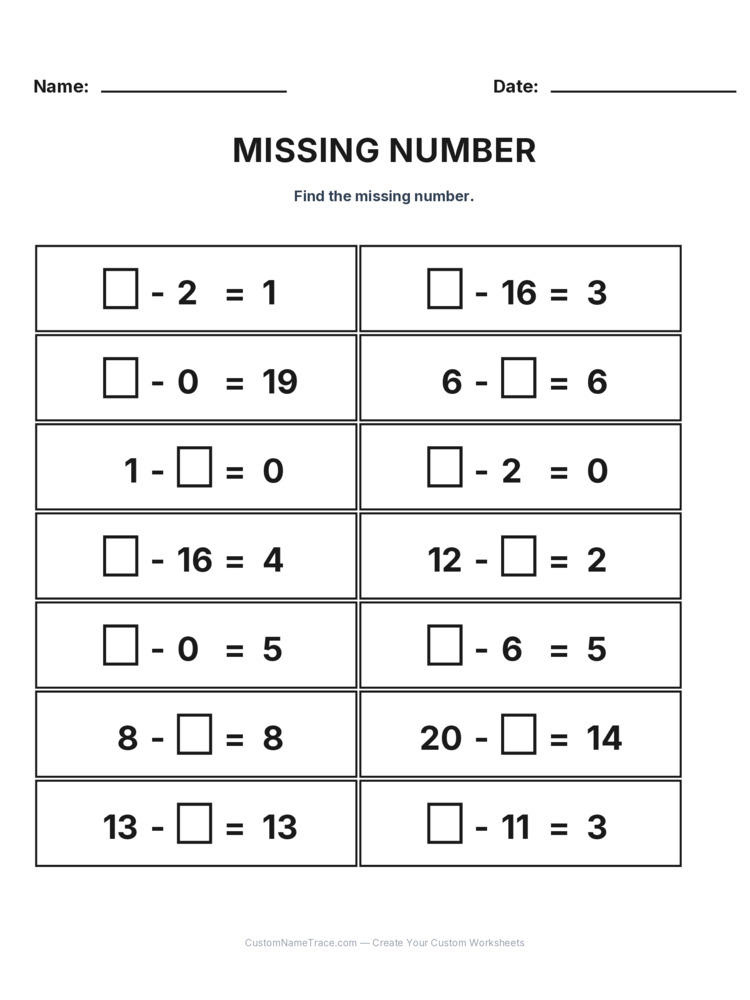
What is on the pages. Equations such as ▢ − 2 = 1 or 20 − ▢ = 14. The box may stand for the start (the whole) or the amount taken away.
Before you start. The child should be comfortable with the addition missing-number bundle. This is the harder of the two.
How to run the ten pages.
- Page 1: Do cold. Expect some confusion.
- Pages 2 to 4: Teach with a story. "I had some cookies. I ate 2. Now there is 1. How many did I start with?"
- Pages 5 to 7: Teach to separate the two kinds: unknown start, and unknown subtracted amount.
- Pages 8 and 9: Mix. Ask which kind each is.
- Page 10: Do under the same conditions as page 1.
What to look for.
- Do they confuse the two kinds? Draw a bar diagram.
- Do they subtract in the wrong direction?
- Do they check by adding?
What a good page 10 looks like. The child can say, for each problem, "I'm looking for the start" or "I'm looking for what was taken," and solve accordingly.
A ten-week unit
For a class or a determined family, here is a way to take all five bundles in order, with a few days of teaching for each.
| Weeks |
Bundle |
Focus |
| 1 and 2 |
Addition within 20 |
Making ten, doubles |
| 3 and 4 |
Subtraction within 20 |
Thinking addition, down through ten |
| 5 and 6 |
Mixed review |
Reading the sign |
| 7 and 8 |
Addition missing number |
The equals sign |
| 9 and 10 |
Subtraction missing number |
Working backward |
Within each fortnight, the first day is for the baseline page and teaching, the middle days for practice, and the last day for the final page and a look back.
Where to start: a five-minute check
If you are not sure which bundle a child needs, a short check will tell you. Print the first page of two bundles, such as Addition within 20 and Subtraction within 20, and ask the child to do just the first four problems of each. Watch rather than mark.
| What you see |
What it suggests |
Where to start |
| Answers at once, with confidence |
The skill is secure |
Skip ahead to the next bundle |
| Answers by counting on fingers, correctly |
A sound but slow method |
The same bundle, teaching counting on and making ten |
| Counting from one every time |
The method is still at Kindergarten level |
A Kindergarten bundle, then back |
| Frequent wrong answers, little hesitation |
Guessing, or misreading the sign |
The mixed-review bundle, with the sign circled |
| Refusing, or visibly upset |
Anxiety, or a big gap |
Hands-on work first, then an easier page |
A check of this kind takes five minutes, and it saves weeks of work on the wrong thing.
A script for the first session
Here is a sample script for the first session with the Addition within 20 bundle, with a six-year-old. Adapt it freely.
- Set the scene (1 minute). "We're going to do ten pages of adding, a few at a time. At the end we'll look at the first one and the last one, and see how much you've grown."
- Warm up (3 minutes). Put 8 counters on a ten-frame. "How many more to make ten?" Then add 5 more. "How many now?"
- Page 1, the first four problems (4 minutes). Say nothing, and watch. Note what the child does with each.
- Talk (2 minutes). "Which one was easiest? Which was trickiest? How did you do the tricky one?"
- Close (1 minute). "Tomorrow we'll do four more." Put the page in the folder.
Notice that the first session is mostly observation. The adult learns where the child is, and the child learns that this is going to be a calm, friendly routine.
A tracker you can copy
A very simple tracker makes progress visible. Draw a table like this on a sheet of paper, one row per page.
| Page |
Date |
Score (out of 14) |
Method |
Notes |
| 1 |
|
|
|
|
| 2 |
|
|
|
|
| 3 |
|
|
|
|
| ... |
|
|
|
|
| 10 |
|
|
|
|
In the Method column, write a one- or two-word note: "counted," "made ten," "doubles," "recalled." In the Notes column, record anything useful: "confused 7 + 8," "fast today," "tired."
After ten pages, you will have a small record that shows the story of a skill. Teachers can keep one for each child, and a parent can keep one in the folder. It takes seconds per page and gives a very clear picture.
Running a class set
In a class of twenty-four, ten pages is an easy number to manage.
- Print one bundle per table group. Four to six children share one.
- Give each child a different page. The numbers differ, so there is nothing to copy.
- Rotate each day. Each child moves on to the next page.
- Keep a class tracker. A grid with names down the side and pages across the top, with a tick for each page done.
- Pull a small group each day for a few minutes of teaching, while the others work.
- Check and discuss one problem from each page, as a whole class.
By the end of two weeks, every child has done all ten pages, and the teacher has a clear picture of who needs more.
Bundles and the summer
A first grader about to enter second grade can use bundles to hold on to skills over a long break. A gentle summer plan:
- Two pages a week, from the Mixed Review bundle, to keep both operations fresh.
- One page from a missing-number bundle every other week, to keep the equals sign alive.
- Games with dice and cards in between.
- A look at the Grade 2 bundles in the last week of the holiday, as a preview.
Small, regular doses of practice protect against the "summer slide," and a bundle makes it easy.
What comes after
When a child has worked through the five Grade 1 bundles, and the within-20 facts are quick and confident, they are ready for the next stage, which brings place value and regrouping. The Grade 2 bundles pick up there. A child who is not quite ready can spend longer on any of the five, or return to the Grade 1 worksheets for individual pages.
A bundle is not a program, and it is not a test. It is a tool for turning intention into a habit: ten pages, a little at a time, and a careful eye on how the child is doing.
Reading the ten pages
A bundle's value lies in the trend. A simple record helps.
- Score. Number correct out of 14.
- Time. Roughly how long it took.
- Method. Counting, strategy, recall.
- Mistake type. Slip, misunderstanding, careless.
Look at pages 1, 5 and 10. If the score is rising and the method is moving from counting to strategy, the bundle has worked. If not, spend a few days on teaching before moving on.
Setting realistic targets
It helps to decide, before starting a bundle, what "good" will look like by page ten. Targets keep the work purposeful, and they stop a child from drifting along. A few examples, to adapt.
- Addition within 20: at least twelve of fourteen correct, with most facts within 10 answered without counting.
- Subtraction within 20: at least eleven of fourteen correct, with the child able to explain one strategy.
- Mixed review: no operation slips, because the child has checked each sign.
- Addition missing number: the child checks every answer by reading the finished equation.
- Subtraction missing number: the child can say whether the box is the start or the amount taken away.
Targets are not tests. If a child reaches page ten a little short of the target, that is a reason to spend a few more days, not a cause for worry. And if a child hits the target by page five, they can move on, because a bundle is a tool, and not a sentence to be served.
Pairing Grade 1 bundles with other pages
For teachers
- Center folders. Print a bundle, and keep it in a folder in a center.
- Morning work. One page a day.
- Differentiation. Give different children different bundles, quietly.
- Assessment. Pages 1 and 10 give a ready-made pre and post.
- Homework. A page or two a night.
For parents
- Print the bundle on Sunday. Five pages for the week.
- Keep sessions short. Ten minutes.
- Talk about each page. "Which one was trickiest?"
- Celebrate page ten. Look at page 1 together.
- Do not worry about speed. Accuracy and understanding first.
Questions that come up
Do I have to do the bundles in order? No. The order above is a suggestion, and your child's needs come first.
My child does the bundle in one sitting. Please don't, if you can avoid it. A page a day is far more effective.
My child finds the bundle too easy. Move to the next one, or to a Grade 2 bundle.
My child finds the bundle too hard. Go back to the previous skill, and use hands-on work.
Can I print only part of a bundle? Yes. Print the pages you need.
Is a bundle the same as the pages on the skill's own page? Yes. It is the first ten of the thirty numbered worksheets.
A Grade 1 bundle is ten pages of one idea. Done a little at a time, with talk and a few games, it can turn an uncertain skill into a secure one.