A teacher's guide to Grade 2 math bundles
Second grade brings the biggest change in the written arithmetic of the early years. Numbers have two digits, and tens and ones must be handled separately. Carrying and borrowing appear, and so do the first glimpses of multiplication and division. Each of these is a distinct skill, and each gets better with regular, focused practice, in the right order, with the right teaching alongside.
This page gathers the seven Grade 2 math bundles. Each is ten worksheets for one skill, packaged as a single PDF in Letter and A4 sizes. This guide explains what is in each bundle, which to use when, how to run the ten pages, what mistakes to expect, and how to arrange the seven across a term. For the thinking behind each skill, including worked examples of regrouping, see the Grade 2 math guide. Here, the focus is on using the bundles.
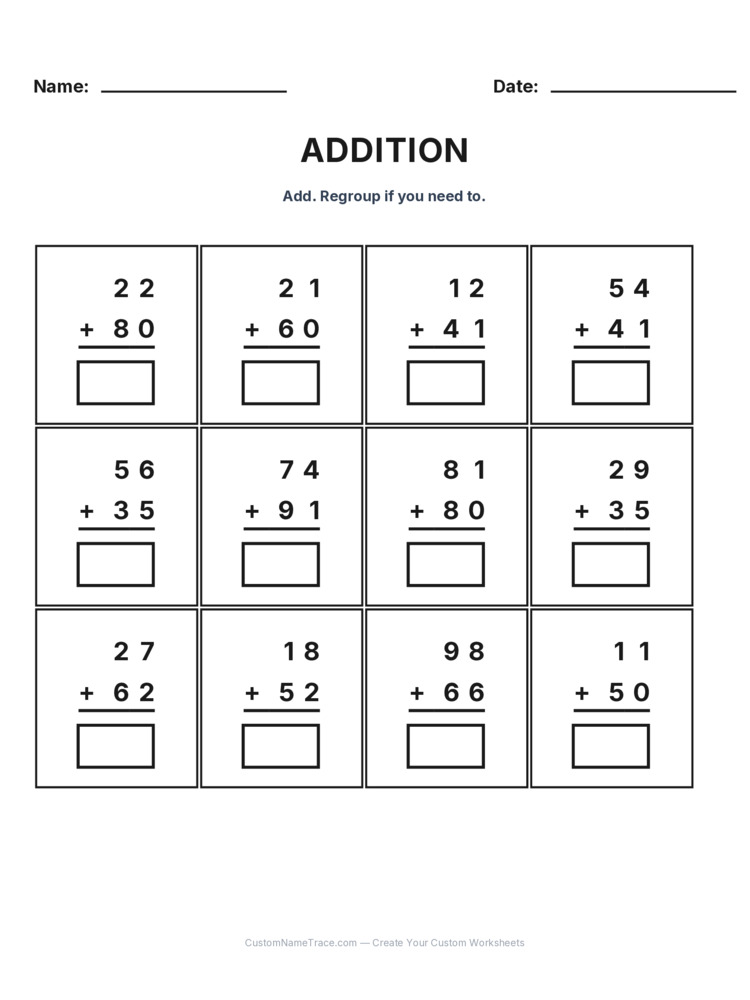
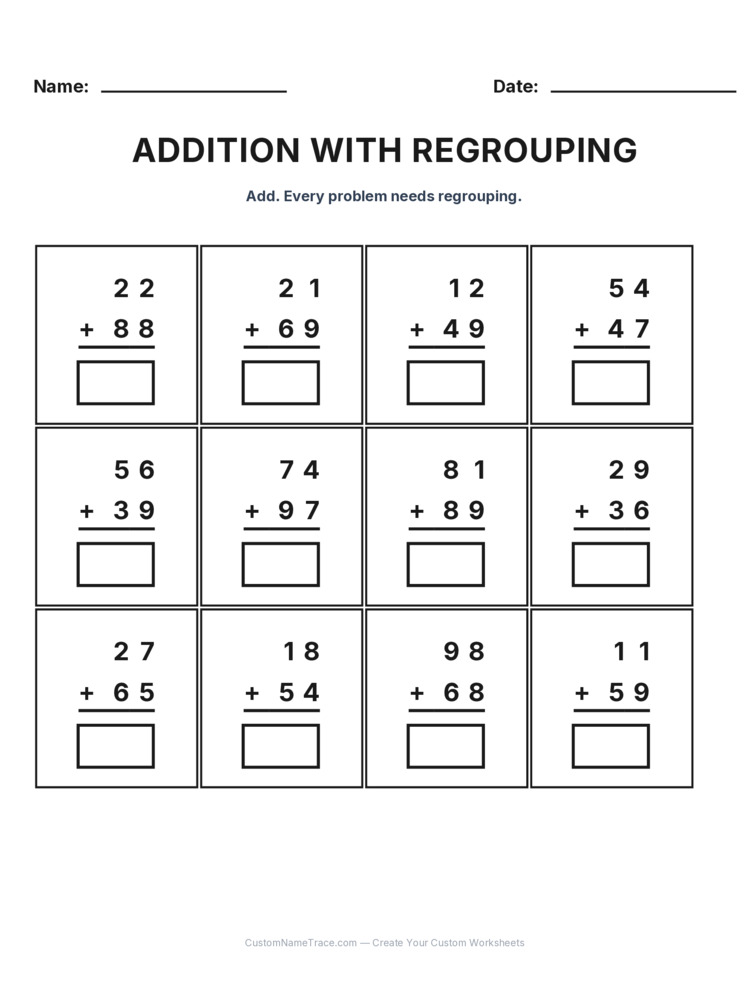 A bundle cover shows its first page. This is Grade 2 Addition Regrouping: twelve stacked problems, each needing a carry, and ten pages like it in the bundle.
The seven bundles
| Bundle |
What each page asks |
The thinking it builds |
| Addition, no regrouping |
Two-digit addition, stacked |
Tens and ones side by side |
| Subtraction, no regrouping |
Two-digit subtraction, stacked |
Tens and ones side by side |
| Addition, regrouping |
Two-digit addition where every problem needs a carry |
Trading ten ones for a ten |
| Subtraction, regrouping |
Two-digit subtraction where every problem needs a borrow |
Trading a ten for ten ones |
| Addition and subtraction mixed review |
Stacked addition and subtraction on one page |
Choosing the right method |
| Multiplication, intro facts |
The 2s, 5s and 10s, with zero and one |
Equal groups, skip counting |
| Division, intro facts |
The reverse of those facts |
Sharing, multiplication in reverse |
Each bundle is the first ten worksheets of its skill. A note on the first of the list: the pages in the no-regrouping addition bundle carry the instruction line "Regroup if you need to," and a page may include a sum whose ones digits add to ten or more. If a child needs strictly carry-free practice, preview the pages in the bundle's viewer and choose the ones you want to print. The subtraction pages, by contrast, are carry-free in the sense of needing no borrowing.
A suggested order
Because the skills depend on one another, the order matters more in Grade 2 than in Grade 1. A reliable sequence:
- Addition, no regrouping. Gets the child comfortable with stacked, two-digit work.
- Subtraction, no regrouping. The same, for subtraction.
- Addition, regrouping. The first big idea: the carry.
- Subtraction, regrouping. The harder idea: the borrow.
- Mixed review. Checks that the child can choose a method.
- Multiplication, intro facts. Can come at any point after the child has met skip counting.
- Division, intro facts. After multiplication.
For a class at one bundle every two weeks, that is fourteen weeks, or a term and a bit. Many teachers interleave: a week of regrouping addition, a few days of the multiplication intro, back to regrouping. That is perfectly sensible.
Bundles 1 and 2: No regrouping
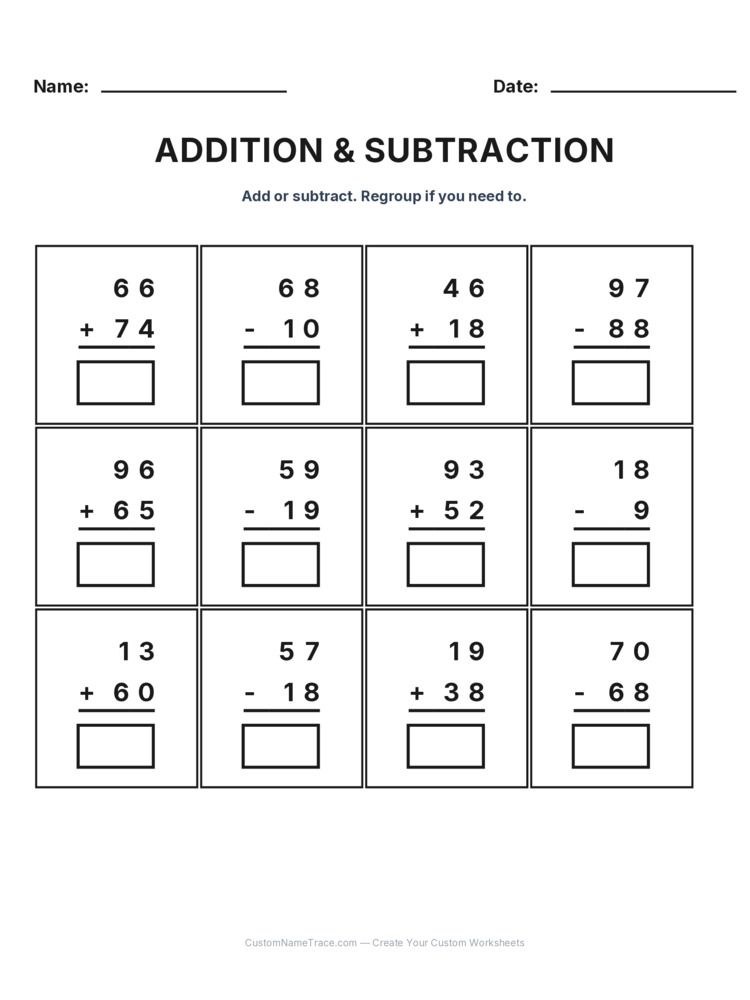
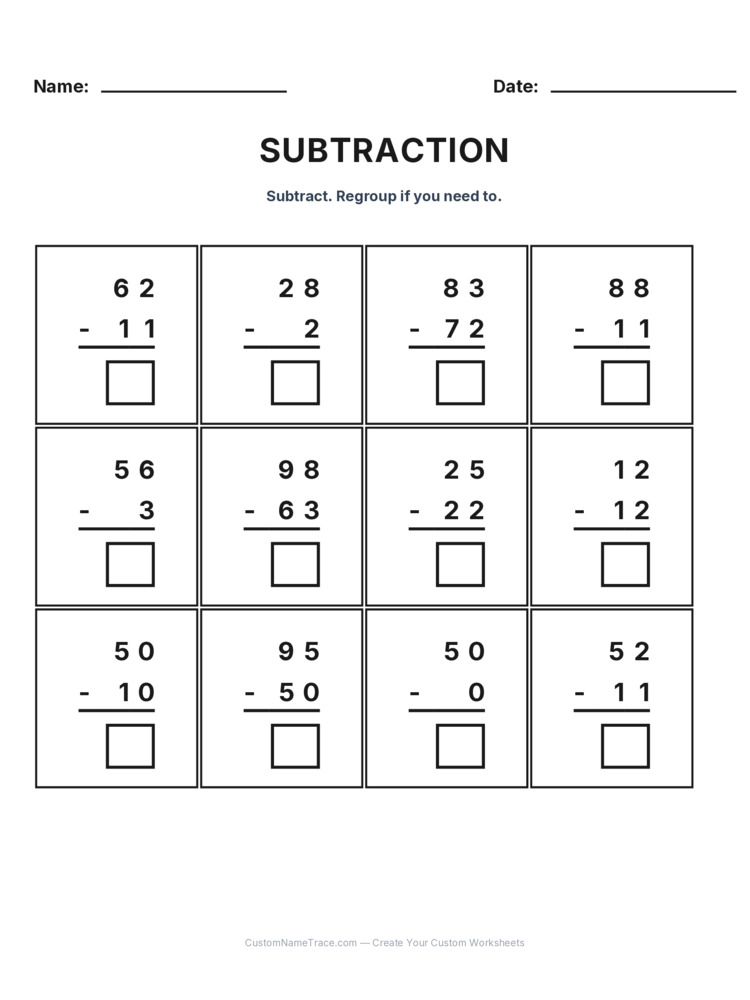
What is on the pages. Twelve stacked problems per page, in a grid of four columns by three rows, with a box for each answer. Both the addition and the subtraction bundles use two-digit numbers.
Why they come first. A child who has never stacked two-digit numbers has several new things to learn at once: lining up the digits, working right to left, and writing the answer under the line. The no-regrouping bundles let a child learn all that without the added burden of carrying or borrowing.
Before you start. The child should understand tens and ones. Base-ten blocks, bundles of sticks or coins are ideal.
How to run the ten pages.
- Page 1: Do cold. Watch whether the child lines up the digits and starts on the right.
- Pages 2 to 4: Model each problem with blocks, then on paper. Say "ones first, then tens."
- Pages 5 to 8: Let the child lead. Ask for a one-sentence explanation.
- Pages 9 and 10: Do for fluency. Compare with page 1.
What to look for.
- Do they start with the ones? Some start on the left.
- Do they misalign the digits? Squared paper helps.
- Do they write the answer in the right place?
- For addition, do they carry when they should? (If a sum needs it, praise the instinct.)
What a good page 10 looks like. The child works quickly and steadily, ones then tens, with no alignment problems.
Bundle 3: Addition, regrouping
What is on the pages. Twelve stacked problems per page. Every one needs a carry from the ones to the tens.
Why it is a milestone. This is the first time a child must trade ten ones for a ten. Understanding it, not just following the rule, is the real goal.
How to run the ten pages.
- Page 1: Do cold, with blocks within reach.
- Pages 2 to 3: Teach with blocks. Build 38 and 47, push the cubes together, and trade ten for a rod. Then do the same on paper.
- Pages 4 to 6: Practice on paper, with a block model for any problem that causes trouble.
- Pages 7 to 9: Remove the blocks. Ask the child to say, "Eight plus seven is fifteen. Write five, carry one ten."
- Page 10: Do under the same conditions as page 1.
What to look for.
- Forgetting to carry. The child writes both digits: 38 + 47 = 715.
- Carrying but not adding the carry. 38 + 47 = 75.
- Writing the carry in the wrong place.
- Using the wrong digit as the carry.
Each is a different slip, and each has a different fix.
What a good page 10 looks like. The child carries correctly, adds the carried ten, and can say why.
Bundle 4: Subtraction, regrouping
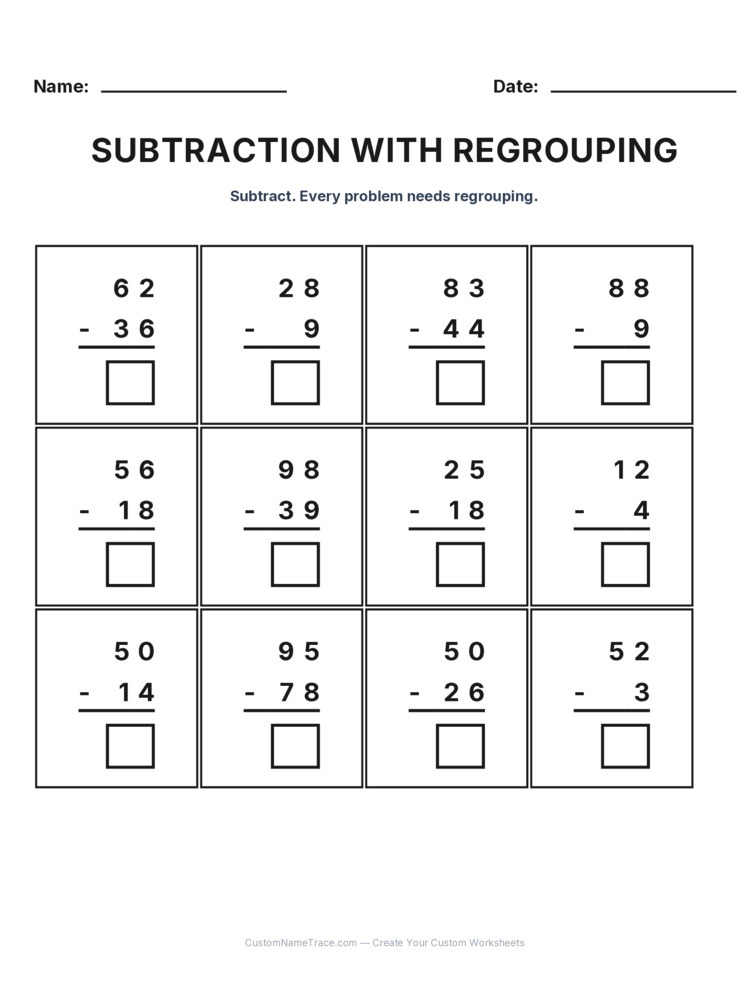
What is on the pages. Twelve stacked problems per page, each needing a borrow from the tens place, as the title states: "Subtraction with regrouping."
Why it is the hardest bundle of the grade. Borrowing has several steps, and a slip at any of them gives a wrong answer. It also includes tricky cases, such as a zero in the ones place.
How to run the ten pages.
- Page 1: Do cold, with blocks near.
- Pages 2 to 4: Teach with blocks. Build 62, try to take away 36, find there are not enough cubes, and trade a rod for ten cubes.
- Pages 5 to 7: Practice with the paper method, using blocks for tough ones.
- Pages 8 and 9: Include the zero cases. Teach 50 − 14 with blocks.
- Page 10: Do under the same conditions as page 1.
What to look for.
- Subtracting the smaller from the larger, column by column.
- Borrowing, but not reducing the tens digit.
- Zero trouble. 50 − 14 gives 44, because 4 − 0 = 4.
- Misaligned digits, especially when the bottom number has one digit.
What a good page 10 looks like. The child borrows correctly, reduces the tens digit, handles zeros and checks answers by adding back.
Bundle 5: Mixed review
What is on the pages. Stacked addition and subtraction on the same page. Some problems need regrouping and some do not, and the child must choose.
Before you start. All four of the earlier bundles should be reasonably secure.
How to run the ten pages.
- Page 1: Do cold. Notice the number of operation slips.
- Pages 2 to 5: Circle the sign and the need for regrouping before solving.
- Pages 6 to 8: Remove the support.
- Pages 9 and 10: Do for fluency and compare.
What to look for.
- Operation slips. Adding when the sign says subtract.
- Unneeded regrouping. Borrowing when there is no need.
- Missed regrouping. Failing to borrow when it is needed.
What a good page 10 looks like. The child scans each problem, decides what is needed, and works accurately.
Bundles 6 and 7: Multiplication and division, intro facts
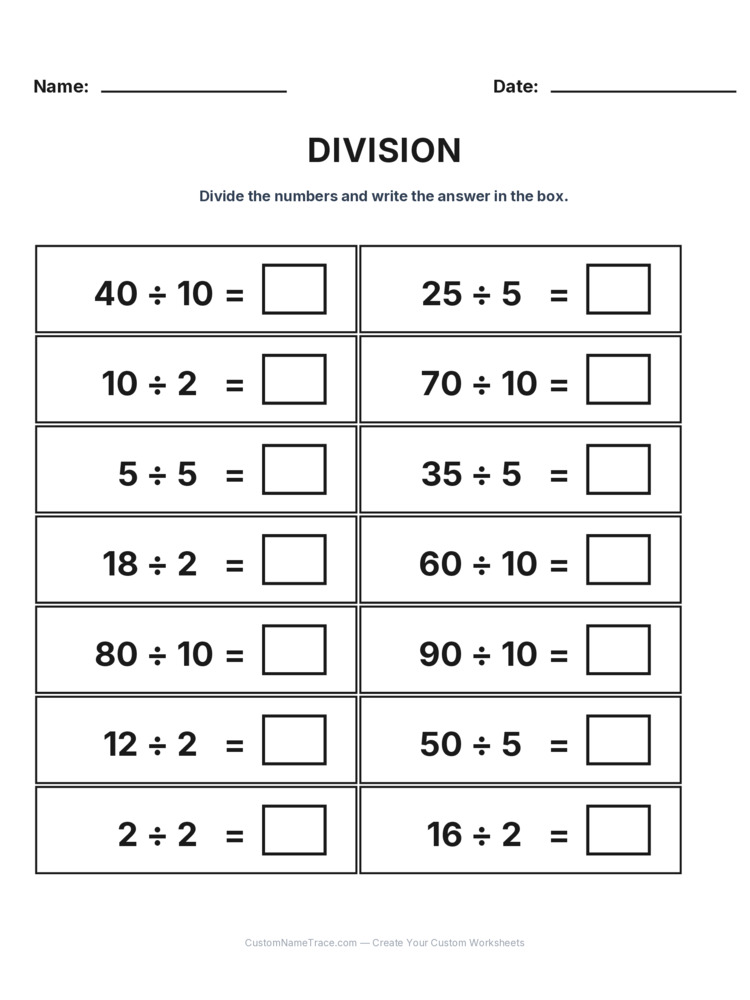
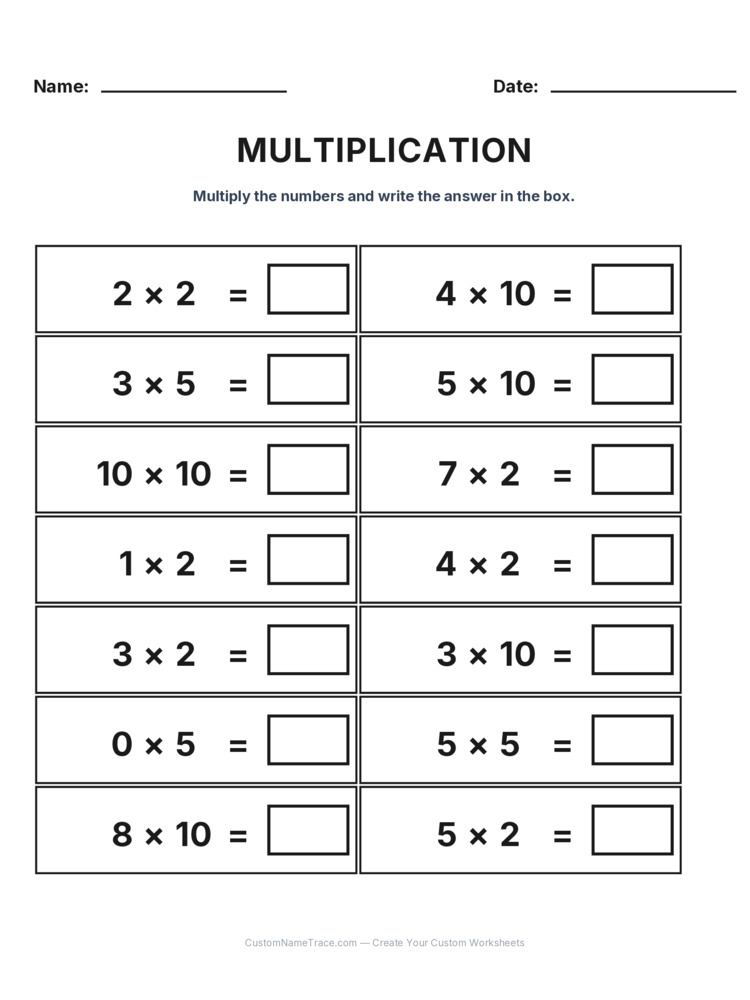
What is on the pages. Fourteen horizontal facts per page, in two columns, with an answer box. Multiplication uses the 2s, 5s and 10s, with zero and one. Division is the reverse.
Why they are called "intro." In many state standards, formal multiplication and division facts belong to Grade 3. In Grade 2, the aim is a first look, built on skip counting and equal groups. The bundles are a gentle way to meet the ideas.
How to run the ten pages.
- Page 1: Do cold. Many children will skip count or draw.
- Pages 2 to 4: Teach equal groups and arrays. Skip count by 2s, 5s and 10s. Draw a few.
- Pages 5 to 7: Practice facts, and encourage skip counting as a method.
- Pages 8 and 9: For division, start from multiplication: "What times 5 makes 35?"
- Page 10: Do under the same conditions as page 1.
What to look for.
- Adding instead of multiplying. 3 × 5 = 8.
- Multiplying instead of dividing. 10 ÷ 2 = 20.
- Zero confusion. 0 × 5 = 5.
- Reliance on counting. A child who counts on every fact is not yet fluent.
What a good page 10 looks like. The child answers 2s, 5s and 10s quickly, and can say how multiplication and division are linked.
An error guide for the regrouping bundles
Over ten pages, errors repeat, and the kind of error is far more useful than the count. Here is a quick guide to the most common slips, what each means, and how to fix it. Use it while looking at a finished page.
| What you see |
What it means |
A fix |
| 38 + 47 = 715 |
Wrote both digits, did not carry |
Show the ten forming from ten ones with blocks |
| 38 + 47 = 75 |
Carried but did not add the carried ten |
Write a small 1 above the tens column, and circle it |
| 62 − 36 = 34 |
Subtracted smaller from larger in each column |
Show with blocks why you cannot take 6 from 2 |
| 62 − 36 = 36 |
Borrowed but did not reduce the tens digit |
Cross out the 6 and write 5 above it |
| 50 − 14 = 44 |
Wrote 4 − 0 = 4 in the ones |
Trade a ten for ten ones, using blocks |
| 8 + 23 = 103 |
Misaligned the digits |
Use squared paper, one digit per square |
| 29 + 35 = 54 |
Ones added correctly, carry lost |
Underline the carried digit before adding tens |
| 40 − 7 = 47 |
Added instead of subtracted |
Circle the sign before solving |
If the same error appears on three pages in a row, stop and reteach. If a different error appears on each page, the method is probably shaky in general, and more hands-on work is needed.
Making base-ten materials at home
Regrouping bundles work best with a physical model, and a model does not need to be bought. Here are some easy homemade versions.
- Pennies and dimes. Ten pennies for one dime, as real as it gets. Use play money or real coins.
- Craft sticks and rubber bands. Bundles of ten sticks, and single sticks for ones.
- Beads on pipe cleaners. A pipe cleaner with ten beads is a ten.
- Paper strips. Cut strips marked into ten squares for tens, and single squares for ones.
- Dried beans and cups. Ten beans in a small cup is a ten.
- Lego bricks. A row of ten studs is a ten.
- Drawn models. A line for a ten and a dot for a one, drawn on the page.
A child who can build 62 with six strips and two squares, and then trade a strip for ten squares to take away 36, understands subtraction with regrouping. The paper method is just a record of that action.
A script for a regrouping session
Here is a sample script for the first session with the Subtraction Regrouping bundle, with a seven-year-old.
- Set the scene (1 minute). "Today we're going to learn a trick for taking away when there aren't enough ones."
- Build (3 minutes). Make 62 with six strips and two squares. "Let's take away 36. First the tens: take away 3 strips." Three strips and two squares are left. "Now we need to take away 6 squares, but we only have 2."
- Trade (2 minutes). "Let's swap one strip for ten squares." Now there are 2 strips and 12 squares. Take away 6 squares, leaving 6.
- Read the answer (1 minute). "Two tens and six ones. Twenty-six."
- Page 1, one problem (3 minutes). Do the first problem on the page together, with the blocks beside it.
- Talk (1 minute). "What was the tricky part?"
Notice that the whole session is one problem, done carefully. That is plenty for a first lesson. Practice on the other pages comes later.
Interleaving the multiplication bundle
The multiplication and division bundles do not depend on regrouping, which means they can be used as a change of pace in the middle of a long run of regrouping. Many teachers find that a child who is tired of carrying and borrowing is refreshed by a few days of skip counting and equal groups.
A good pattern is:
- Monday to Thursday: regrouping pages.
- Friday: a multiplication page, with a game.
Over a term, the child accumulates both, and the Friday page is something to look forward to. The same pattern works at home: a short game of skip counting on the way to school, and a page of intro facts at the weekend.
Setting realistic targets
Before starting a bundle, decide what success looks like by page ten.
- No regrouping: at least ten of twelve correct, with digits aligned and work done right to left.
- Addition regrouping: at least nine of twelve correct, with the carry written and added.
- Subtraction regrouping: at least eight of twelve correct, with zeros handled. This is the hardest, so be generous.
- Mixed review: no operation slips, and regrouping used only where needed.
- Multiplication and division intro: most of the 2s, 5s and 10s answered quickly, with the ability to explain how.
These are only guides, and they should flex for the child. A child who reaches page ten a little short has still gained, and a child who reaches the target on page five can move on.
A year with Grade 2 bundles
For a family or a teacher wanting to see the bigger picture, here is how the seven bundles might sit in a year.
- Autumn. The no-regrouping bundles, alongside place value work with blocks.
- Winter. The two regrouping bundles, slowly, with plenty of teaching.
- Spring. Mixed review, and the first multiplication bundle.
- Summer term. The division bundle, and a return to any bundle that needs another pass.
At a rate of about one bundle a month, with lots of other activities, a child will have done seventy pages of focused practice by the end of the year, and the picture of their growth, from the first page to the last, will be clear.
A fourteen-week unit
Here is how the seven bundles might fit into a term, with a fortnight each.
| Weeks |
Bundle |
Focus |
| 1 and 2 |
Addition, no regrouping |
Stacking, ones then tens |
| 3 and 4 |
Subtraction, no regrouping |
The same, for subtraction |
| 5 and 6 |
Addition, regrouping |
The carry, with blocks |
| 7 and 8 |
Subtraction, regrouping |
The borrow, with blocks |
| 9 and 10 |
Mixed review |
Choosing the method |
| 11 and 12 |
Multiplication, intro |
Skip counting, arrays |
| 13 and 14 |
Division, intro |
Sharing, reversing |
This is a suggestion. A class may move faster, and a child who needs more time can spend longer.
Reading ten pages
A bundle is most useful when read as a trend. A tracker with a row per page, and columns for score, time, method and mistake type, shows a skill growing. The key comparison is page 1 and page 10.
For regrouping bundles, a good additional note is the kind of error. Over ten pages, a child who makes the same error every time needs a different teaching move from one who makes a different slip each time.
Pairing Grade 2 bundles with other pages
For teachers
- Center folders. One bundle per folder, with a tracker sheet.
- Differentiation. Different children, different bundles, one routine.
- Small-group teaching. Pull a few children for the block-based teaching, while others work on a page.
- Assessment. Pages 1 and 10 give a pre and post for each skill.
- Homework. A page a night, with a note about the method.
For parents
- Use coins. Dimes and pennies are base-ten blocks you already own.
- Keep sessions short. Ten to fifteen minutes.
- Ask for the method. "Show me how you did that one."
- Do not hurry the borrowing bundle. It is the hardest.
- Celebrate the last page. Compare it with the first.
Questions that come up
My child finds regrouping very hard. That is common. Return to blocks, do fewer problems, and spend longer on the bundle.
Should my child learn the multiplication facts now? Not necessarily. Grade 2 is about equal groups and skip counting. The full table is Grade 3 work.
What if a no-regrouping addition page includes a carry? Preview the pages before printing, and pick the ones you want. Or use the page as an extra regrouping problem.
Can I do the bundles out of order? Yes, but the regrouping bundles depend on the no-regrouping ones.
How many pages a day? One, or half of one. Quality matters more than quantity.
A Grade 2 bundle is ten pages of one idea, and the idea is usually a big one. Taught with blocks, practiced a little at a time, and read carefully, it turns a hard step into a solid one.