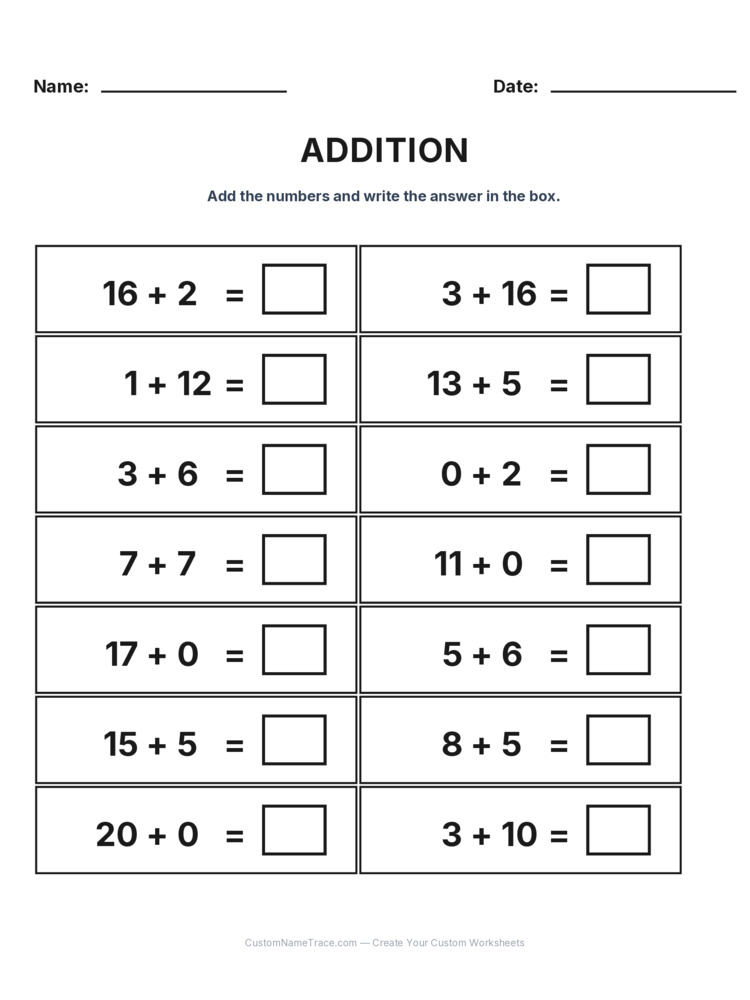
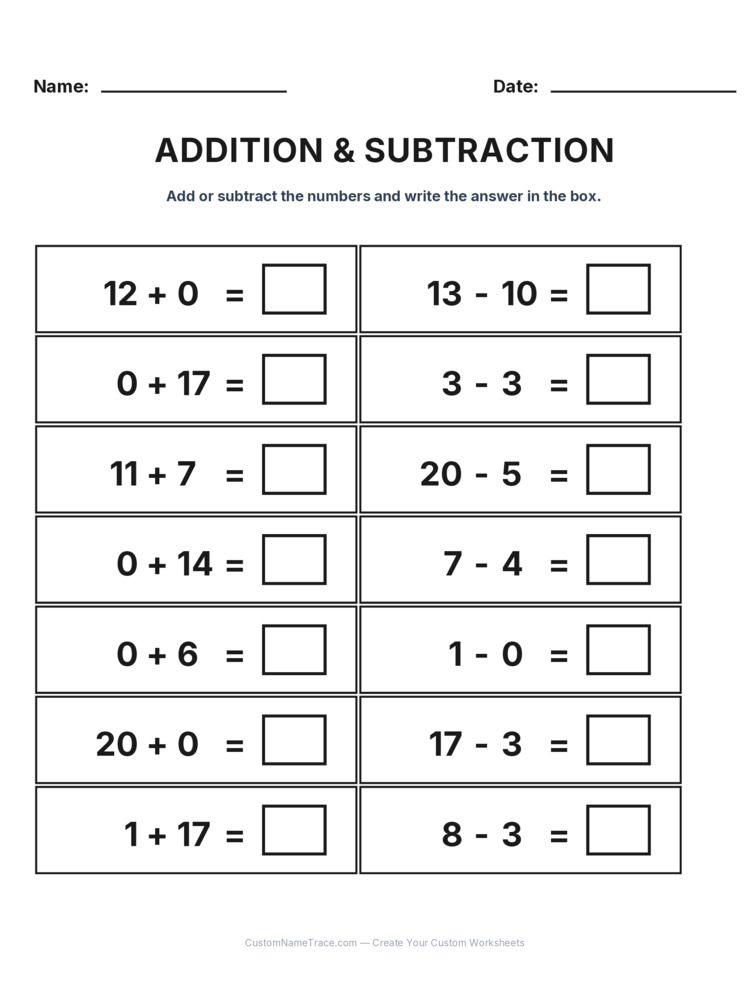
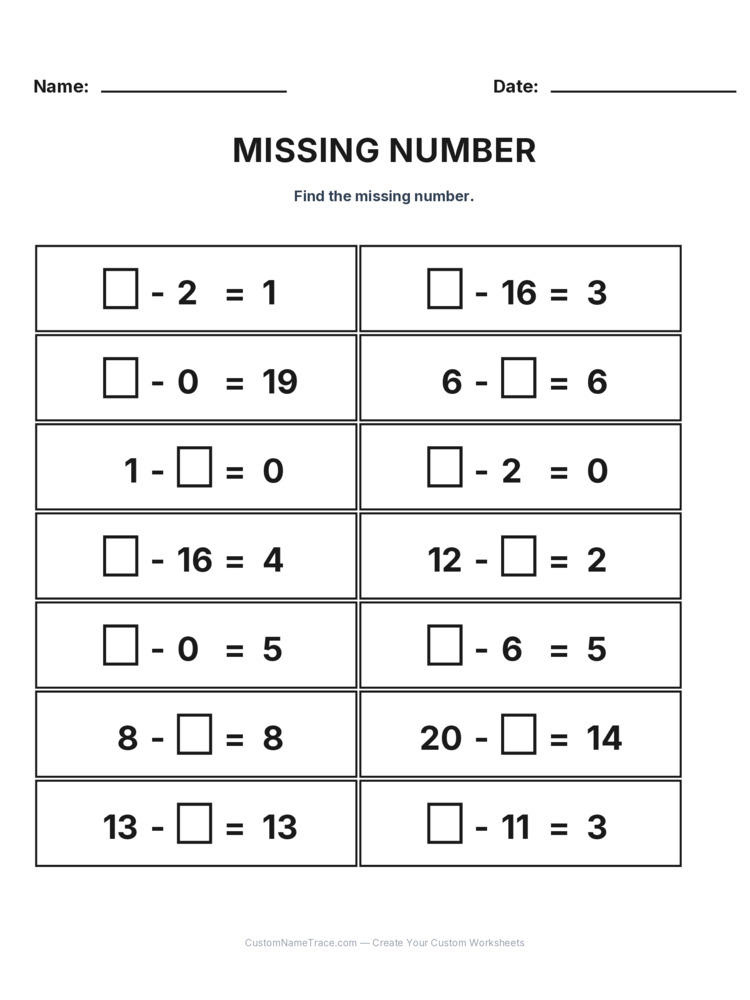
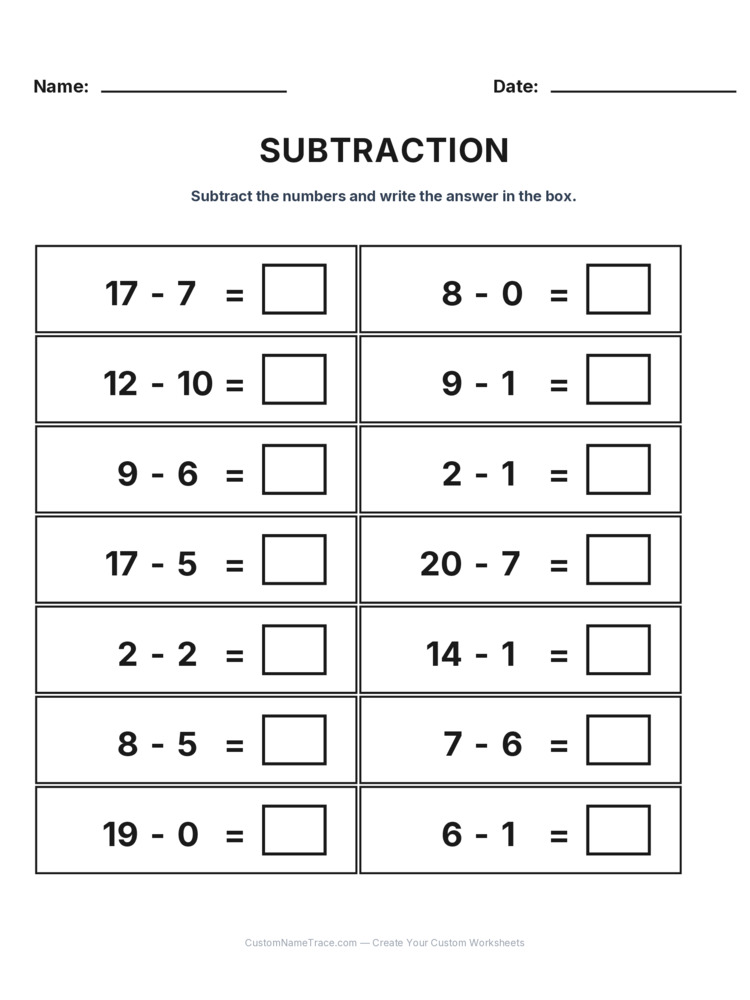
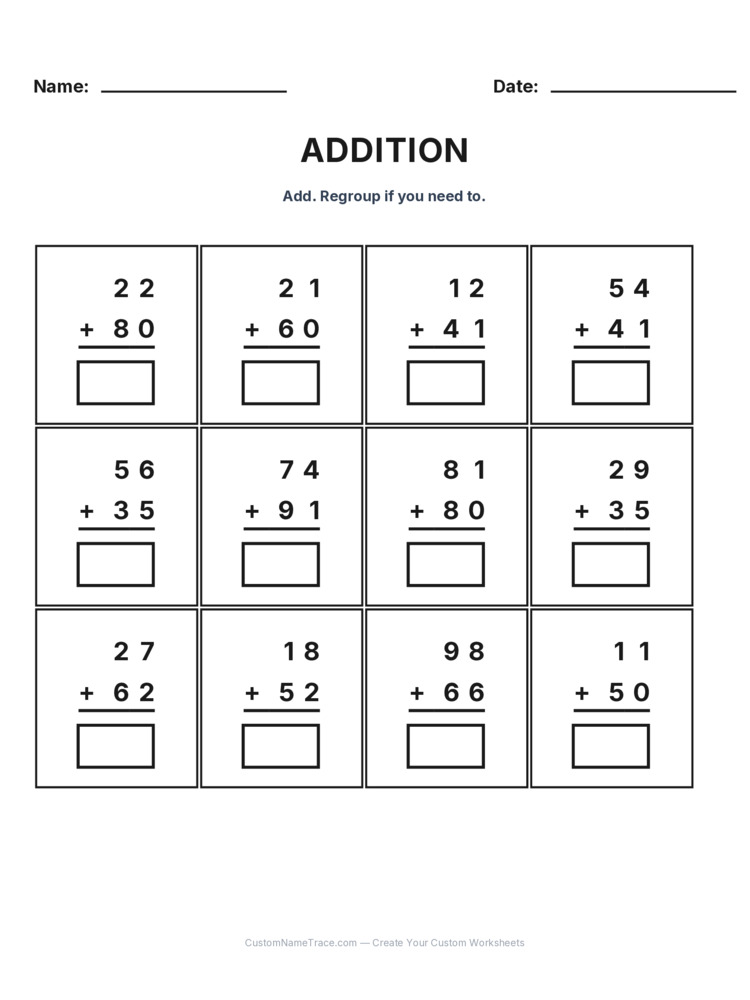
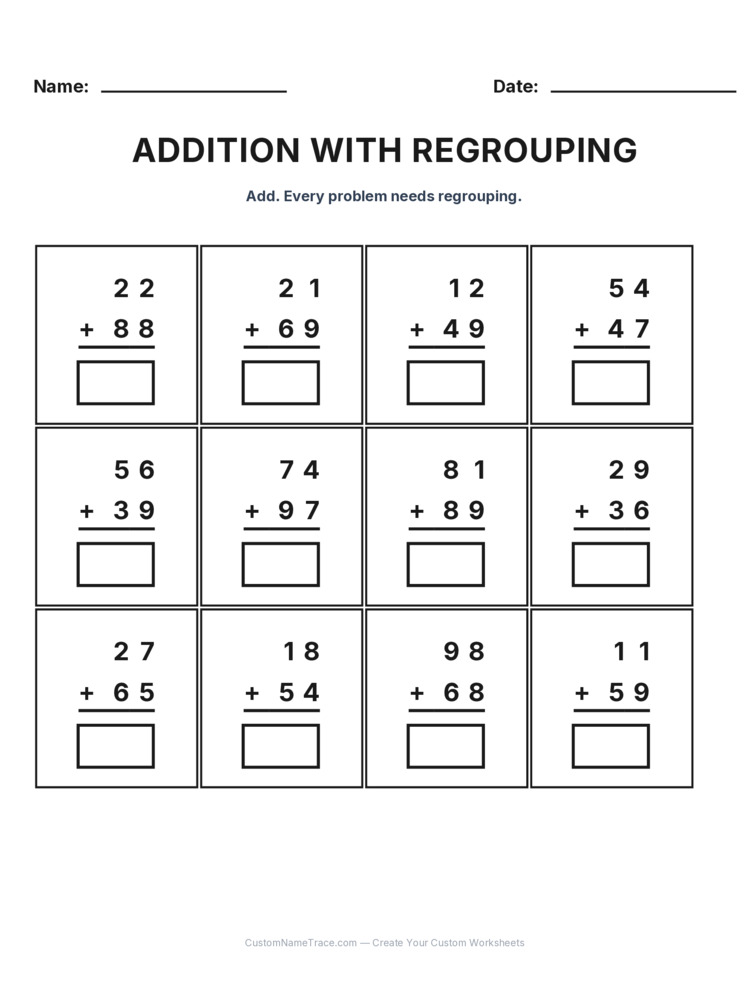
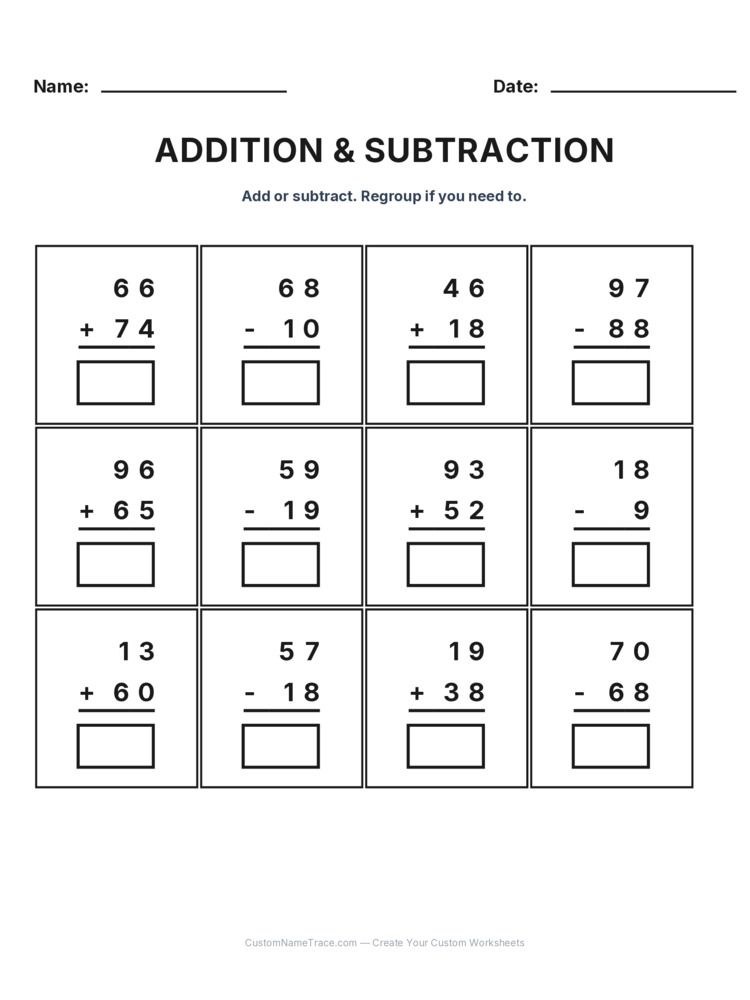
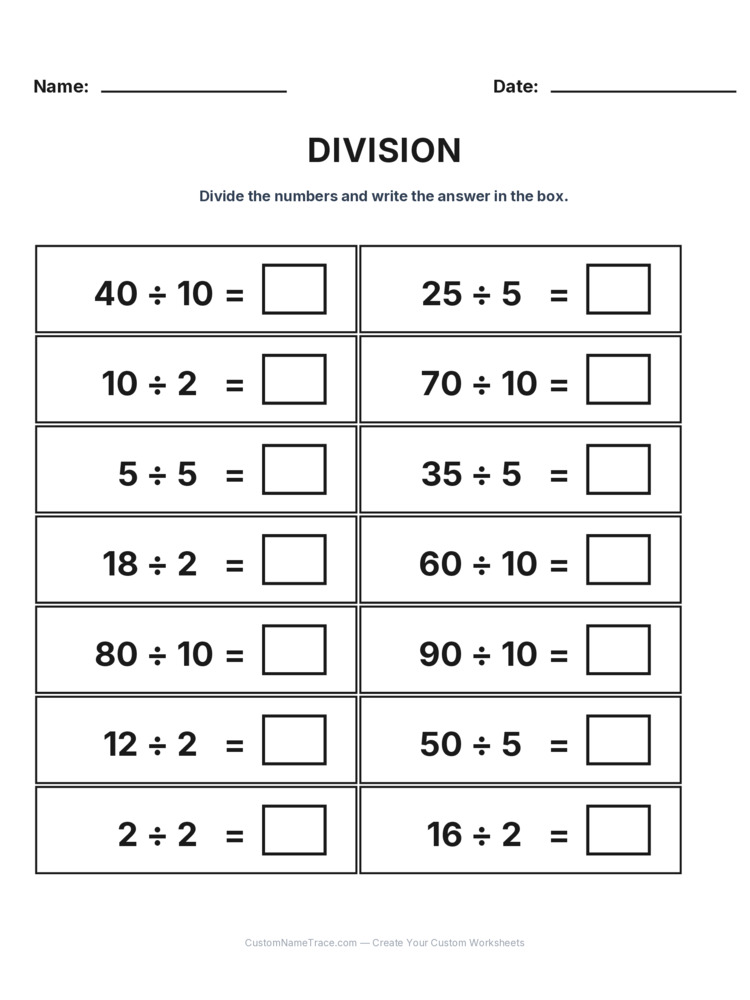
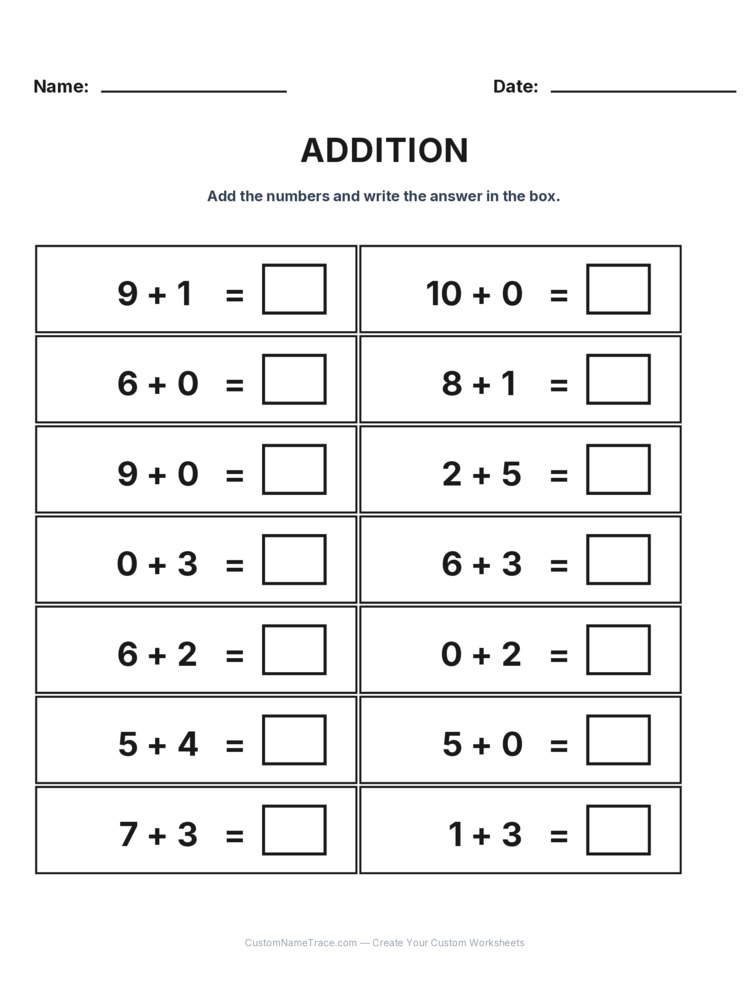
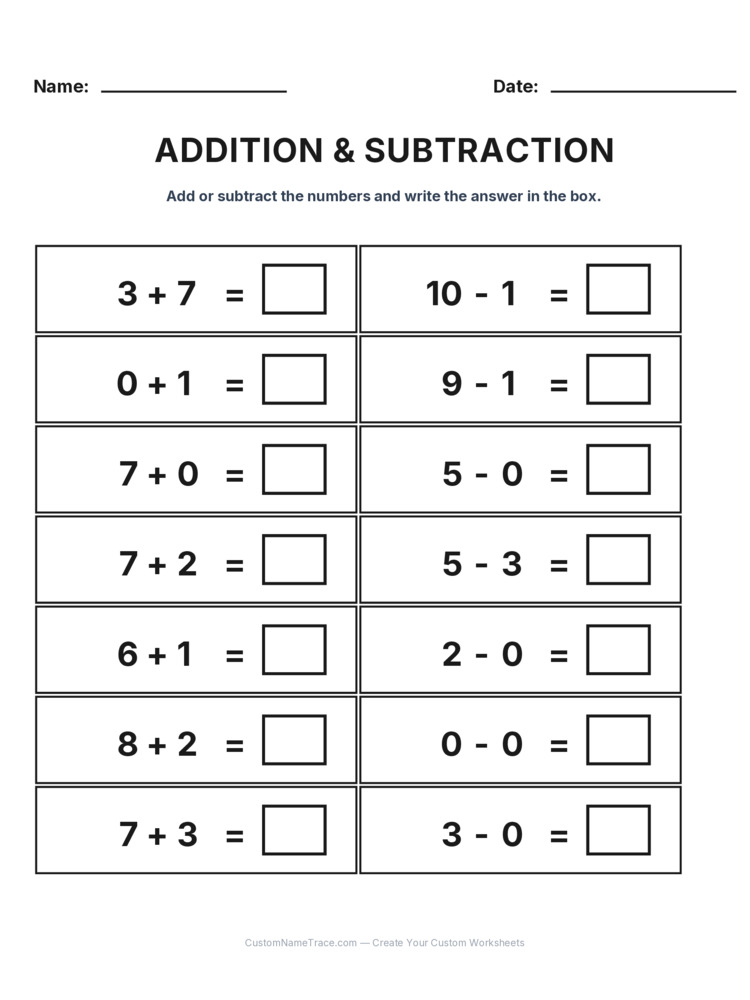
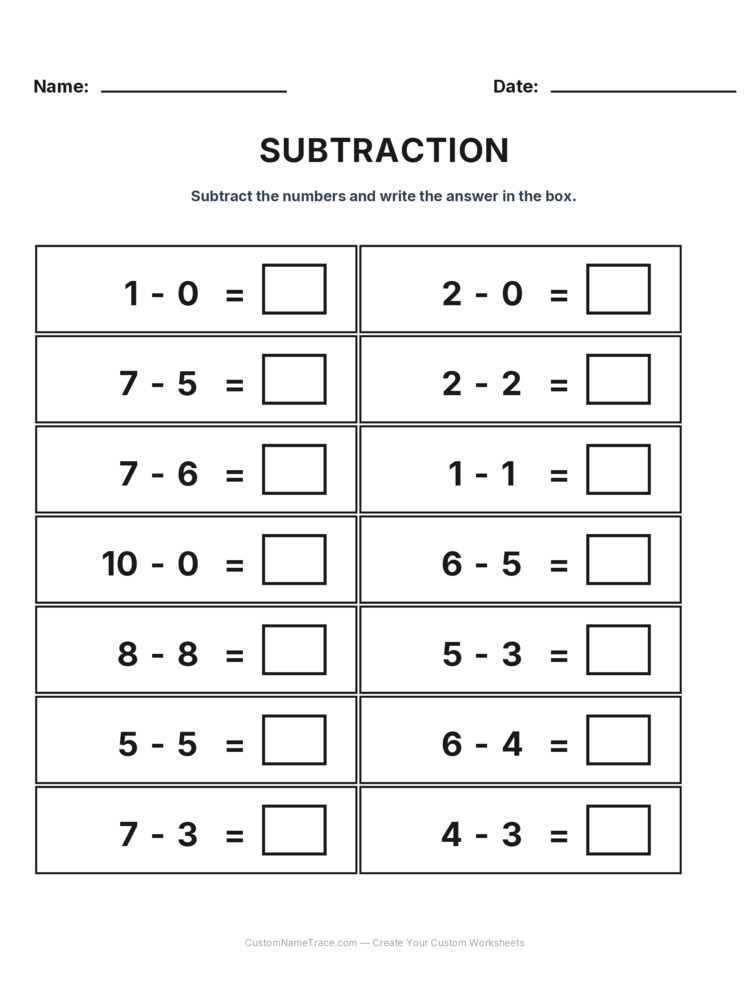
Why download a bundle instead of one worksheet at a time
A bundle doesn't change what's on each page — it changes how many you get in one click. Every math worksheet on this site is already free to print one at a time, but a week of real practice usually means five to ten separate visits back to the same page, printing one sheet each time. A bundle collapses that into a single download: ten worksheets for one specific skill, in one PDF, so the whole week is one print job instead of a running errand you have to remember to do.
What's inside a bundle
Each bundle is ten worksheets for one specific skill — the same grade, the same number range, the same format you'd find browsing that skill's own page directly, just packaged together. Nothing here is new or different content; a bundle is a convenience for printing a full set at once, not a separate product with its own rules. Every one of the ten uses a fresh set of numbers, so it's genuinely ten different worksheets, not one page repeated with a new date on it.
Who actually reaches for a bundle over a single page
A parent handling three or four skill-and-drill sessions a week doesn't want to come back to this site every single time — one download at the start of the week means the worksheets are already sitting in a folder, ready to hand over. A classroom teacher planning a two-week unit around one specific skill has the same problem at a bigger scale: printing individually for twenty-five students, five times over, is real time lost that a single class set solves in one trip to the printer. Either way, the worksheets themselves don't change — only how many arrive at once.
How bundles are organized
Bundles are grouped by grade first, then by the specific skill within that grade — the same organization this site's regular math worksheets already use, so a bundle for a given skill sits at the same place in the structure a single worksheet for that skill would. Browsing by grade below shows every bundle available at that level; each bundle's own page shows exactly which ten worksheets are inside before you download anything, so there's no guessing what you're about to print.
Free, printable, and nothing saved
Every bundle downloads as a clean, print-ready PDF in both Letter and A4 sizes, with no account, no sign-up, and nothing saved on our end — the same policy as every other worksheet on this site. There's no premium tier that unlocks bundles or gates a specific grade behind a paywall; what's here is what's free, for anyone who wants it, as many times as it's needed.
A teacher's guide to math worksheet bundles
Every math page in this library is free to print one at a time, and for a single quick practice that is exactly right. But a week of real practice looks different. A teacher preparing a center needs a stack of different pages, not one. A parent planning five short sessions wants all five in a folder before Monday. A tutor needs something to hand a student who has finished their work. In each case, the useful unit is not a page but a set, and that is what a bundle is.
This section collects twenty math bundles, from Kindergarten through Grade 3. Each bundle is ten worksheets for one skill, packaged as a single PDF in both Letter and A4 sizes. This guide explains what is in the bundles, how they are organized, how to choose among them, and how to use ten pages well, so that a bundle becomes a small, coherent course of practice and not a stack of paper.
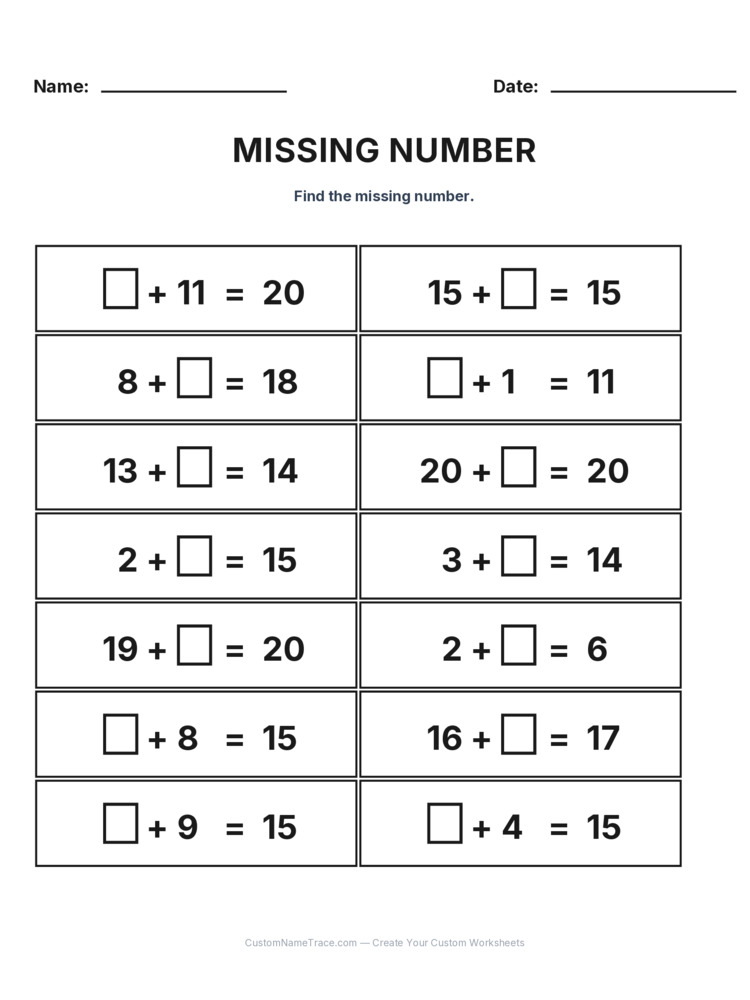 The cover image of a bundle shows its first worksheet. This is Grade 1 Addition Missing Number, and the bundle holds ten pages like it, each with fresh numbers.
What a bundle is
A bundle is the first ten numbered worksheets of one skill, combined into one file. The Grade 1 Addition Missing Number bundle, for example, contains the ten pages that you would find at "Worksheet 1" through "Worksheet 10" on that skill's own page. They are the same pages, with the same rules and the same range of numbers, just gathered together.
That means a bundle has three useful features.
- One skill. Every page asks the same kind of question at the same difficulty, so a child's results are easy to read.
- Ten different pages. The numbers change from page to page, so there is no repetition.
- One download. Download once, print once, and the whole set is ready.
Each bundle's page shows a preview of its worksheets, with a viewer that lets you flip through "1 of 10" to "10 of 10," and a list of what is inside. You can see exactly what you will be printing before you print it.
The twenty bundles
The math bundles follow the same structure as the worksheets themselves: grade first, then operation, then skill.
| Grade |
Bundles |
| Kindergarten |
Addition within 10; Subtraction within 10; Addition and Subtraction mixed review |
| Grade 1 |
Addition within 20; Subtraction within 20; Addition and Subtraction mixed review; Addition missing number; Subtraction missing number |
| Grade 2 |
Addition no regrouping; Addition regrouping; Subtraction no regrouping; Subtraction regrouping; Addition and Subtraction mixed review; Multiplication intro facts; Division intro facts |
| Grade 3 |
Addition regrouping; Subtraction regrouping; Addition and Subtraction mixed review; Multiplication facts 0 to 12; Division basic facts |
That is 3 + 5 + 7 + 5 = 20 bundles, and 200 worksheets in total. (The blank multiplication chart is a single reusable page, so it does not have a bundle of its own.) You can browse them from the all bundles page, which also includes the emoji pattern bundles.
Why ten pages
Ten is a deliberately chosen number. It is large enough to cover a real stretch of practice, and small enough not to be overwhelming.
- Two weeks of daily practice. Five pages a week, two weeks.
- A week of two-a-day practice. One in the morning and one at home.
- A class set with variety. Ten different pages means ten different children can have different pages, which discourages copying.
- A natural before-and-after. The first page is a baseline. The last shows what has changed.
- A convenient size to print and carry. Ten sheets is a pleasant, manageable stack.
If a child needs more than ten, you can go back to the skill's own page, and pick up Worksheet 11 onward, or download another bundle of a different skill. If a child needs fewer, print only the pages you need.
The twenty skills at a glance
Each bundle practices one skill, and each skill has its own central idea. Here is a quick map, with the kind of problem you will find in each.
| Bundle |
A typical problem |
The idea underneath |
| K Addition within 10 |
6 + 2 = ▢ |
Combining small groups |
| K Subtraction within 10 |
8 − 3 = ▢ |
Taking away, and what is left |
| K Mixed review |
3 + 7 and 10 − 1 on one page |
Reading the sign |
| G1 Addition within 20 |
8 + 5 = ▢ |
Making ten |
| G1 Subtraction within 20 |
14 − 8 = ▢ |
Going down through ten |
| G1 Mixed review |
9 + 6 and 15 − 9 |
Switching operations |
| G1 Addition missing number |
8 + ▢ = 18 |
The equals sign as balance |
| G1 Subtraction missing number |
▢ − 2 = 1 |
Working backward |
| G2 Addition, no regrouping |
42 + 35 |
Tens and ones side by side |
| G2 Addition, regrouping |
38 + 47 |
Trading ten ones for a ten |
| G2 Subtraction, no regrouping |
86 − 23 |
Tens and ones side by side |
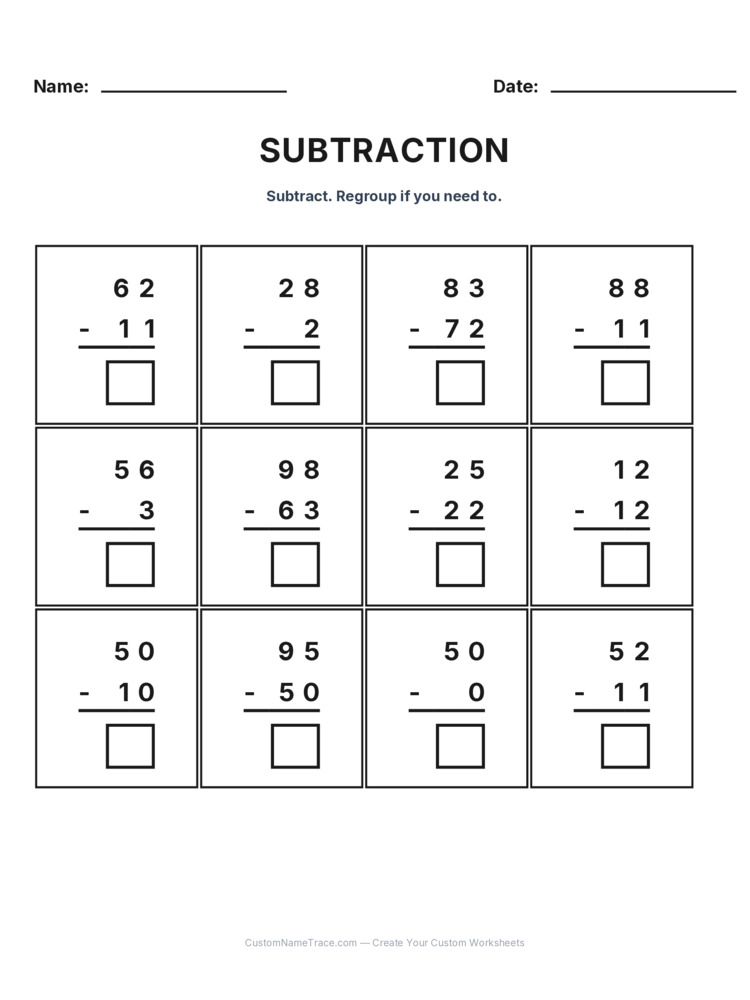
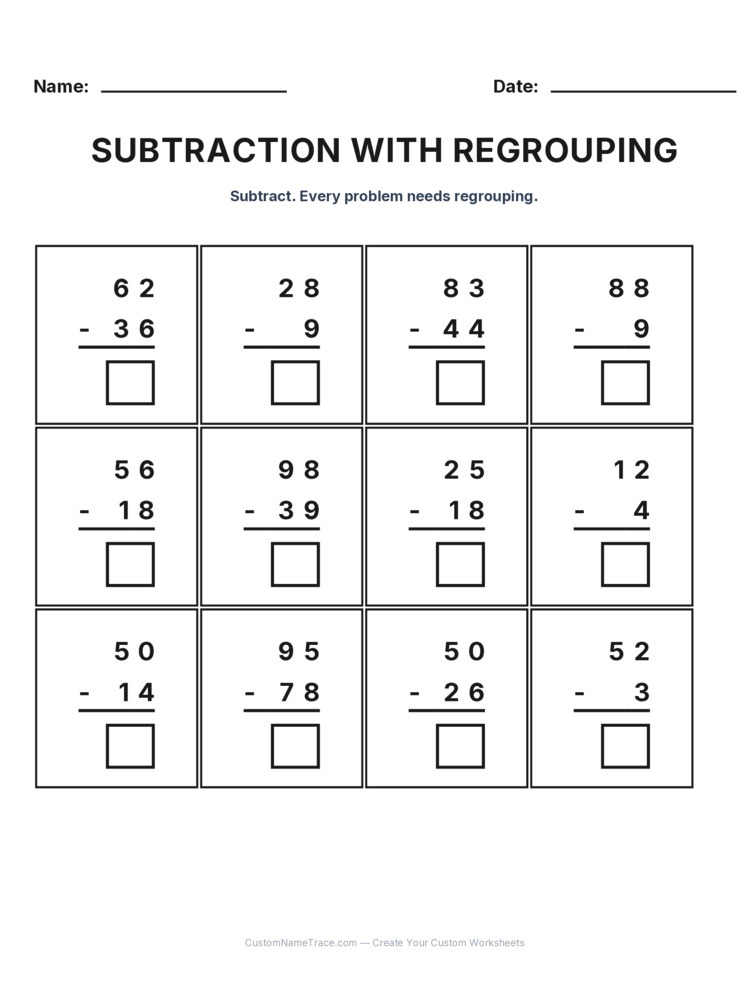
| G2 Subtraction, regrouping |
62 − 36 |
Trading a ten for ten ones |
| G2 Mixed review |
Stacked addition and subtraction |
Choosing the method |
| G2 Multiplication intro |
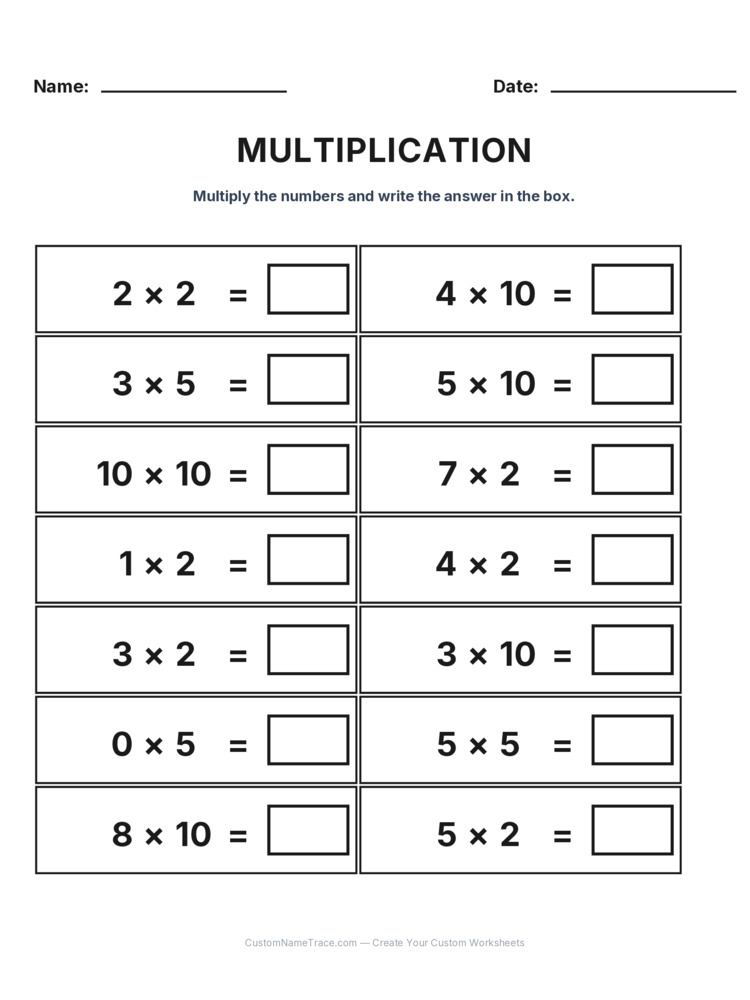
3 × 5 = ▢ |
Equal groups, skip counting |
| G2 Division intro |
40 ÷ 10 = ▢ |
Sharing, the reverse of multiplying |
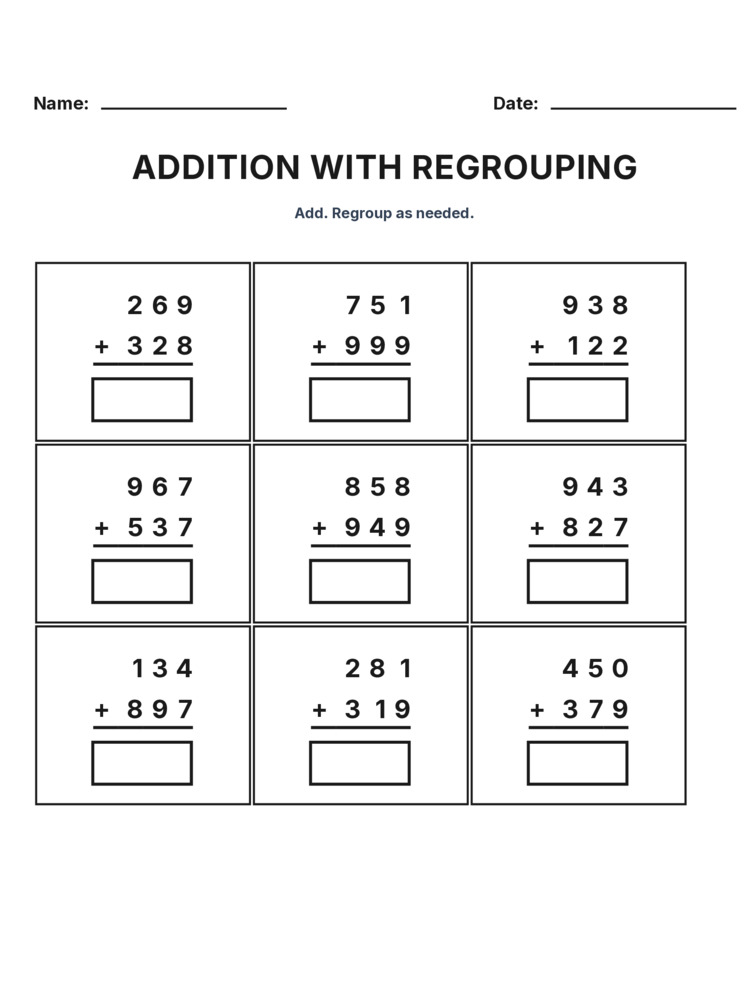
| G3 Addition, regrouping |
269 + 328 |
Carrying across three digits |
| G3 Subtraction, regrouping |
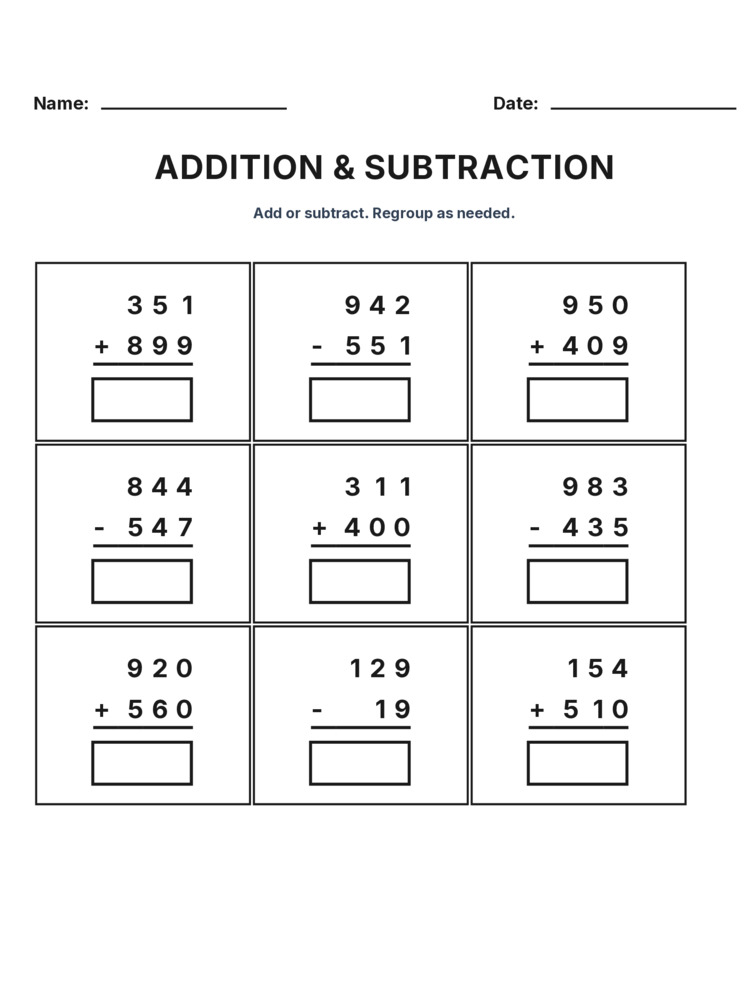
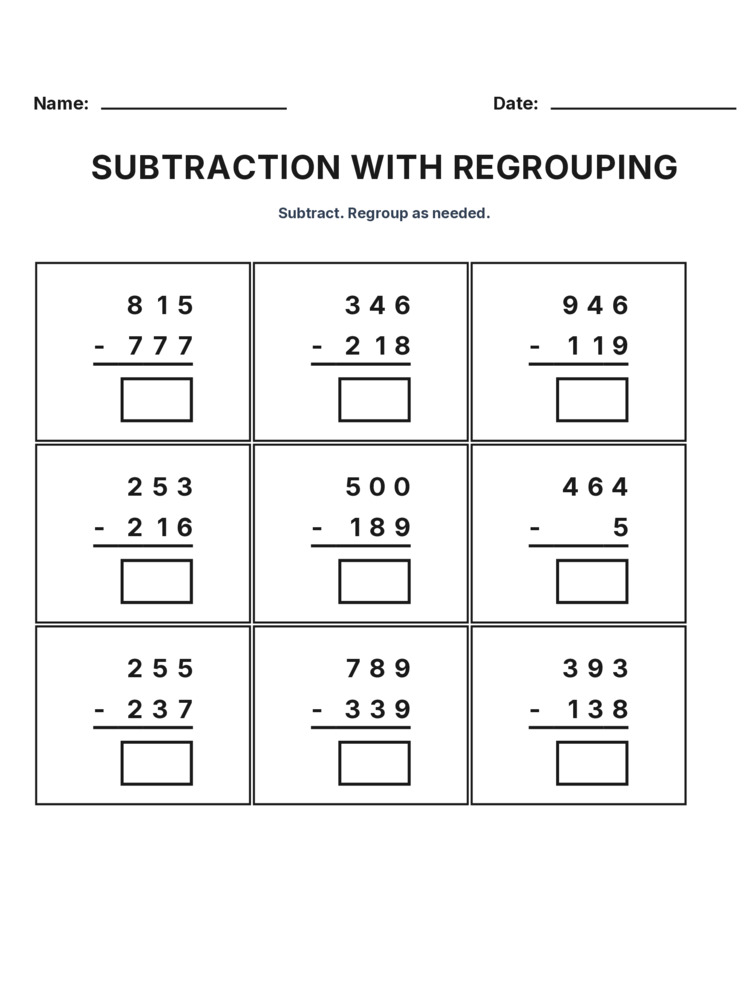
503 − 267 |
Borrowing across a zero |
| G3 Mixed review |
Three-digit addition and subtraction |
Careful method |
| G3 Multiplication 0 to 12 |
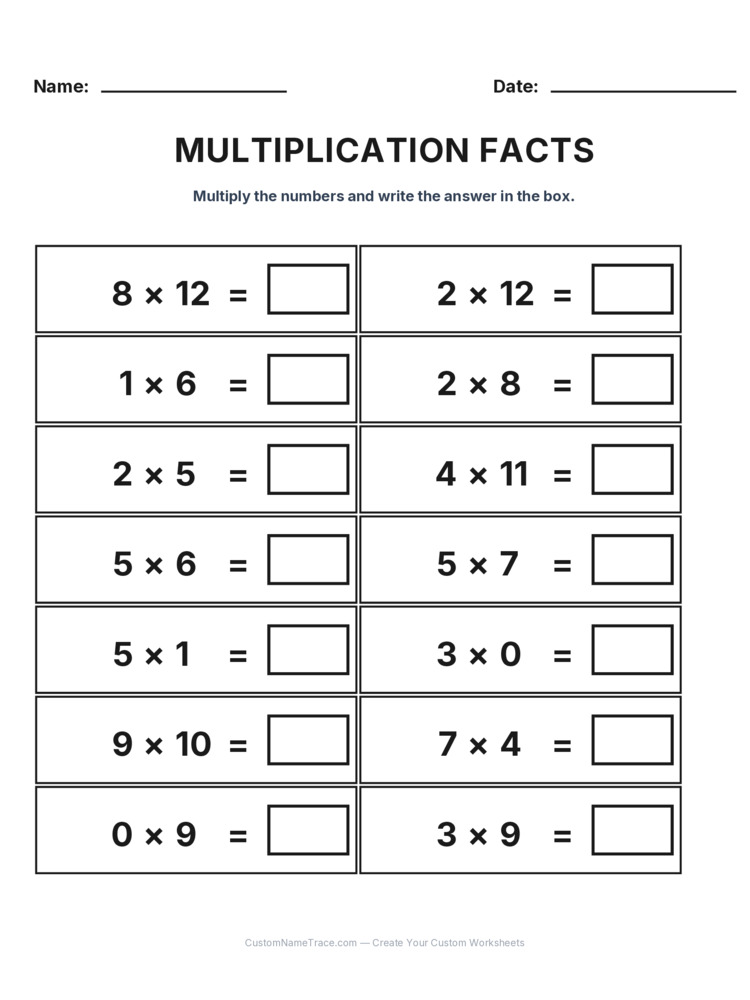
8 × 12 = ▢ |
The whole table |
| G3 Division basic facts |
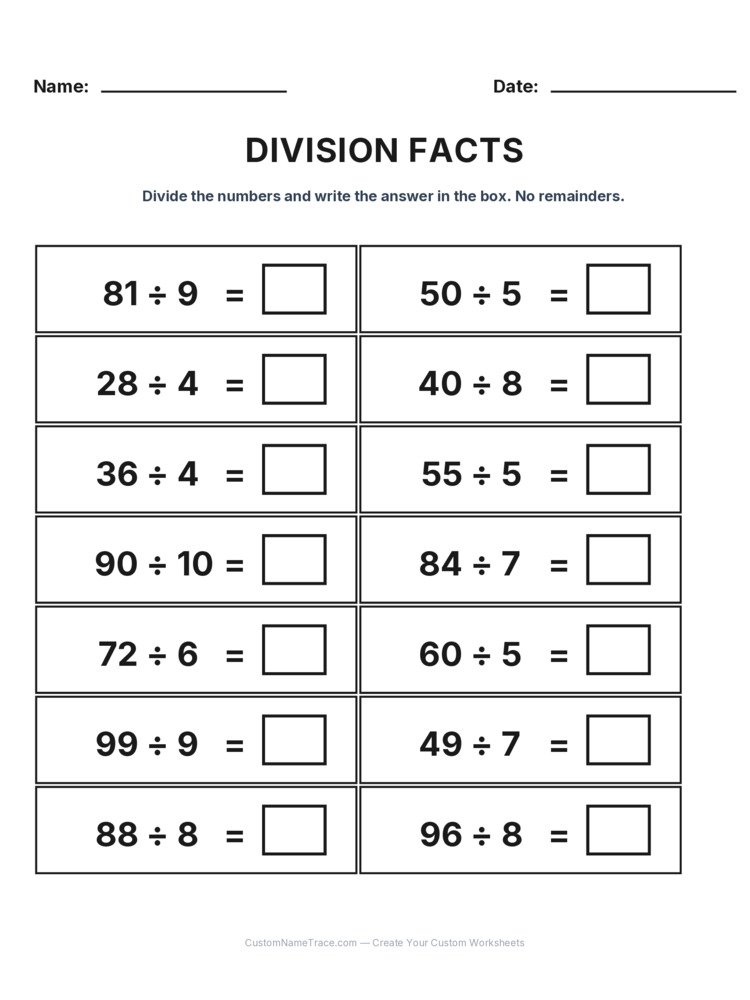
72 ÷ 6 = ▢ |
Multiplication in reverse |
A glance down the middle column shows the shape of early arithmetic: first combining and separating, then trading between places, then repeated groups.
Pairing bundles for a stronger week
Doing a single skill for two weeks is fine, but many teachers find that pairing two bundles works better. This idea is sometimes called interleaving, and it asks a child to keep switching between related skills, which makes them think harder about which method to use.
Here are some natural pairs.
- Addition and subtraction within 20 (Grade 1). Alternate days, or put one of each in the same session.
- Regrouping addition and regrouping subtraction (Grade 2). The child has to choose between carrying and borrowing.
- Multiplication and division facts (Grade 3). Division checks multiplication.
- A new skill and an old one. Two pages of the new bundle and one of an older bundle, to keep earlier learning fresh.
- A fact bundle and a missing-number bundle. The same numbers, asked in a different way.
A mixed-review bundle is, in a sense, a ready-made pair. If a child is not ready for the mixed review, a simple pairing of two separate bundles on alternate days is a gentle step toward it.
Knowing when to move on
Ten pages is a natural point to stop and decide: stay, or move forward? A few simple tests help.
Move on when:
- Most answers are correct on the last three pages.
- The child works at a steady pace, without counting every problem on fingers.
- The child can explain a method in their own words.
- The child is bored, or asks for something harder.
Stay when:
- The same kind of mistake appears on several pages.
- The child works very slowly, or with obvious effort.
- The child is anxious, or avoids the pages.
- The child can do the problems but cannot say why.
Step back when:
- The child is mostly guessing.
- The method is not yet understood.
- The child is frustrated even after help.
Stepping back is not a failure. A child who returns to hands-on work for a few days and then tries again will usually do far better.
A year of bundles
A grade of math contains more than the bundles, of course, and bundles are best seen as the practice component. But it can be useful to see how they might fit.
- Kindergarten. Three bundles, one per month, with lots of hands-on work between.
- Grade 1. Five bundles, one every four to six weeks.
- Grade 2. Seven bundles, roughly one per month, with place value work in between.
- Grade 3. Five bundles, with the multiplication bundle revisited several times as facts are learned.
A child who works through all the bundles for their grade, with proper teaching around them, will have done two hundred pages of focused practice across four years, and that is a solid base.
Choosing the right bundle
The best choice is the bundle just at the edge of what a child can do. A few guidelines help.
- Start with a diagnostic page. Print one worksheet from the skill's own page, and see how the child does.
- Choose by skill, not by age. A child's grade is a rough guide. What they can actually do is a better one.
- Prefer a bundle where the child gets about three-quarters right. That is a place where practice is useful.
- If the child gets nearly everything right, move up.
- If the child is mostly stuck, step back and teach.
- Pair a new skill with a familiar one. A bundle of subtraction and a bundle of mixed review make a good pair.
The grade pages list the skills in each grade, and the individual guides for Kindergarten, Grade 1, Grade 2 and Grade 3 describe each one.
A sequence across a grade
Each grade has a natural order in which the skills build. Here is the logic behind the order, grade by grade.
Kindergarten. Addition within 10, then subtraction within 10, then mixed review. Mixed review comes last, because it asks the child to tell the operations apart.
Grade 1. Addition within 20 and subtraction within 20 come first, with the "make ten" strategy as the thread. Then the missing-number bundles, which ask the child to think about the equals sign. Mixed review comes at the end to check that the child can switch.
Grade 2. No-regrouping addition and subtraction before regrouping. The introduction to multiplication and division can come at any time after the child has met skip counting. Mixed review at the end.
Grade 3. Regrouping with three digits, and the multiplication facts, which take most of the year. Division follows multiplication, and mixed review checks addition and subtraction regularly.
A child who works through each grade's bundles in this order, taking about two weeks each, will have a coherent year of practice in about eight to fourteen weeks of bundle work, and the rest of the time can go to teaching and play.
Differentiating with bundles in a mixed class
A single classroom holds children at very different points, and bundles make quiet differentiation easy. Because each bundle is a self-contained set with the same look and feel, nobody needs to know that one child is working on a different skill from the next.
A simple pattern is to run three groups.
- Group A: consolidating. Children who have just met a skill and need more practice. They work through the bundle for that skill, a page a day.
- Group B: on level. Children who are secure on the current skill and are ready for the next. They work on the following bundle.
- Group C: extending. Children who are well ahead, and who are ready for the next grade's bundle on a related skill.
Because the three bundles are printed as separate PDFs, the teacher prints three small stacks, and hands each child their own folder. The pages all look alike. No child sees the label "easier" or "harder."
The numbered pages also make it easy to prevent copying. In a table group of four, give each child a different page of the same bundle. They can talk about the method without sharing answers.
Bundles for early finishers, morning work and homework
Because a bundle is a ready-made stack, it fits neatly into several parts of the school day.
Early finishers. A folder of ten pages kept in the corner of the room. A child who finishes early takes the next page, works on it quietly, and files it back. Over a term, the folder fills with evidence of steady practice.
Morning work. A single page, set out on each desk as children arrive. It gives the day a calm start, and the page is a quick warm-up for the lesson that follows.
Homework. One page a night, or three a week, taken from a bundle. A parent can see at once what the child is working on, and the single skill means no confusion about what to do.
Intervention groups. A small group working on the same gap can share a bundle, with the teacher circulating.
Sub plans. A substitute needs work that is clear and self-explanatory. A page from a bundle is both.
In every case, the key is one skill, repeated in small amounts. That is the strength of the bundle format.
First and last: the page that measures growth
A very useful feature of a ten-page bundle is that the first and the last pages are of exactly the same kind. That makes them a natural before and after. A simple way to use this:
- Do page 1 without any help. Note the score, the time it took and the method.
- Teach and practice with pages 2 to 9.
- Do page 10 under the same conditions as page 1.
- Compare. Put the two pages side by side.
The comparison is more than a score. Look at the handwriting, the neatness of the work, the confidence of the child and the method. A child who counted on fingers for every problem on page 1, and wrote the answers quickly on page 10, has made visible progress.
Share the two pages with the child. "Look at this one from two weeks ago. Look at this one now. What do you notice?" It is one of the most encouraging conversations a teacher or parent can have, and it costs nothing.
For a teacher, the same pair of pages is useful evidence to share with a family, or to put in a portfolio.
Bundles and games
Practice does not have to be all paper. A bundle can be the base for games that use the same skill.
- Race the page. Two children each take a page from the same bundle. Who can finish first, correctly? (Only if both enjoy it.)
- Problem swap. Each child writes a few problems of the same type for a partner.
- Bundle bingo. Pick numbers from a page and make a bingo card.
- Dice and cards. Use the skill as a base: roll two dice for addition within 20, or turn over two cards for multiplication.
- Teacher in the hot seat. The adult makes deliberate mistakes on a page, and the child corrects them.
- Partner check. Two children swap pages, check each other's, and discuss.
A game takes five minutes, and a few of them in a week change the feeling of practice.
Using bundles in different settings
At home. A parent can download a bundle on Sunday and have the whole week ready. Five pages for five days, with a sixth and seventh as extras.
In a classroom. A teacher can print a bundle, and use the ten pages across the class. Different children get different pages on the same day.
For tutoring. A tutor can use a bundle as a progress chart across several sessions.
For homeschool. A homeschool parent can build a year of math from bundles, with one a fortnight, and fill the rest with games and projects.
For intervention. A specialist working with a child on a specific gap can use a bundle focused on that skill, and track progress through the ten pages.
For substitute plans. A bundle is a ready-made, low-prep set of work that a substitute can hand out.
For summer. A bundle for the coming grade, or one to keep skills fresh, is a pleasant summer project.
Making practice stick
Ten pages of practice is only as good as the thinking around it. A few habits make bundles more effective.
- Teach first. A bundle is for practice, not for introducing an idea.
- Do a little, often. Ten minutes a day beats an hour on Saturday.
- Talk. Ask the child to say a problem aloud, and explain one answer.
- Fix mistakes the same day. A correction soon after is more effective than one a week later.
- Mix in play. Dice and card games work the same skill.
- Stop while it is going well. End on a success.
- Review old bundles. Go back to a previous skill after a month.
Printing and organizing
A bundle is a PDF, so a few practical tips are worth knowing.
- Print once, copy as needed. One printed set can be photocopied for a class.
- Choose Letter or A4. Both sizes are provided.
- Print in black and white. The pages are designed for it, and save ink.
- Use a folder or binder. Label each bundle, and keep a record sheet inside.
- Double-sided printing is possible, but leave room for the child's writing.
- Keep the PDF. Save it on your device so it is ready when you need it.
Questions that come up
Is a bundle different from the individual pages? No. A bundle is the first ten numbered worksheets of a skill, combined. The content is the same.
Do bundles have answer keys? Check what is in the file you download. In any case, working a few problems yourself is a good way to check.
Can I get more than ten pages? Yes. The skill's own page has thirty numbered worksheets, so you can print more individually.
Are the pages the same in every bundle I download? The first ten pages of a skill are always the same. For variety, use the other numbered pages.
Does a bundle cost anything? No. Like everything here, bundles are free, with no account.
Which bundle should we start with? One that is just at the edge of what the child can do. A diagnostic page will tell you.
A bundle is a small thing, ten pages in a folder. But a folder of ten well-chosen pages, used with a little teaching and a lot of encouragement, is a quiet and effective way to build skill.