What a pyramid worksheet is
Instead of tracing the same full name over and over, a pyramid worksheet changes what's printed on every row: one letter on the first row, two on the second, three on the third, and so on, until the complete name appears on the last row. Because every row is centered, the rows themselves form a triangle shape on the page as the name grows.
Why build up instead of trace repeatedly
Repeating the exact same word on every row is efficient practice, but it asks a child to do the same thing six times in a row. A pyramid changes on every line — a genuinely different, slightly harder task each row — while still ending on the reward of writing the whole name, fully formed, as the last thing on the page.
How the worksheets are organized
Pyramid worksheets are grouped first by country, then by gender, using the same country and gender groupings as this site's regular name tracing library. Each name has its own page with a real, pre-rendered pyramid image sized to that name's own length.
How the pyramid images are made
Every pyramid worksheet is rendered through the same underlying engine as this site's interactive editor and every other worksheet — the identical guide-line spacing and letter calibration, just a different pattern of what text appears row by row. A name page here looks and prints exactly the way the editor's Pyramid style would produce it.
A teacher's guide to name pyramid worksheets
A name pyramid page is titled "Watch My Name Grow!" and it does exactly that. The first row shows only the first letter of a name. The second row adds the next letter. The third adds another, and so on, until the final row shows the complete name. The early rows are dotted, so a child can trace them, and the last row is solid, a clean, finished version of the whole name, as a reward for getting there.
It looks simple, and it is, but there is real teaching thinking behind it. This guide explains why building a word up one letter at a time works, what it asks of a child, how to use it in a classroom or at home, and how to carry the idea beyond names.
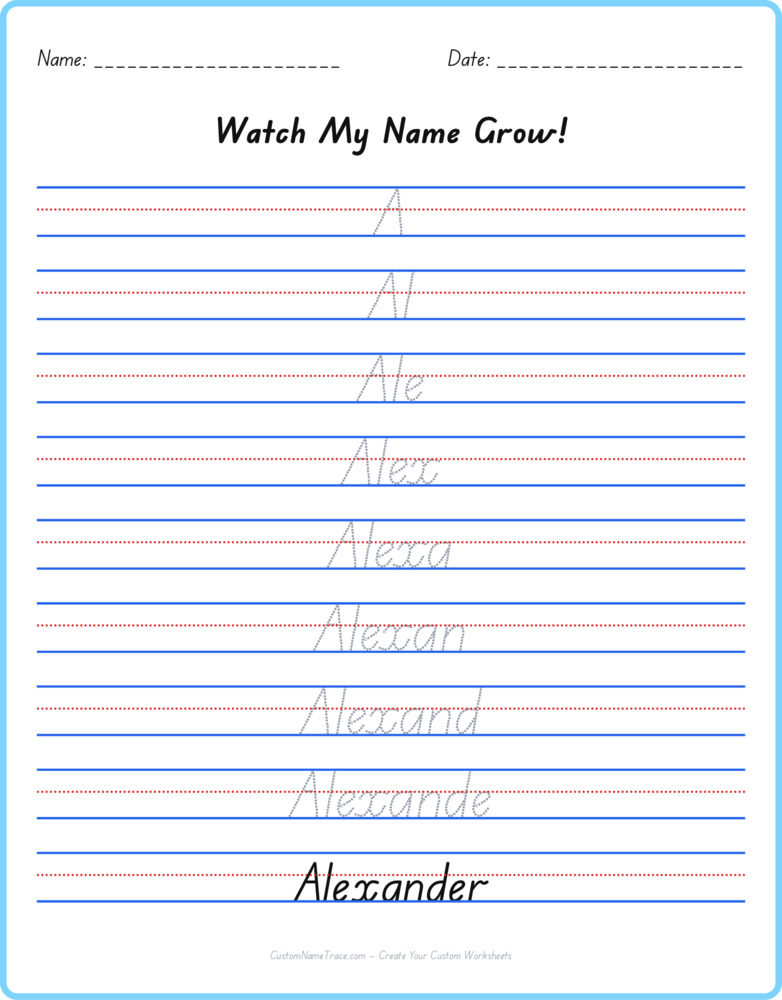 Each row adds one letter. The dotted early rows are traced, and the last row shows the finished name.
Why build up instead of tracing the whole name again and again
Tracing a whole name over and over is useful, and it is what the names gallery is for. But a long name has a hidden difficulty. The child is asked to deal with every letter at the same moment, and for a name such as "Alexander," that is nine letters and a very large mental load. A tired or anxious child may simply move the pencil along without really looking at each letter.
A pyramid changes the task in a few helpful ways.
- The load starts small. Row one asks for a single letter. A child who is nervous can do that. Success in the first row makes the second row feel possible.
- Each new row adds exactly one new thing. The child has already written everything but the last letter. The only new decision is "what comes next?" That keeps attention on the order of the letters, which is where many spelling mistakes begin.
- The word is rehearsed many times, in pieces. By the end of a nine-letter pyramid, the first letter has appeared nine times, the second eight times and so on, which gives a lot of practice to the early letters, the ones that start every attempt at the name.
- There is a built-in finish. The page has an obvious shape and an obvious end. Children like to see a pyramid grow, and they like reaching the top.
- The reward is visible. The final row is solid and complete, and a child can compare it with their own writing.
This is a form of what teachers call scaffolding. The task is made easy at the start and gradually becomes more demanding, until the child is doing the full job without support.
What a pyramid actually teaches
On the surface it is handwriting practice. Underneath, several different skills are being exercised.
Letter order. A name is a sequence, and the pyramid makes that sequence visible. Reading the rows from top to bottom, the child sees exactly how the name is assembled.
Left-to-right movement. Every row grows to the right, which reinforces the direction of reading and writing.
Counting. The number of letters in a name is the number of rows. A child who counts the rows has counted the letters.
Chunks inside the name. As the pyramid grows, certain partial rows are words or familiar chunks. "Alex" appears inside "Alexander." "Eliza" and "Beth" appear inside "Elizabeth." Noticing those chunks is the beginning of seeing how longer words are built from shorter ones.
Listening. If a child reads each row aloud, they hear the name develop: "A... Al... Ale... Alex... Alexa..." Each row has its own sound, and that is a gentle exercise in phonemic awareness, the ability to hear the individual sounds in a word.
Persistence. A pyramid for a long name asks the child to keep going through many short steps. Finishing is satisfying, and it builds a child's belief that they can do long tasks.
How to use a pyramid page
- Say the whole name first, and clap it. The child should know where they are going before they start. "Al-ex-an-der. Four beats."
- Look at the finished name at the bottom. Point to it. "This is where we are going. Let's watch it grow."
- Trace row by row, saying each row aloud. "A." "Al." "Ale." Say what you have written before moving on. The voice and the hand work together.
- Pause at natural breaks. After a syllable, such as "Alex," stop and say the chunk. It marks progress.
- Take a break in the middle for a long name. There is no rule that a pyramid must be finished in one sitting. For a long name, do the top half one day and the bottom half the next.
- Celebrate the last row. It is the full name, in solid letters. Let the child read it aloud and point to each letter.
- Finish by writing the name from memory on plain paper, as a proud conclusion.
Short names and long names
The number of rows is the length of the name, so a pyramid for "Mia" is short and quick, and a pyramid for "Alexander" is long. This has a few consequences.
For a short name, the pyramid is a quick, satisfying activity, but it may be too easy for an older child. Use it as a warm-up, or for a younger child as a first success.
For a long name, the pyramid is the real value. It makes a long, daunting word manageable. It is worth planning for stamina: a nine-row page asks for a lot of small movements, and a child's hand may tire. Stop and shake out the hand, or split the page over two days.
For a very long name, it may help to use the pyramid for just the early letters on one occasion, and the later ones another time. The aim is not to finish a page, but to learn the name.
Hidden words inside names
A pleasing extension is to hunt for words inside the name. It is a favorite game with children, and it teaches something real about how words are made.
- Alexander contains Alex and Alexa, and also and.
- Elizabeth contains Eliza, Liza and Beth.
- Benjamin contains Ben and jam.
- Jonathan contains Jon, Nat and than.
- Isabella contains Isabel and Bella.
- Katherine contains Kat, Kath and her.
Ask the child to find a smaller word as the pyramid grows, and to circle it on the page. Children are often delighted to find "jam" inside "Benjamin," and it is a quick, memorable lesson in the idea that words can be broken into parts.
Pyramids beyond names
The idea of building a word up letter by letter is much older than this page, and it works with any word. Teachers use it for spelling lists, vocabulary words and difficult words that a child keeps getting wrong. You can make one by hand on any scrap of paper.
- Spelling words. Write the word one letter at a time, stacking the rows: b, br, bri, brig, brigh, bright.
- Sight words. For a tricky word such as "because," the pyramid slows the child down and makes each letter visible.
- Theme words. Elephant, butterfly, rectangle, September. Long words from a theme can be built up in the same way.
- Colored pyramids. Write each new letter in a different color, so the growth is easy to see.
- Upside-down pyramids. Start with the full word, and remove a letter at a time. Alexander, Alexande, Alexand... It is a lively reverse.
- Letter tile pyramids. Use magnetic letters or tiles on a tray, and add one at a time. It is the same activity, without a pencil.
For any word, the sight word and name tracing generators give a clean model to copy from. The name tracing generator also includes the pyramid as a tracing style, so you can make a pyramid for any name in any spelling.
A progression for a single name
The pyramid fits neatly into a sequence of three name galleries, each asking a little more of the child.
- Names. Trace the whole name many times. The child learns the shapes of the letters.
- Name Pyramid (this page). Build the name up one letter at a time. The child learns the order of the letters.
- Name Missing Letter. Fill in the gaps. The child recalls the letters without a model.
A calm plan for one name is to spend a week on each step, finishing with writing the name from memory. A child who has done all three has rehearsed the name in many different ways, and they usually write it with real confidence.
What to watch for
A pyramid is also a window into what a child knows. While the child works, a few observations are worth making.
- Where do they slip? If the child consistently makes a mistake at a particular row, that letter is the one that needs attention.
- Do they say the letters? A child who names each letter as it is written is processing it. A silent child may be copying shapes.
- Do they look back? A child who checks the previous row is using it as a model, which is exactly what the page is designed to teach.
- How is their pencil pressure? Heavy pressing signals tension. Shorten the session.
- Are they rushing? A child who races to the end is not really learning. Slow down, and speak each row.
- Do they get tired? Fatigue is natural, and it is a good reason to split a long page.
Keep notes, and look for patterns across several sessions.
Common difficulties and what helps
A child writes the wrong letter in a row. Say the name aloud slowly, and point to each letter in the row above. "A... l... what comes next?"
A child loses their place. Use a finger or a ruler to mark the current row, and cover the rows below with a sheet of paper.
A child's letters get larger or smaller as they go. Point to the guide lines, and remind them where the letters should sit.
A child gets bored with the short rows at the start. Let them skip the first two or three rows, and begin at the point where the challenge starts.
A child is anxious about getting it wrong. Do the first row together, hand over hand if needed, and praise effort, not accuracy.
A child finishes quickly but sloppily. Ask them to find their best row, and explain why it is the best.
Adjusting it by age
- Age 4 to 5. Use the pyramid for a short name, such as "Mia" or "Leo," and expect a loose, wobbly attempt. Trace with a finger first. The aim is to see the name grow, not to write it perfectly.
- Age 5 to 6. The sweet spot. A first name of four to six letters, dotted trace, and saying each row aloud. Move to writing the last row from memory.
- Age 6 to 7. Longer names, including a middle name or a surname. Cover the lower rows, and try to write the next letter from memory.
- Age 7 and up. Use pyramids for spelling words, and make your own by hand. A child can make a pyramid for a parent or a friend.
What a pyramid looks like, row by row
It helps to see the shape for a few different names. Here is how three names of different lengths build up.
| Name |
Rows |
The pyramid, top to bottom |
| Mia |
3 |
M, Mi, Mia |
| Noah |
4 |
N, No, Noa, Noah |
| Sophia |
6 |
S, So, Sop, Soph, Sophi, Sophia |
Notice that the pyramid for "Sophia" passes through "So" and "Soph," and the row for "Soph" is a good moment to talk about the ph sound. A pyramid for a name with a double letter, such as "Emma" or "Hannah," has a row where the same letter appears twice in a row, and that is exactly the row where children most often write just one. Slowing down at that row is a small, targeted lesson in itself.
A sample ten-minute session
Here is what a calm session might look like with a five-year-old and the name "Alexander," which is a long name chosen on purpose to show the pacing.
- Minute 0 to 1. Say the name together and clap the beats. "Al-ex-an-der." Ask, "How many claps?" Four.
- Minute 1 to 2. Point to the solid name at the bottom of the page. "This is the whole name. We are going to build it."
- Minute 2 to 6. Trace the first five rows, saying each one aloud. Stop after "Alex." "That's the first part! Who else is called Alex?" Let the child talk for a moment.
- Minute 6 to 8. Continue to the end. Let the child set the pace, and do not hurry the long rows.
- Minute 8 to 9. Read the last, solid row together, pointing at each letter.
- Minute 9 to 10. Turn the page over and ask the child to write the first four letters from memory. Do not correct. Just notice.
Ten minutes is a good limit for a child of five. If the child is still interested, great, but stopping while they are still enjoying it means they will come back to the next session willingly.
A simple two-week plan
For a child who is just starting to write their name, a gentle sequence can be spread over two weeks, with short sessions on most days.
- Days 1 and 2. Trace the whole name on a Names page, so the shapes of the letters are familiar.
- Days 3 and 4. Do the top half of a pyramid. Say each row aloud.
- Day 5. Finish the pyramid. Celebrate the solid last row.
- Days 6 and 7. Rest, or play with magnetic letters and build the name on a tray.
- Days 8 and 9. Do a second pyramid, this time covering the rows below with a sheet of paper.
- Day 10. Write the name from memory, on plain paper, and compare it with the solid row.
- Then. Move on to a missing-letter page, where the child has to supply letters without a model.
Most children do not need all ten days. The point is that the child never feels rushed, and that each step is a little harder than the last.
Hand, posture and comfort
A pyramid asks for many small movements, so the way a child sits and holds the pencil matters.
- Feet flat, back supported. A child whose feet dangle is unstable, and their hand often tires sooner.
- Paper tilted. A right-handed child usually tilts the page slightly to the left, and a left-handed child slightly to the right, so the writing hand does not hide the work.
- A comfortable grip. A tripod grip, with the pencil held between the thumb and the first two fingers, is the goal, but many young children get there gradually. A short, chunky pencil often helps.
- A light touch. The dotted letters are a guide, not a groove. Remind the child to write lightly.
- Left-handed children. Let them start each row at the left, and do not push them to switch hands. For a left-handed child the page should be placed where their hand does not cover the row above, so they can see the previous letters.
- Short rests. After a long row, a stretch of the fingers, or a "shake it out," keeps the hand fresh.
Using pyramids at home
Parents do not need a classroom to use a pyramid well.
- A bedtime page. A short pyramid is a calm, finite activity, a good fit for the end of the day.
- A birthday project. Make a pyramid for a family member's name and turn it into a card.
- A sibling game. An older child can make a pyramid for a younger child, and the younger child can trace it.
- A travel activity. A printed page and a clipboard make a quiet car-trip task.
- A fridge display. A finished pyramid, hung at the child's eye level, is a visible reminder of what they can do.
Praise should be specific. "I can see you wrote the x so carefully" teaches more than "good job," and it keeps the child's attention on the work.
Names with special features
Not every name behaves in the way a simple example does. A few cases are worth planning for.
- Names with a capital letter in the middle, such as "DeShawn" or "LaToya." The pyramid will include the capital in its place, and it is worth pointing out.
- Names with an apostrophe or hyphen, such as "O'Brien" or "Mary-Jane." Check how the page treats the punctuation, and talk about it with the child.
- Names with accents, such as "José" or "Zoë." If the accented letter matters to the family, make sure it appears as intended.
- Very short names, such as "Al" or "Bo." These make a pyramid of two rows, which is not much of a pyramid. Combine the first and last name, or make a pyramid for a longer word the child likes.
- Nicknames. A child who answers to a nickname may want to practice that, and it is perfectly good to do so.
- Names from other writing systems. The name tracing generator is built around the Latin alphabet, so for other scripts it is best to ask a family member to model the name by hand.
Questions that come up
Is a pyramid better than ordinary tracing? They do different jobs. Ordinary tracing builds the shape of each letter, and a pyramid builds awareness of the order. Most children benefit from both.
Should the child say the letter names or the sounds? Either. Letter names help with spelling, and sounds help with reading. A good habit is to say the name of each letter as it is written, and then the whole row.
What if the child finishes very quickly? Ask them to do it again with their non-favorite color, or to write the last row from memory, or to find a hidden word inside the name.
What if the child refuses? Stop, and come back another day. Pressure turns a pleasant activity into a chore. Try the magnetic-letter version, or a pyramid for a favorite character's name.
When should a child move on? When they can write the name from memory, in the right order, with letters of a reasonable size, they are ready for missing-letter practice, and later for other words.
For teachers
A pyramid page is a good center activity, because it is self-explanatory and self-limiting. A child can do it independently, and the shape of the page tells them when they are finished. It also makes a good warm-up on the first days of school, when names matter most. A few practical suggestions follow.
- Use it as a first-week routine. A name pyramid on the second or third day gives children a calm, purposeful task.
- Pair children. One child reads the letters aloud while the other traces.
- Display the finished pages. A wall of pyramids, each growing to a different name, is a pleasing sight.
- Keep a sample. A pyramid completed in September and another in December show real growth.
- Offer choice. Some children will want to start from the top, and some from the bottom. Allow both.
If a child's name is not in the gallery, the name tracing generator can build a pyramid for any name. For the whole class, Batch / Teacher Mode can produce a page for every child in a single PDF.