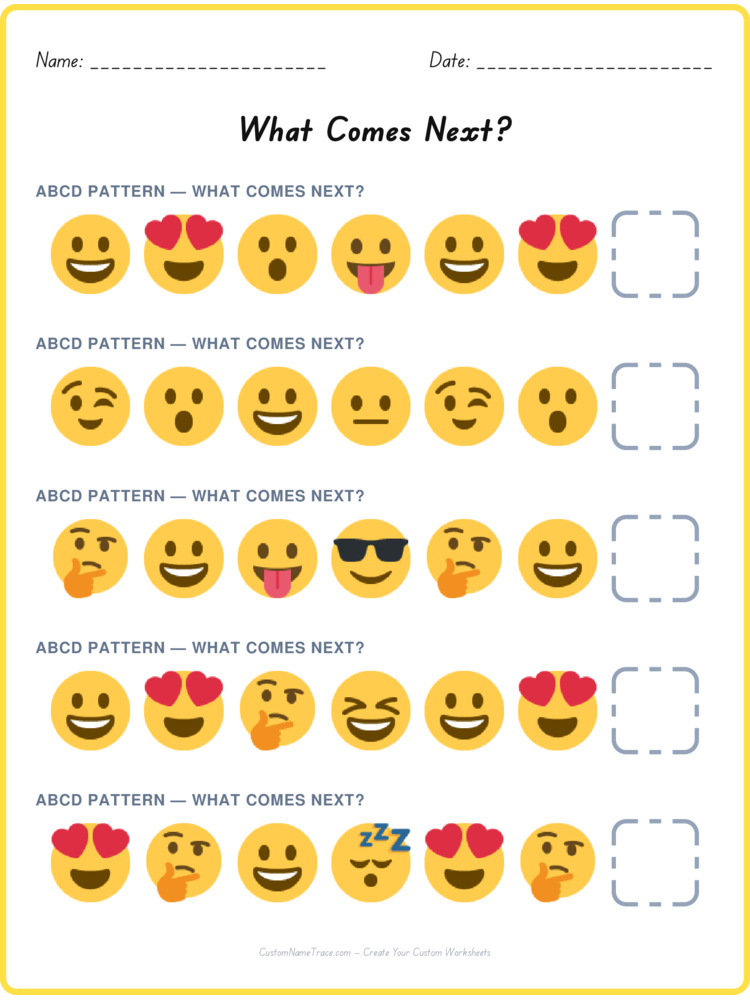
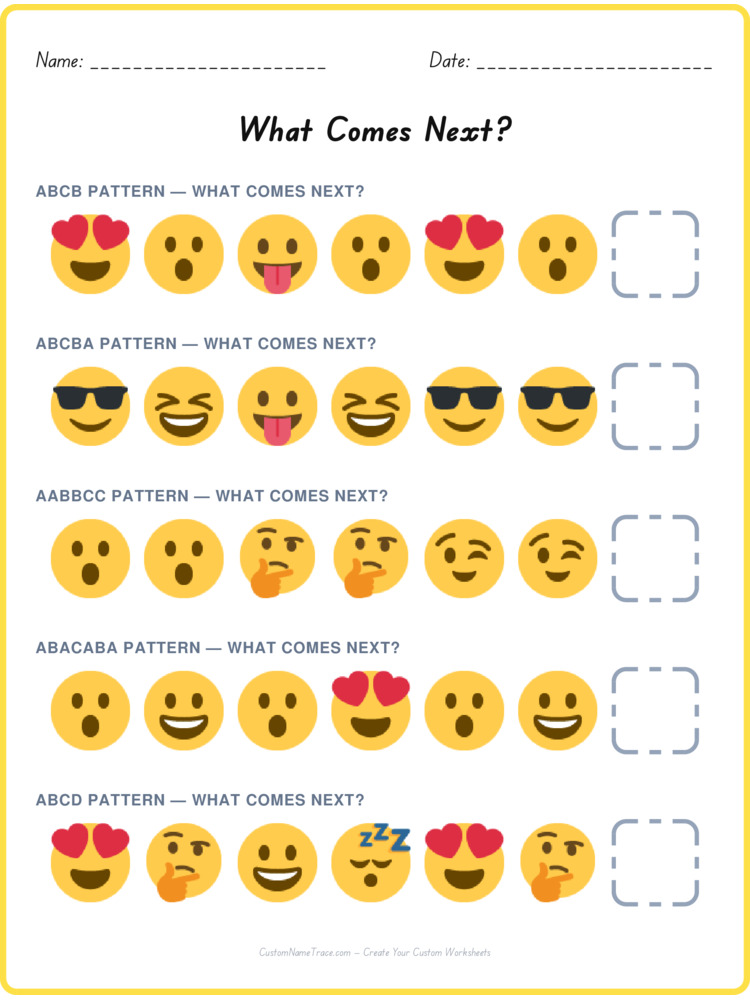
A teacher's guide to advanced emoji pattern bundles
The advanced pattern worksheets ask a child to do something that looks simple and is not: to read six icons, work out the rule that made them, and say what comes seventh. There are nineteen different rules in the gallery, from the plain alternation of AB to the seven-icon unit of ABACABA, and a mixed-review page that moves between them. Each rule feels different to a child, and each deserves a little time.
That is exactly what the advanced bundles are for. There are twenty of them, one for each pattern and one for mixed review, and each holds ten worksheets in a single PDF, in Letter and A4 sizes. This guide explains how the twenty are organized, which to take in what order, how to run ten pages of one pattern so that the thinking stays alive, and what to look for as a child moves through the families. For the ideas behind each pattern in depth, see the advanced patterns guide, and for the general use of bundles, see the emoji bundles guide.
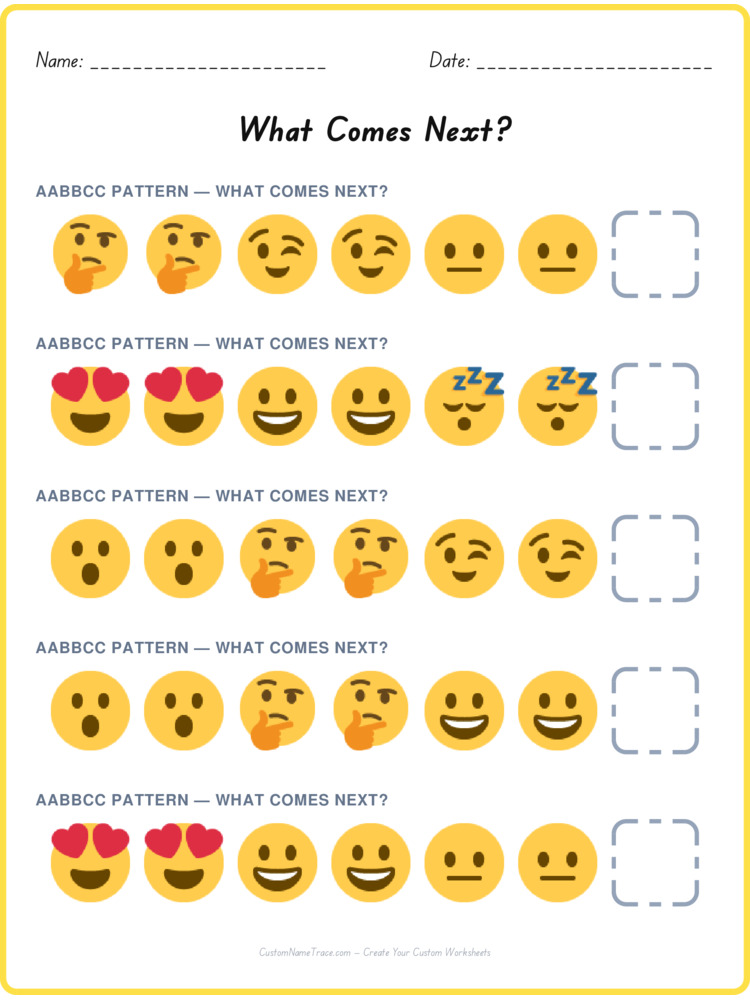
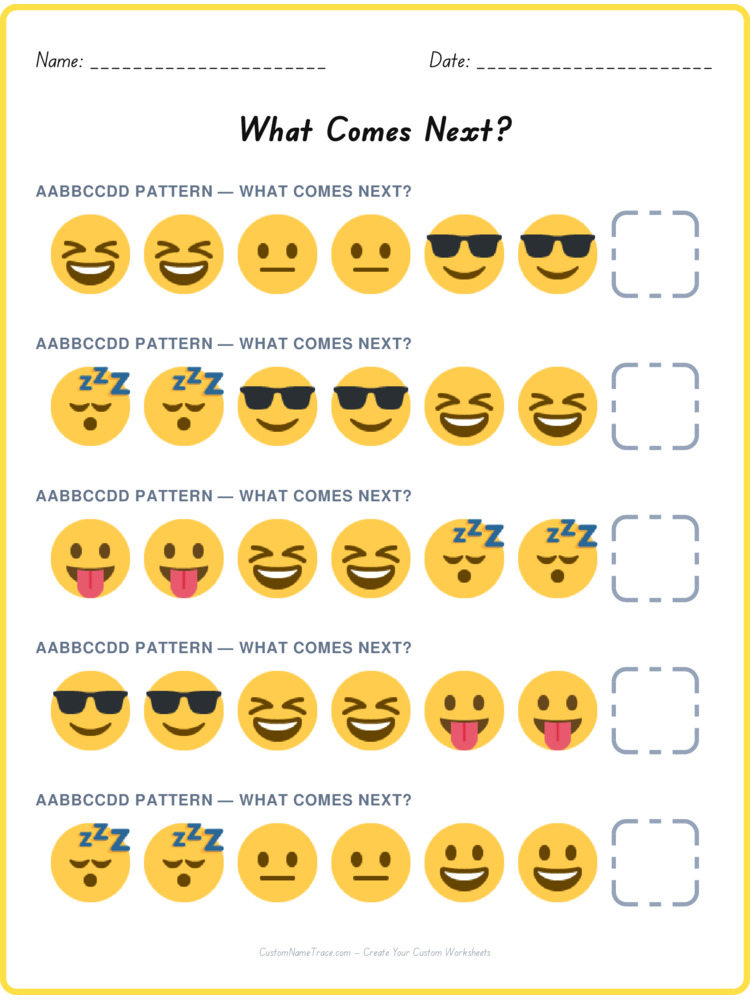
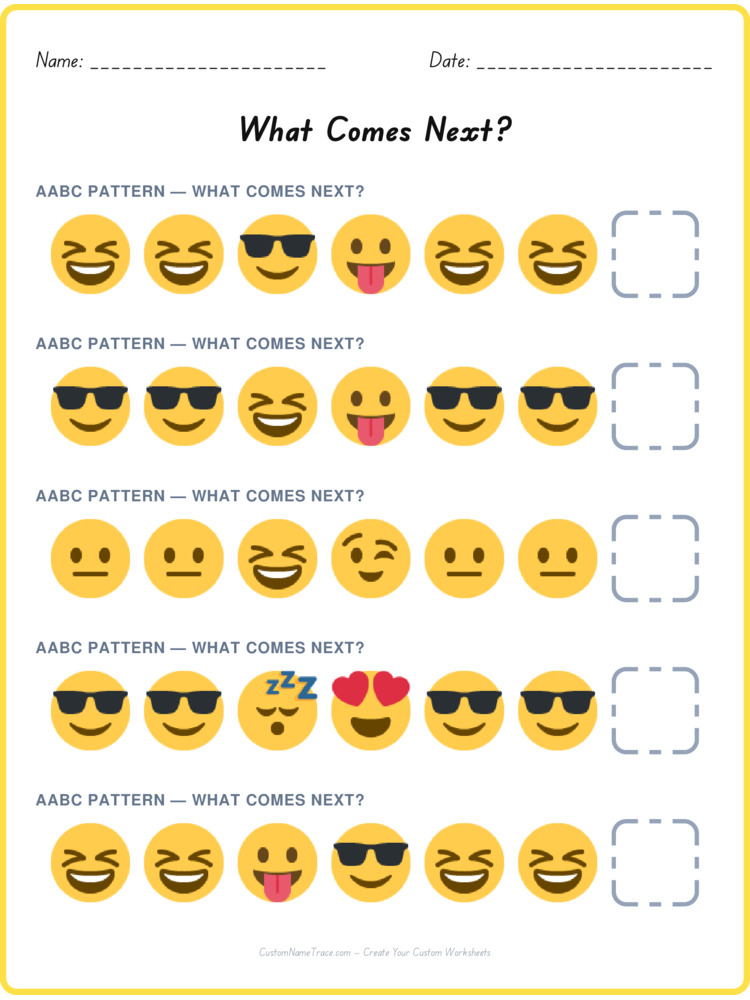
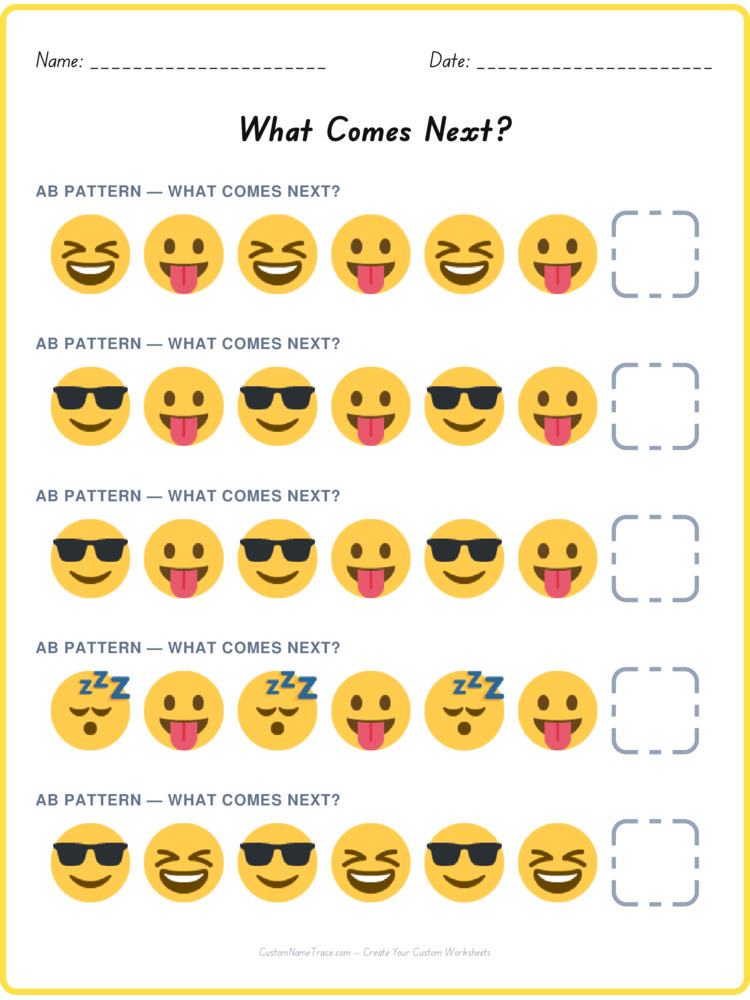
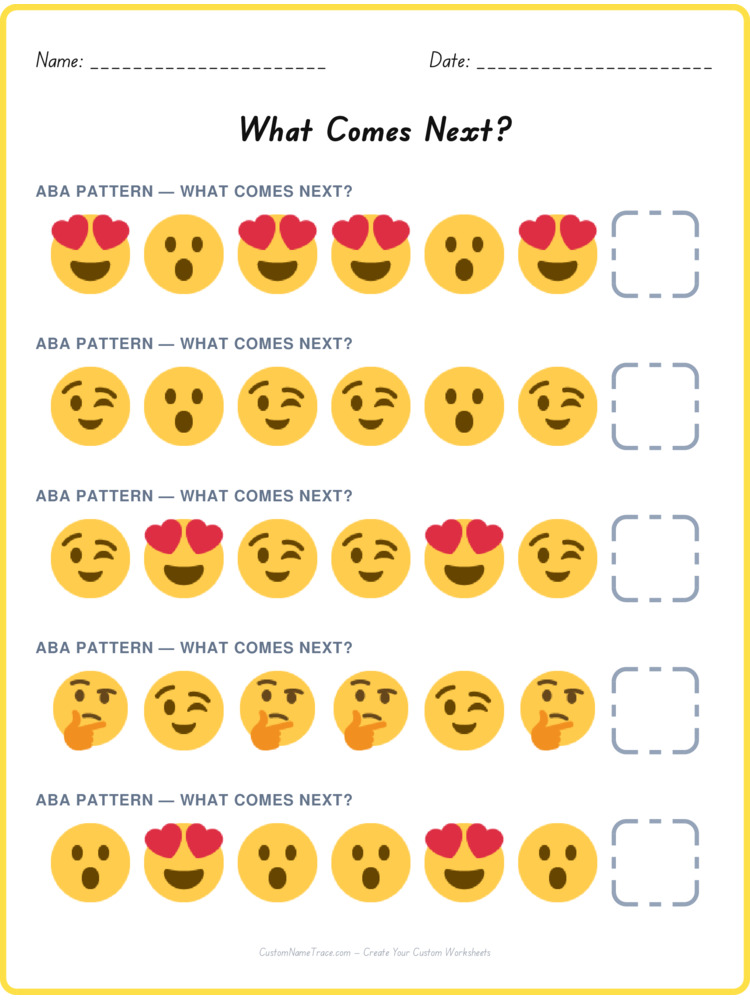
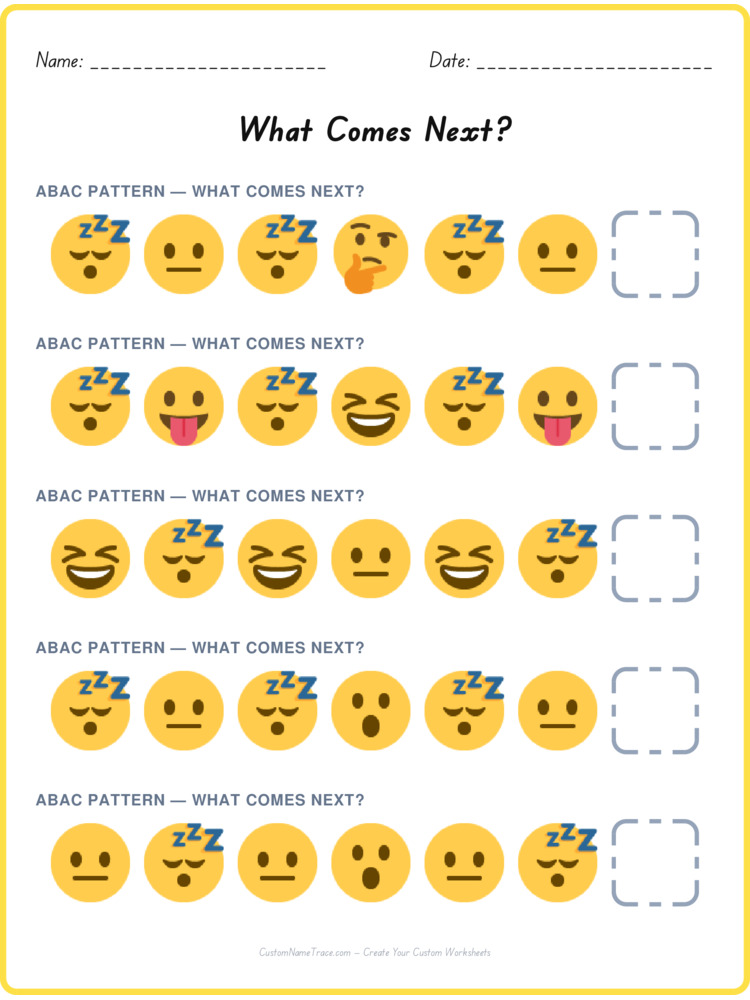
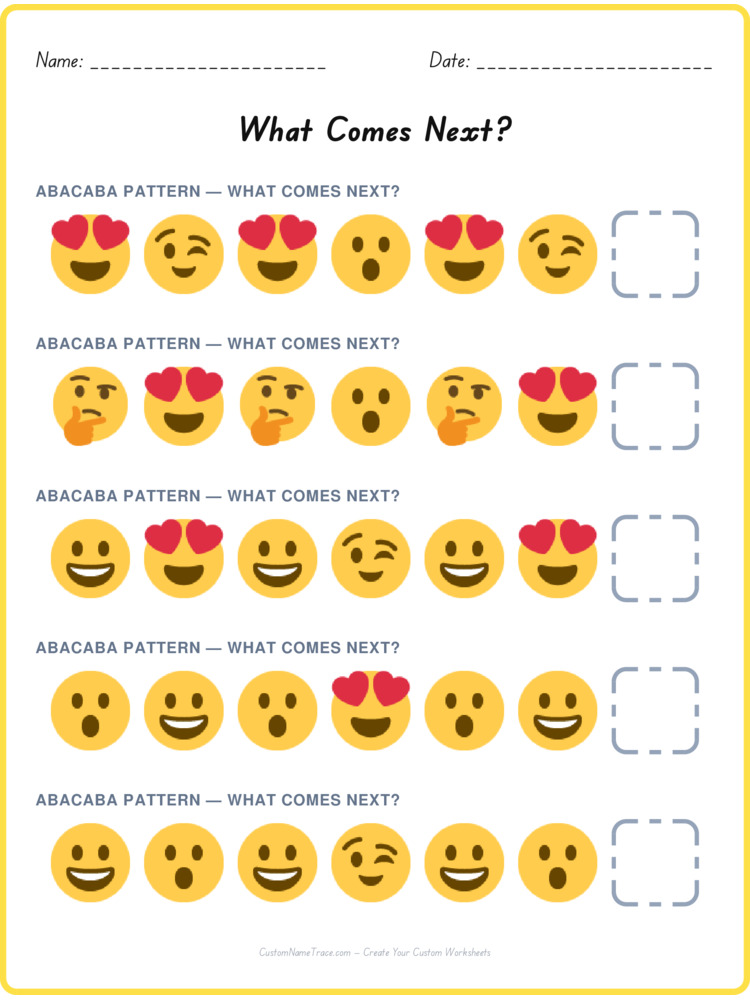
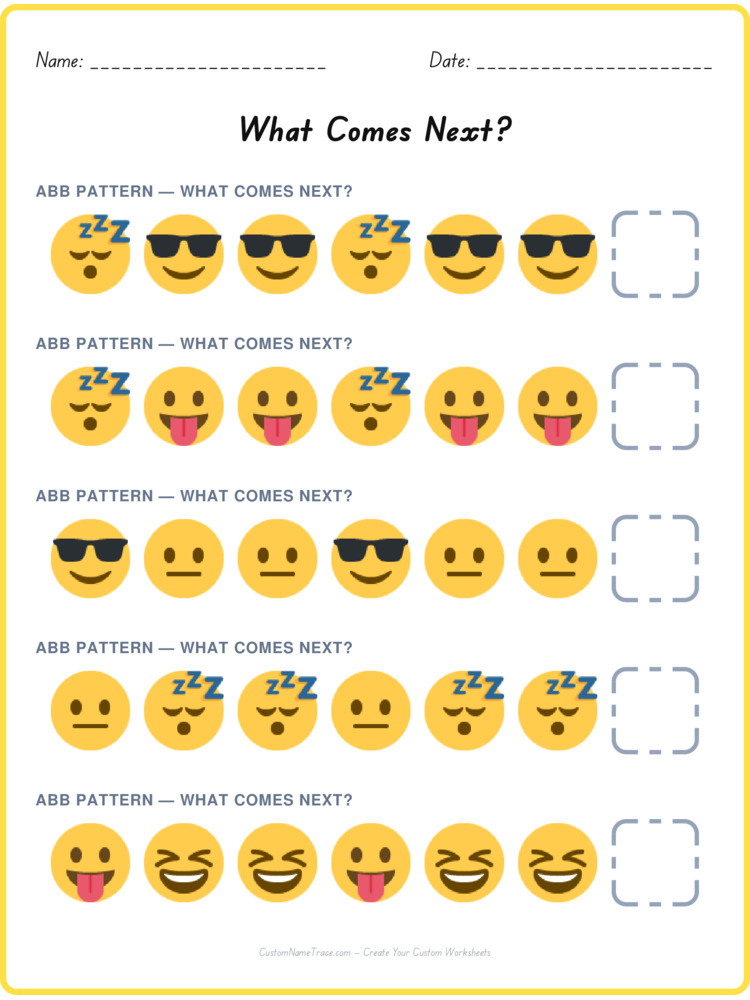
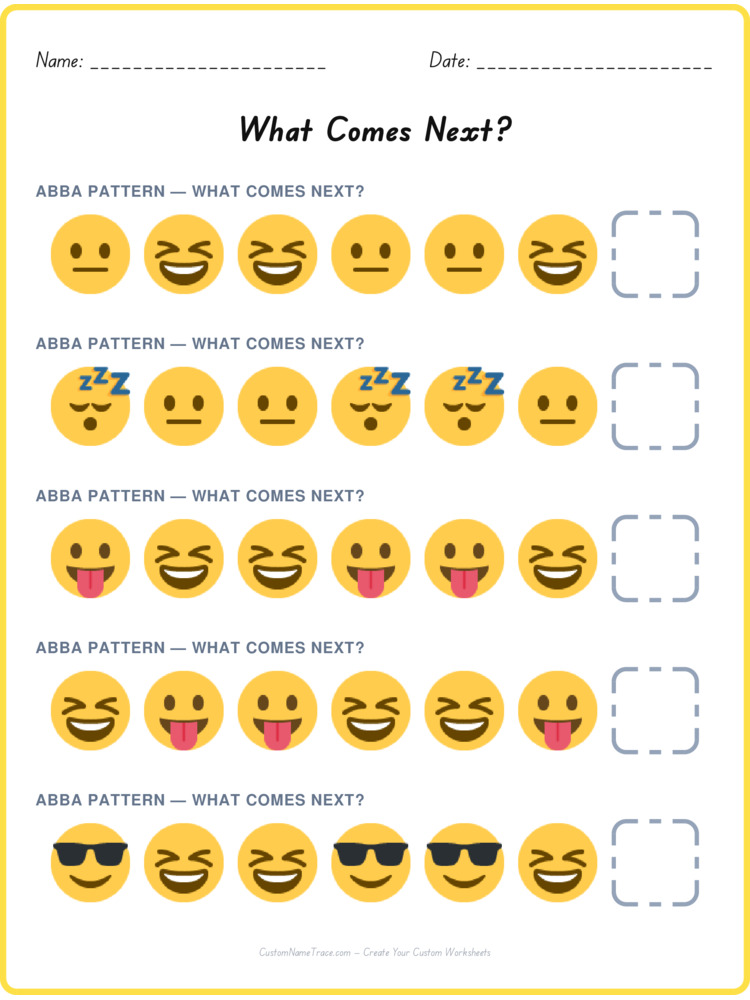
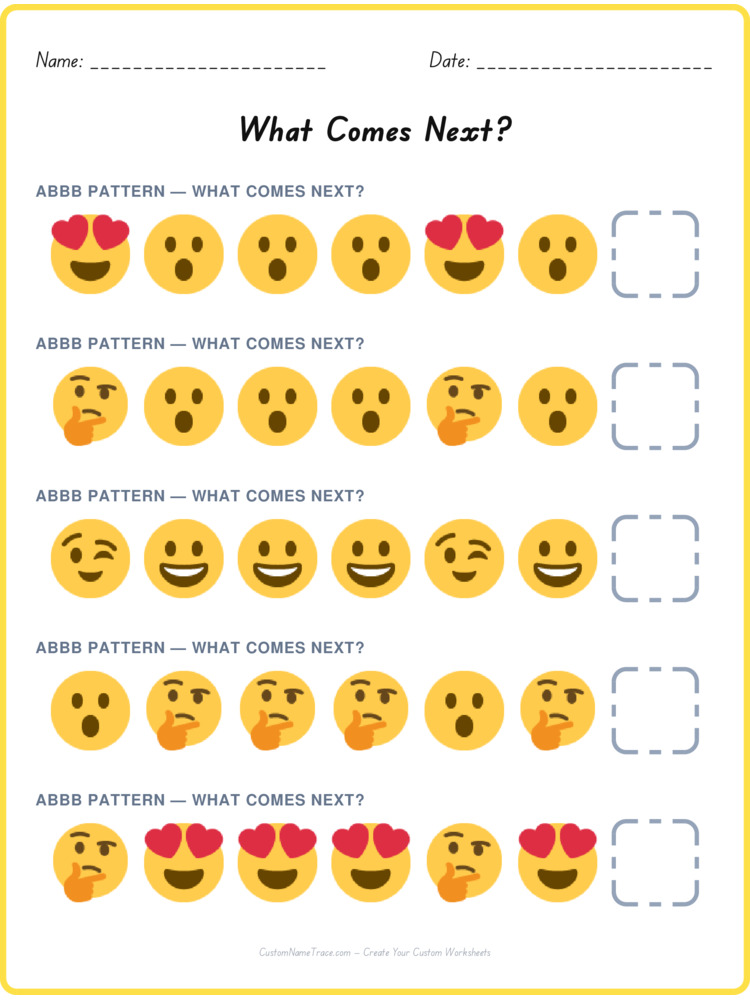
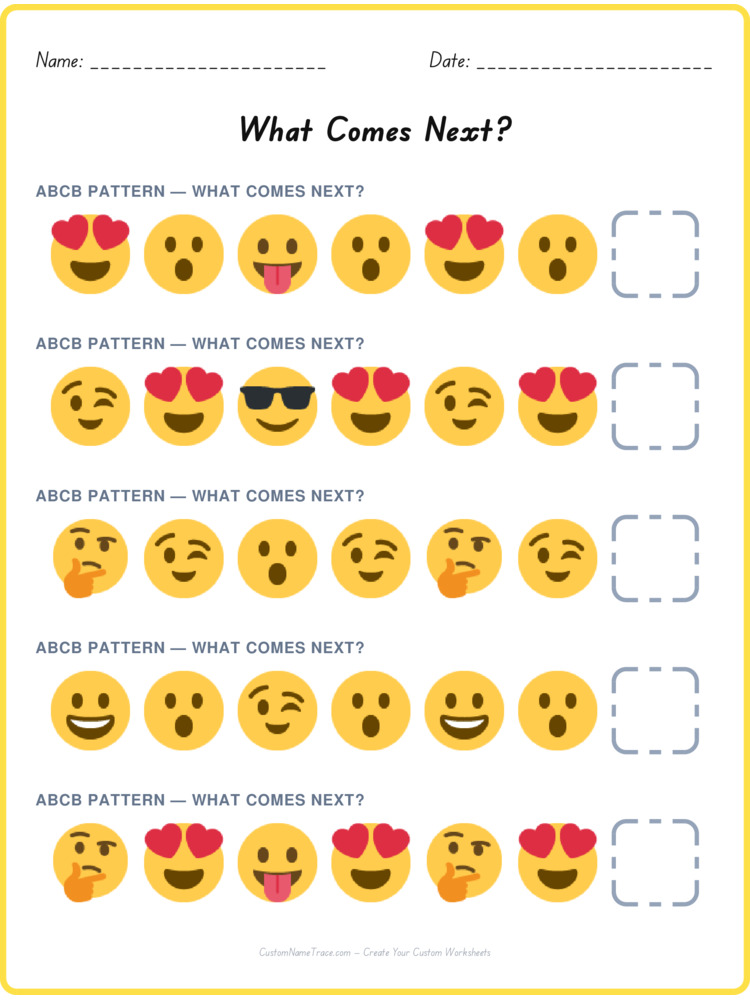
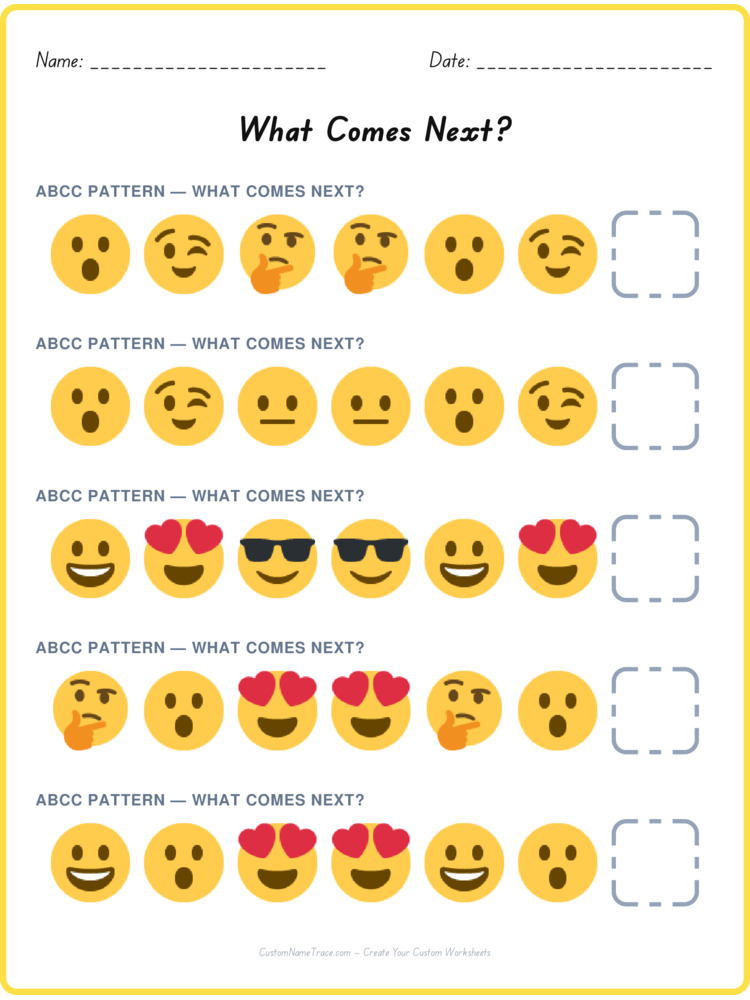
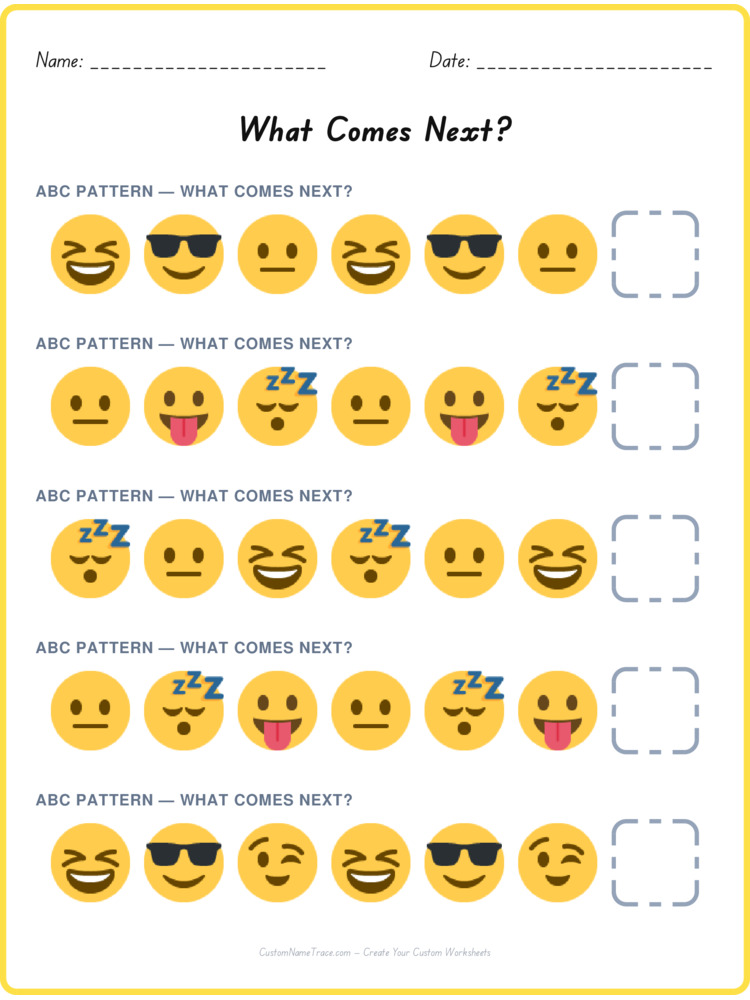 The cover of a bundle is its first page. This is the ABC bundle: five rows, six icons each, and a box for the seventh.
The twenty bundles
The bundles follow the same families as the worksheets themselves.
| Family |
Bundles |
What changes |
| Two icons, a repeating run |
AB, AAB, ABB, AABB, AAAB, ABBB |
The run length, and counting |
| Mirrors |
ABA, ABBA, AABBAA, ABCBA, ABACABA |
Symmetry |
| Three icons |
ABC, AABC, ABCC, ABAC, ABCB, AABBCC |
Holding three items in order |
| Four icons |
ABCD, AABBCCDD |
The longest memory load |
| Review |
Mixed |
Switching between rules |
That makes nineteen pattern bundles and one mixed bundle, or twenty bundles and two hundred pages. Each bundle is the first ten numbered worksheets for its pattern, and its page shows a previewer you can flip through before printing.
The labels on every row
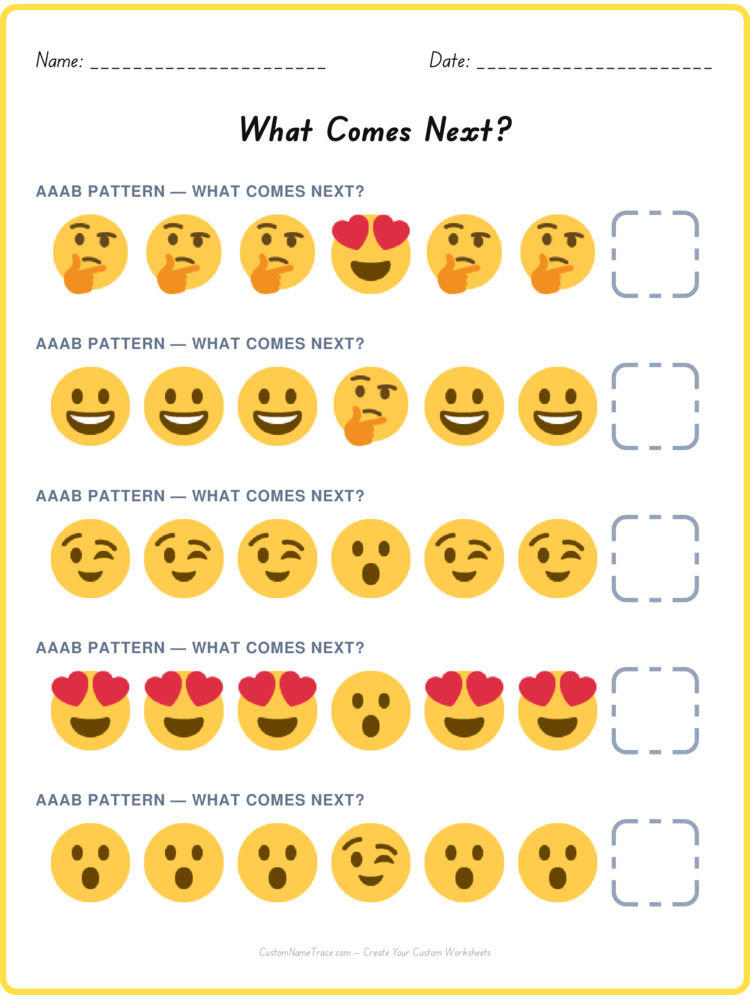
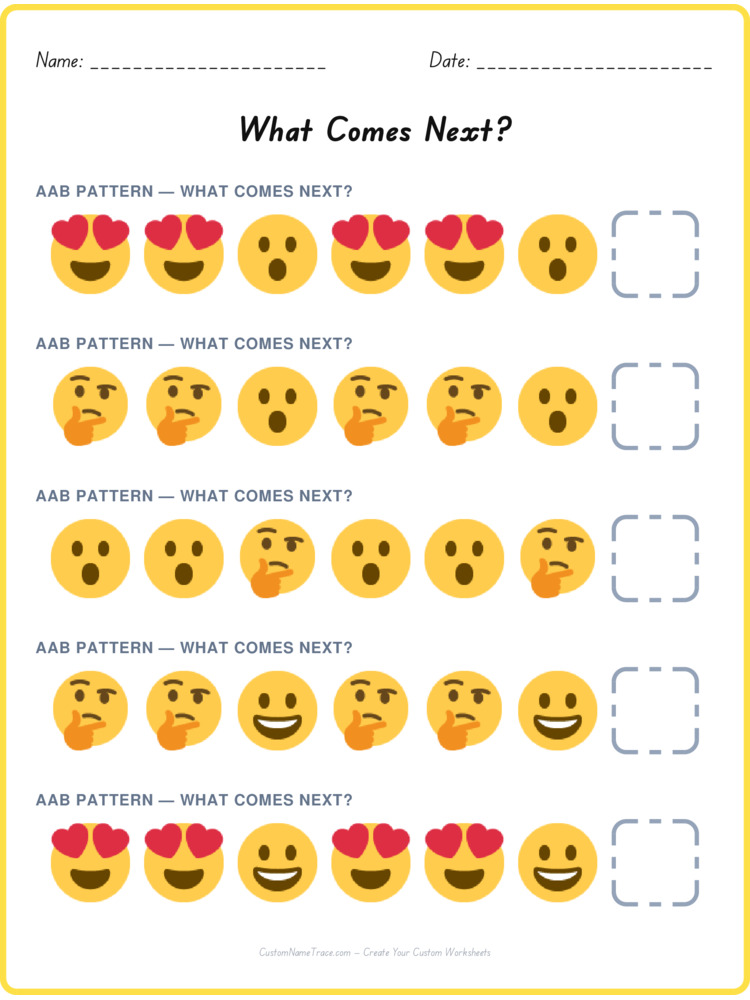
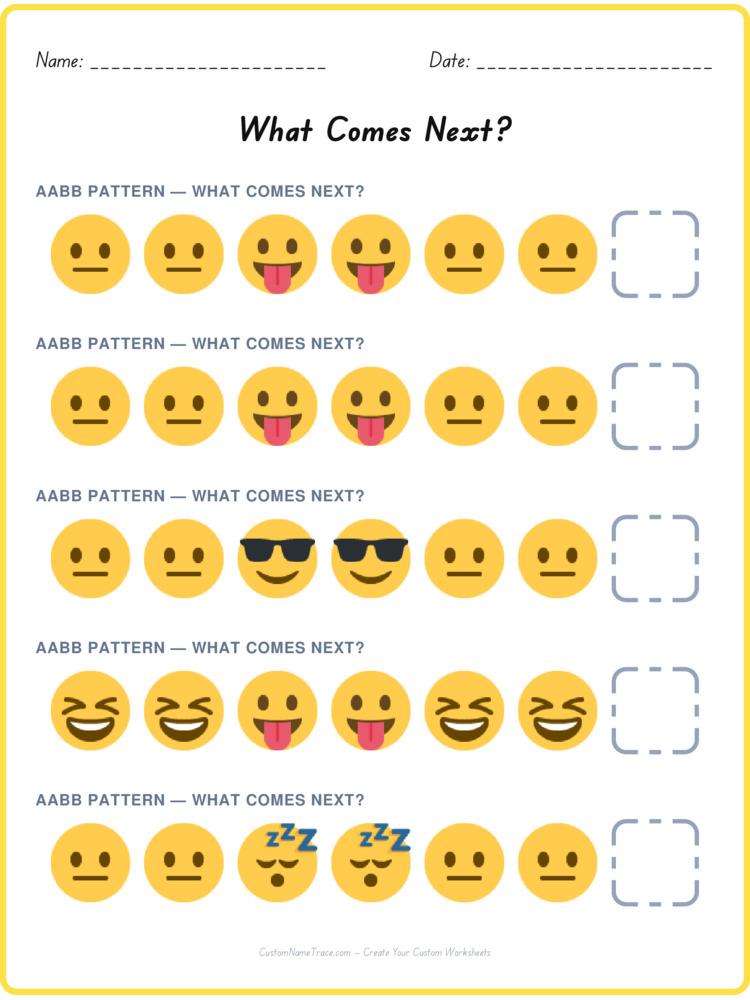
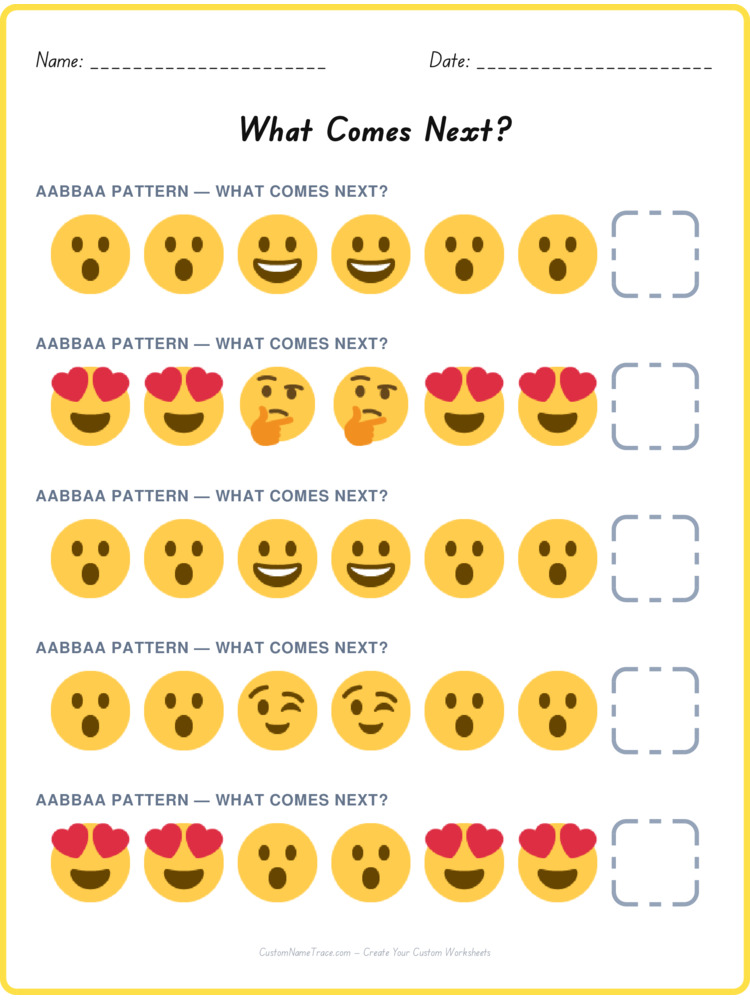
One feature of the advanced pages is worth understanding before you begin. Every row carries a label naming its pattern: "AAB pattern, what comes next?" That label does two jobs.
It supports the child. A long unit, such as ABACABA, is hard to infer from six icons alone. The label tells the child which rule to look for, so the puzzle becomes "does this fit?" and not "what is this?"
It teaches the vocabulary. A child who sees "ABC pattern" on every row of a page learns to call it that, and to link the name to the structure.
In a bundle, every row on every page has the same label, so the child sees the name fifty times. That is plenty of exposure.
Order of the bundles
There is no single correct order, but this one has a clear logic, and it keeps each step close to the one before.
- AB. The base case, and a gateway from the Beginner level.
- AAB, ABB. The first counting step. Do AAB, then ABB.
- ABA. A first mirror, and a bridge between families.
- AABB. Two runs, side by side.
- ABBA. A four-icon mirror.
- ABC. Three icons.
- AAAB, ABBB. Longer runs.
- AABC, ABCC, ABAC, ABCB. Three-icon units of four.
- ABCBA. A five-icon mirror.
- ABCD. Four icons.
- AABBAA, AABBCC. Six-icon units.
- ABACABA, AABBCCDD. The longest.
- Mixed. At several points, as a check.
At a rate of one bundle a week, the whole sequence takes about five months, with a good many weeks for games and review. At a rate of one a fortnight, a year. A class can pick up the pace or slow it down, and a child can skip bundles that feel easy.
Family 1: Two icons, a repeating run
The bundles. AB, AAB, ABB, AABB, AAAB, ABBB.
What changes. AB asks which icon comes next. AAB, ABB and the others ask how many of an icon have appeared before the switch. That is a counting task laid on top of identity tracking, and it is the first real jump in difficulty.
How to run a bundle in this family.
- Page 1: Do cold, and note whether the child counts the run.
- Pages 2 to 4: Say each row in rhythm. "Star, star, moon. Star, star, moon."
- Pages 5 to 7: Ask "how many stars before the moon?"
- Pages 8 and 9: Make a row with blocks first, then answer.
- Page 10: Do under the same conditions as page 1.
What to look for.
- Switching too early or too late. The child loses count of the run.
- Copying the last icon. They are not looking at the unit.
- Confusing AAB and ABB. Say "two then one" and "one then two."
A good page 10. The child answers quickly, and can say "two of one, then one of the other."
Family 2: Mirrors
The bundles. ABA, ABBA, AABBAA, ABCBA, ABACABA.
What changes. The unit reads the same forward and backward. The child can use symmetry to help find the missing icon: look at the other side of the center.
How to run a bundle in this family.
- Page 1: Do cold, and see whether the child uses symmetry.
- Pages 2 to 4: Point to the center of the unit, and compare each side.
- Pages 5 to 7: Draw an arc over each pair that matches, first with the last, second with the second to last.
- Pages 8 and 9: Look for mirrors in the room: a face, a butterfly, a window.
- Page 10: Do under the same conditions as page 1.
What to look for.
- Treating the pattern as a plain cycle, and ignoring the symmetry.
- Losing the center. In ABCBA and ABACABA, the center is one icon.
- Losing the repeat. After the unit ends, the next one begins again.
A good page 10. The child can say "it's a mirror, so the other side must match."
Family 3: Three icons
The bundles. ABC, AABC, ABCC, ABAC, ABCB, AABBCC.
What changes. Three distinct icons must be held in order, with no repeated icon to lean on in plain ABC. In the longer units, one or two icons repeat in different positions.
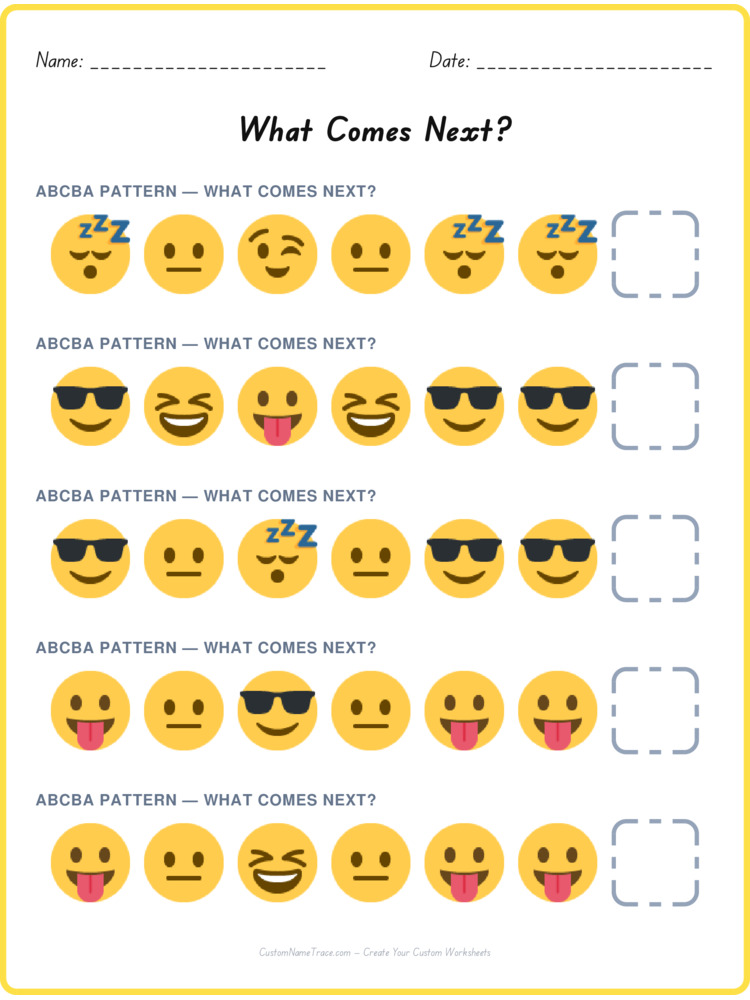 The cover of the ABCBA bundle. Each unit has five icons and reads the same forward and backward.
How to run a bundle in this family.
- Page 1: Do cold.
- Pages 2 to 4: Use three colors of blocks, and build each row first.
- Pages 5 to 7: Underline each unit, and chant it: "Triangle, square, moon."
- Pages 8 and 9: Translate into sound: clap, snap, stomp.
- Page 10: Do under the same conditions as page 1.
What to look for.
- Losing the order of three items.
- Mixing up similar units, such as ABAC and ABCB. Draw loops around each unit.
- Missing the repeat of a doubled icon in AABC and ABCC.
A good page 10. The child says the unit aloud without looking, and finds the missing icon at once.
Family 4: Four icons
The bundles. ABCD, AABBCCDD.
What changes. The memory load is greatest. A child has to hold four items, or four doubled items, in order.
How to run a bundle in this family.
- Page 1: Do cold, and be patient.
- Pages 2 to 4: Chunk the unit. For AABBCCDD, think of four pairs.
- Pages 5 to 7: Use four colors of block, and build the unit before answering.
- Pages 8 and 9: Ask the child to predict the tenth icon.
- Page 10: Do under the same conditions as page 1.
What to look for.
- Fatigue. These are demanding pages, and short sessions help.
- Losing the third or fourth icon.
- Over-reliance on the label.
A good page 10. The child works steadily and can explain the unit.
The mixed bundle
What is on the pages. Each row is a different pattern, named in its label. The child must recognize the rule row by row.
When to use it. After the child has worked through several of the single-pattern bundles, as a check.
How to run it.
- Page 1: Do cold.
- Pages 2 to 5: Ask the child to say the name of the pattern before solving.
- Pages 6 to 8: Let them lead.
- Pages 9 and 10: Do for fluency, compare with page 1.
What to look for.
- Switching errors. Carrying a rule from one row into the next.
- A particular pattern that always trips them. That tells you which bundle to revisit.
Six icons and a long unit
An interesting feature of the advanced pages is that every row shows exactly six icons, whatever the pattern. For a short unit, six icons show the unit two or three times. For a longer one, they show less than a full repeat.
| Pattern |
Unit length |
What six icons show |
| AB |
2 |
Three full units |
| AAB, ABB, ABA |
3 |
Two full units |
| AABB, AAAB, ABBB, ABBA, ABCD and the four-icon units |
4 |
One and a half units |
| ABCBA |
5 |
One unit and the start of the next |
| AABBAA, AABBCC |
6 |
Exactly one unit |
| ABACABA |
7 |
Almost the whole unit |
| AABBCCDD |
8 |
Three-quarters of the unit |
This table explains why the label matters so much. For ABC, six icons show the unit twice, and a child can see the rule from the evidence alone. For AABBCCDD, six icons show only AABBCC, and the child must know the pattern's name to see that DD comes next. The label turns an impossible guess into a reasoned step.
It also shows why the longer patterns are harder: the child has less evidence and more to remember. A teacher who knows this can explain why a child who sails through AB and AAB may stall at ABACABA, and can offer extra support, such as writing the full unit on a separate sheet.
A sample session with an AAB bundle
A session with a five-year-old, early in the bundle, on page 3.
- Minute 0 to 3. Build the pattern with blocks: red, red, blue, red, red, blue. "What comes next?" Let the child place a red block. "Why red?" "Because it goes two reds and a blue."
- Minute 3 to 5. Look at the page. Read the label of the first row together: "AAB pattern." "What does AAB mean? Two of the same, then a different one."
- Minute 5 to 9. Do the first two rows. For each, point to each icon and chant the unit before answering.
- Minute 9 to 11. Ask, "How did you know?" Listen for "two hearts, then a face."
- Minute 11 to 13. Do the third row alone.
- Minute 13 to 15. Make a new AAB pattern with blocks for someone else to continue.
This session uses three modes: hands, voice and page. A child who has worked in all three has a much stronger grip on the pattern than one who has only filled in boxes.
A sample session with an ABCBA bundle
A session with a six-year-old, on page 6.
- Minute 0 to 3. Build the unit with five blocks: red, blue, green, blue, red. "Look at it. Is there anything special?" Guide the child to see that it reads the same from either end. "It's a mirror."
- Minute 3 to 5. Point to the center. "This is the middle. What is next to it on each side?" Both blue.
- Minute 5 to 9. Look at the first row of the page. Draw an arc from the first icon to the fifth, and from the second to the fourth. "Do they match?"
- Minute 9 to 12. Find the missing icon. Remember that the unit repeats: after the fifth comes the first again. The sixth icon matches the first, and the seventh matches the second.
- Minute 12 to 15. Do another row, and ask the child to explain.
The arcs are a very useful device. They turn a vague feeling of "symmetry" into something that can be checked.
A fortnight-by-fortnight plan
A teacher or parent who wants a structure could use the following. It runs about sixteen fortnights, with a break when needed.
| Fortnight |
Bundle |
Focus |
| 1 |
AB |
The base case, labels, saying the rule |
| 2 |
AAB |
Counting a run of two |
| 3 |
ABB |
The same, with the repeat second |
| 4 |
ABA |
A first mirror |
| 5 |
AABB |
Two runs |
| 6 |
ABC |
Three icons |
| 7 |
ABBA |
A four-icon mirror |
| 8 |
AABC and ABCC |
Doubled icons in three-icon units |
| 9 |
ABAC and ABCB |
The trickier three-icon units |
| 10 |
ABCBA |
A five-icon mirror |
| 11 |
Mixed |
A first check |
| 12 |
ABCD |
Four icons |
| 13 |
AAAB and ABBB |
Longer runs |
| 14 |
AABBAA and AABBCC |
Six-icon units |
| 15 |
ABACABA and AABBCCDD |
The longest |
| 16 |
Mixed |
A final check |
That is about thirty-two weeks, a school year, with room for holidays. A faster class can double up, and a slower one can linger.
Creating after the bundle
After working through a bundle, a child is ready to make their own pages. This is a much harder task than solving one, and it is a delight. Here is how to guide it.
- Choose the pattern. "Let's make an AAB page."
- Choose the icons. Draw stars and moons, or stick stickers.
- Draw five rows. In each, put six icons and leave a box for the seventh.
- Write the label. "AAB pattern, what comes next?"
- Check the answer. Does the pattern work?
- Swap with a friend.
A child who can create a page has fully understood the pattern, because they have had to think of the structure first and then decorate it. Many children are proud of these pages, and a stack of them makes a lovely class book.
A pattern portfolio
A teacher or parent can collect finished bundle pages into a small portfolio. It does not need to be elaborate: a folder, with the first and last page of each bundle, with dates. After a term, the folder shows the child's journey through the families.
- Page 1 and page 10 of each bundle, side by side.
- The child's own created pages.
- A short note, in the child's words or an adult's, about what was learned. "I learned that ABBA is a mirror."
- A photo of a block pattern, a bead bracelet or a clapping game.
A portfolio is a pleasure to look through, and a good thing to share with families.
Linking patterns to number
At some point, pattern work shades into number work, and the advanced bundles are a good moment to make the link.
- ABC as multiples of three. In a long run of ABC, the third, sixth and ninth icons are always C. That is the multiples of three.
- AB as odd and even. The A icons are in the odd positions, the B in the even.
- AAB and the position of B. B is in positions 3, 6, 9. Again, multiples of three.
- ABCD and multiples of four. D is in positions 4, 8, 12.
- Mirrors and symmetry in number. 12321 reads the same forward and backward.
A child who sees that "the twelfth icon in an AAB pattern is B because 12 is a multiple of 3" has made a connection between patterns and multiplication that is genuinely mathematical. The skip counting pages and the number pattern puzzles pick up that thread.
A record of progress
A simple record across bundles helps. A grid with the twenty patterns down the side and three columns, "Started," "Secure" and "Needs another look," shows at a glance where a child is. A tick in each column, with a date, is enough.
Over a term, the grid fills in, and the child can see a growing list of patterns they have mastered. For many children, that is as motivating as a sticker chart.
For teachers
- Differentiate by giving different children different bundles on the same day.
- Centers. A bundle, blocks and a partner.
- Whole class. Display a row on the board, and ask the class to find the rule.
- Assessment. Pages 1 and 10 of any bundle give a before and after.
- Enrichment. Ask a quick child to create a mixed page for a friend.
- Link to music and art. Patterns appear in rhythm and design.
For parents
- Start small. One bundle, one page at a time.
- Say the pattern aloud.
- Ask for the rule.
- Use real things. Spoons, buttons and blocks.
- Celebrate each finished bundle. A sticker or a small treat.
Questions that come up
Do I have to do all twenty? No. Choose what suits the child.
My child skips straight to the hard ones. That is fine if they succeed. If they struggle, go back.
The labels give away the answer. They name the rule, but the child still has to apply it. They also teach the vocabulary.
Can I mix bundles in one week? Yes. Two patterns on alternate days is a good pattern of its own.
What if my child gets bored? Move on, or ask them to create their own.
What comes next? Number patterns, skip counting and the logic puzzles. See the Grade 1 and Grade 2 guides.
Twenty bundles, two hundred pages, nineteen rules. A child who has worked through them has learned to see structure in a stream of pictures, and that is a skill that is useful far beyond any worksheet.