A teacher's guide to Grade 3 math bundles
Third grade asks a child to do two big things at the same time. The first is to extend addition and subtraction to three digits, with carries and borrows that can ripple across more than one column. The second is to learn the whole multiplication table, and its reverse, division, until the facts come without effort. Both reward steady, spaced practice, and both are easier to manage when the practice is chunked into sets with a clear purpose.
This page gathers the five Grade 3 math bundles. Each is ten worksheets for one skill, packaged as a single PDF in Letter and A4 sizes. This guide explains what is in each bundle, what to teach before and during it, how to run ten pages with real purpose, which mistakes to expect, and how the five fit across a term. For the thinking behind the skills, including strategies for the multiplication table, see the Grade 3 math guide. Here, the focus is on using the bundles.
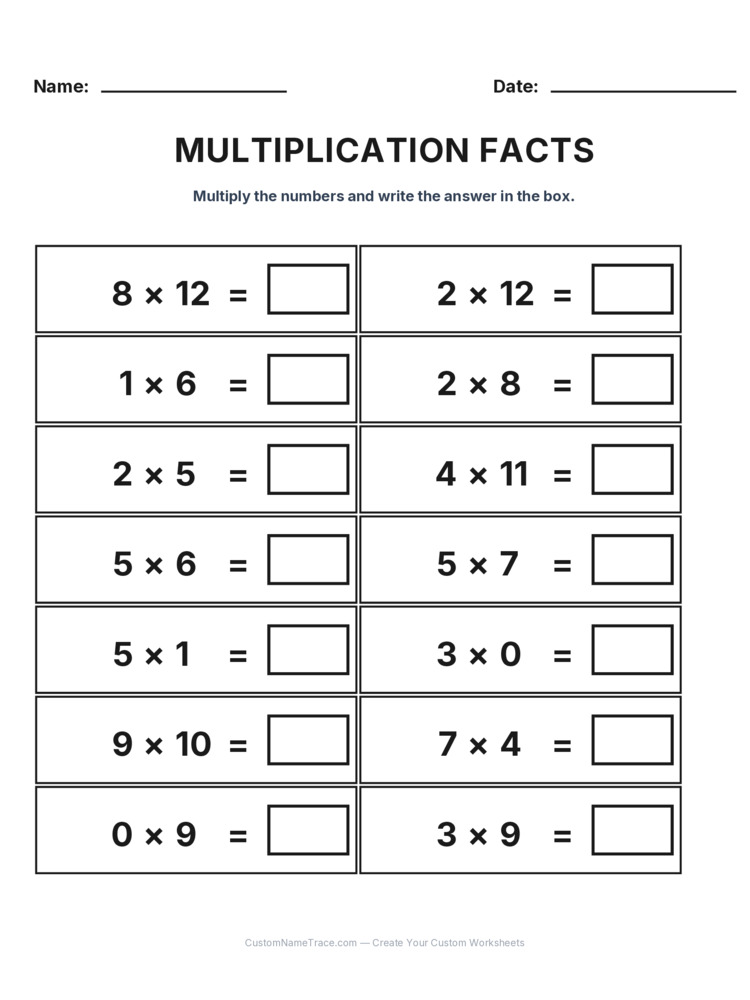 A bundle cover shows its first page. This is Grade 3 Multiplication Facts 0 to 12: fourteen facts, and ten pages in the bundle.
The five bundles
Each bundle is the first ten worksheets of its skill. The blank multiplication chart, a single reusable page, does not have its own bundle, but it is a fine companion: print several copies and use one a week.
A suggested order
The multiplication bundle is, for most children, the longest-running work of the year. The three-digit bundles can be fitted around it. One sensible order:
- Addition, regrouping. Extends the Grade 2 carry to three digits.
- Subtraction, regrouping. The harder partner, with zeros.
- Multiplication, facts 0 to 12. Taught family by family, revisited for several weeks.
- Division, basic facts. After most of the multiplication facts are known.
- Mixed review. Throughout, as a check on the earlier skills.
At one bundle a fortnight, the five fit comfortably into ten weeks. But the multiplication bundle can be run slowly and returned to many times. Ten pages of the 0 to 12 table, spread across a term, with games between, is often more effective than ten pages in two weeks.
Bundle 1: Addition, regrouping
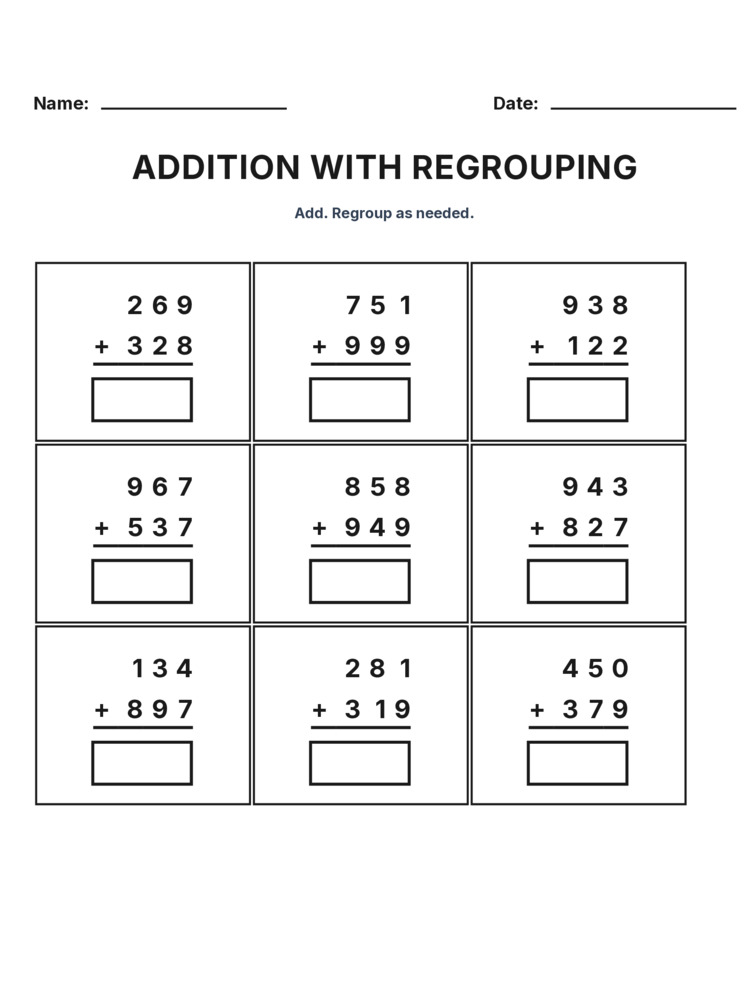
What is on the pages. Nine stacked three-digit problems per page, arranged in a three-by-three grid, each with a box for the answer. The title states the skill: "Addition with regrouping."
Before you start. The child should be secure with two-digit regrouping, and understand place value to hundreds.
How to run the ten pages.
- Page 1: Do cold. Note whether the child carries from ones to tens and from tens to hundreds.
- Pages 2 to 3: Teach with an example, such as 269 + 328 (ones make 17, so write 7 and carry a ten, then tens make 9, hundreds make 5, for 597). Do one together, then two alone.
- Pages 4 to 6: Include problems where the hundreds carry into a thousand, such as 751 + 999.
- Pages 7 to 9: Estimate first. Ask: "About how big should the answer be?"
- Page 10: Do under the same conditions as page 1.
What to look for.
- A lost carry. The child carries from the ones but forgets to add it to the tens.
- A carry written in the wrong place.
- A missing thousands digit. In 751 + 999, the child writes 750 instead of 1,750.
- Careless alignment.
What a good page 10 looks like. The child carries across two columns correctly, writes the thousands digit when needed, and can check with an estimate.
Bundle 2: Subtraction, regrouping
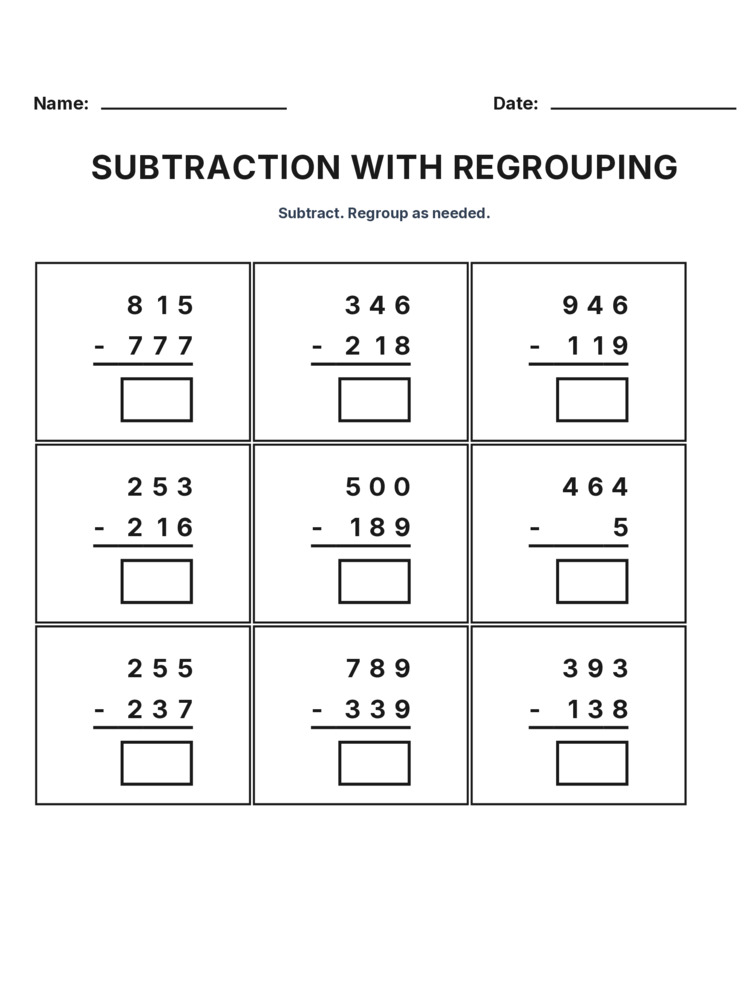
What is on the pages. Nine stacked three-digit problems per page. Each needs a borrow, and some require borrowing across a zero.
Why it is the hardest of the three-digit bundles. The case of a zero in the middle, as in 503 − 267, requires the child to borrow from the hundreds in two steps. Many adults still find it fiddly.
How to run the ten pages.
- Page 1: Do cold, and note where the child gets stuck.
- Pages 2 to 3: Teach with place value blocks, if possible. Build 432, and take away 178.
- Pages 4 to 6: Introduce the zero cases. Use blocks to trade a hundred for ten tens, and a ten for ten ones.
- Pages 7 to 9: Teach "count up" as a second method and as a check. For 503 − 267, count from 267 to 300, to 500, to 503.
- Page 10: Do under the same conditions as page 1.
What to look for.
- Subtracting the smaller from the larger, column by column.
- Borrowing from a zero. The child writes 10 − 1 = 9, but forgets to reduce the hundreds.
- Partial borrowing. The child borrows once but not twice.
- No checking. Adding back would catch most errors.
What a good page 10 looks like. The child handles a zero in the middle, and checks the answer by adding.
Bundle 3: Mixed review
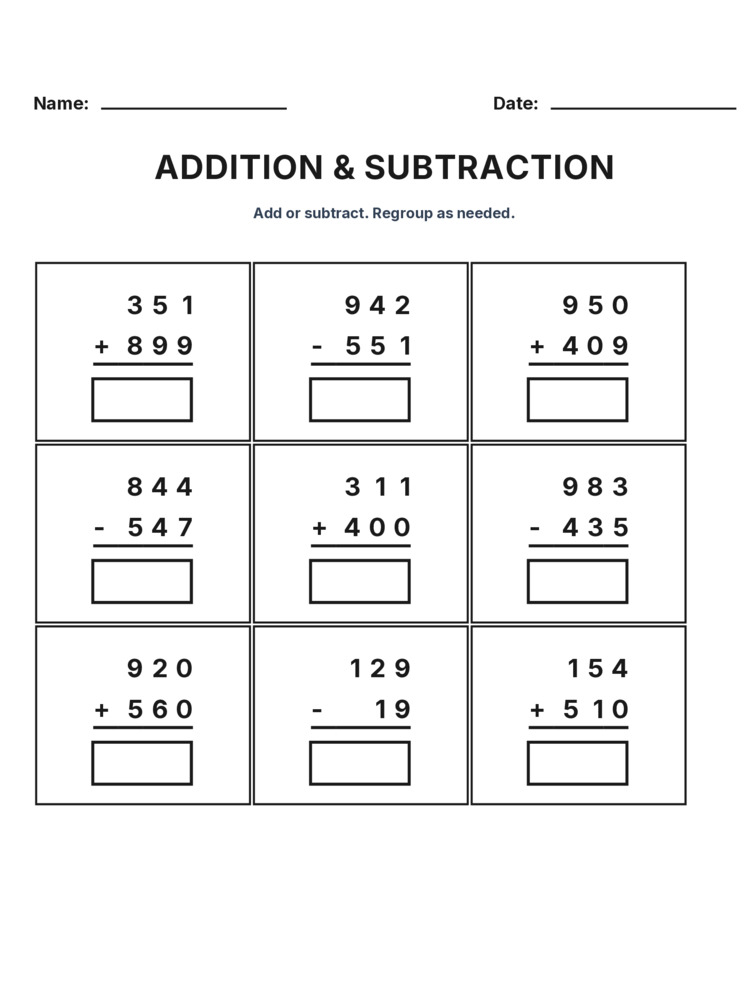
What is on the pages. Addition and subtraction on the same page, three-digit, with regrouping where needed.
How to run the ten pages.
- Page 1: Do cold. Watch for operation slips.
- Pages 2 to 5: Circle the sign and decide whether regrouping is needed before solving.
- Pages 6 to 8: Let the child lead, with an estimate before each.
- Pages 9 and 10: Do quickly, with page 1 as the comparison.
What to look for.
- Operation slips.
- Over-regrouping. Borrowing when it is not needed.
- Under-regrouping. Missing a needed carry or borrow.
- Estimation habits. Does the child check that the answer is the right size?
What a good page 10 looks like. The child works accurately across both operations, and checks with an estimate.
Bundle 4: Multiplication, facts 0 to 12
What is on the pages. Fourteen horizontal facts per page, in two columns, drawn from the whole table from 0 × 0 to 12 × 12. The sample page includes facts such as 8 × 12, 4 × 11, 9 × 10 and 3 × 0.
Why it needs special handling. A bundle of ten pages cannot teach the table by itself. The table is learned over weeks, through patterns, strategies and games. The bundle is for practicing what has been taught, and for showing which facts are secure.
How to run the ten pages. A good approach is to use the bundle across a long stretch, with teaching between.
- Page 1: Do cold, at the very start. This shows the child's starting point.
- Pages 2 to 4: After teaching the easy families (0, 1, 2, 5, 10), do a page. Mark the facts the child knows instantly, and those they work out.
- Pages 5 to 7: After the 3s, 4s, 9s and 11s, do another page.
- Pages 8 to 9: After the 6s, 7s, 8s and 12s.
- Page 10: Do at the end, and compare with page 1.
Between pages, play games and fill in the blank multiplication chart.
What to look for.
- Which facts are slow? Mark them in a different color. Those are the "hard facts."
- Adding instead of multiplying.
- Zero and one errors.
- Reliance on skip counting, which is fine early on but slow in the long run.
- Patterns in errors. Is it always the 7s? The 8s?
What a good page 10 looks like. Most facts are answered in a few seconds, with a handful of "hard facts" still being worked out. That is a good place to be at this stage.
Bundle 5: Division, basic facts
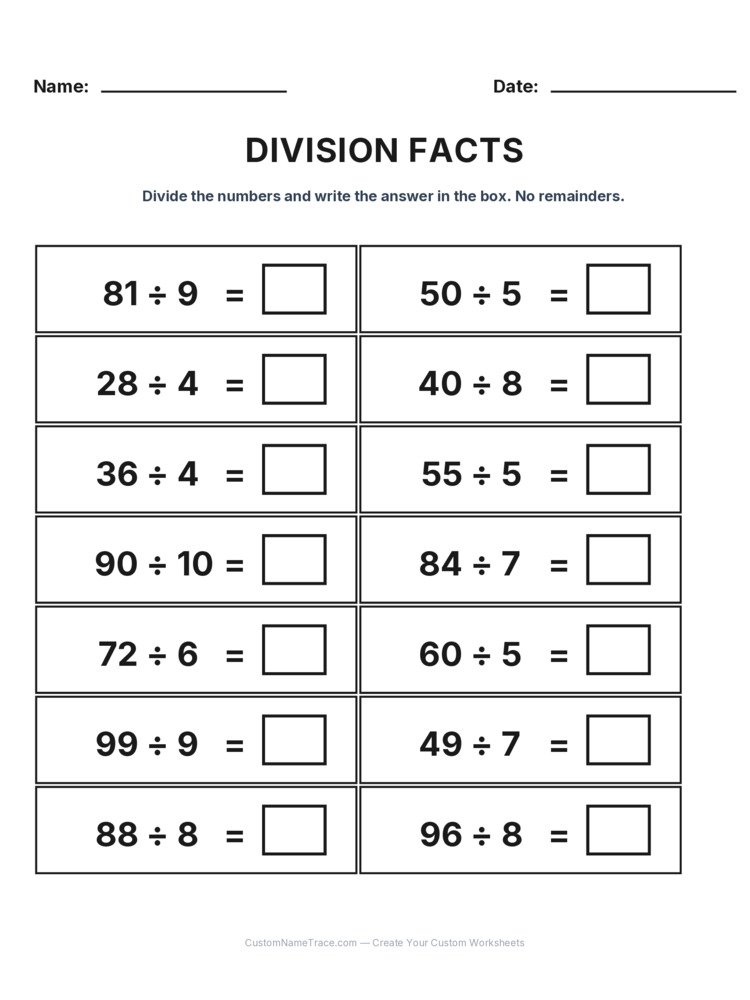
What is on the pages. Fourteen horizontal division facts per page, with no remainders, such as 81 ÷ 9 and 99 ÷ 9.
Before you start. Most of the multiplication facts should be reasonably known. Division is multiplication in reverse, and a child who does not know the table has nothing to reverse.
How to run the ten pages.
- Page 1: Do cold, and notice whether the child uses multiplication to answer.
- Pages 2 to 4: Teach "think multiplication." For 72 ÷ 6, ask "6 times what is 72?"
- Pages 5 to 7: Practice with fact families: 6 × 12 = 72, 12 × 6 = 72, 72 ÷ 6 = 12, 72 ÷ 12 = 6.
- Pages 8 and 9: Mix with word problems.
- Page 10: Do under the same conditions as page 1.
What to look for.
- Multiplying instead of dividing.
- Dividing the wrong way round, such as 9 ÷ 81.
- Not using multiplication. A child who tries to divide by repeated subtraction is working too hard.
- Zero and one rules.
What a good page 10 looks like. The child answers division facts by recalling the matching multiplication fact.
A ten-week unit
| Weeks |
Bundle |
Focus |
| 1 and 2 |
Addition, regrouping |
Three-digit carries |
| 3 and 4 |
Subtraction, regrouping |
Borrowing, zeros, checking |
| 5 to 8 |
Multiplication, facts 0 to 12 |
Family by family, with games |
| 9 |
Division, basic facts |
Think multiplication |
| 10 |
Mixed review |
A check on everything |
A class might run the multiplication bundle across the whole term in the background, with one page a week, while the other bundles take their turn.
Building a personal "hard facts" list
The most valuable by-product of the multiplication bundle is not a score but a list. After each page, ask the child to circle the facts that took more than a few seconds, or that they got wrong. Copy these onto a card. After three or four pages, the same few facts will keep turning up, and that short list is what the child actually needs to work on.
For most children the list is small, and it has a familiar look: 6 × 7, 6 × 8, 7 × 8, 7 × 9, 8 × 9, 6 × 9, 12 × 7, 12 × 8. That is a handful of facts, not a hundred and sixty-nine.
Here is how to attack the list.
- Pick two or three facts a week. No more.
- Say the story. "Seven eights. Seven groups of eight. That's 7 × 5 plus 7 × 3, which is 35 plus 21, which is 56."
- Put it on a card. The fact on the front, the answer on the back.
- Practice for two minutes a day. Quick, relaxed, and stopping while the child is still keen.
- Test at the end of the week. The child tries the three facts from memory.
- Move the learned facts off the list, and add new ones.
Within six weeks, a child can learn most of the hard facts this way, and the bundle's later pages will show it.
A script for the first multiplication session
A sample first session with the Multiplication Facts bundle, with an eight-year-old. It uses about fifteen minutes.
- Set the scene (1 minute). "We're going to find out which multiplication facts you already know. Don't worry about the ones you don't. That's what the next few weeks are for."
- Page 1 (6 minutes). Let the child do as many of the fourteen as they can, without help. Note which are quick and which are slow.
- Mark (2 minutes). Together, put a tick by the facts the child knew at once, a dot by those they worked out, and a cross by those they skipped or got wrong.
- Talk (3 minutes). "Which family looks easiest? The tens? The twos?" Start with those.
- Teach one thing (2 minutes). Show how to find 9 × 10 or 5 × 6, whichever is on the page.
- Close (1 minute). "Next time we'll do a little more. Look how many ticks you've got already."
Notice that nothing here feels like a test. It is a map, and a first look at where the child is.
Interleaving the facts bundles
Multiplication and division are best learned together, and a bundle makes it easy to alternate. A good weekly rhythm:
- Monday: a multiplication page.
- Wednesday: a division page, using the same facts.
- Friday: a mixed-review page of three-digit addition and subtraction, to keep the earlier skills fresh.
Over a term, a child sees each skill regularly, and no skill is forgotten while another is being learned. This weekly rhythm also gives a family or class a calm structure.
Estimating to catch big errors
Three-digit arithmetic gives plenty of room for slips, and a habit of estimating catches most of them before they reach the page.
- Round each number to the nearest hundred. 269 + 328 is about 300 + 300 = 600.
- Compare the answer. 597 is close to 600. Good.
- For subtraction, 432 − 178 is about 400 − 200 = 200. The answer, 254, is in the right neighborhood.
- For multiplication, 8 × 12 is about 8 × 10 = 80, so the answer should be a bit more. 96 fits.
- For division, 72 ÷ 6: how many sixes in 60? Ten. So the answer is a bit more. 12 fits.
A child who estimates is checking their own work, and a child who checks their own work is far less dependent on an adult's red pen.
Bundles for the summer before Grade 4
A child heading into fourth grade has a long break in which the multiplication facts can fade. A small, regular plan helps.
- One multiplication page a week, with the hard facts circled.
- One division page every second week.
- Games on the road, such as skip counting or "the nines trick."
- A mixed-review page every two weeks.
- A look at the first Grade 4 topics in the last week: fractions, and multi-digit multiplication.
Twenty minutes a week keeps most of the learning in place, and a child who arrives in September with the facts at their fingertips is well placed for the year.
A classroom routine for the table
For a teacher, here is a way to use a facts bundle across a whole class without turning it into a drill.
- Monday: introduce a family, with arrays and skip counting.
- Tuesday: a game with the family.
- Wednesday: a page from the bundle, on a few chosen facts.
- Thursday: an oral round, with division facts from the same family.
- Friday: a quick quiz, ungraded, to see who knows what.
Children get exposure to each family in several forms, and the page is only one of them.
Spaced practice for the table
The multiplication table is the best example of something that is learned by spacing. A child who sees a fact once a day for ten days remembers it better than one who sees it ten times in one day. A bundle makes this easy.
- Print the bundle, and keep it in a folder.
- Do one page a week, for ten weeks.
- Between pages, do short games and oral practice.
- After each page, circle the facts the child had to work out.
- At the start of each session, quickly review the circled facts.
By the end of ten weeks, the circled facts will have shrunk, and the child will know the table in a way that no crammed week could achieve.
Reading ten pages
A tracker with a row per page, and columns for score, time, method and mistake type, is useful for every bundle. For the facts bundles, add a column for the facts that took a long time. That list is the child's personal study list.
Compare pages 1, 5 and 10. If the score rises and the working time falls, the skill is growing. If the same facts keep appearing in the "slow" column, focus on them: draw an array, use the distributive trick, or make a flash card.
Pairing Grade 3 bundles with other pages
For teachers
- Differentiate. Some children need the addition bundle, others the division.
- Centers. A bundle, a deck of cards and a partner.
- Fact fluency routines. A page a week, with oral drills.
- Assessment. Pages 1 and 10 as a pre and post.
- Homework. A page a week, with a game.
For parents
- Short and often. Ten minutes a day.
- Use patterns. The nines, the elevens, the squares.
- Play card and dice games.
- Look at the slow facts. They are the list to work on.
- Be patient. The table takes a term, or longer.
Questions that come up
Should my child memorize the table before doing the bundle? No. The bundle is part of how they learn it. Teach a family, then do a page.
My child gets the facts right but slowly. That is common. Practice the slow ones, and use games.
My child is stuck on the 7s and 8s. That is typical. Use the distributive trick: 7 × 8 is 7 × 5 plus 7 × 3.
Do I need to print all ten pages at once? No. Print a few at a time, or all at once, whichever works.
Is there an answer key? Check the file you download. Working a few problems yourself, or using a calculator, is a good check.
What comes after Grade 3? Larger multiplication, long division and fractions, which are Grade 4 topics.
A Grade 3 bundle is ten pages of focused practice, and the best bundles are the ones used slowly, with teaching, games and patience. A child who works through all five will have done fifty pages of well-chosen practice, and will have the foundation for the arithmetic of the years that follow.