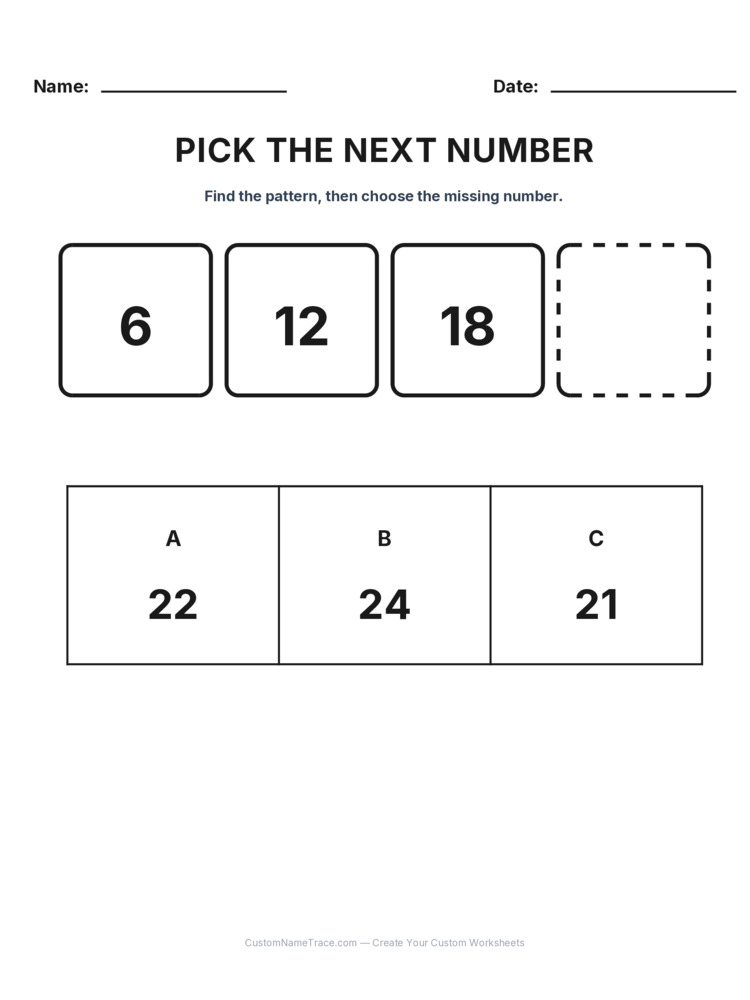
The same reasoning, a different answer format
Number Pattern uses the identical skip-counting and arithmetic-sequence reasoning as this site's Growing Sequence worksheets, but instead of leaving a blank to fill in, it shows three lettered answer options (A, B, C) and asks a child to pick the correct one. That shift from producing an answer to selecting one sounds small but changes the task in a real way — recognition and production draw on related but distinct skills, and a child who's confident writing in a missing number isn't automatically as confident picking the right one out of plausible-looking alternatives.
The two incorrect choices on this worksheet aren't arbitrary numbers — they're built from common mistakes a child genuinely makes at this stage. One distractor is typically the previous value repeated (a "forgot to add anything" answer), and the other uses a slightly wrong step size (an "added the wrong amount" answer). That means picking correctly requires actually confirming the rule against the sequence, not just choosing the number that looks roughly right — a careless glance is genuinely more likely to land on a wrong option here than on an obviously silly one.
The correct answer isn't always option A, or always in the same position across worksheets — which lettered slot holds the right answer varies from puzzle to puzzle, deliberately, so a child can't shortcut the exercise by learning a positional pattern instead of genuinely checking the sequence each time. That variation is invisible unless a child is specifically looking for it, but it's part of why working through several different numbered variants gives a more honest picture of real skill than judging from just one page.
A strategy that beats guessing
The most reliable approach is to ignore the three answer options entirely at first, work out what the next number should be independently, and only then check which lettered option matches. Looking at the options before working out the rule tempts a child into picking whichever one "looks right" rather than actually confirming it — and because the distractors are deliberately plausible, that shortcut fails more often on this worksheet than it would on an easier multiple-choice puzzle.
A specific, teachable habit worth reinforcing directly: read all three lettered options before selecting one, even after spotting what looks like the right answer in option A. Because the distractors are deliberately plausible, a child who stops reading as soon as one option looks correct sometimes misses that a later option is the genuinely better match — training the habit of scanning every choice before committing pays off well beyond this specific worksheet.
If a child seems to favor answer A (or B, or C) regardless of the actual sequence, that's worth checking directly — some children develop a habit of picking a "lucky" letter rather than genuinely evaluating each option, especially if that letter happened to be correct a few times in a row by chance. Mixing up which letter holds the correct answer is already handled automatically since every variant generates its own random arrangement, so a repeated same-letter pattern in a child's answers, rather than in the puzzles themselves, is the signal to address directly by asking them to justify that specific pick out loud.
What a wrong pick usually reveals
Choosing the "repeated value" distractor usually means a child stopped tracking the pattern and defaulted to the last number they saw. Choosing the "wrong step size" distractor usually means they noticed the numbers were increasing but didn't check by exactly how much each time. Naming which kind of mistake it was, rather than just marking it wrong, helps a child recognize the same trap the next time it shows up.
After a child picks an answer, correct or not, asking them to explain in one sentence why each of the other two options is wrong builds a habit that plain right/wrong feedback never does — actively ruling out plausible alternatives, rather than just confirming a hit. That explaining-the-rejects habit is precisely what distinguishes a confident test-taker from a lucky guesser on any future multiple-choice assessment, well beyond this specific worksheet.
Games and connections
With two children (or a parent and a child) working the same page, each person picks an answer independently and then compares before checking — disagreement is a natural, low-pressure prompt to talk through the reasoning together rather than one person simply being told they're wrong. That peer or parent-child discussion format tends to surface a specific sticking point (missed the step size, defaulted to the repeated number) faster than working alone and checking against an answer key.
A child who alternates between this worksheet and its Growing Sequence counterpart practices the identical underlying rule-finding skill from two directions — producing an answer from scratch versus selecting it among distractors — and getting comfortable with both forms matters, since real-world math and test questions show up in either shape unpredictably. Neither format alone fully prepares a child for both; working both regularly does.
Why this format matters
The number range and how close the distractors sit to the correct answer are both matched to Grade 1's level — not a flat difficulty setting reused everywhere, but a real match to what a child at this stage should be able to reason through with focused effort, not by guessing. As grade level increases elsewhere on this site, this same format returns with a wider range and closer, more convincing wrong answers, deepening the same skill rather than introducing a new one.
Distinguishing a correct answer from a close, plausible-looking wrong one is its own genuine skill, separate from generating an answer from scratch — and it's the exact skill standardized tests and later multiple-choice math problems depend on. Practicing it now, in a low-stakes worksheet format with numbers a child can actually reason through, builds a habit (verify before selecting, don't just pick what looks right) that pays off well beyond this specific puzzle type.
Because this worksheet mirrors the exact structure of a standardized multiple-choice math question — a stem, three plausible answers, one correct — regular practice with it builds general comfort with that format itself, separate from the specific number-pattern skill involved. A child who's used to reasoning carefully through plausible wrong answers here tends to approach any future multiple-choice test with the same habit, rather than treating it as an unfamiliar format under time pressure.
Because every numbered variant tests the identical underlying skill with fresh numbers, keeping a simple informal tally of how many a child gets right on the first try, session over session, gives a clearer picture of real progress than judging any single worksheet in isolation. A child who's slowly moving from needing to work out every option carefully toward confidently spotting the pattern at a glance is making exactly the progress this format is designed to build, even if any one individual page still takes real effort.
Behind the scenes, each puzzle's correct answer is calculated first from the actual sequence rule, and only then are the two distractors generated from it — one by repeating the previous number, one by applying a plausible but wrong step size — rather than three numbers being picked arbitrarily and one declared correct after the fact. That order matters: it guarantees the correct answer is always genuinely, mathematically right for the stated pattern, and that both wrong answers are realistic enough to actually test whether the rule was checked properly rather than being obviously silly filler.
Every numbered variant generates a fresh sequence and a fresh set of distractors testing the same Grade 1-level skill, so repeat practice always means a genuinely new pattern to work out rather than a memorized answer. This same format exists at other grade levels on this site too, with ranges and distractor difficulty matched to each one.
A teacher's guide to Grade 1 "Pick the Next Number" puzzles
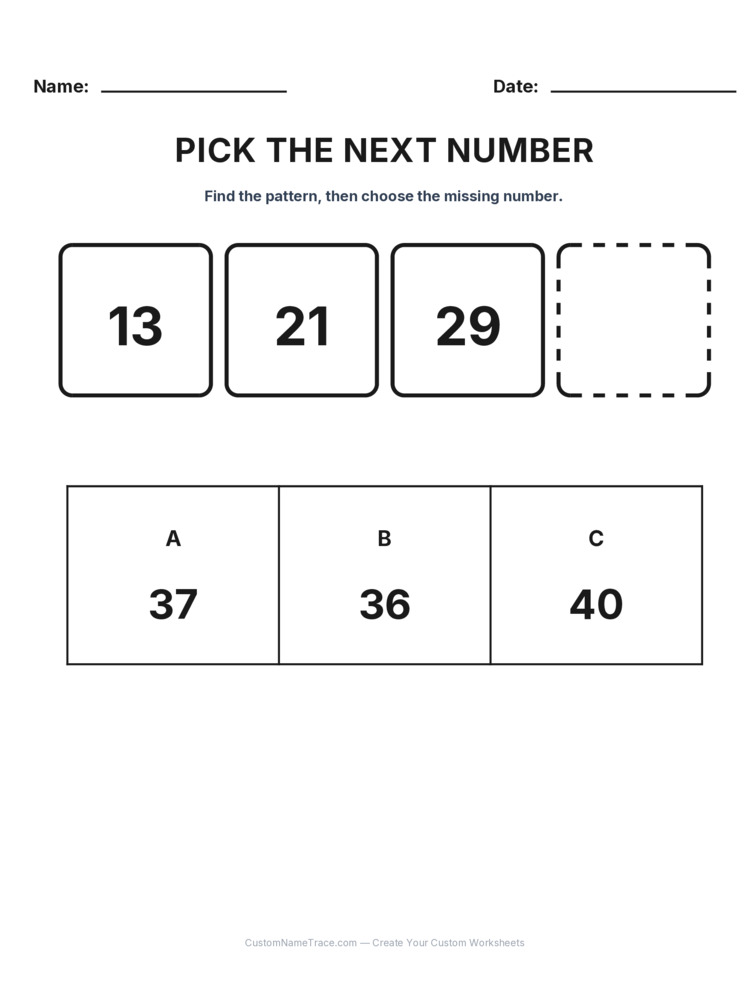
Show a six-year-old the numbers 13, 21 and 29, and ask what comes next, and you will see several different kinds of thinking. One child will look at the last number and say "thirty," because thirty is the number after twenty-nine. Another will count on by ones until they run out of patience. A third will pause, look from 13 to 21, and say, "It goes up by eight." That third child has found the rule, and the rule is the whole point.
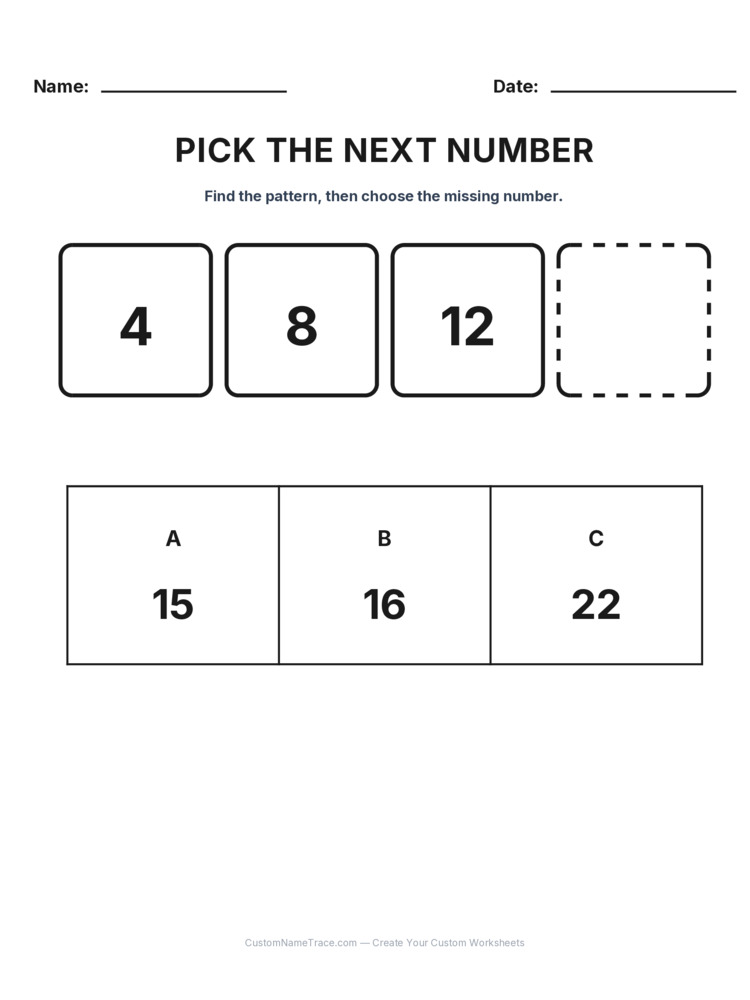
The Grade 1 Pick the Next Number puzzle is built to encourage that third kind of thinking. Each page shows three numbers in a pattern, a blank, and three choices: A, B and C. The child decides which choice belongs. It is a small, tidy puzzle, and it holds a good deal of teaching inside it. This guide explains how the puzzle is built, what each of the wrong answers is designed to reveal, how to teach a child to find the step, and how to turn a page of multiple choice into real mathematical thinking.
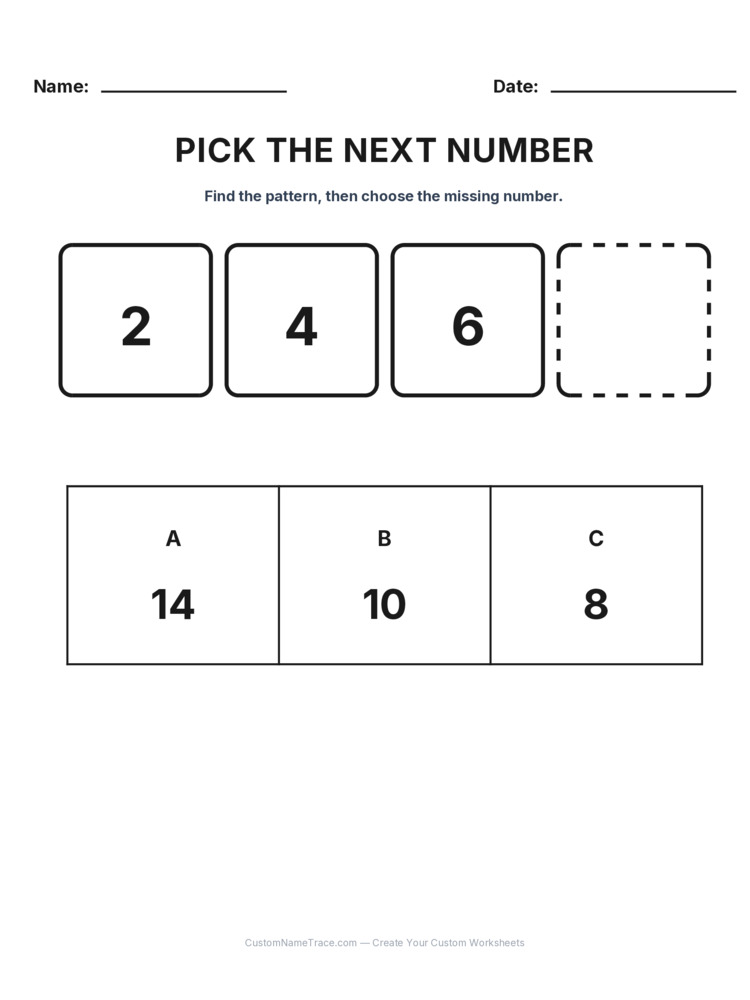
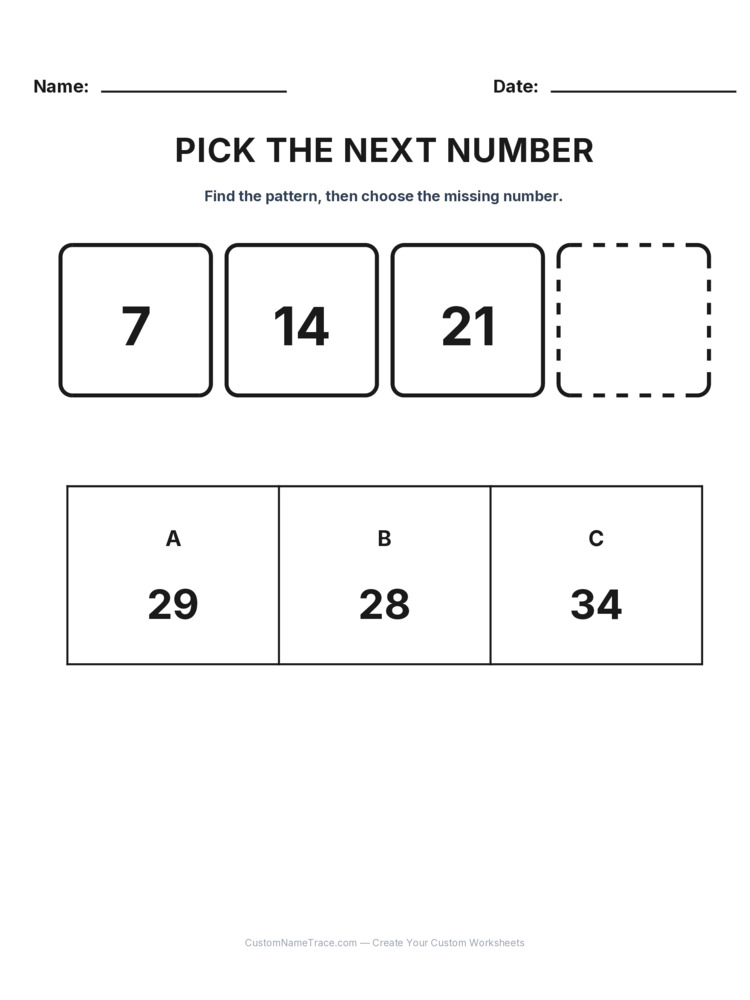
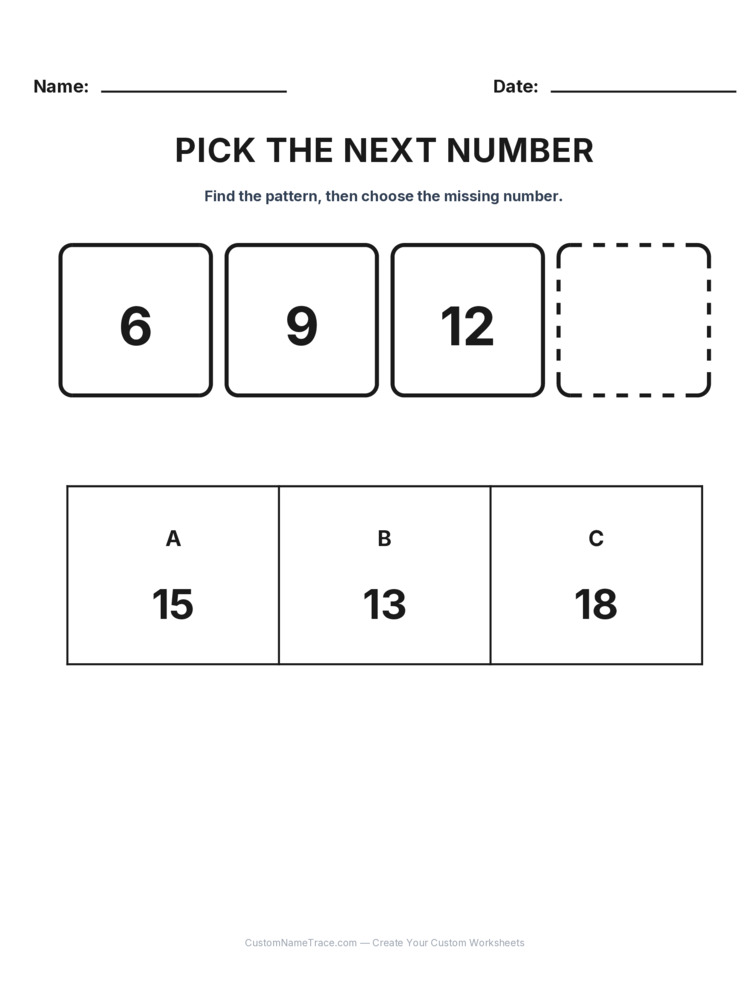
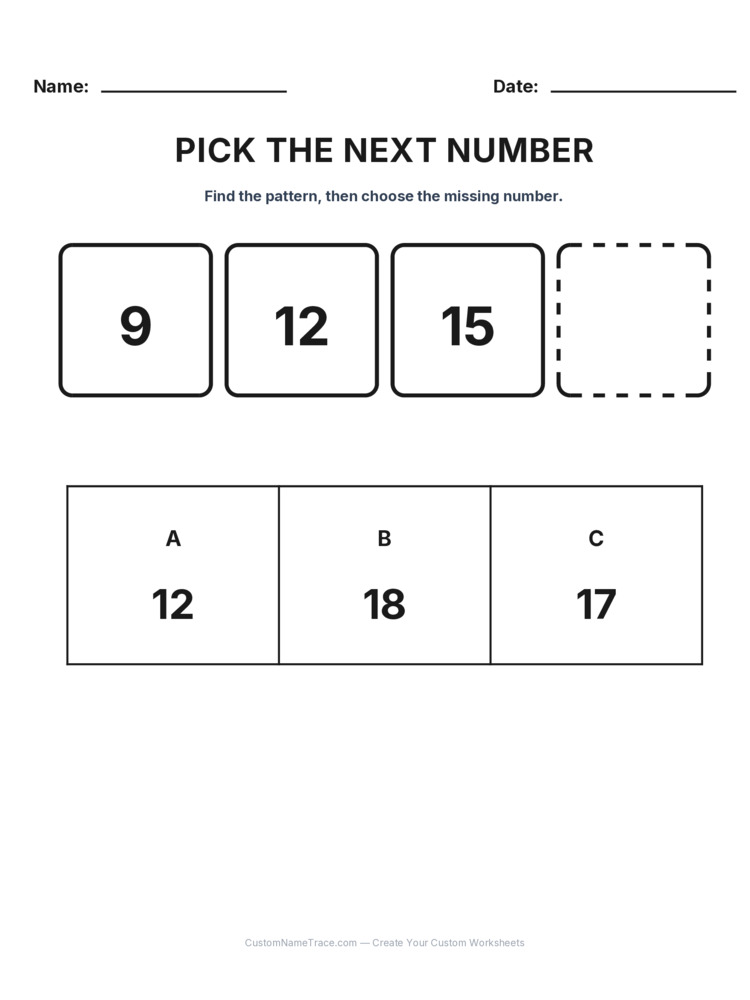
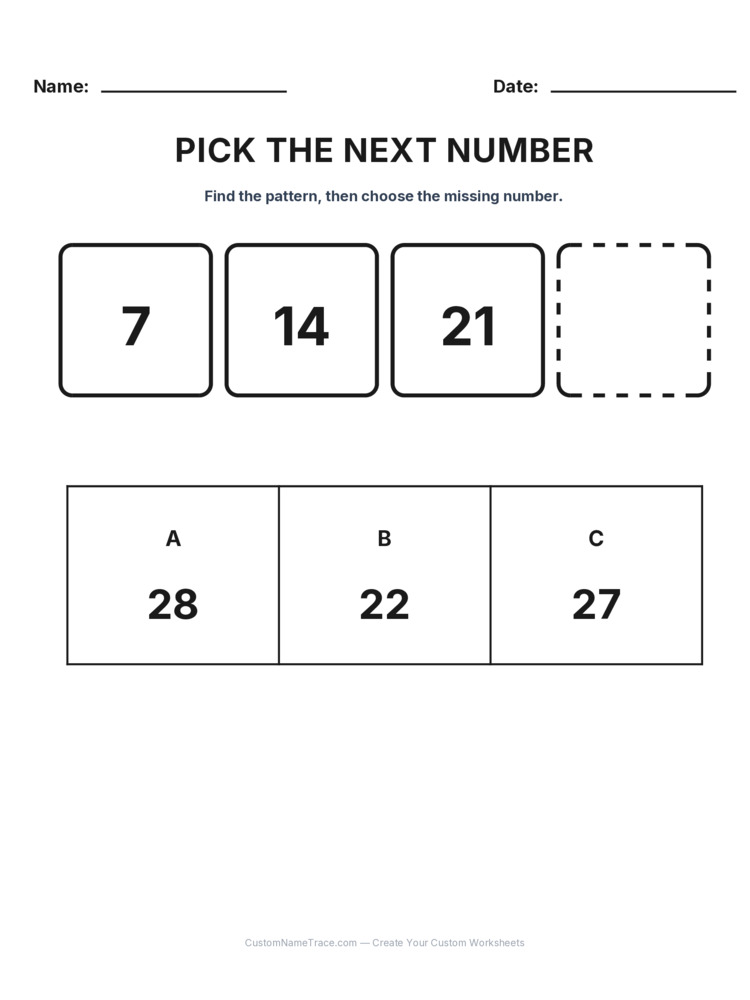
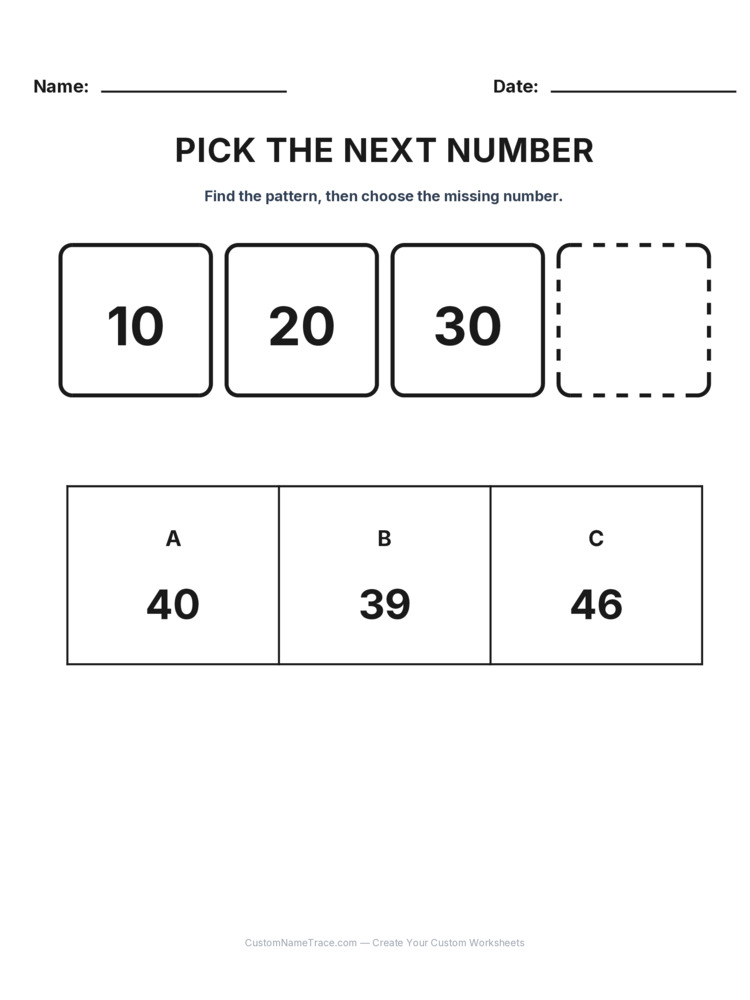
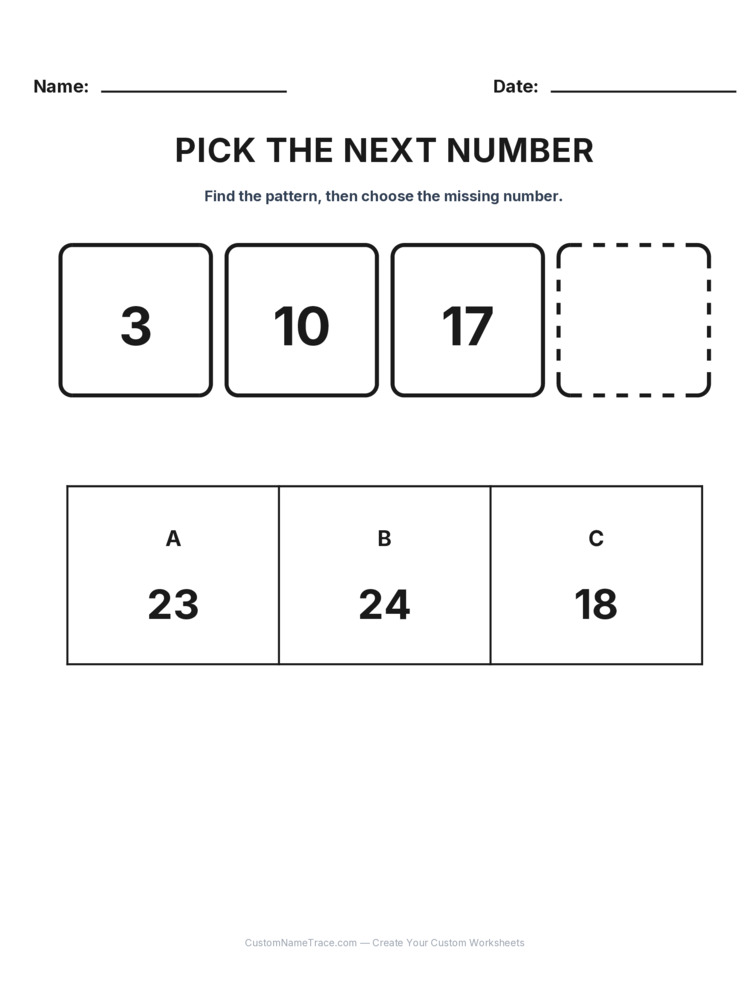
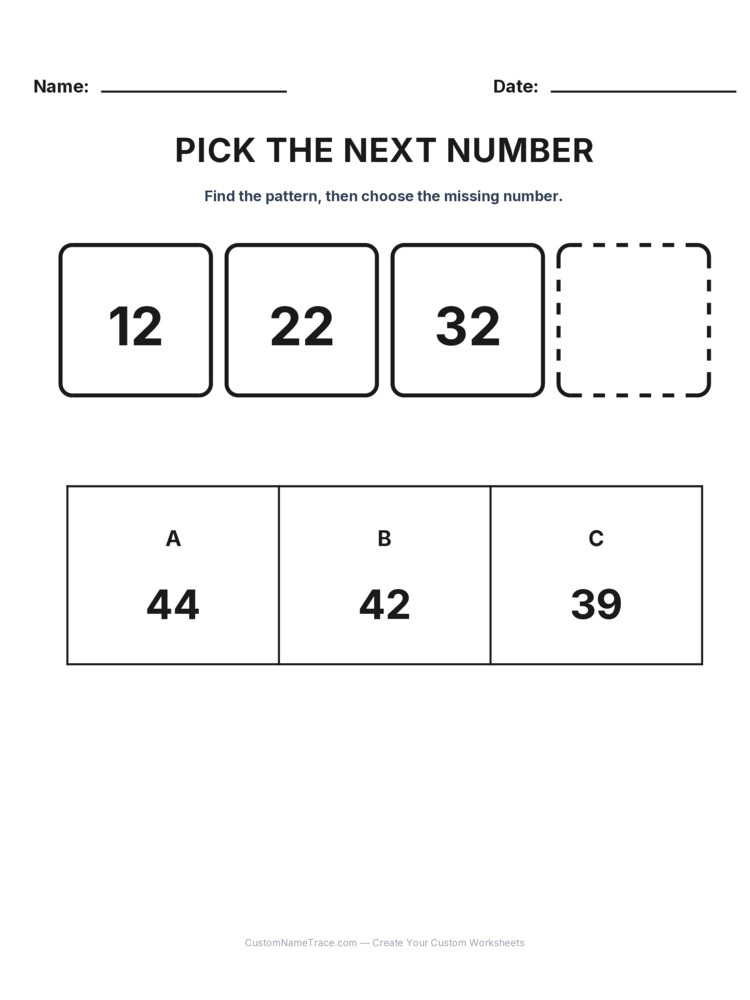
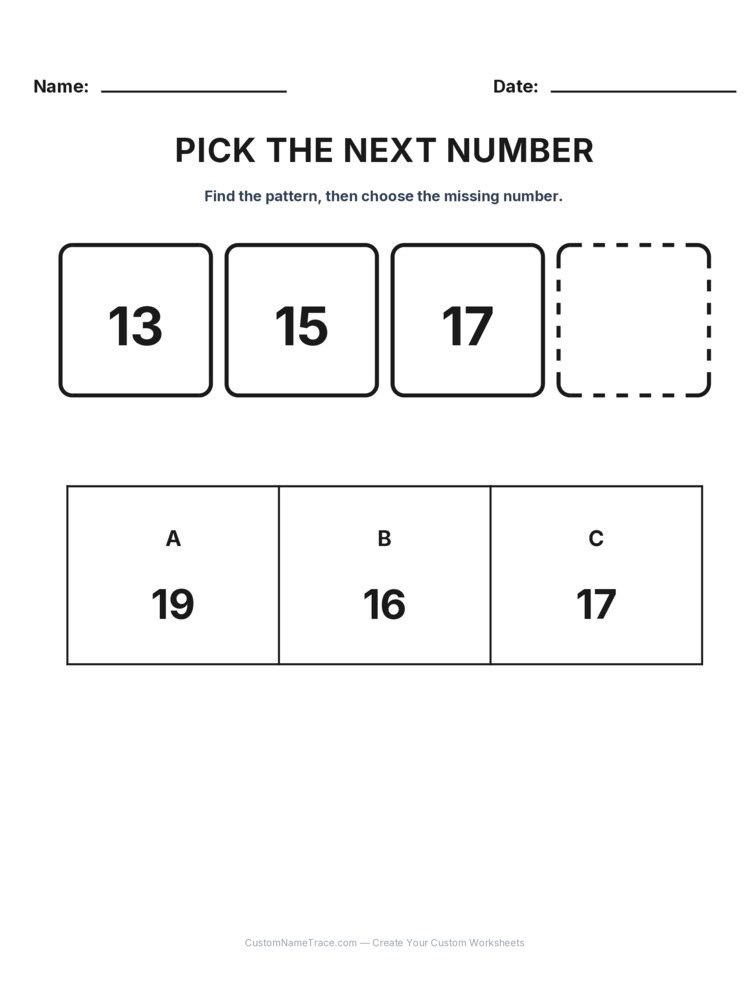
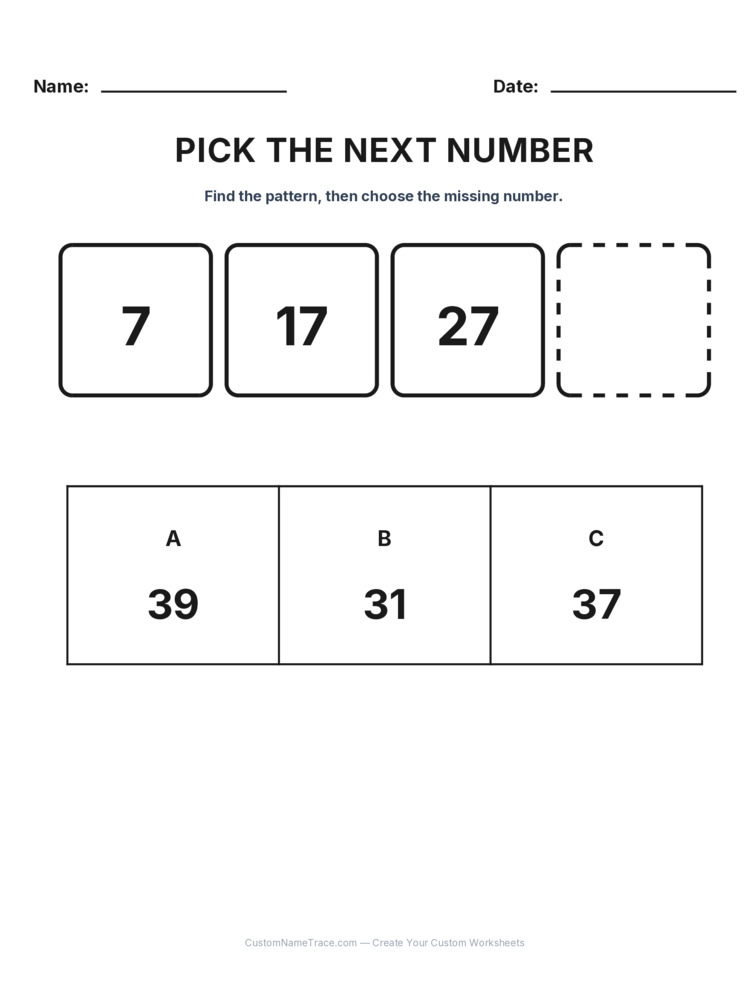
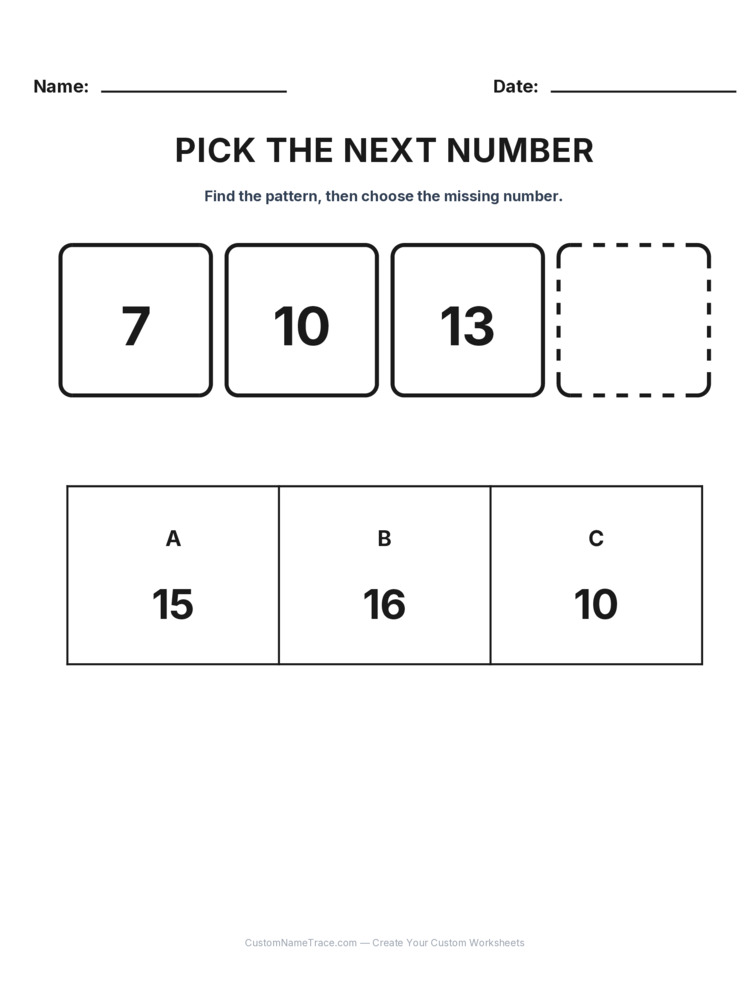
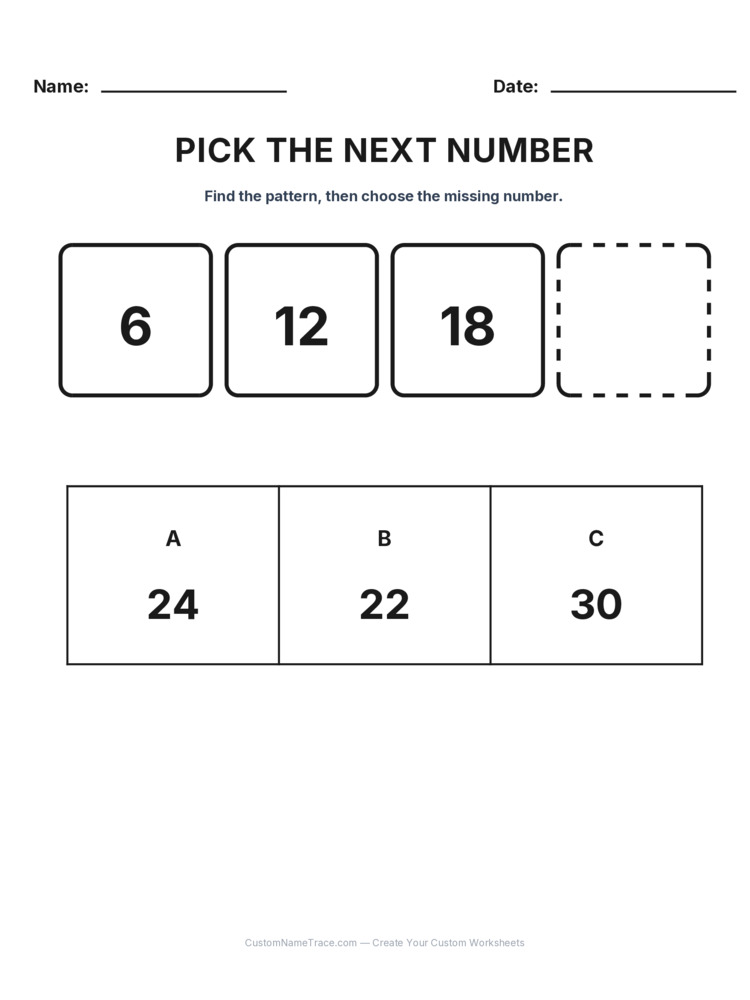
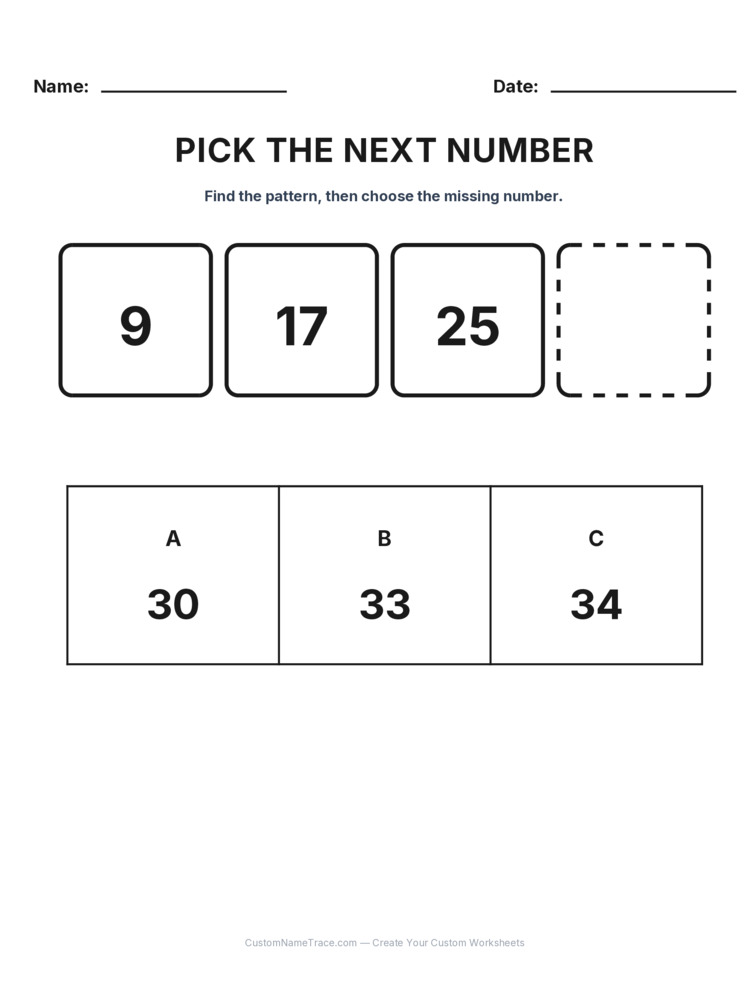
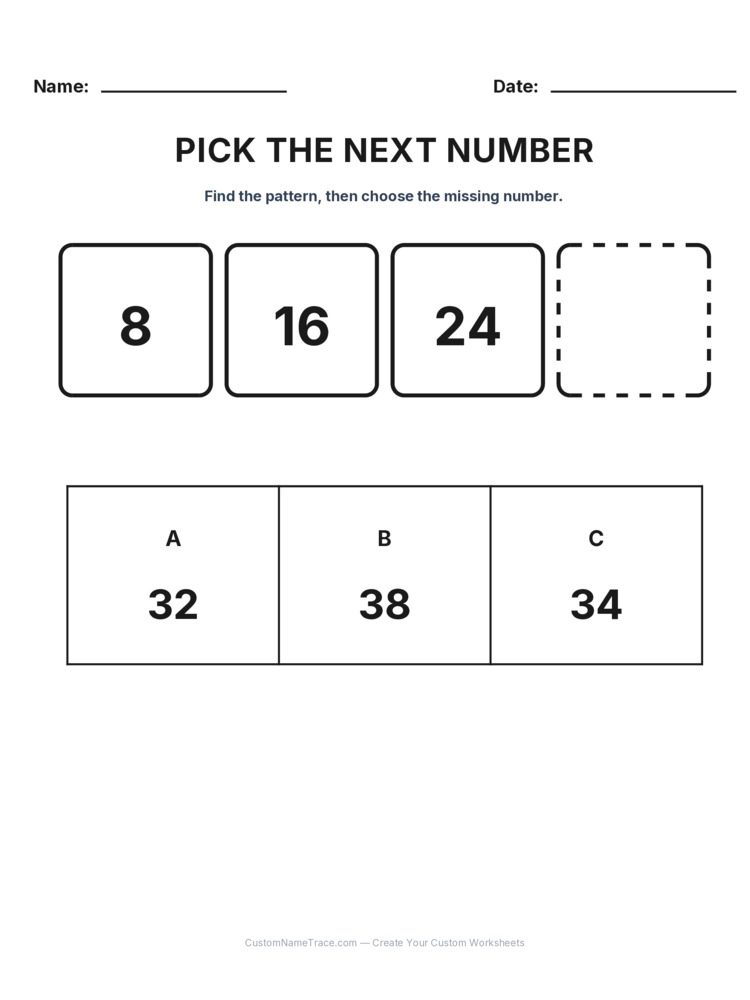
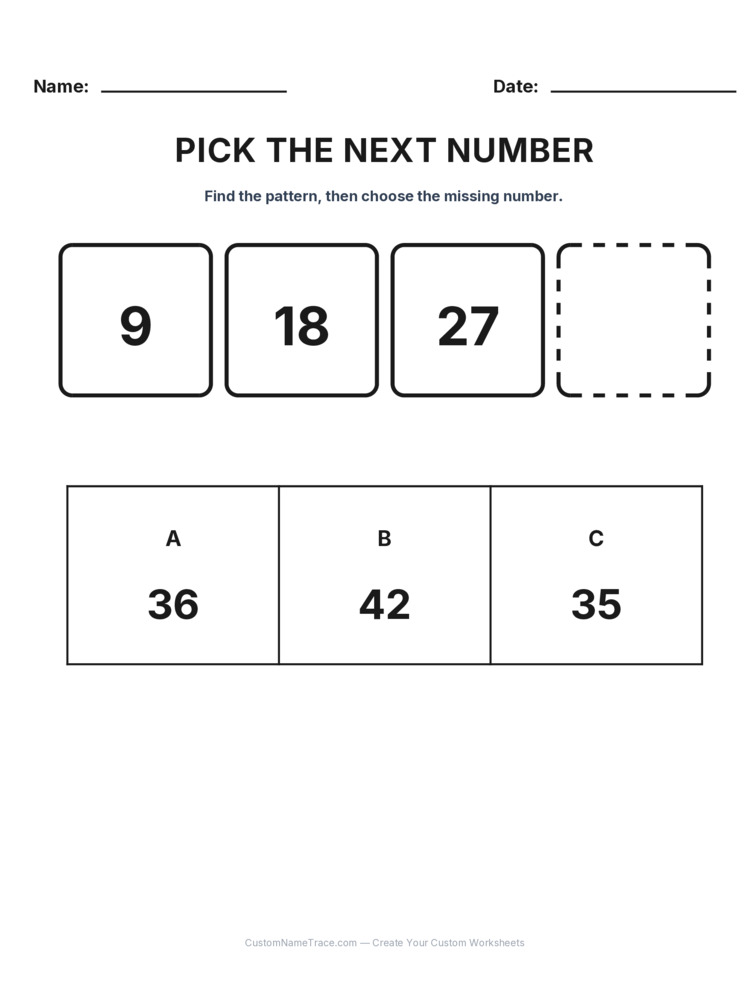
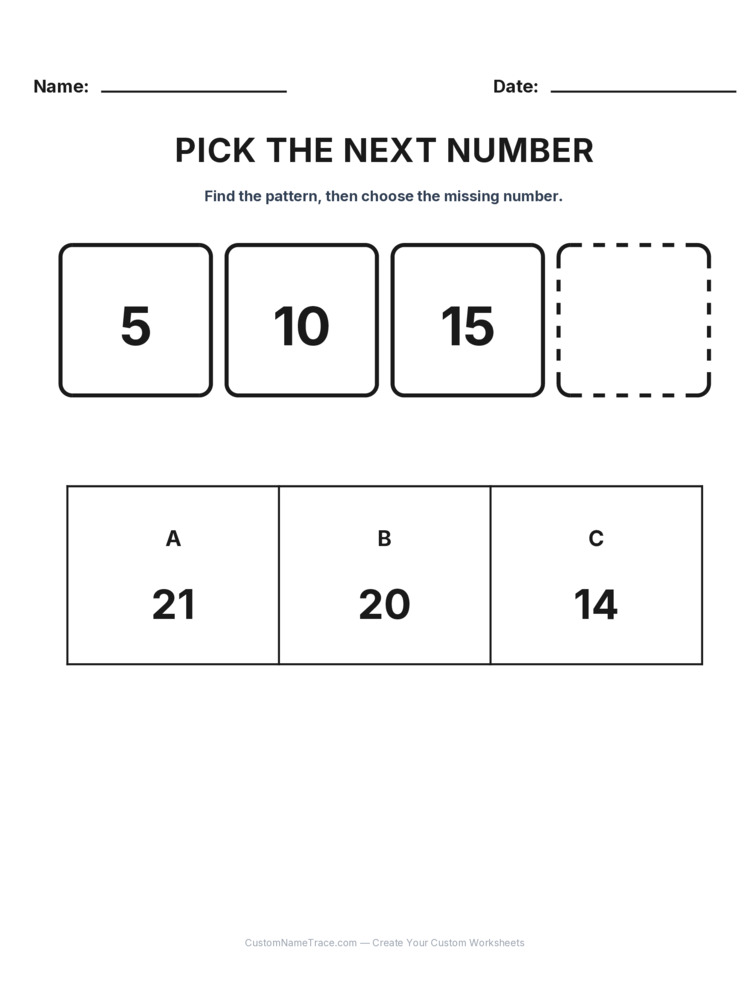
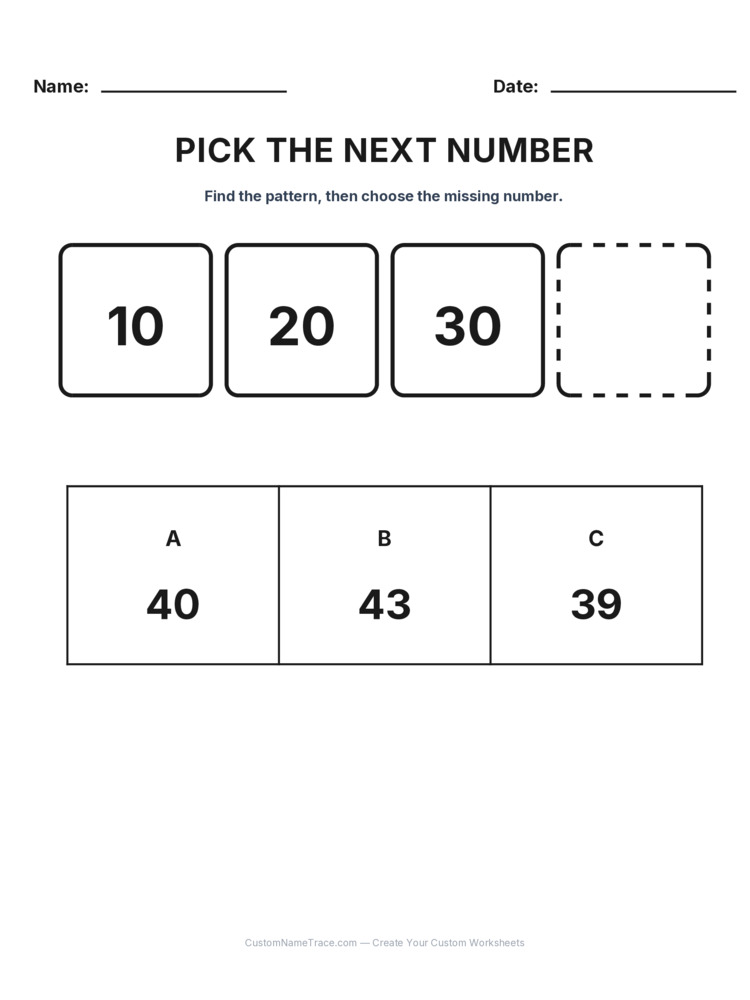
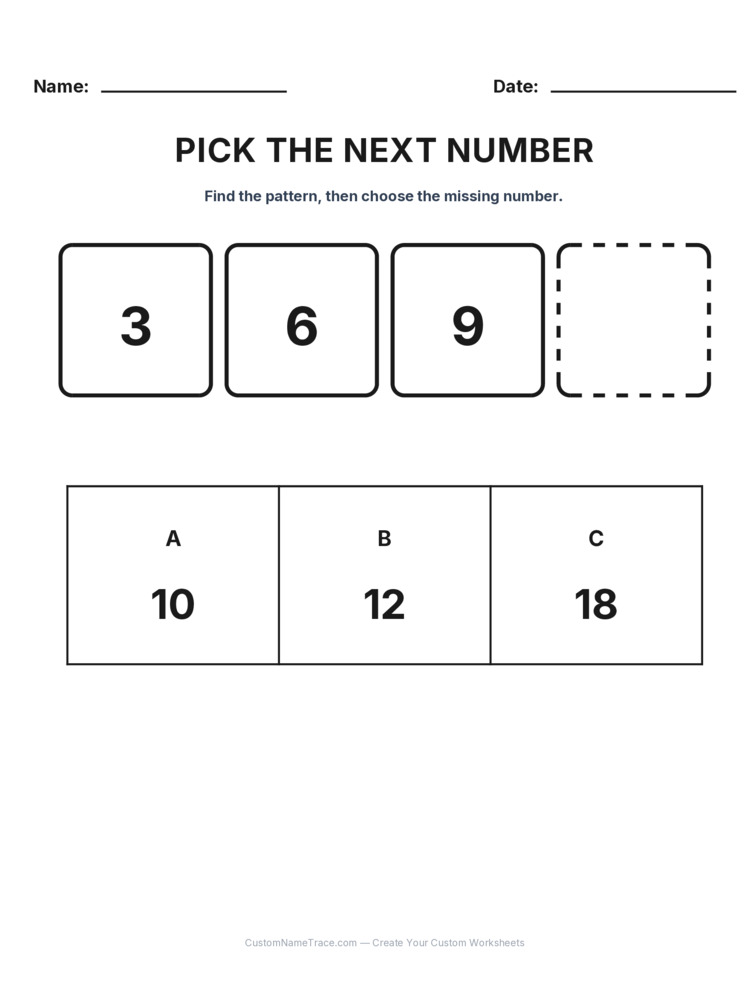
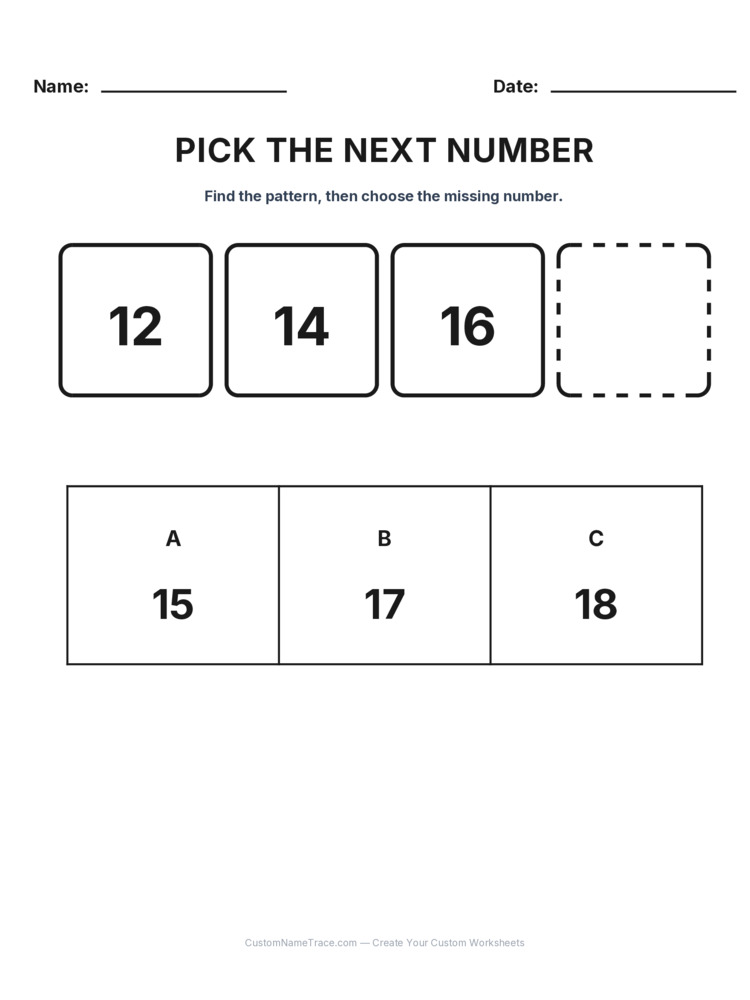
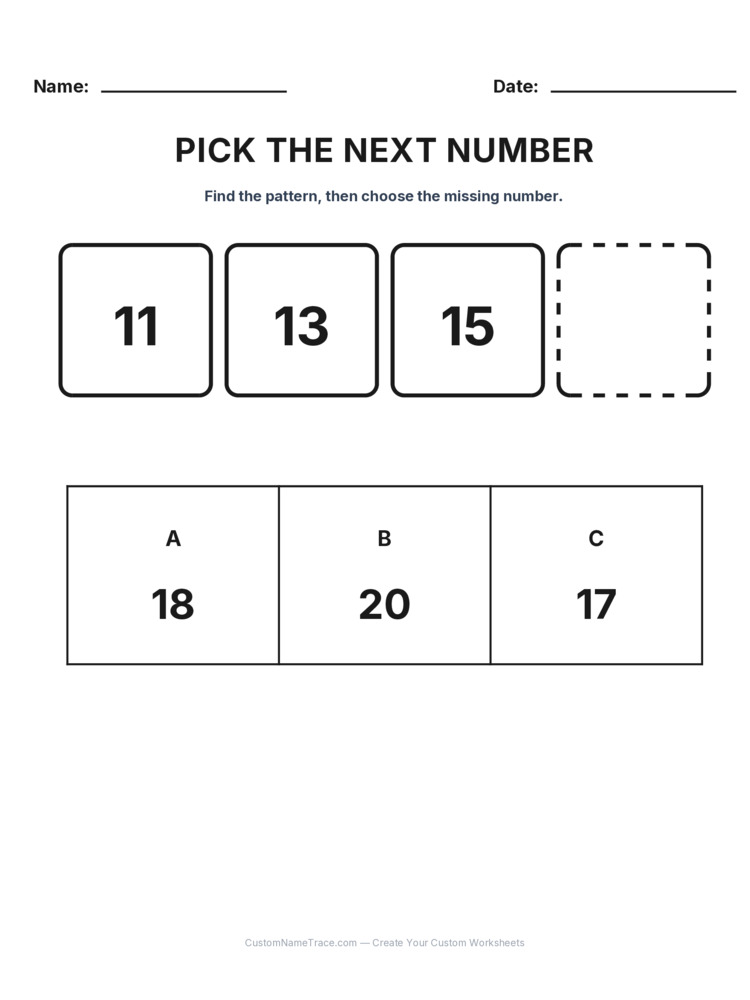
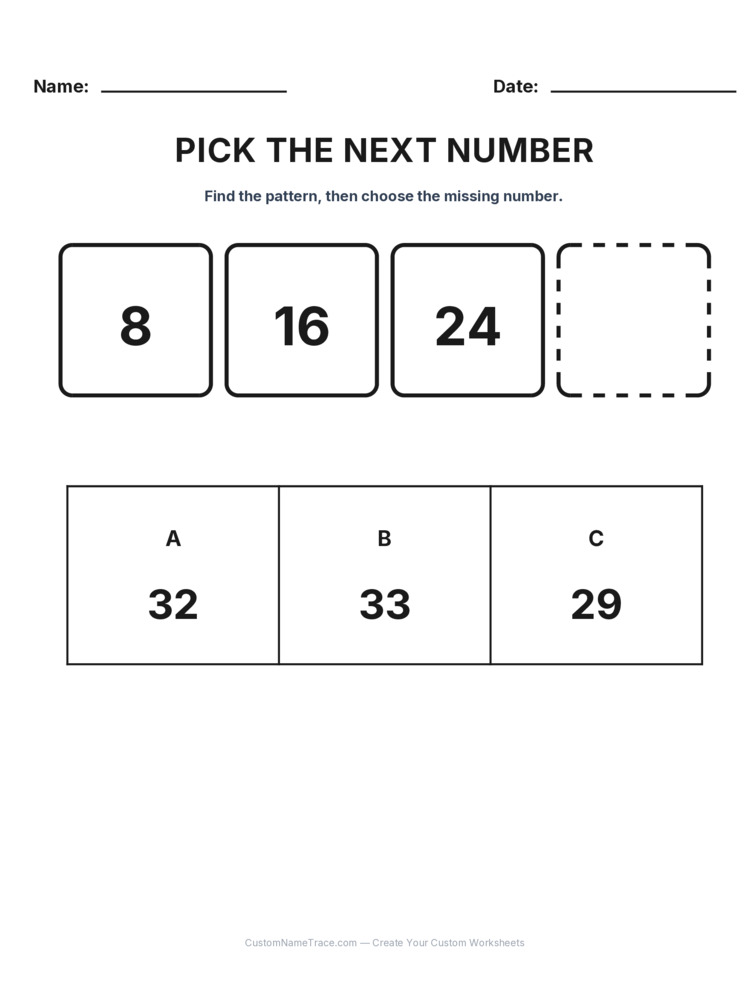
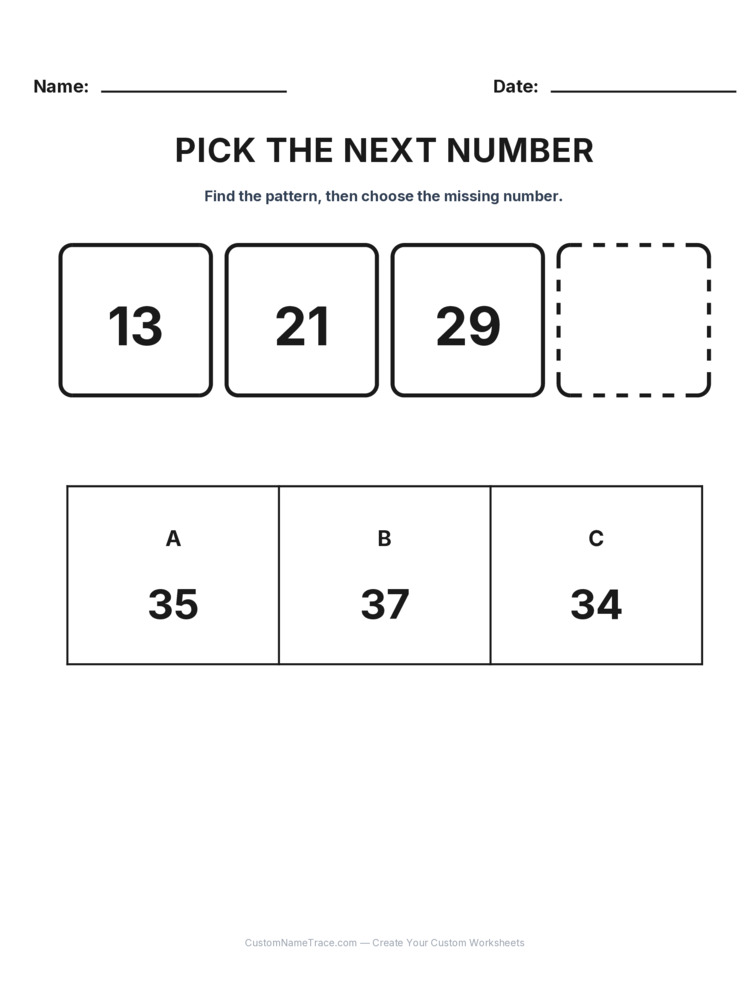 A Pick the Next Number page: three numbers, a blank, and three choices to pick from.
How the page works
Every page has the same layout.
- The title and instruction. "Pick the Next Number. Find the pattern, then choose the missing number."
- Three numbers in boxes, followed by a dashed box that is empty.
- A row of three choices, labeled A, B and C, each showing a number.
The child works out the pattern, decides which of the three numbers belongs in the empty box, and marks it, by circling or writing the letter.
In every puzzle, the numbers go up by the same amount each time. That amount is the step. In the sample, 13 to 21 is 8, and 21 to 29 is 8, so the step is 8. The next number is 29 plus 8, which is 37. That is choice B.
What Grade 1 puzzles look like
In Grade 1, the steps are small and friendly: anywhere from 2 to 10. The pages come in two flavors, and the two are roughly equally common.
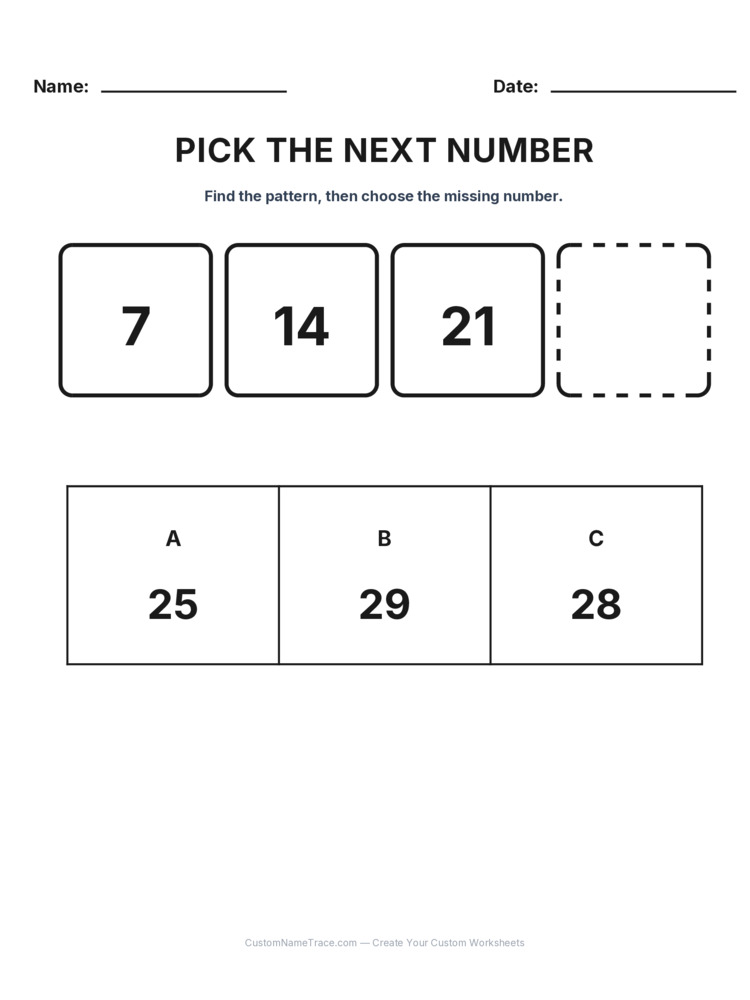
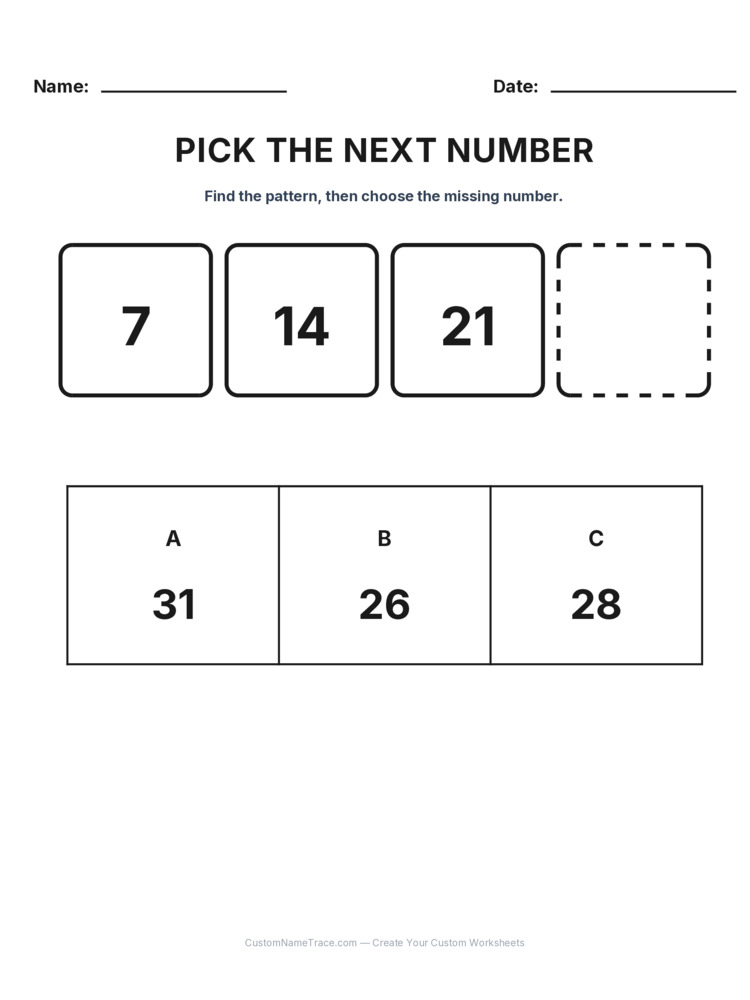
Skip counting. The first number is the same as the step. The sequence is a counting-by pattern: 2, 4, 6... or 5, 10, 15... or 7, 14, 21... A child who knows their skip counting will find these quickly.
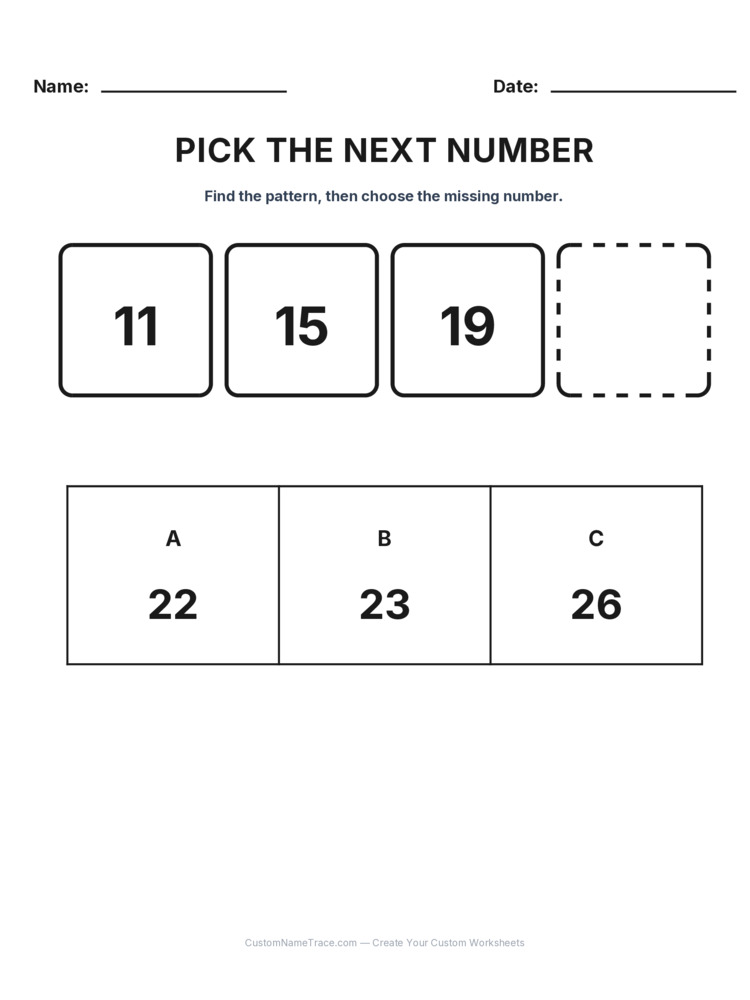
General steps. The first number is not the step. The sequence starts somewhere else and counts up by the step: 7, 11, 15... or 13, 21, 29... These cannot be solved by recalling a counting-by chant. The child has to find the difference.
Mixing the two is deliberate. If every puzzle were skip counting, a child might simply be reciting multiplication tables in disguise. By including starts that are not the step, the puzzles make sure the child is looking at the numbers and reasoning.
The three choices: what each is built to reveal
The multiple-choice format is not just a convenience. The wrong choices are designed, and each one tells a teacher something. There is one correct answer and two distractors, and the two distractors are of two kinds.
The near miss. One wrong answer is close to the correct one, off by one or two. It is the sort of answer a child gets from counting on fingers and losing track. In the sample, 35 is two less than 37.
The wrong step. The other wrong answer applies the right idea but a step that is one or two off. It is what you would get if you counted up by a slightly different amount each time. In the sample, 34 is what you get if the step were 7 instead of 8: 13, 20, 27, 34.
This design has a purpose. If the wrong choices were random, a child could rule them out without understanding the pattern. But these are plausible, and a child has to check each choice against the rule.
When a child picks a wrong answer, the type of error is informative.
| Child picks |
What it suggests |
What to do |
| The near miss |
Right idea, a counting slip |
Recount the jump on a number line |
| The wrong step |
Found a step, but one that is slightly off |
Check the step against both gaps |
| The number after the last |
Counting by ones, not looking for a rule |
Ask "how much did it change?" |
| The correct answer, but cannot explain |
May be lucky, may be intuitive |
Ask "how do you know?" |
How to teach a child to find the step
The central skill is finding the step, and it can be taught in four moves.
1. Look at the first two numbers. Ask: "How far is it from the first to the second?"
2. Find the gap. Count up from the first to the second, or subtract. From 13 to 21: count up in jumps (13 to 20 is 7, then 1 more is 8), or compute 21 minus 13.
3. Check the second gap. Is the distance from the second to the third the same? From 21 to 29 is also 8. Yes. The rule holds.
4. Apply the step. Add the step to the last number. 29 plus 8 is 37.
Then, and this is essential, check the choices. Look at A, B and C. Which one is 37? B.
It helps to say it aloud as a little chant: "Gap, gap, same? Add it on."
Tools for finding the gap
Different children find the gap in different ways, and all of them are valid.
- Counting up. From 13, count up to 21: 14, 15, 16, 17, 18, 19, 20, 21. Eight jumps. (Counting on a number line or with fingers helps.)
- Subtracting. 21 minus 13 equals 8.
- Using tens. From 13 to 20 is 7, and then 1 more is 8. This is the "bridge through ten" strategy.
- Using a number line. Draw a line, mark the numbers, and count the jumps.
- Using a hundred chart. Put a finger on 13 and another on 21, and count the squares.
- Using base-ten blocks. Build 13 and 21, and compare.
A good teacher shows several methods and lets the child pick the one that feels natural.
Skip counting and the step
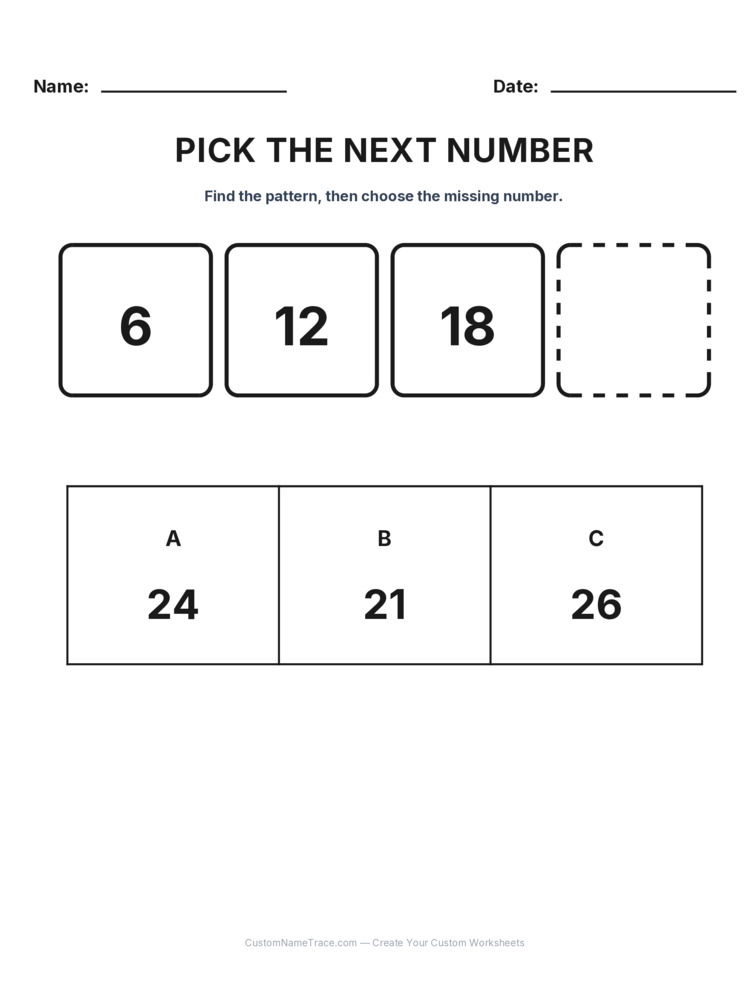
Many of the puzzles can be solved quickly by a child who has practiced skip counting, because the sequence is simply a table. If the page shows 6, 12, 18, a child who knows the sixes says "24" at once.
That is a perfectly good strategy, and it is worth building. The skip counting pages are the best companion. But the puzzle goes further. When the sequence does not start with the step, such as 7, 11, 15, skip counting does not help directly, and a child has to find the gap.
A good progression is:
- Skip counting by 2s, 5s and 10s, out loud, until it is automatic.
- Skip counting by 3s, 4s and 6s, with a hundred chart.
- Starting from other numbers, such as 3 and going up by 4: 3, 7, 11.
- Finding the step in a sequence you have not seen before.
Each stage builds on the one before.
Checking an answer
Many children rush to choose, and a few habits help them slow down.
- Say the whole sequence with the answer. "Thirteen, twenty-one, twenty-nine, thirty-seven." Does it sound right?
- Check the gap again. From 29 to 37 is 8. Same as before. Good.
- Test the other choices. "If it were 35, the gap would be 6. That's not the same. So not A."
- Count by jumps, not numbers. The most common error is counting the starting number as one. Use a number line.
- Estimate. "The numbers go up by a bit less than ten each time. So the next will be in the high thirties." This rules out 34.
Estimation is particularly valuable. A child who knows that the answer should be in the high thirties will not choose 34.
A sample twelve-minute session
A session with a six-year-old.
- Minute 0 to 2. Warm up with skip counting. "Count by 5s from 5. Count by 2s from 2. Count by 10s from 10."
- Minute 2 to 4. Look at the page. "We have three numbers: 13, 21, 29. How far from 13 to 21?" Let the child count or subtract. "And from 21 to 29?" Same. "So what do we do to 29?"
- Minute 4 to 5. Add 8 to 29 together: 29 plus 1 is 30, plus 7 is 37. Find 37 among the choices.
- Minute 5 to 6. Look at the other two. "Why isn't 35 right? Why isn't 34?" Let the child explain.
- Minute 6 to 11. Let the child do a few more pages, one at a time, saying each step.
- Minute 11 to 12. Invent a puzzle for each other.
The explanation of why the other choices are wrong is one of the best moments in the session. A child who can say "35 is not right because 29 plus 6 is 35, and the step is 8" has understood the pattern.
A table of worked examples
Here are a few examples of the kind of puzzle a child will meet, with the thinking written out. The numbers are illustrations of the type, so a page may differ, but the reasoning is the same.
| Shown |
The gap |
The step |
The next number |
| 6, 12, 18 |
6 each time |
6 |
24 |
| 3, 5, 7 |
2 each time |
2 |
9 |
| 7, 11, 15 |
4 each time |
4 |
19 |
| 10, 19, 28 |
9 each time |
9 |
37 |
| 4, 9, 14 |
5 each time |
5 |
19 |
| 13, 21, 29 |
8 each time |
8 |
37 |
Notice that the first number carries no special meaning. In the second row, 3 is not the step, and yet the sequence is easy once the gap of 2 is found. A child who learns to ignore the first number and look at the difference has grasped the central idea.
Why distractors are so valuable
It is easy to see the wrong choices as an annoyance. A smart teacher sees them as a gift. When a child picks the wrong answer, the choice is a clue.
Imagine that a child, faced with 13, 21, 29, picks 34. You can ask: "Why did you pick that one?" The child may say, "Because it goes up by seven." Now you know exactly what the child did: they used a step that is close but not right. A moment of conversation can fix it: "Let's check the gap from 13 to 21. Is it seven?"
Or the child picks 35, and says, "I counted up eight, and I got confused." Now you know it is a counting slip, not a rule error. Practice with a number line will help.
Or the child is dismayed that the number they expected, 30, is not among the choices. That is a lovely moment: it shows the child was counting by ones, and the absence of 30 invites them to look at the difference instead.
In each case, the multiple-choice format makes the child's thinking visible, which a plain fill-in-the-blank often does not.
Counting the jumps, not the numbers
A very common slip deserves its own spotlight. A child asked to find the gap from 13 to 21 may count: "13, 14, 15, 16, 17, 18, 19, 20, 21," and say "nine," because there are nine numbers in that list. But the gap is eight, because there are eight jumps between them.
Here is a way to make it clear.
- Draw a number line with 13 and 21 marked.
- Draw arcs from 13 to 14, from 14 to 15, and so on. Each arc is one jump.
- Count the arcs, not the numbers. There are eight.
Or use fingers: put a finger up for each jump, starting after the first number. A child who counts "fourteen (1), fifteen (2)..." and ends at "twenty-one (8)" has done it right. A child who starts by saying "thirteen (1)" has added one too many.
This is the same "off by one" error that causes trouble in subtraction, in measuring with a ruler, and in counting fence posts. Catching it early is a great help.
A practice ladder
A child can move through these puzzles gradually, starting with the easiest and working up. Here is one way to climb.
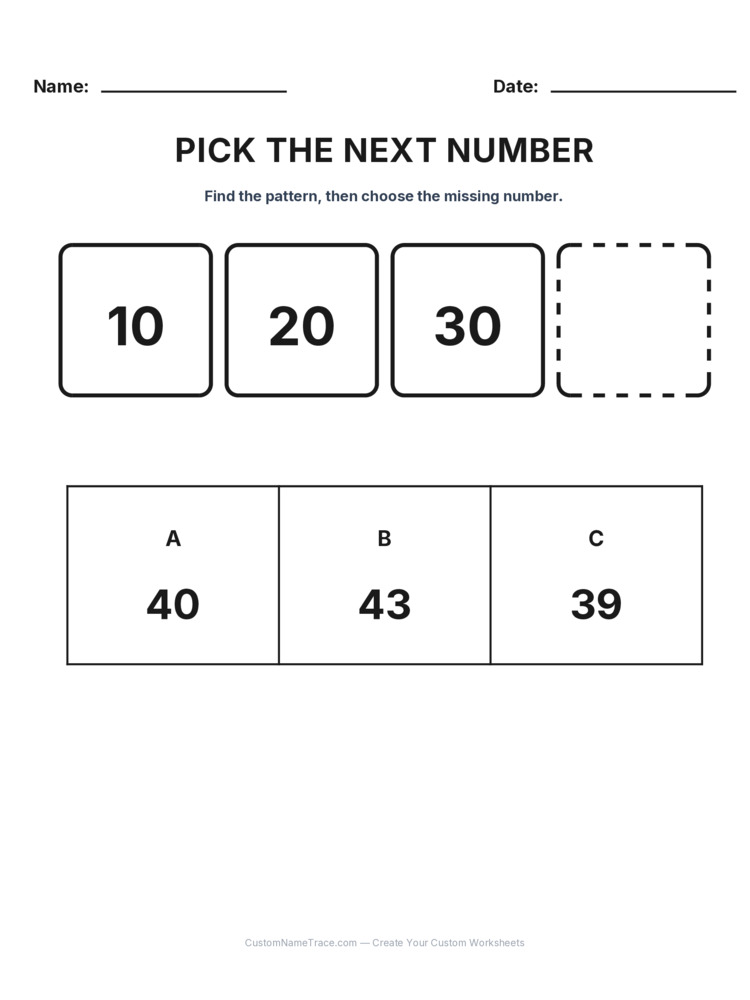
- Skip counting by 2s, 5s and 10s, with obvious starts: 2, 4, 6; 5, 10, 15; 10, 20, 30.
- Skip counting by 3s, 4s and 6s, with starts equal to the step.
- Steps of 2 to 5 from any start: 3, 5, 7; 8, 11, 14.
- Steps of 6 to 10 from any start: 4, 10, 16; 13, 21, 29.
- Explaining the wrong choices for a puzzle.
- Making a puzzle for someone else.
A child may spend a few days on each rung. The ladder is not a race, and a child who is happy on step three for a week is learning.
Games with number patterns
Number patterns are easy to turn into games.
- The rule machine. One player has a secret rule, such as "add 3." The other says a number, and the first replies with the answer. After a few rounds, the second guesses the rule.
- Hop the sequence. Chalk a number line on the pavement, and hop the steps.
- Sequence race. Each player writes a sequence of four numbers, and the other has to find the rule in thirty seconds.
- What's my step? One player says two numbers, and the other has to say the step.
- Missing number hunt. Write a sequence with the first number missing, and ask the child to work backward.
- Number pattern bingo. Call the sequence, and mark the next number on a bingo card.
- Clap the step. Clap once for each jump from one number to the next.
A few minutes of play often does more for understanding than a page of worksheets.
Common difficulties and what helps
A child picks the number after the last one. They are counting by ones. Ask, "How much did it change from 13 to 21?"
A child cannot find the gap. Use a number line, and jump from one number to the next. Count the jumps.
A child counts the starting number. They say 13, 14, 15... up to 21 and count nine numbers instead of eight jumps. Use a number line with the jumps marked.
A child finds the step but adds wrongly. That is an arithmetic slip, not a logic one. Practice addition within 20.
A child picks the near miss. Slow down, and recount. Ask, "Does this fit the gap?"
A child guesses. Ask for the reason. "How do you know?" If there is no reason, go back to a simpler page.
A child rushes. Ask them to say the sequence aloud with the answer in it.
A child is anxious about multiple choice. Remind them that all three are possible, and that the way to choose is to check each against the rule.
Making the multiple choice meaningful
Multiple choice has a bad reputation, because it can be solved by guessing. But a well-designed multiple-choice puzzle teaches something valuable: that you can test an answer against a rule. In real life, much of what we do is choosing among options, and a child who learns to check each option against a criterion has learned something useful.
A few ideas for using the format well:
- Cover the choices first. Ask the child to work out the answer before looking at A, B and C. Then find it.
- Ask about all three. "Why is A wrong? Why is C wrong?"
- Make the wrong choices. Ask the child to write the correct answer and two tempting wrong ones.
- Turn it into a game. "Can you fool me?" The child writes a sequence with choices for an adult.
- Look for the trap. "Which choice is a near miss?"
A child who designs a multiple-choice puzzle has to understand it deeply.
Connecting to the rest of the curriculum
The number pattern puzzle links to many areas of learning.
- Skip counting. The foundation. See the number sense skip counting pages.
- Addition. Adding a step again and again. See the Grade 1 addition pages.
- Patterns. Number patterns are cousins of the emoji patterns.
- The hundred chart. A visual tool for gaps and steps.
- Early algebra. The step is a constant, and the sequence is a function.
- Multiplication. Counting by 5s is the beginning of the fives table.
Another puzzle in the same grade, What Comes Next?, asks the same question without choices. It is a natural companion, and a good way to build the underlying skill before the multiple-choice format.
For teachers
A Grade 1 classroom can use these puzzles in many ways.
- Warm-ups. A sequence on the board, and the class finds the next.
- Centers. A page, a pencil and a partner.
- Early finishers. A quiet task.
- Differentiation. Choose different numbered pages for different children.
- Discussion. Ask a child to explain why a wrong choice is wrong.
- Assessment. The pattern of wrong answers shows who counts by ones, who slips by one, and who finds the wrong step.
- Link to math. Skip counting and addition within 20.
For parents
You do not need to be good at math.
- Read it aloud together. "Thirteen, twenty-one, twenty-nine..."
- Ask, "How much did it change?"
- Let your child explain.
- Check the choices. "Why not A?"
- Keep it short. A few puzzles at a time.
- Play with sequences in the car: "I'm thinking of a pattern. Start at 3, and add 4."
Questions that come up
Is it okay to guess? If a child guesses and then checks the guess against the rule, that is a good strategy. If they guess without checking, ask them to explain.
My child always picks the middle choice. The correct answer is placed at varying positions. Ask them to check each one.
What if my child can't do skip counting? Practice it first, with a hundred chart and chants.
Should my child use their fingers? Yes, if it helps. Fingers are a fine tool for counting up the gap.
What if my child finds it too easy? Move to Grade 2, where the steps are bigger and some sequences go down.
How many puzzles at a time? One to three, with discussion. Quality matters more than quantity.
A Pick the Next Number puzzle is a small thing. A child who has learned to find the step, apply it, and check the choices against it has learned a way of thinking that will carry them from skip counting to algebra.