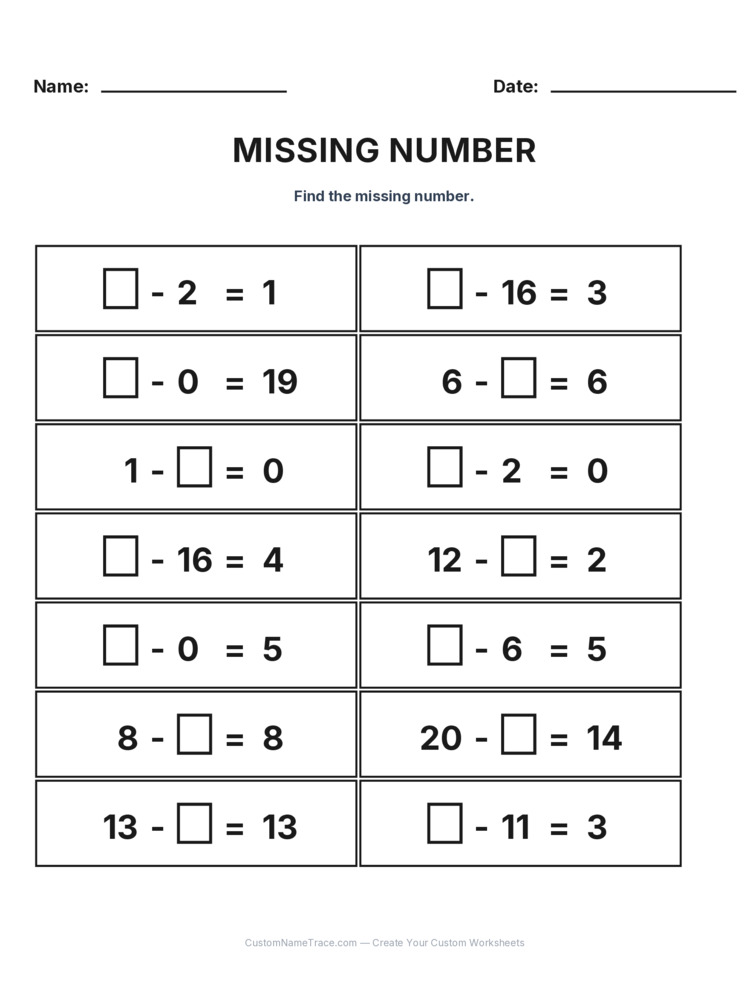
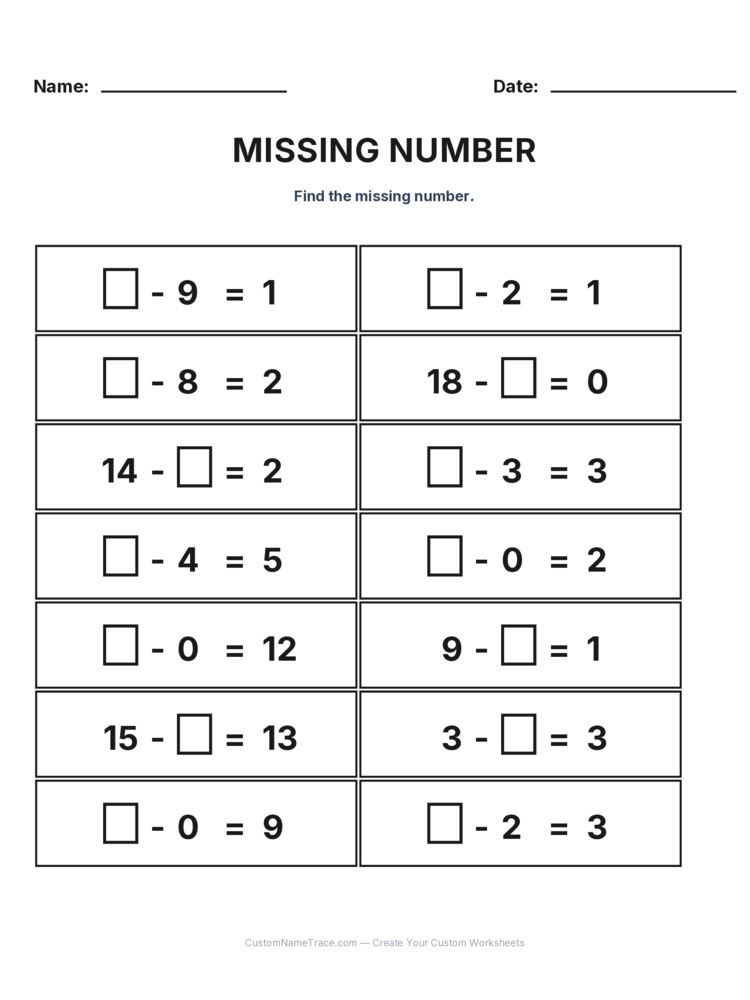
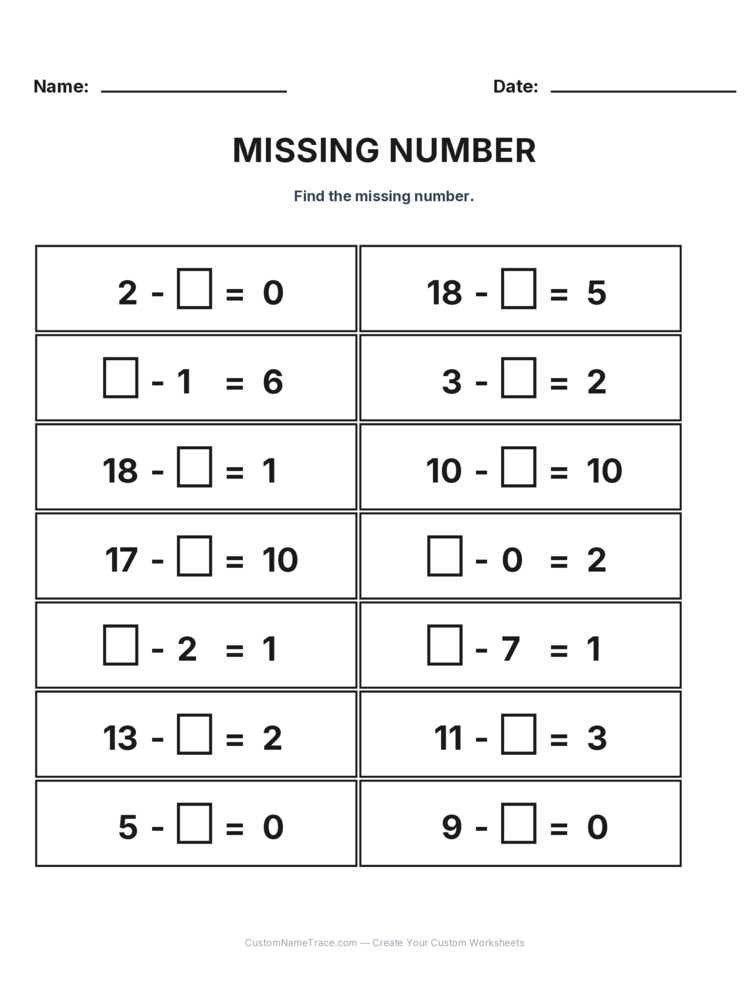
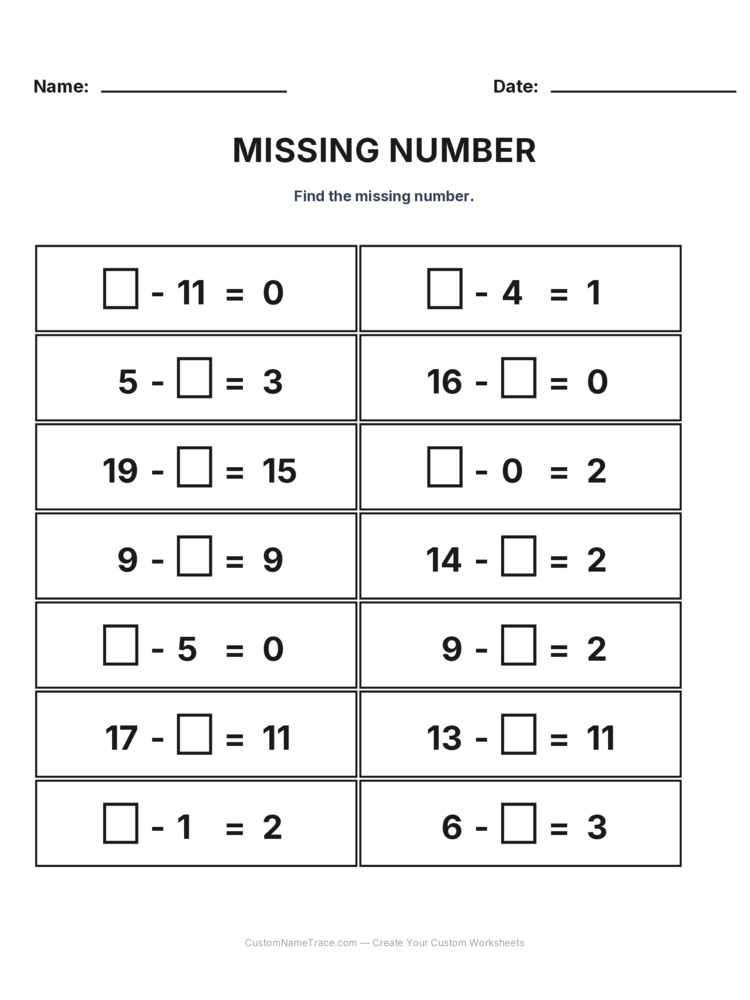
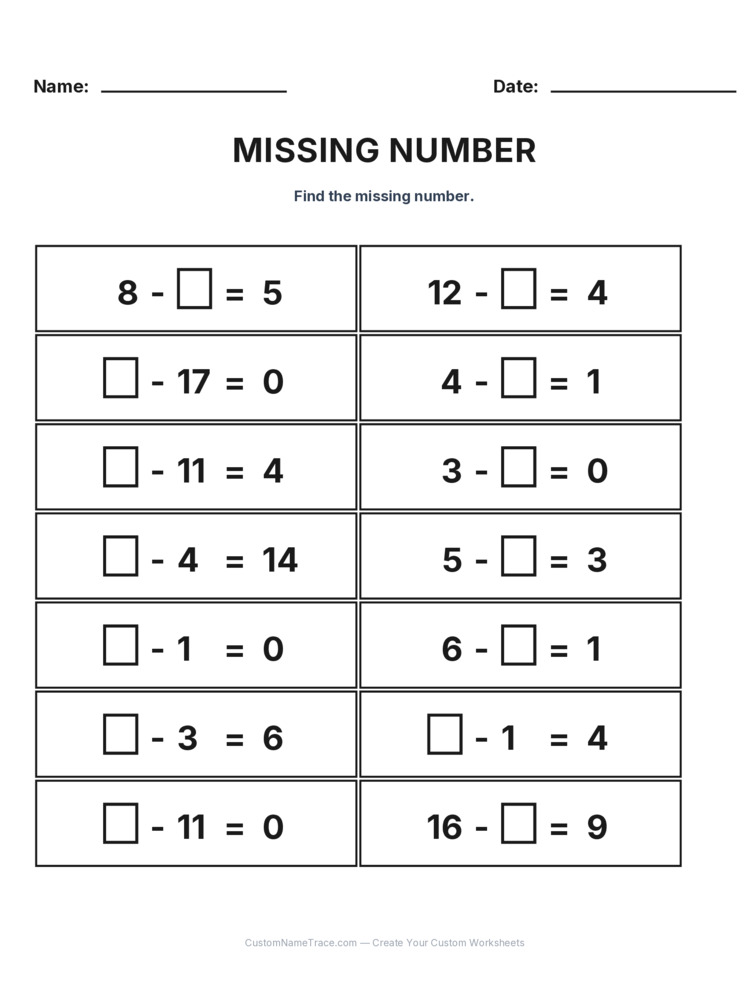
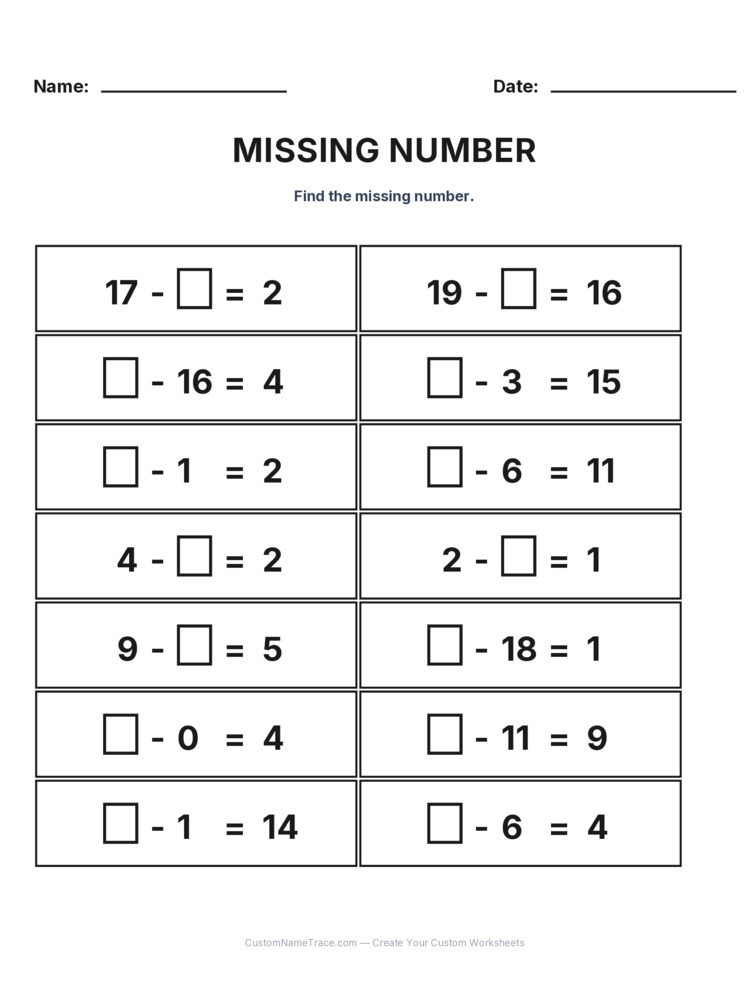
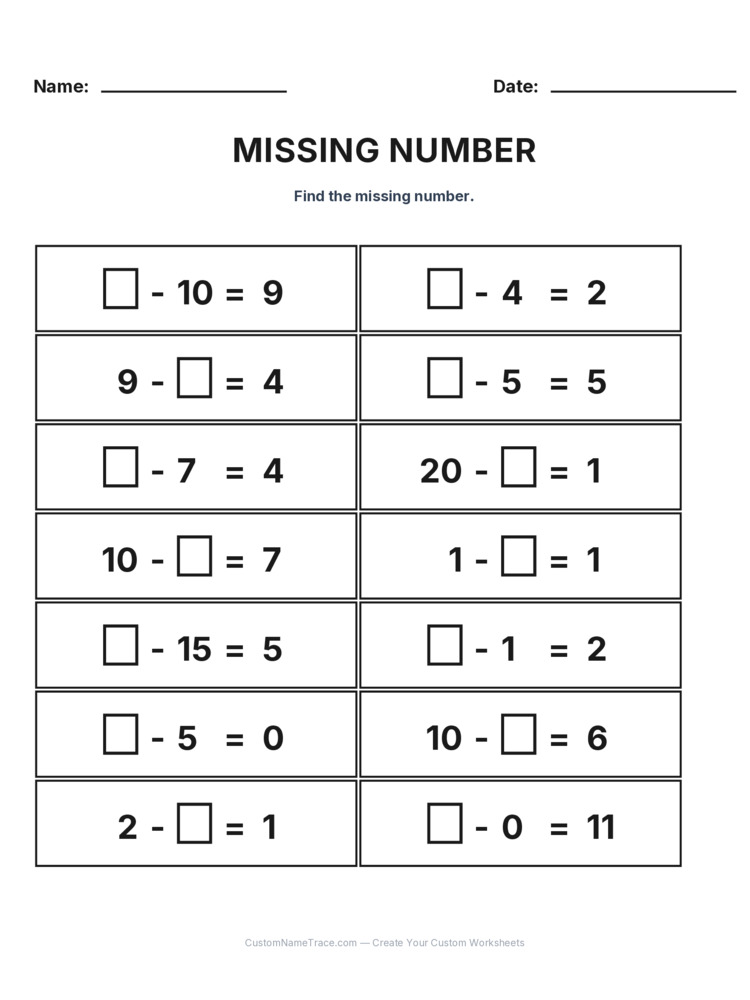
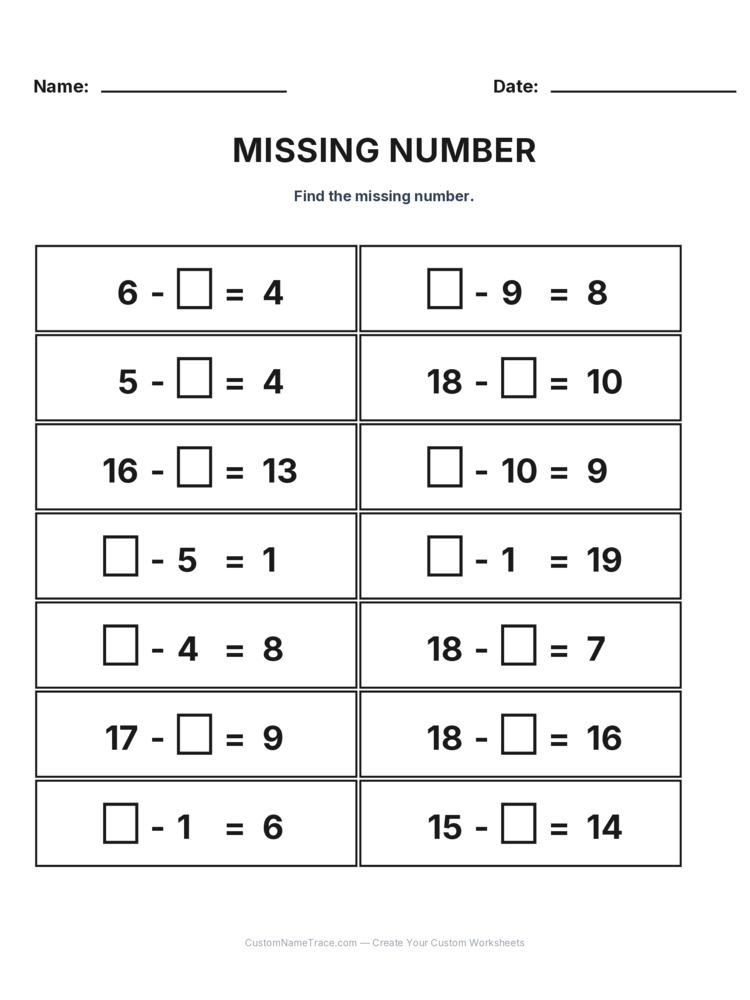
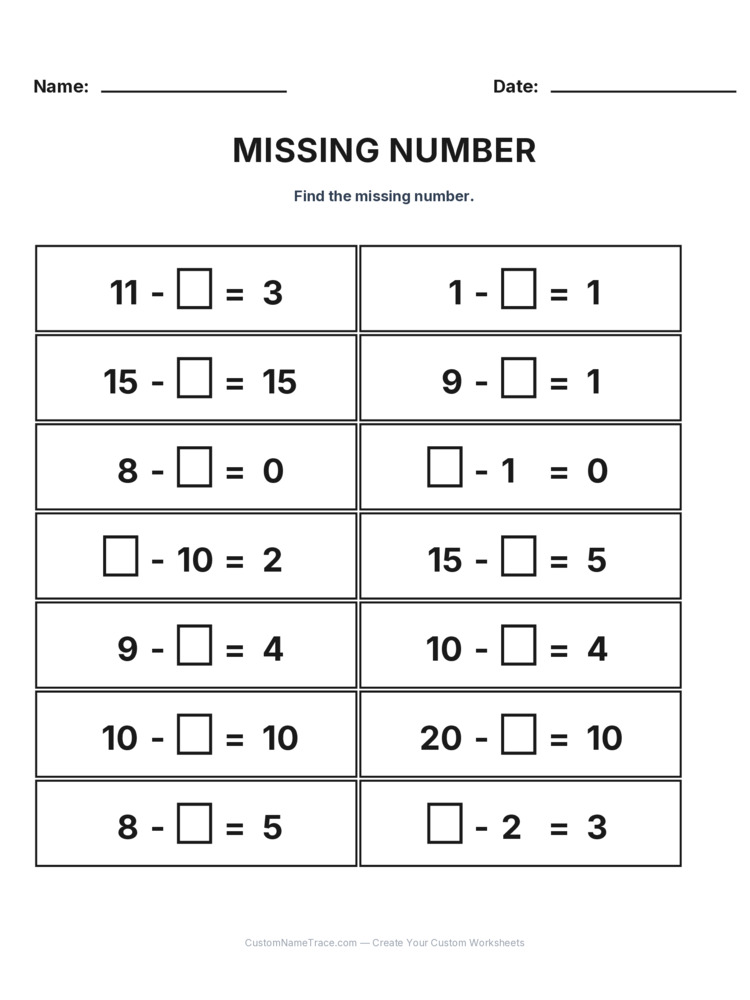
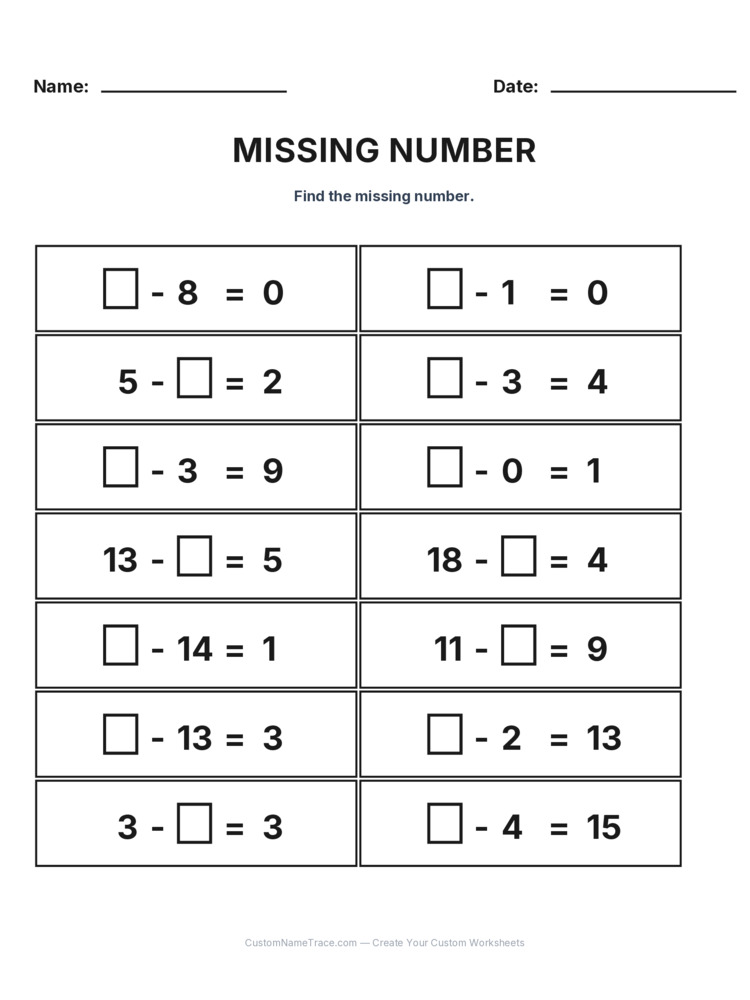
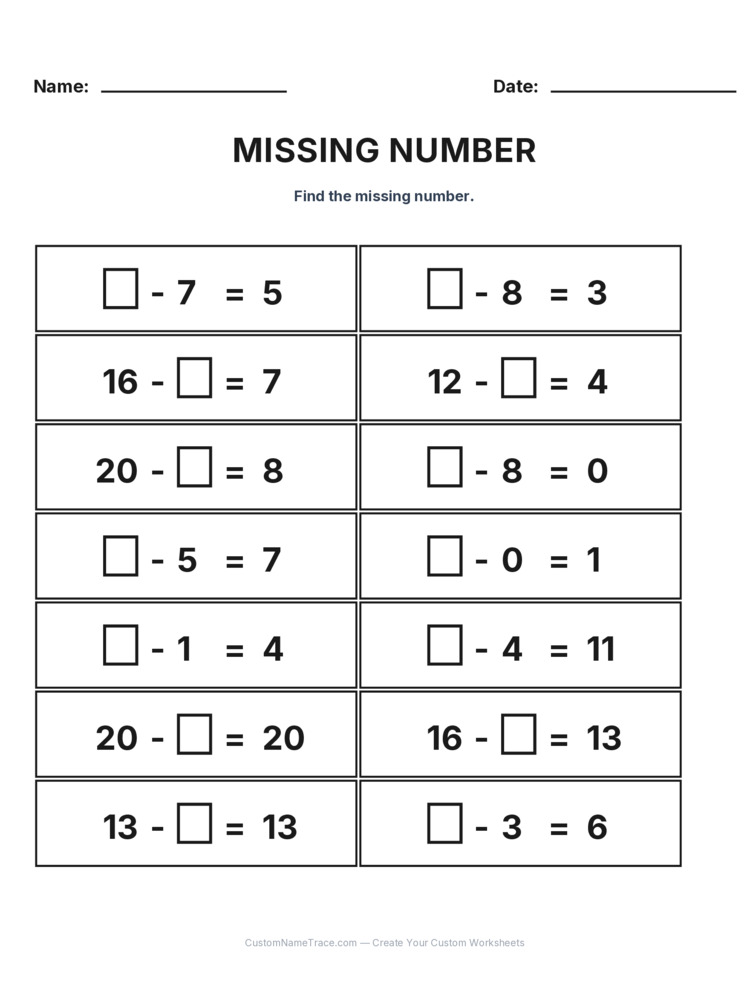
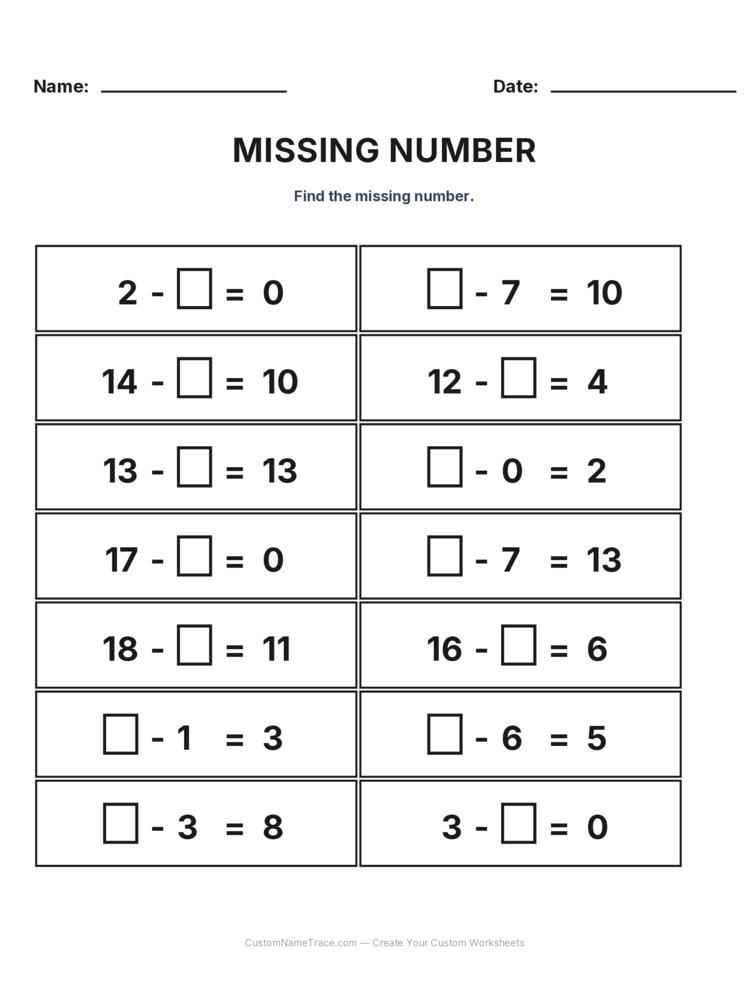
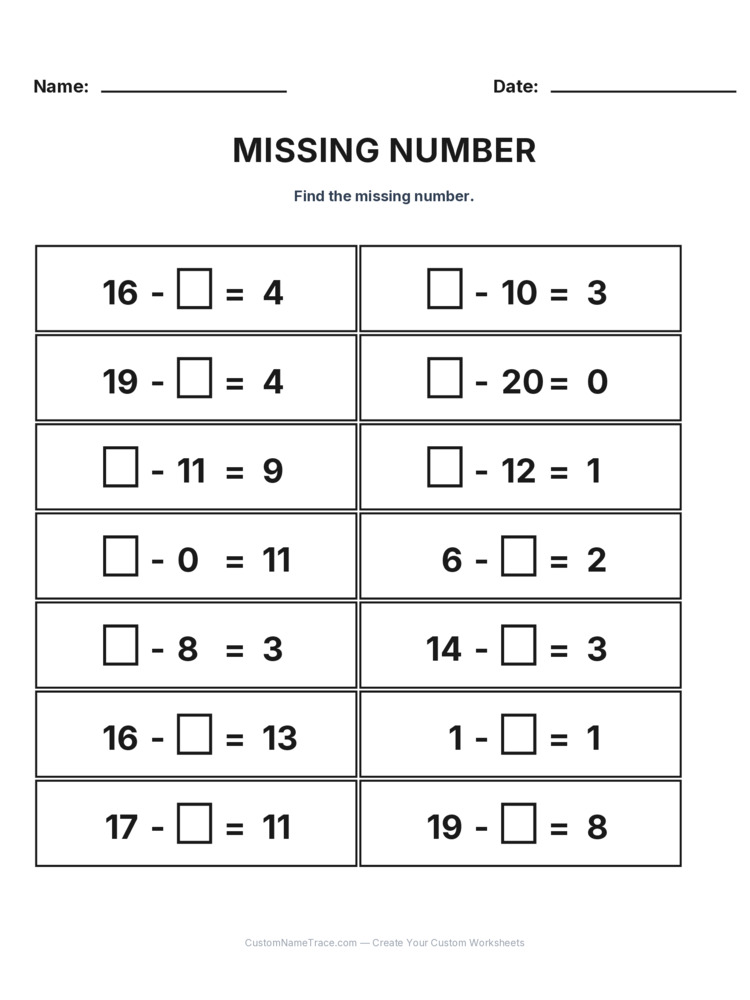
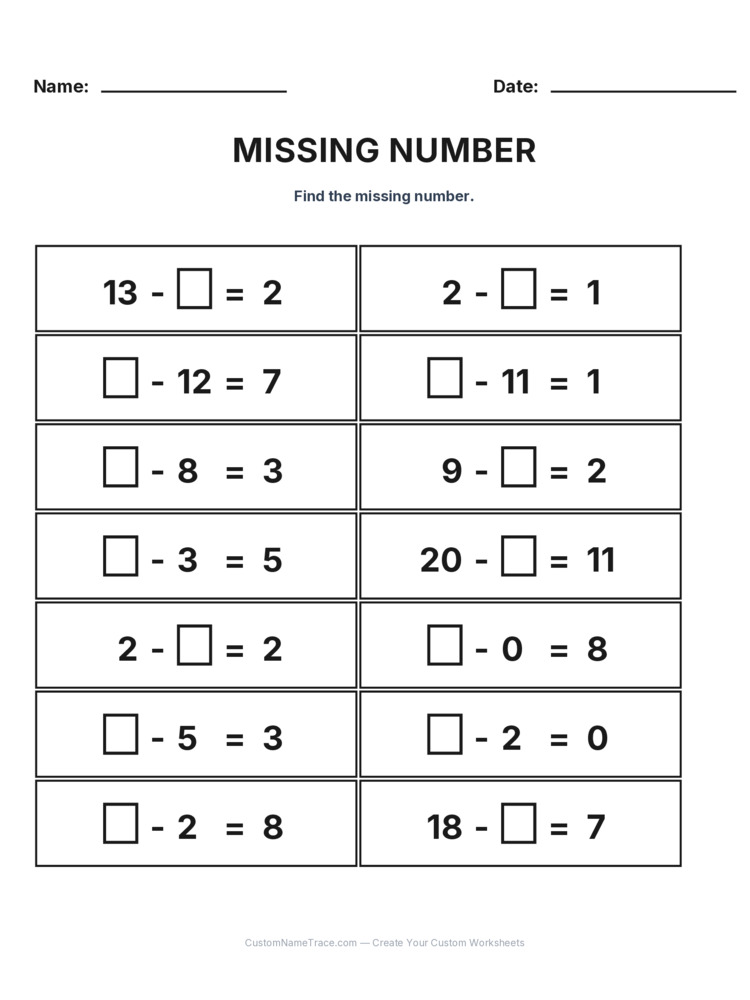
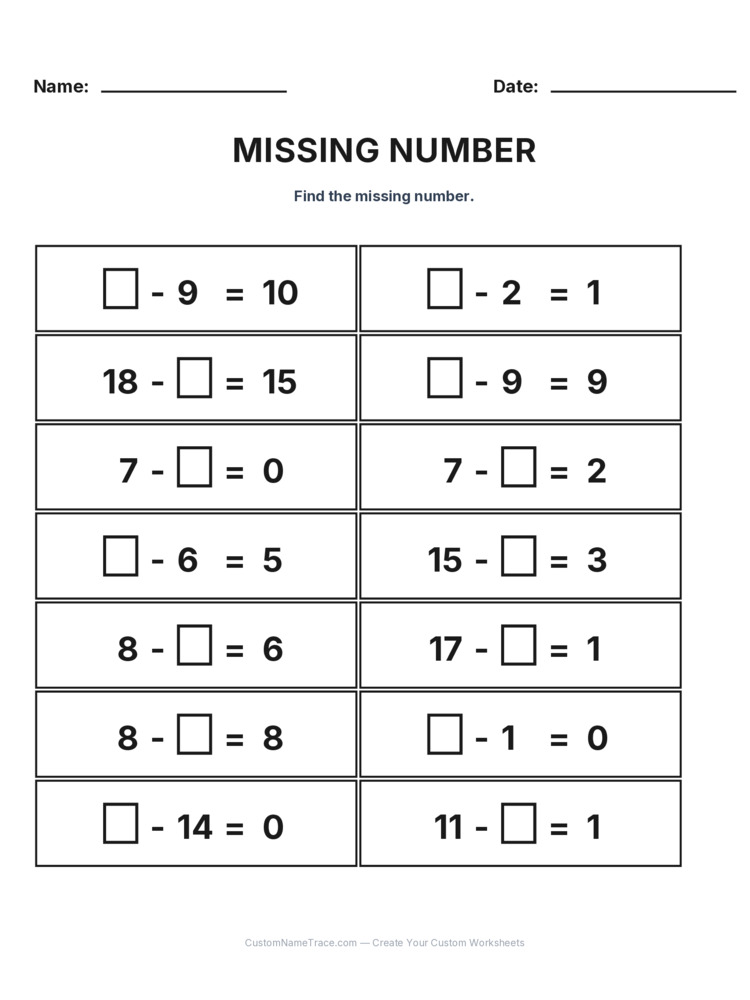
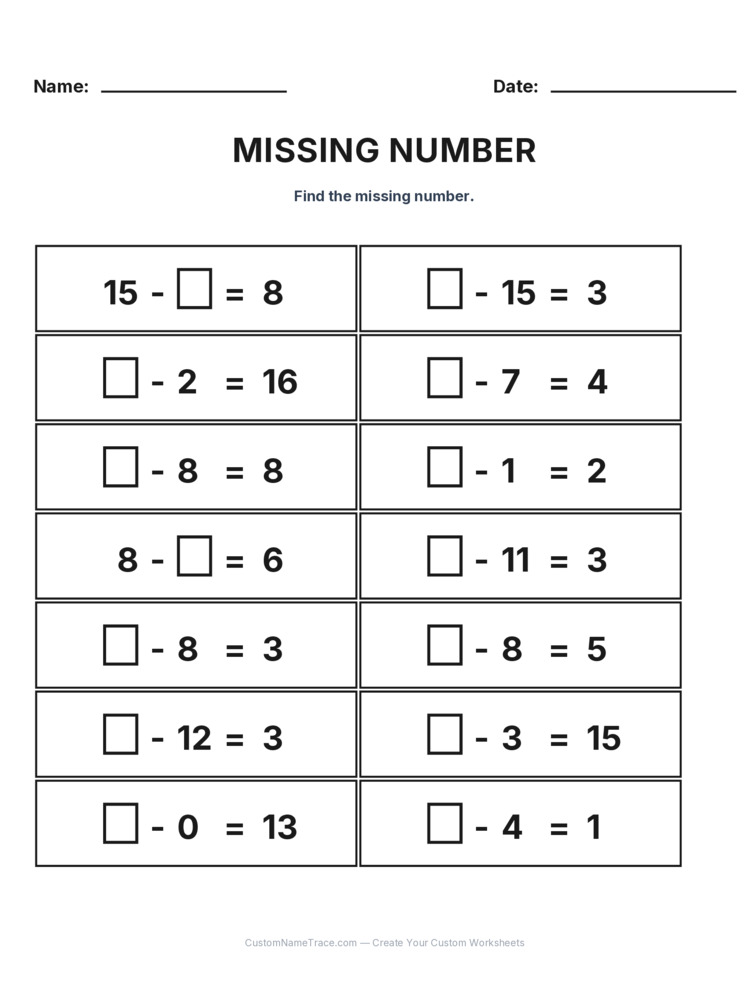
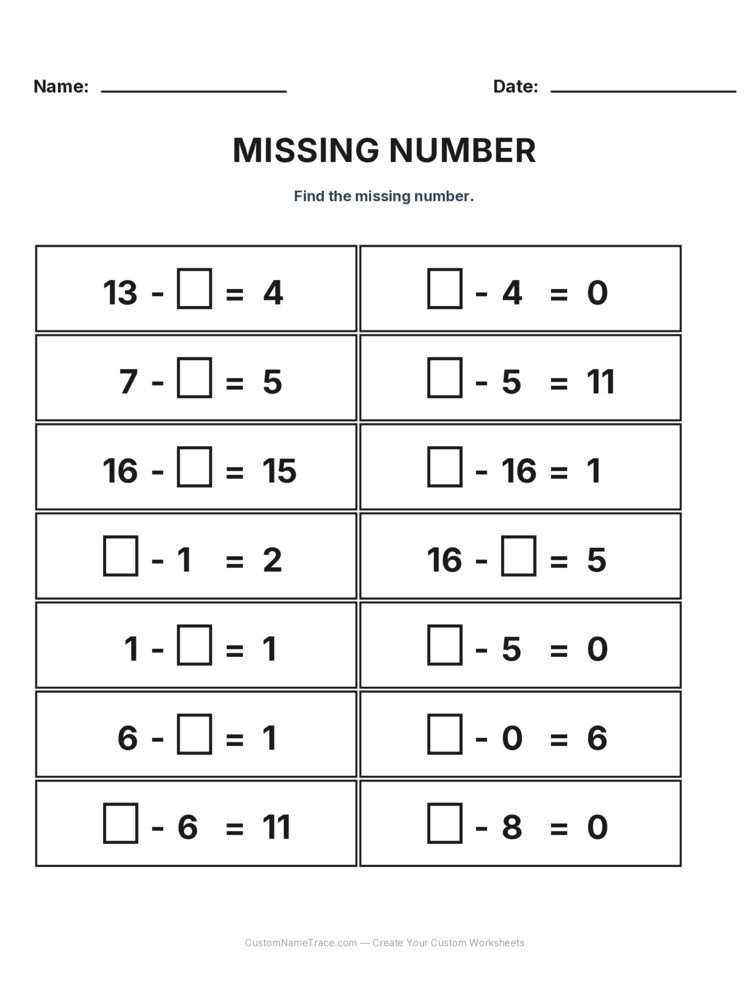
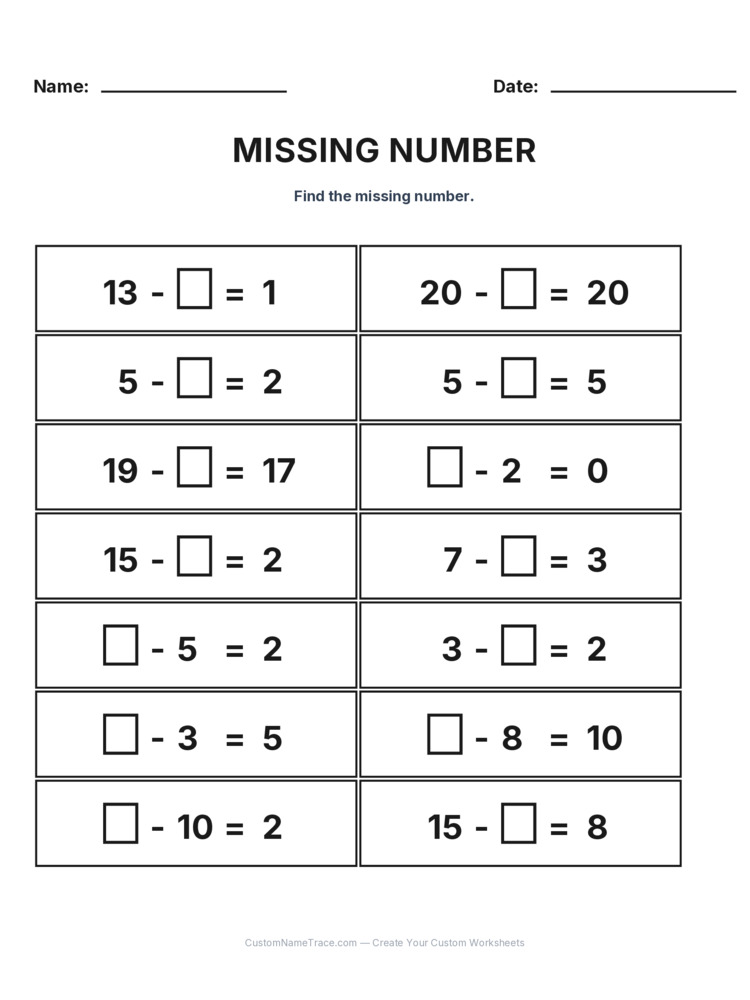
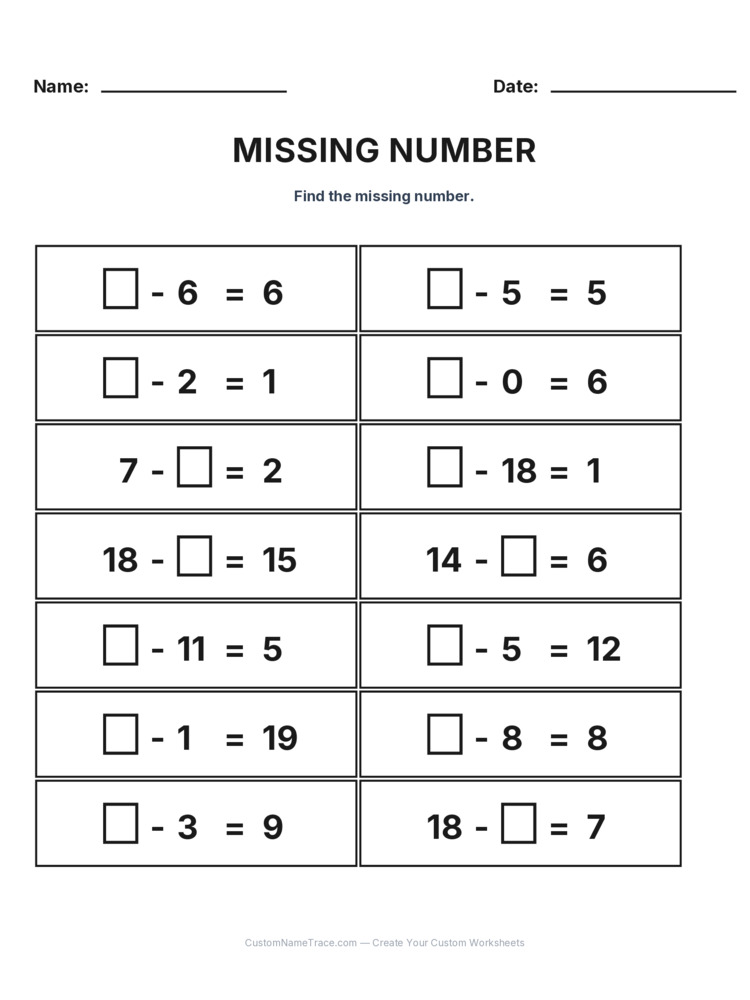
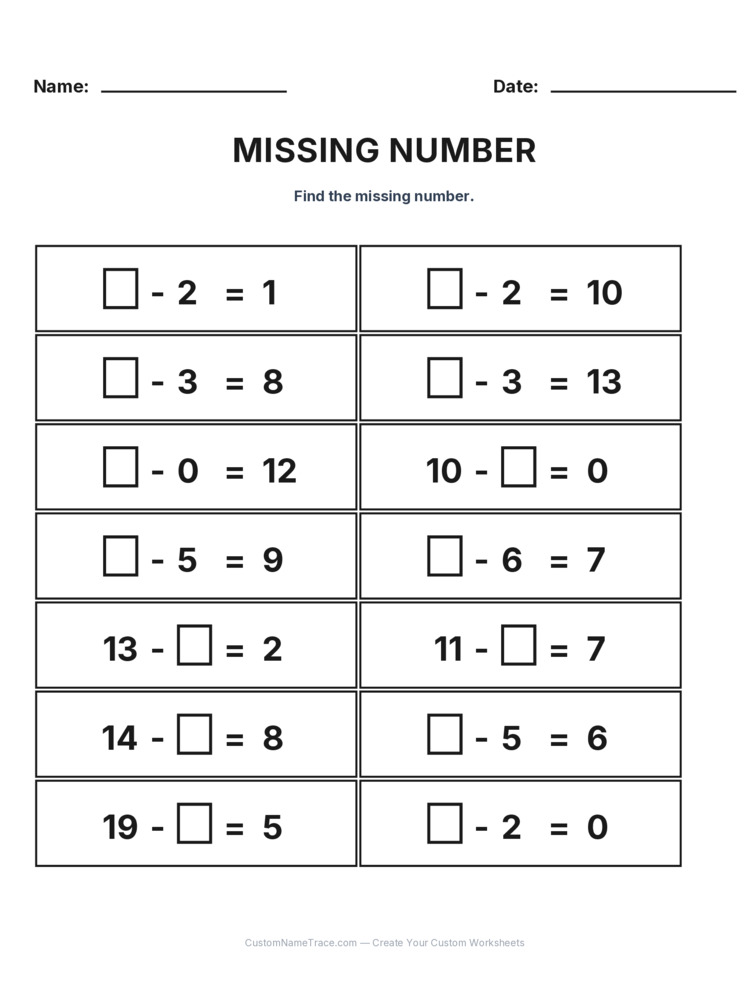
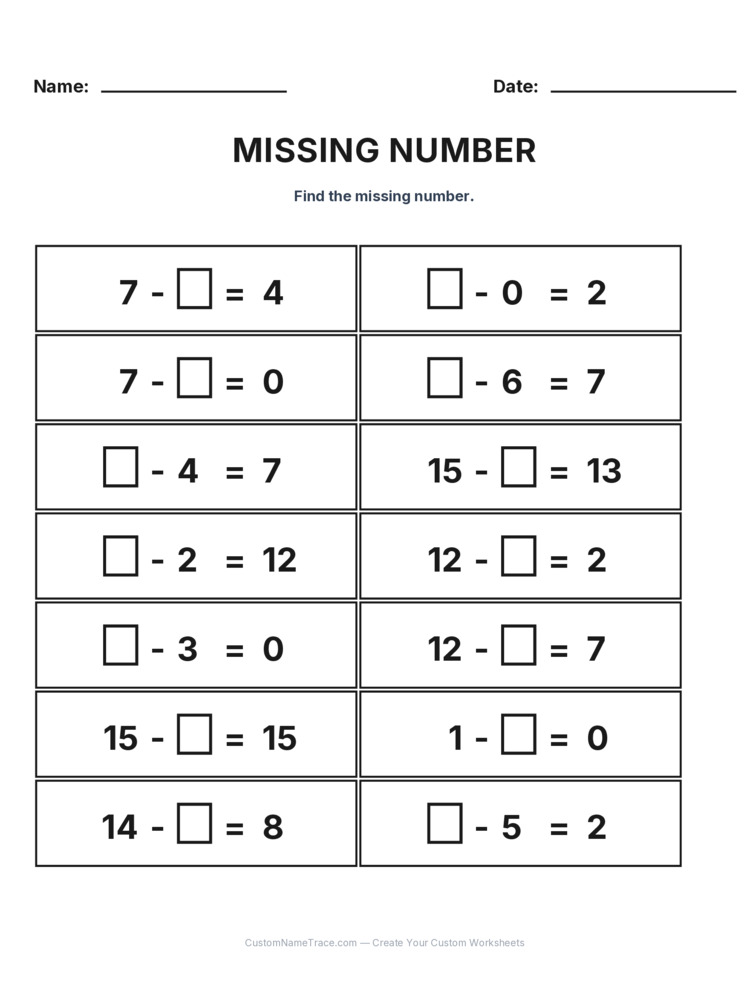
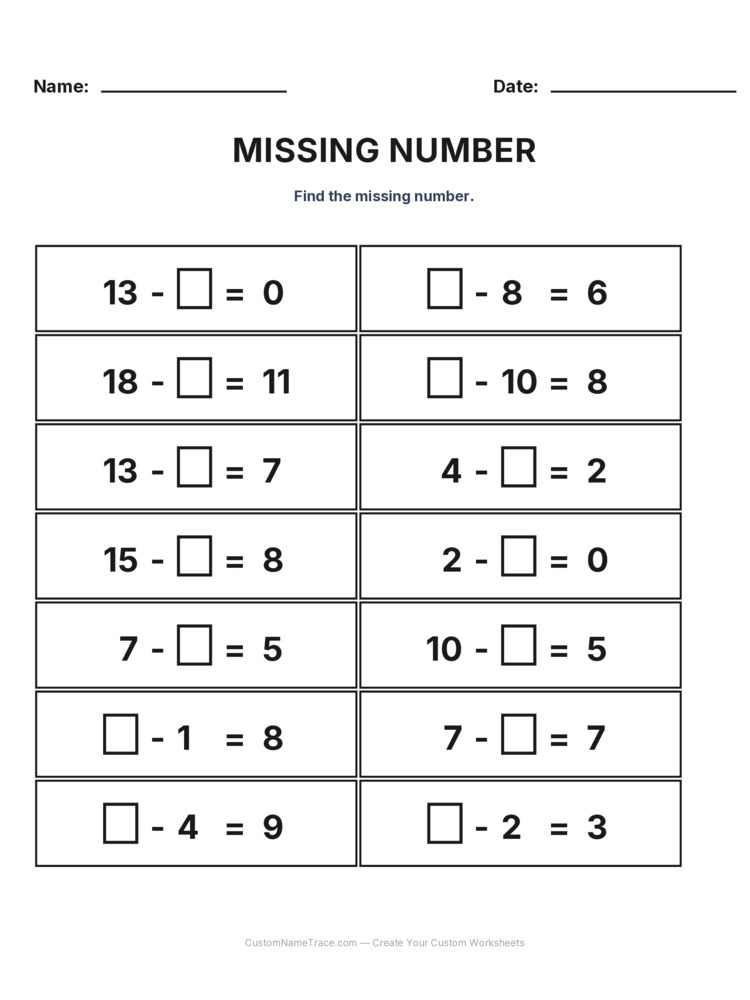
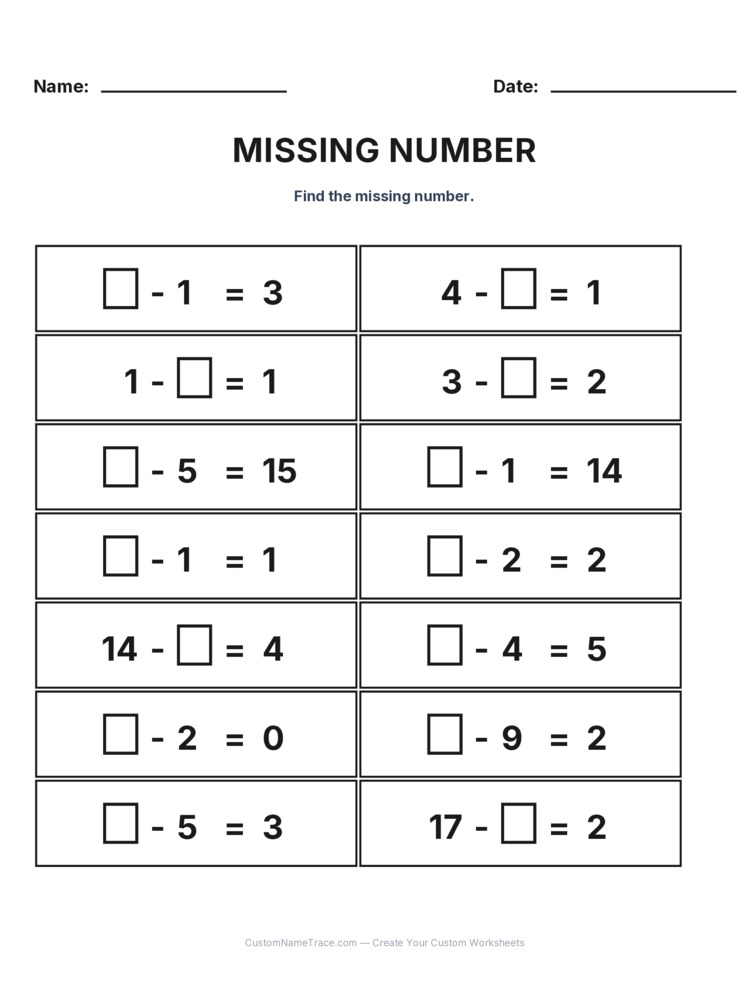
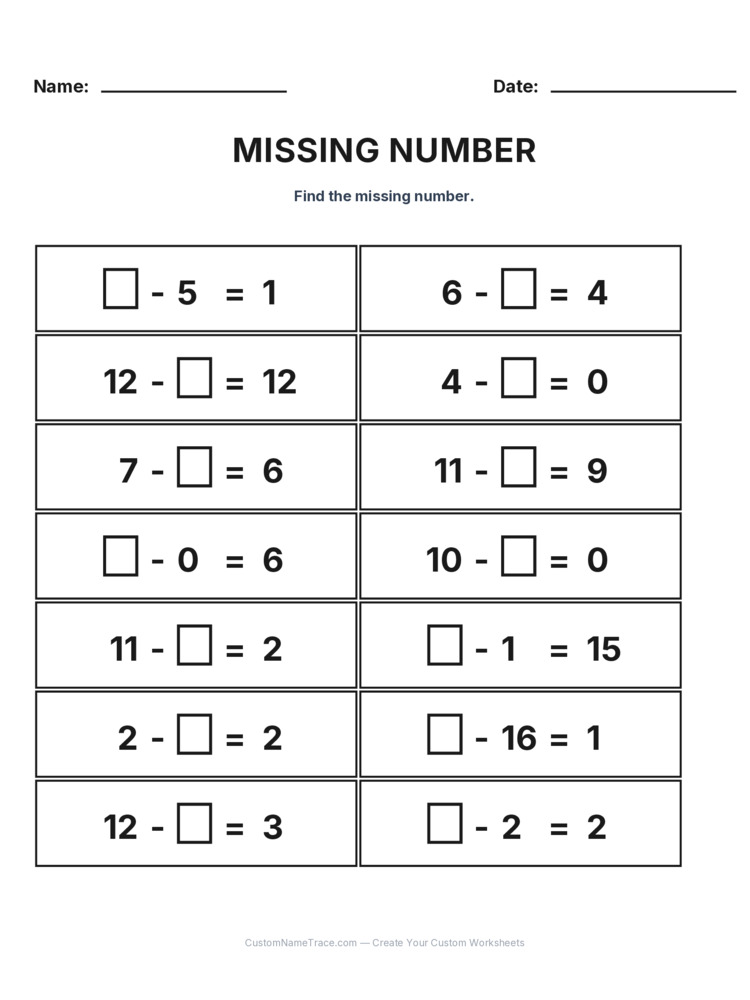
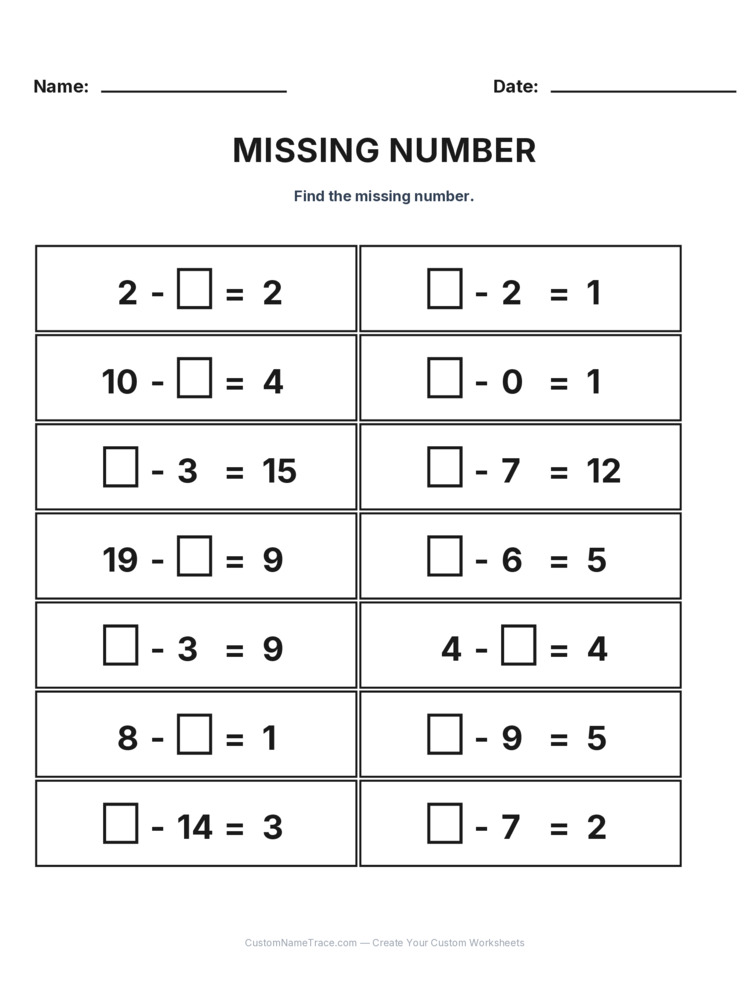
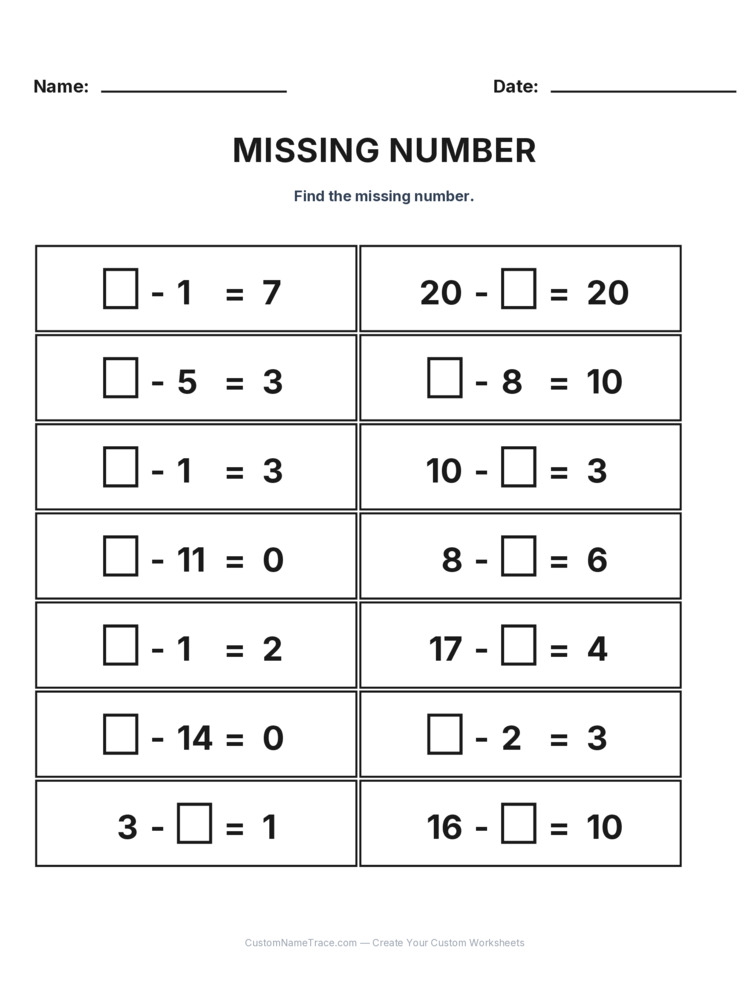
Why a missing number is a genuinely different question
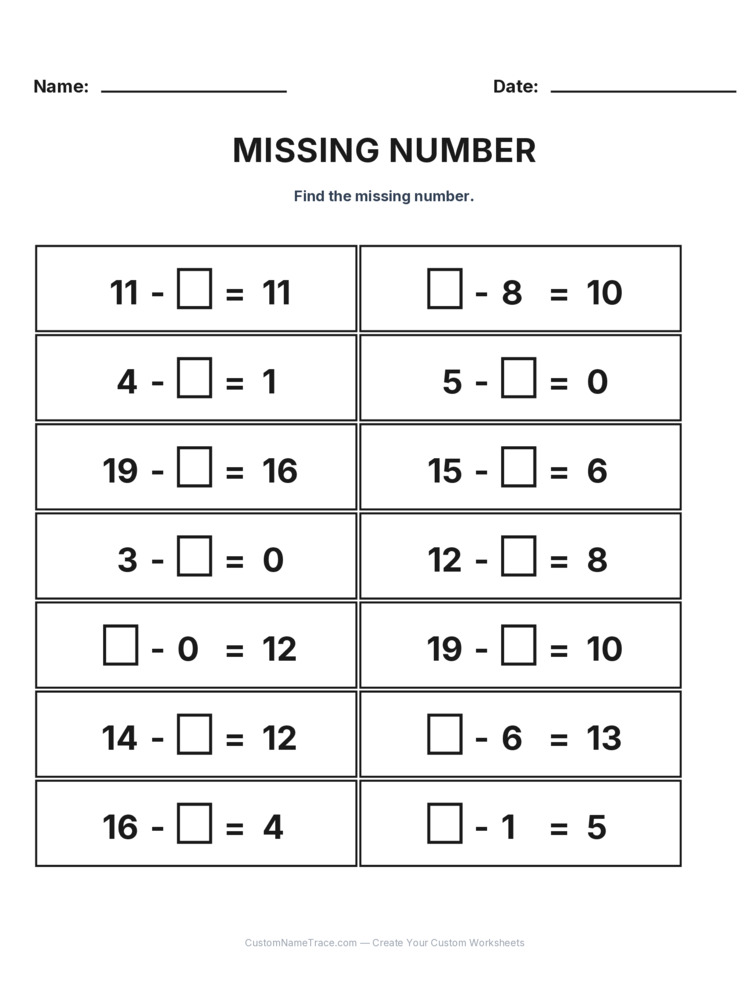
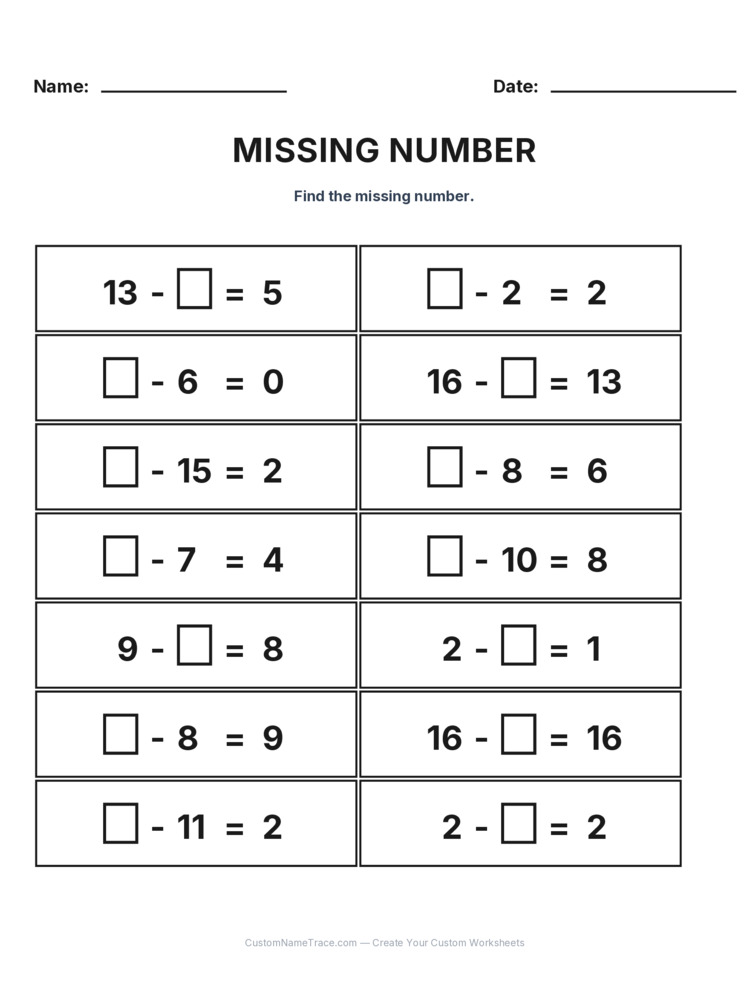
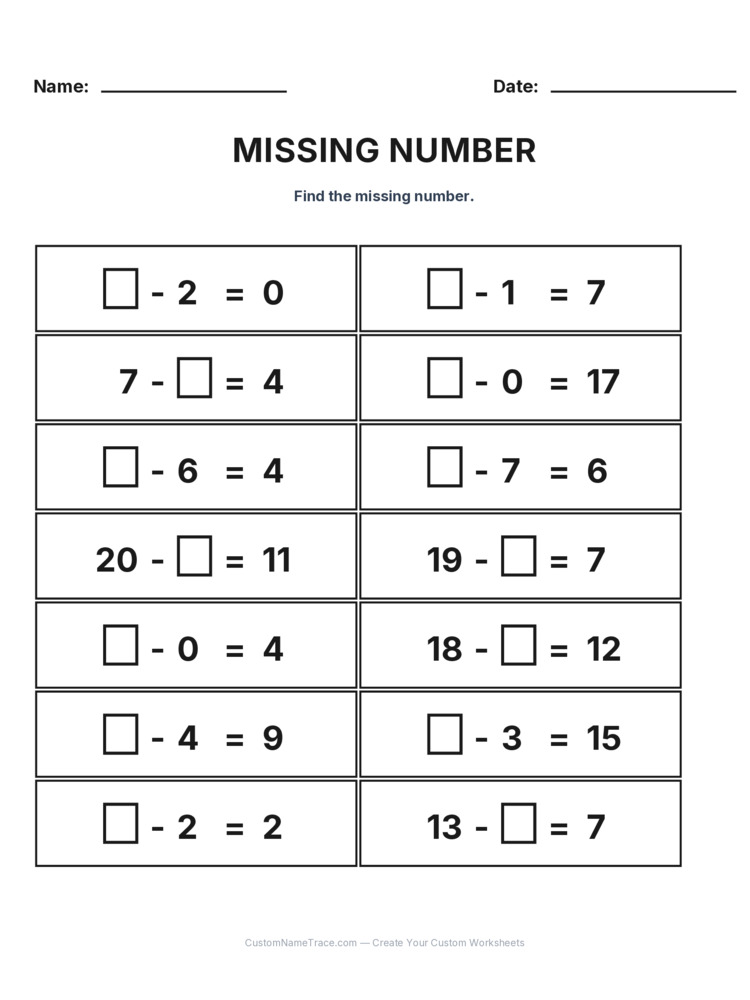
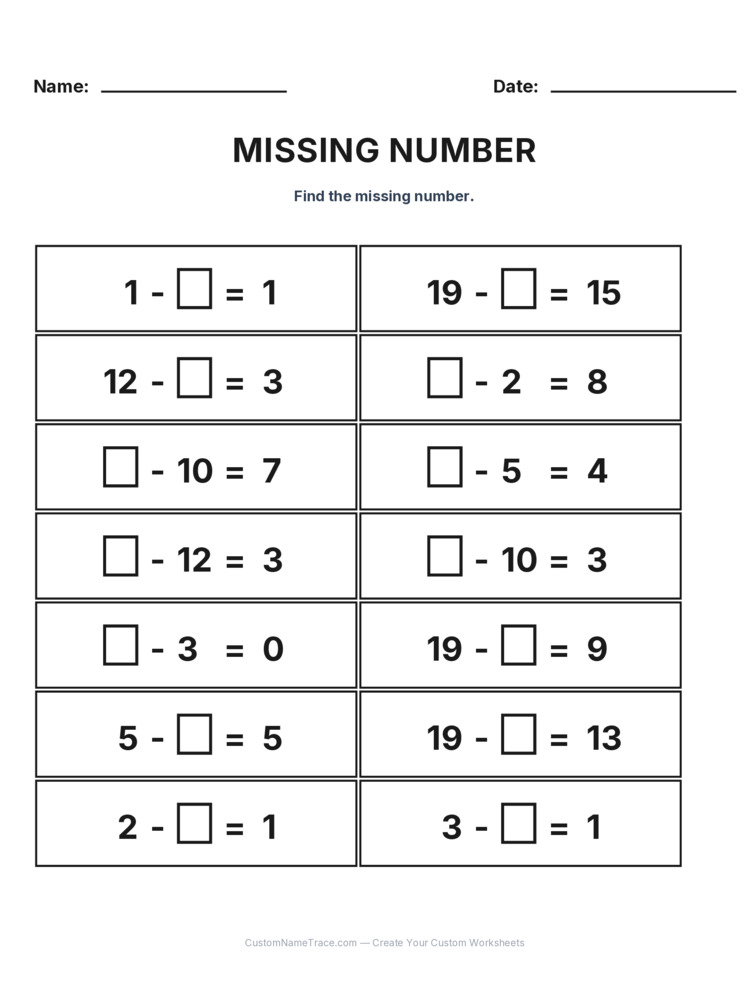
A problem like 7 + box = 12 looks similar to 7 + 5 = box, but it asks for something meaningfully different — instead of combining two known numbers to find a total, a child has to work backward from a known total to find what's missing. That's the earliest, most concrete form of algebraic thinking a child encounters: solving for an unknown, just written with a blank box standing in for a letter rather than a variable like x. Every problem on this worksheet is built at Grade 1's number range specifically so the reasoning is new, even though the numbers themselves are already familiar from this site's other Grade 1 practice.
The position of the missing box also varies deliberately — sometimes it's the second number (7 + box = 12), sometimes the total itself is missing in a related problem elsewhere on this site, and sometimes, for subtraction, the missing number sits at the very start (box − 4 = 9). Each position asks for a slightly different backward move, and working through several positions in the same sitting builds real flexibility rather than one memorized trick for one specific box position.
A strategy that works for every missing-number problem
The most reliable approach is to rewrite the problem as its opposite operation before solving — for 7 + box = 12, that means asking "what does 12 − 7 equal?" instead of guessing numbers and checking. This flip-the-operation strategy works because addition and subtraction are two views of the same relationship: any missing addend can be found by subtracting, and any missing number in a subtraction problem can be found by adding. Teaching that flip explicitly, rather than expecting a child to discover it through trial and error, turns a confusing new format into a straightforward application of a skill they already have.
For a child who isn't ready to flip the operation mentally yet, drawing the known total as a group of objects, then physically removing or adding the known quantity, makes the missing amount visible and countable rather than abstract. This concrete version is worth using for the first several problems a child encounters, phasing it out once the flip-the-operation shortcut starts to feel natural on its own.
What a wrong answer usually reveals
A child who answers a missing-number problem by simply adding the two visible numbers together, regardless of their actual position, hasn't yet recognized that this format asks for something different from a standard sum — 7 + box = 12 answered as "19" is a clear sign the backward-reasoning step was skipped entirely rather than attempted incorrectly. Pointing out plainly that the total is already given, and the box is asking what's missing to reach it, resets the framing before trying the strategy again.
A close-but-wrong answer, on the other hand, usually reflects a small arithmetic slip in an otherwise correct approach — the flip-the-operation strategy was applied, just with a minor calculation error. Distinguishing between these two very different kinds of mistakes (wrong approach versus a solid approach with a small error) shapes what kind of help actually moves a child forward.
Where this leads next
Missing-number problems are the direct bridge between concrete arithmetic and the formal algebra a child encounters years later — solving 7 + box = 12 today and solving 7 + x = 12 in a future algebra class require exactly the same underlying move, just with a different symbol standing in for the unknown. A child who's genuinely comfortable finding a missing number at Grade 1's range has already practiced the core reasoning skill that equation-solving depends on, well before the word "algebra" ever comes up.
This format also pairs naturally with this site's standard Subtraction worksheets at the same range — moving between finding a total and finding a missing addend, using the identical numbers, reinforces that both are the same underlying fact family viewed from different angles.
Using this worksheet effectively
For a child encountering this format for the first time, working through the first few problems together — saying the flip-the-operation strategy out loud each time — builds the habit explicitly rather than leaving a child to guess at what's being asked. Once a child solves several problems correctly and explains their reasoning without prompting, that's a strong, concrete sign the underlying skill has genuinely taken hold, not just been memorized for this one worksheet.
Every numbered variant generates a fresh set of missing-number problems at Grade 1's range, with the missing position varied across the page, so repeat practice always means working through genuinely new problems rather than recalling a previous page's answers. Every worksheet here downloads as a free, print-ready PDF with no account required.