Division as splitting into equal groups
Before division becomes a fact recalled from memory, it's genuinely the question "how many equal groups can this be split into, and how big is each one?" Every division worksheet under Grade 3 is built with that concrete, splitting-into-groups idea underneath it, because a child who understands what division represents can reason through a forgotten fact rather than being stuck the moment memory alone isn't enough.
Splitting 20 into groups of 5 to find out how many groups result, and splitting 20 into 5 equal groups to find out how big each group is, are both genuinely division, even though they can feel like different questions to a child encountering them separately. Pointing out explicitly that both situations use the identical operation — and the identical division fact, 20 divided by 5 equals 4 — prevents a child from treating them as two unrelated skills to learn from scratch.
Division at Grade 3 is introduced only once a child has real footing in multiplication, because the two are directly, inseparably linked — every division fact is really a multiplication fact viewed from the opposite direction. Twenty divided by five asks the same underlying question as five times what equals twenty, and a child without solid multiplication facts to draw on has nothing to reason from when a division problem gets difficult.
What Grade 3 specifically covers within division
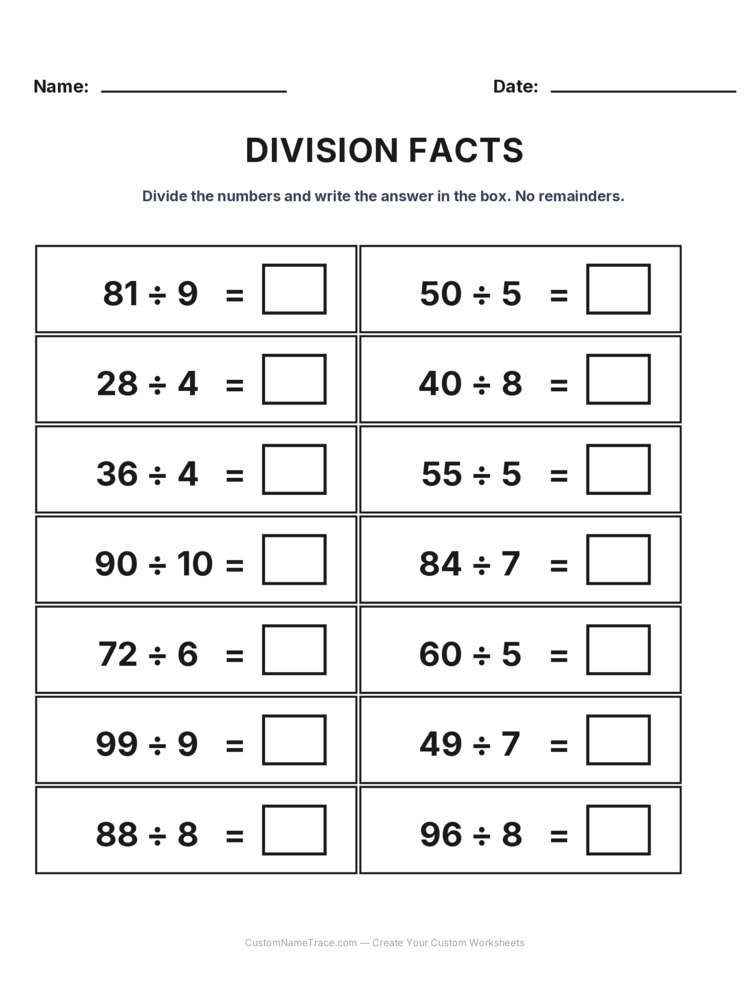
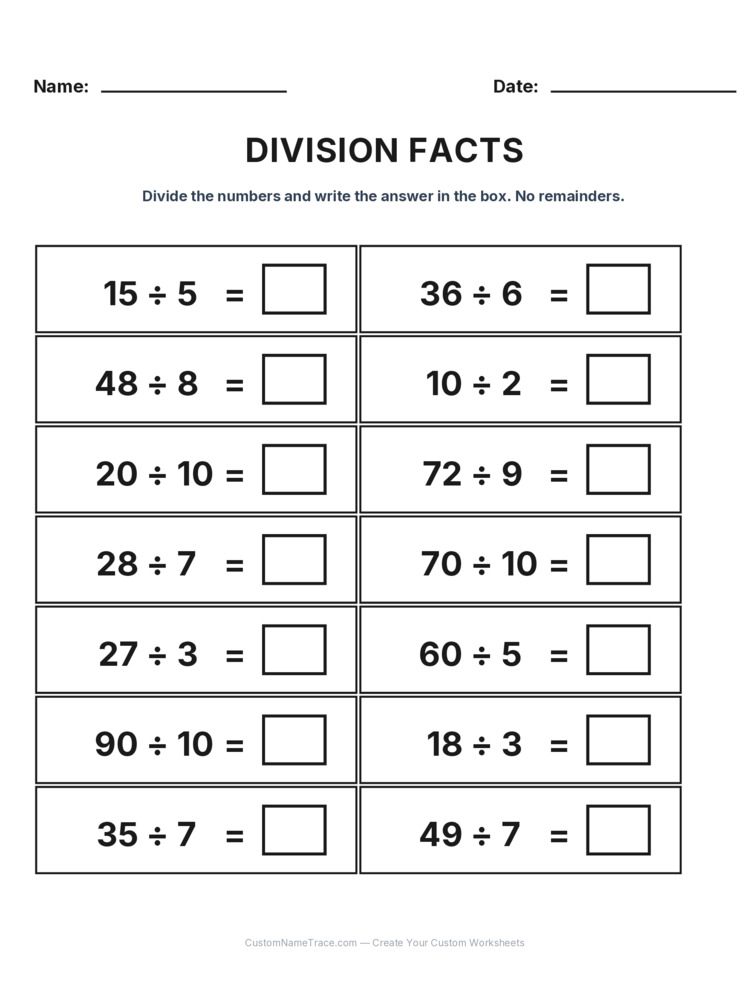
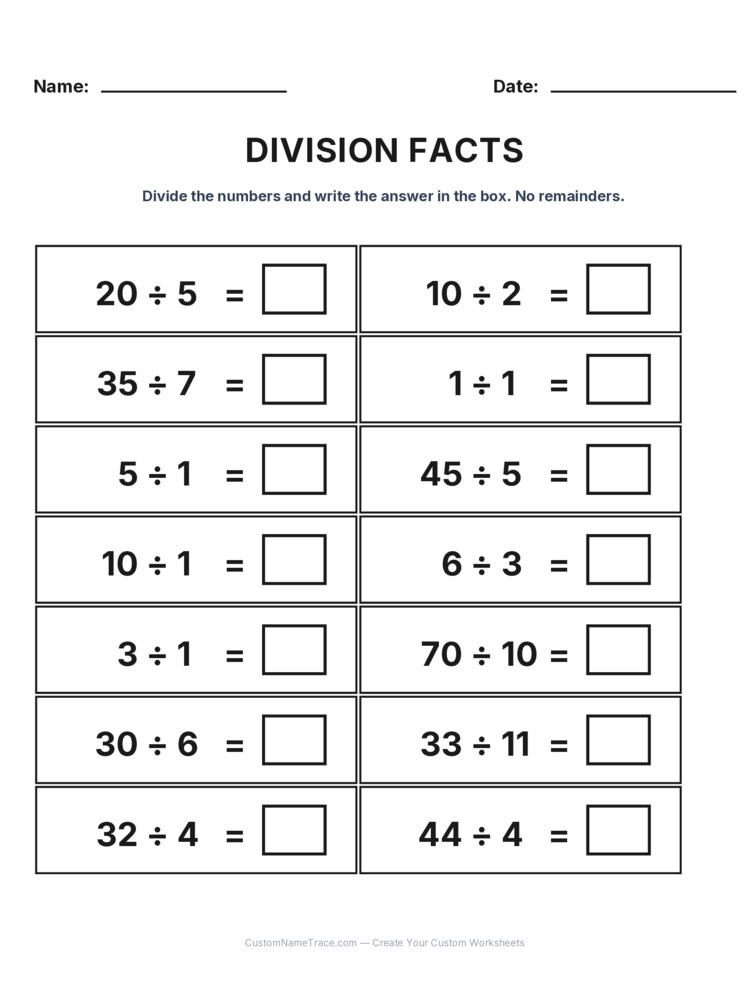
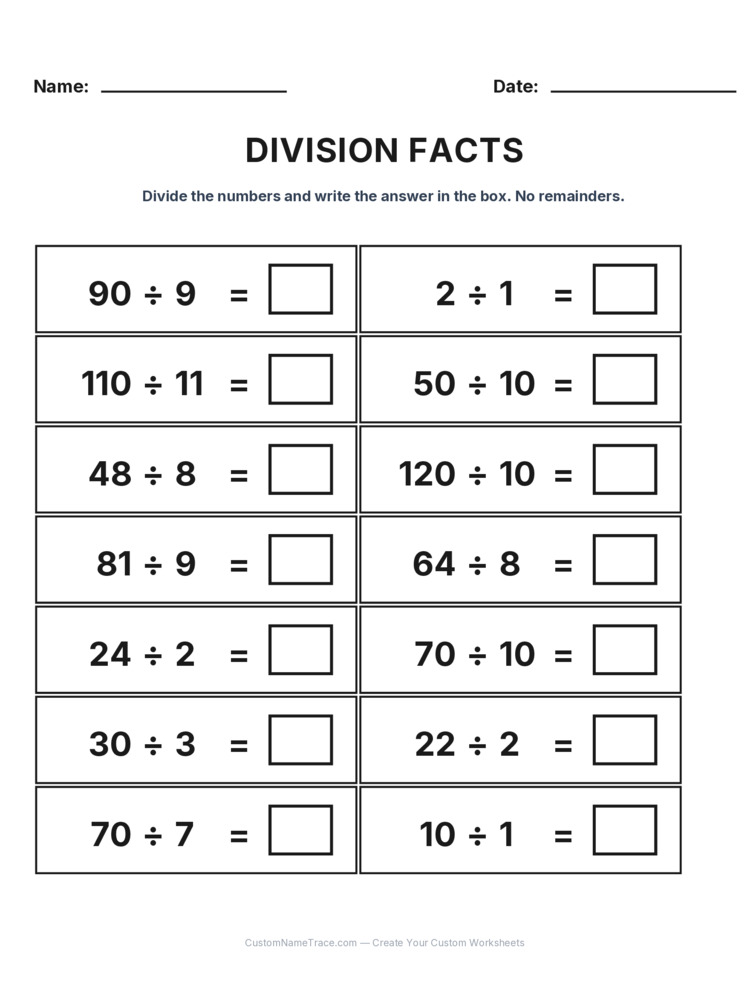
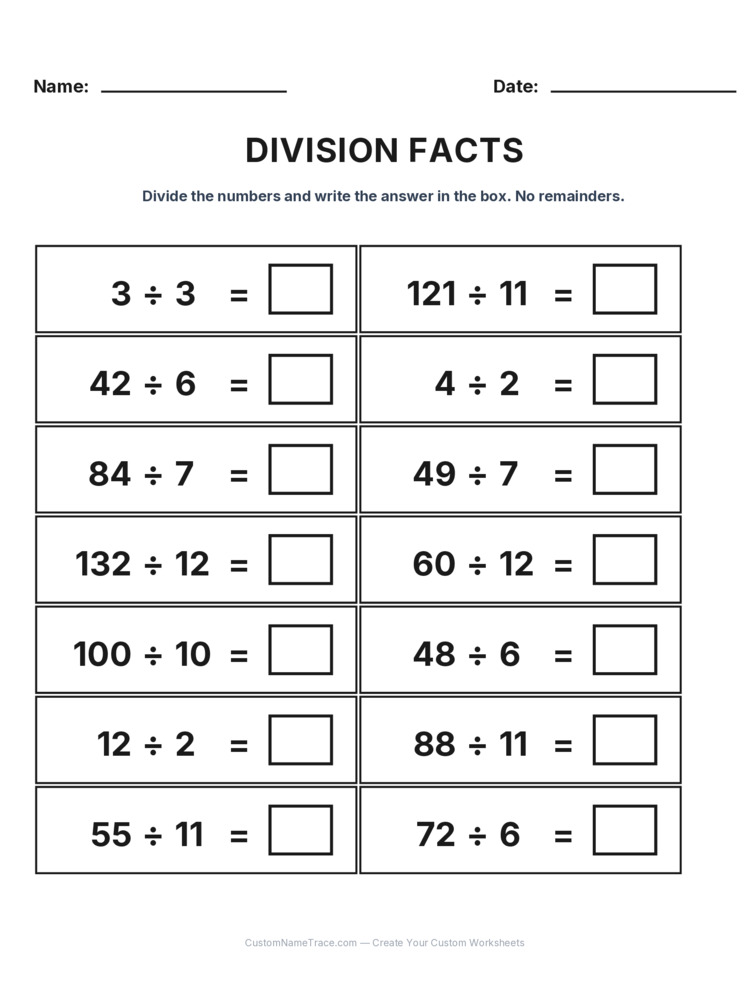
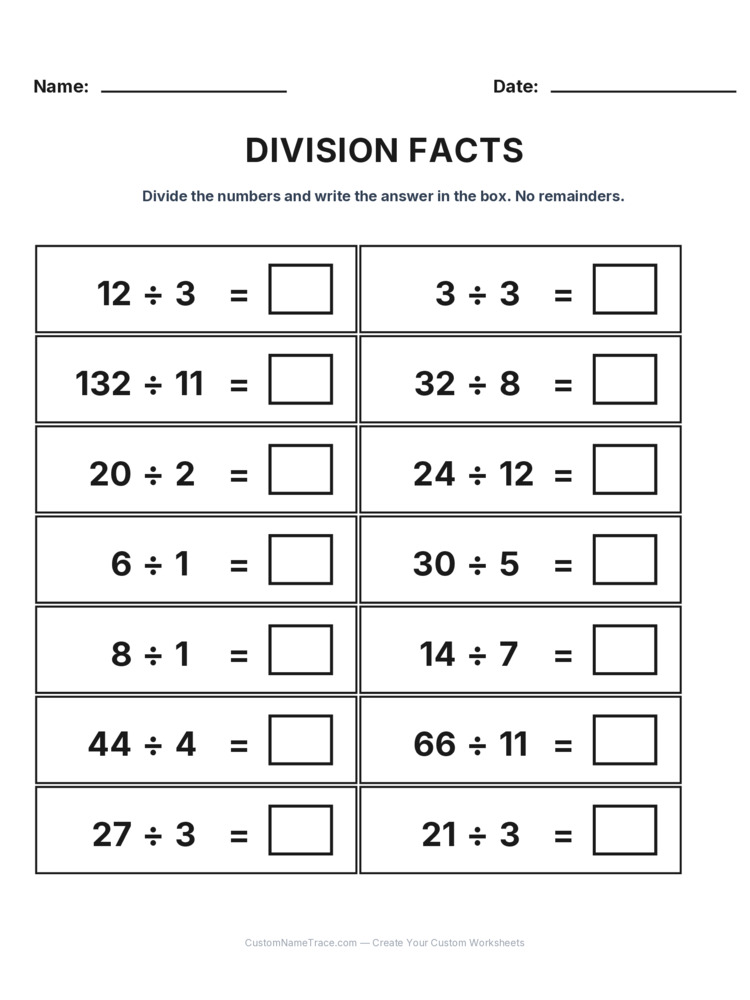
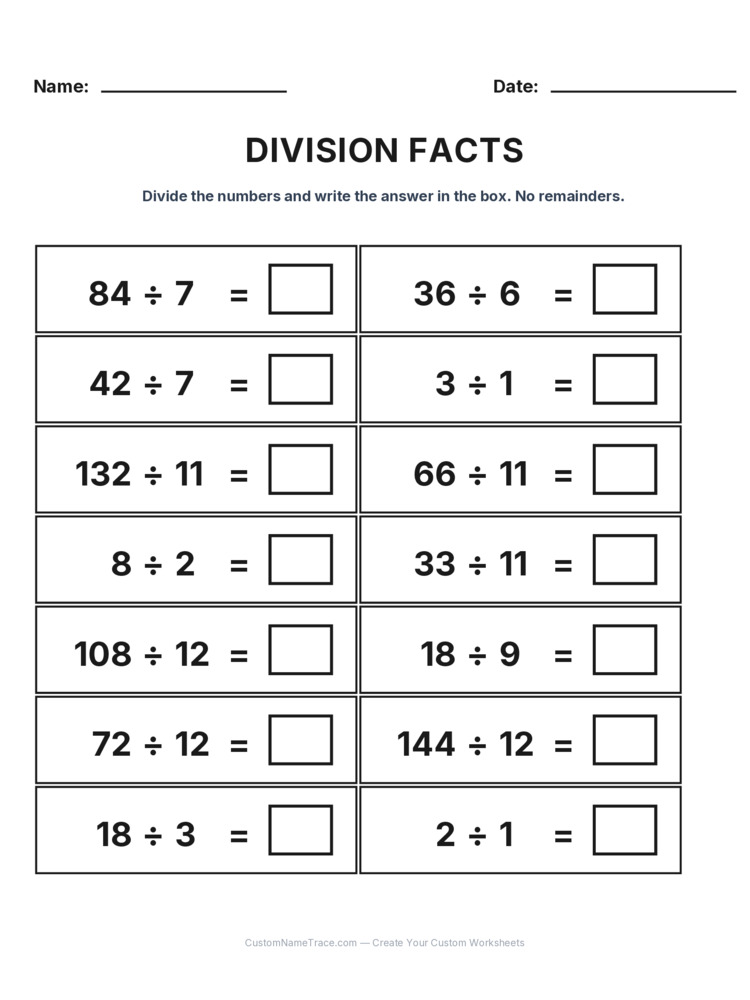
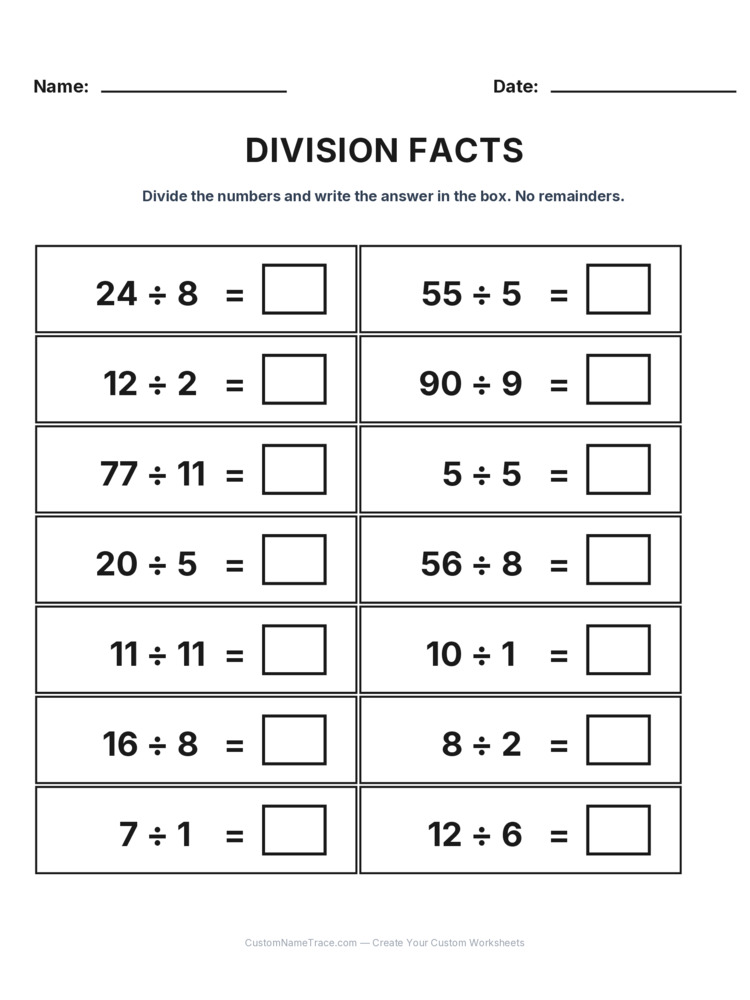
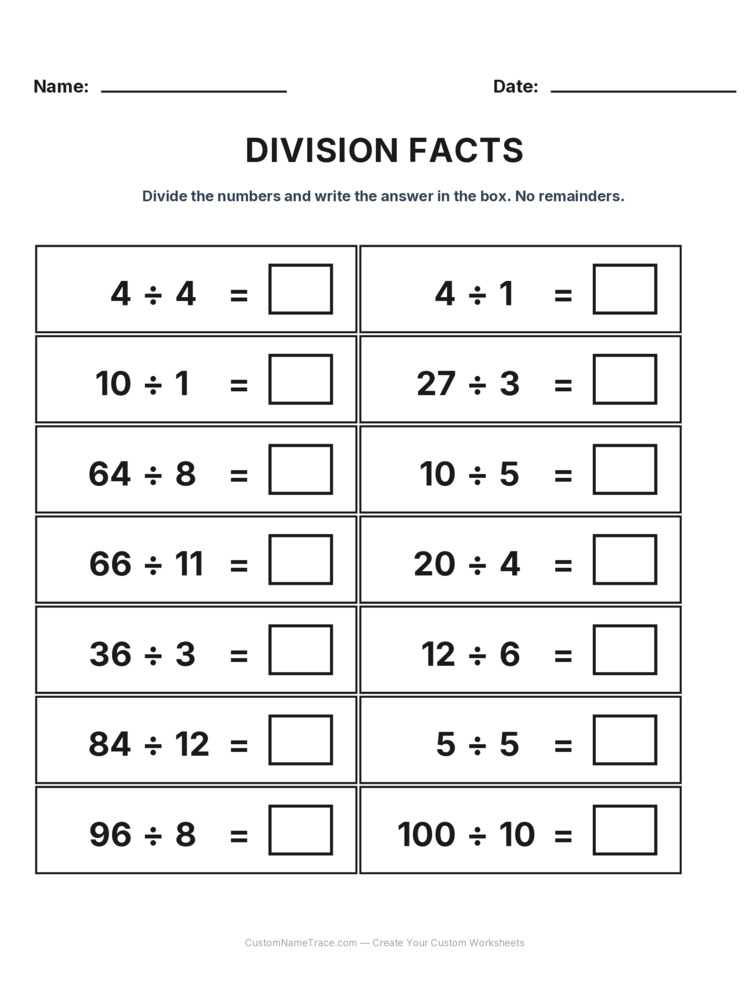
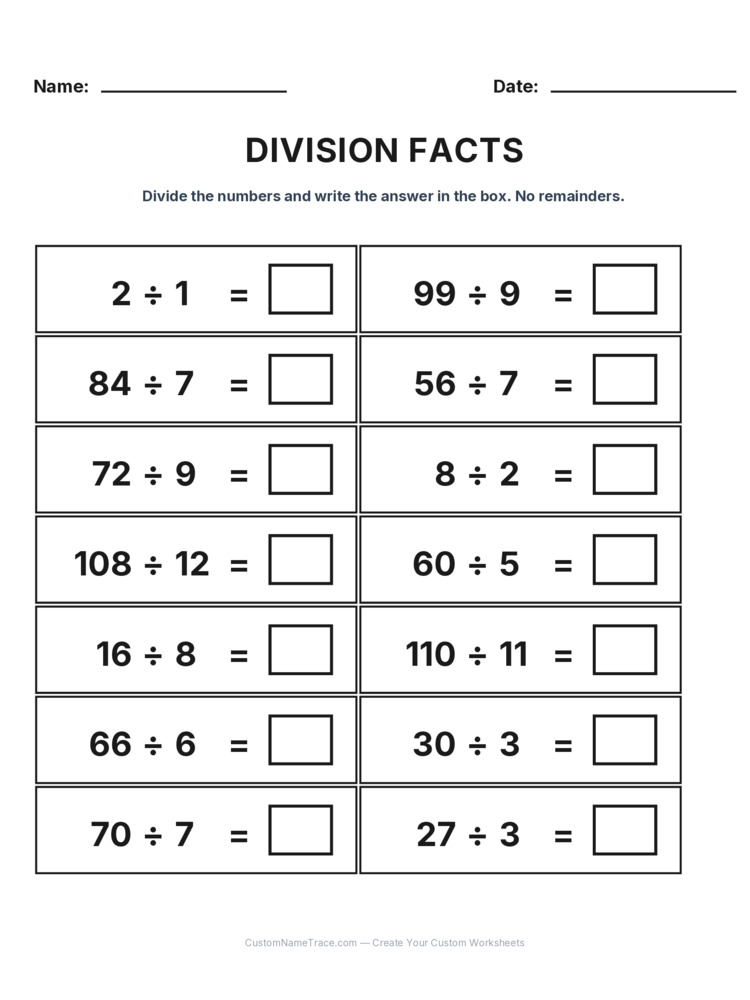
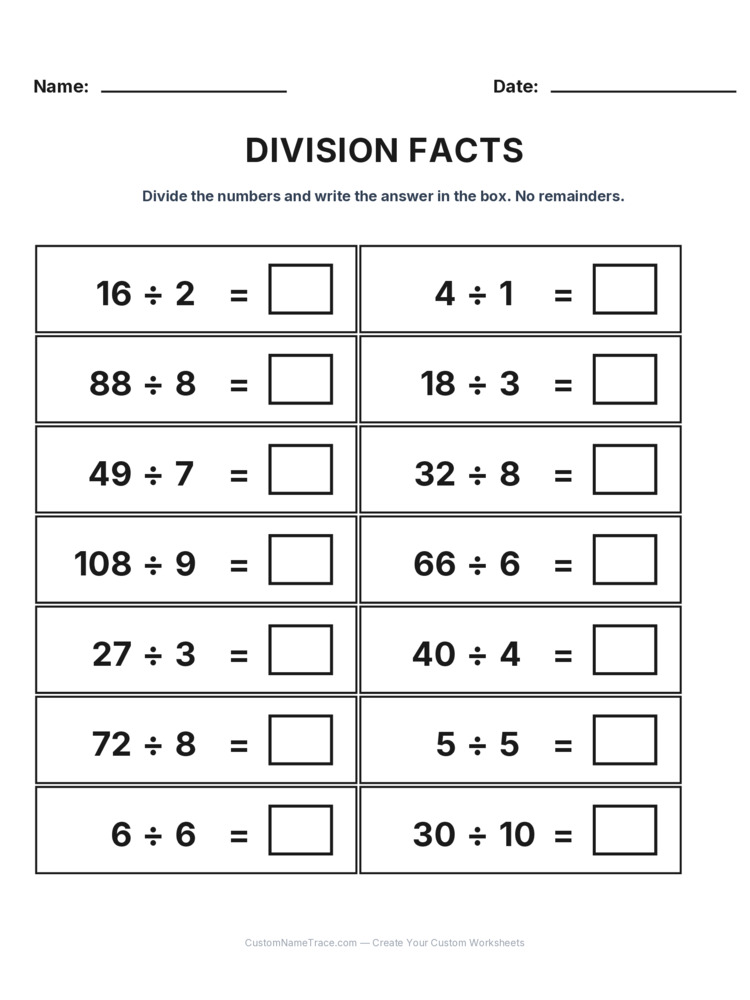
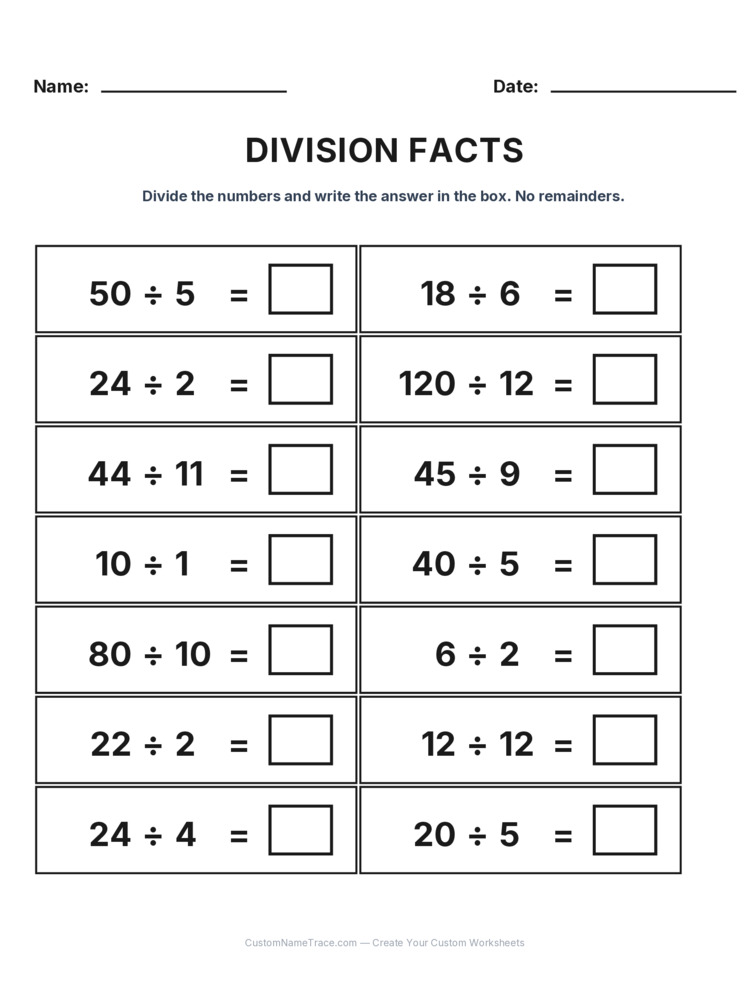
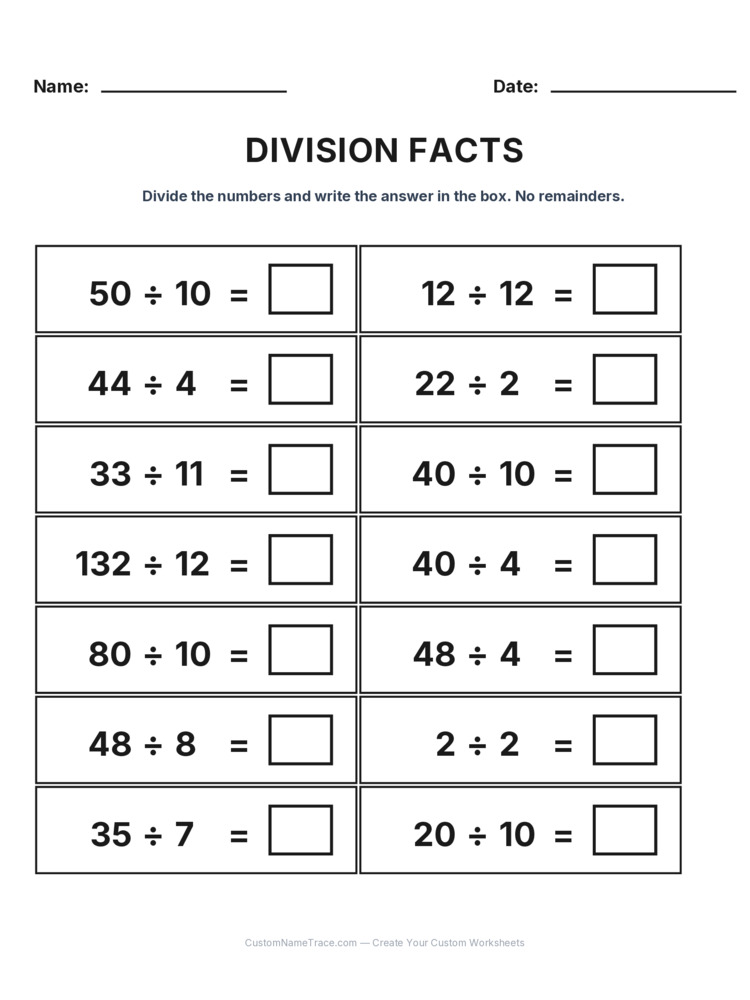
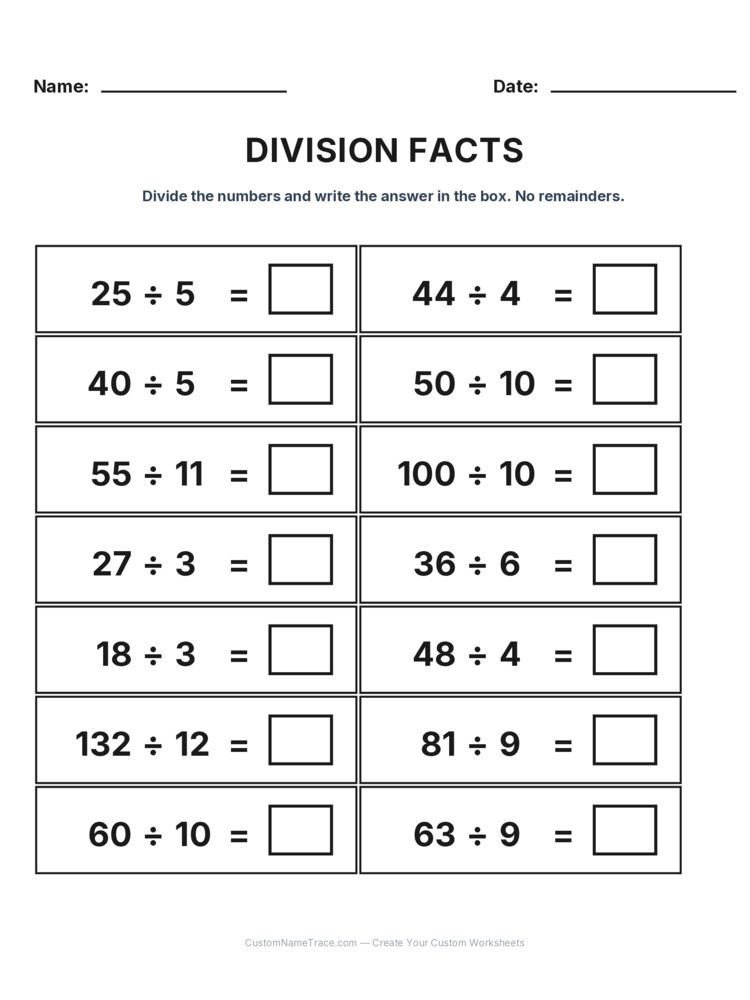
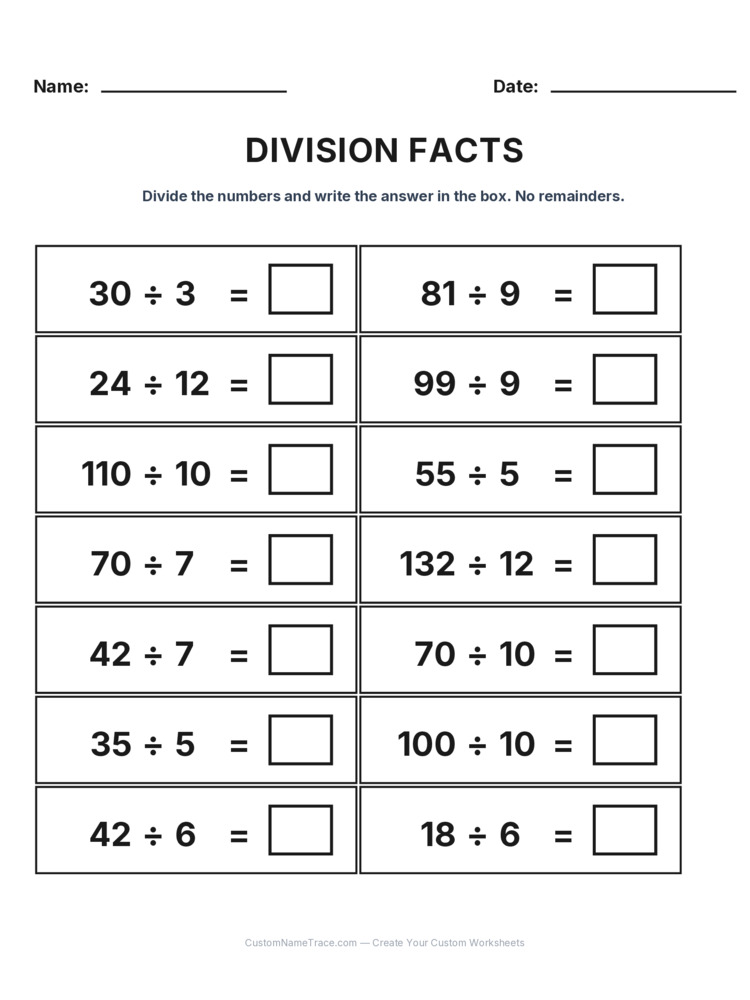
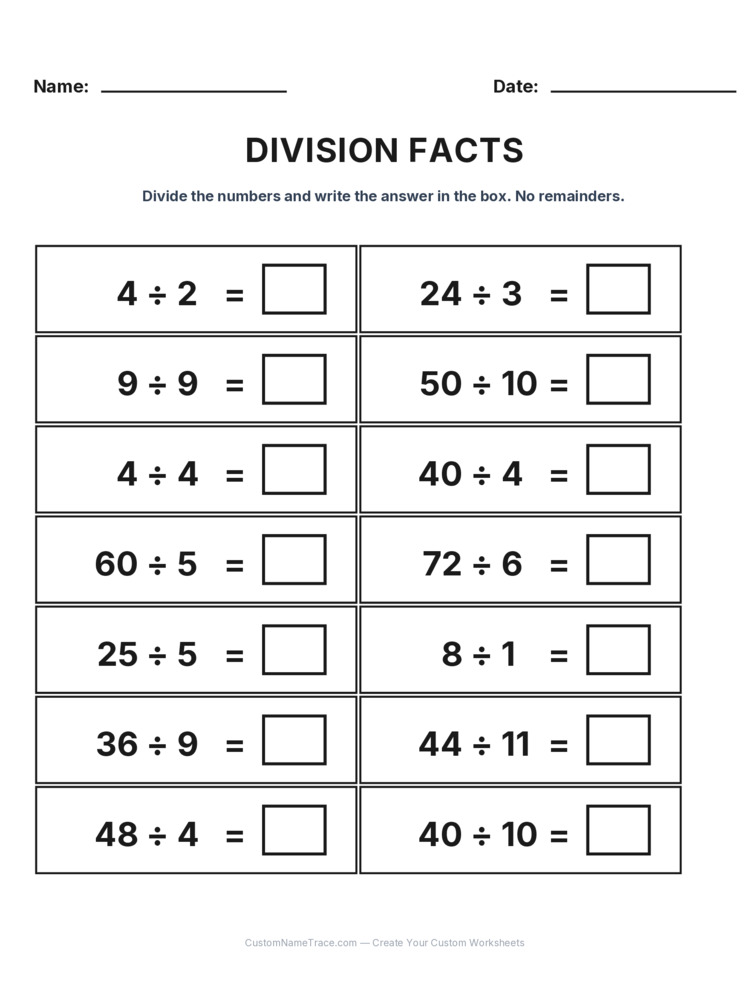
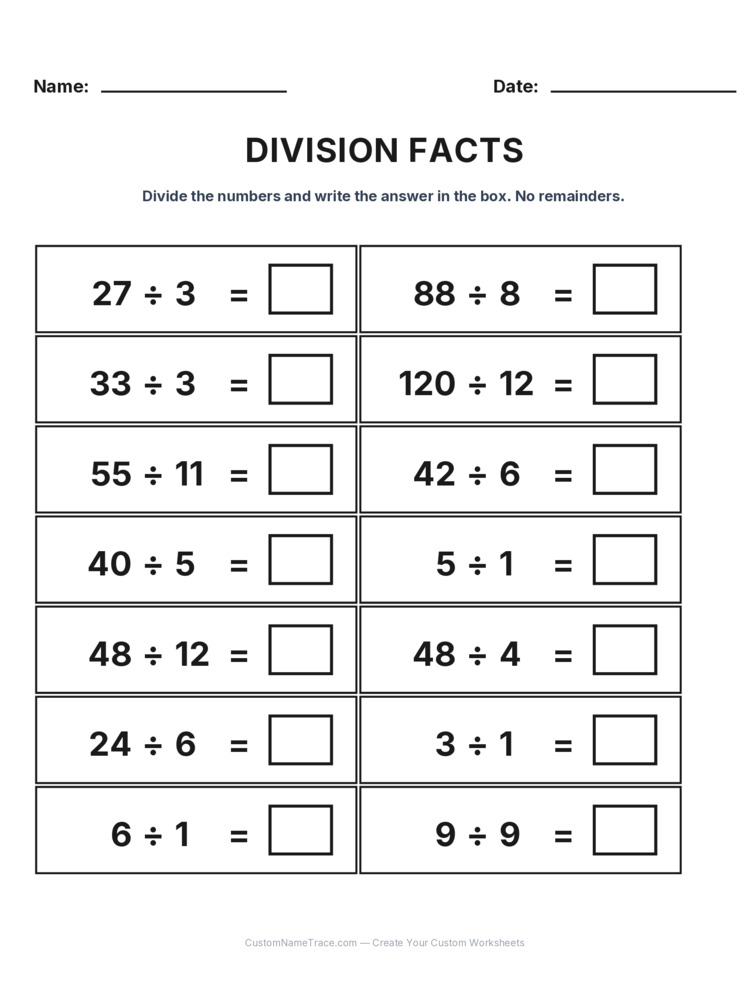
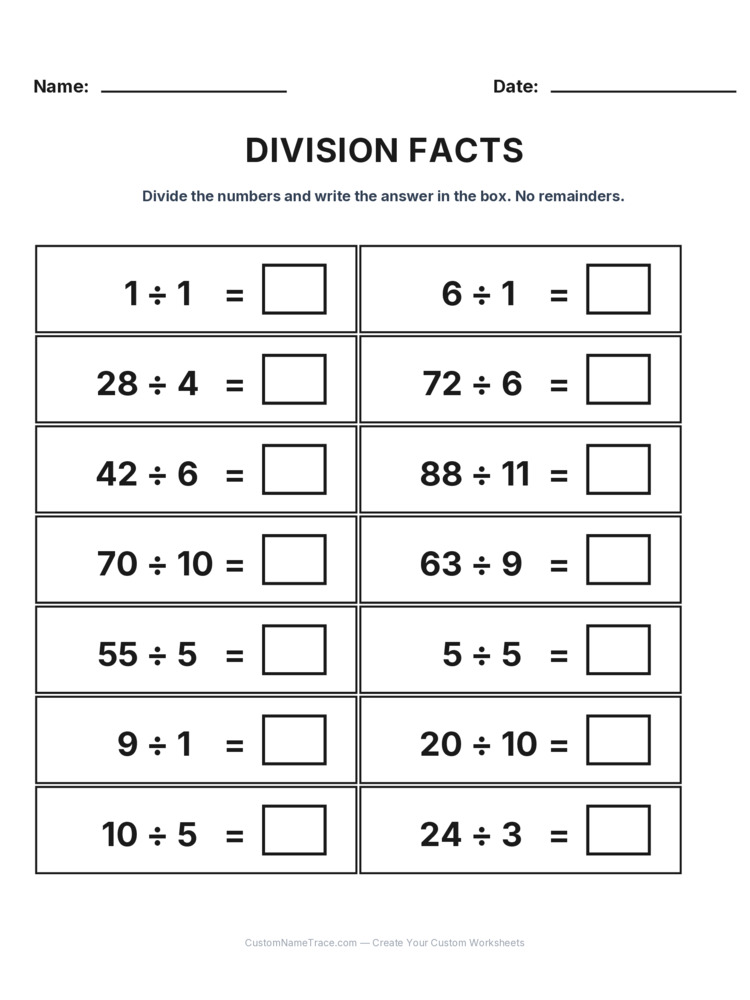
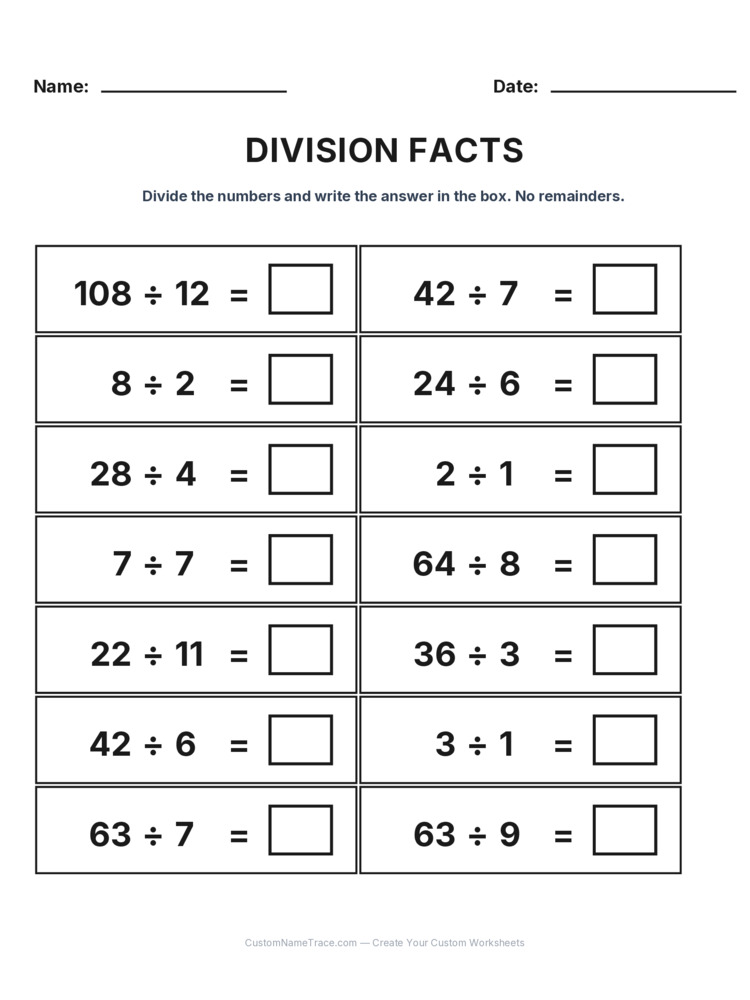
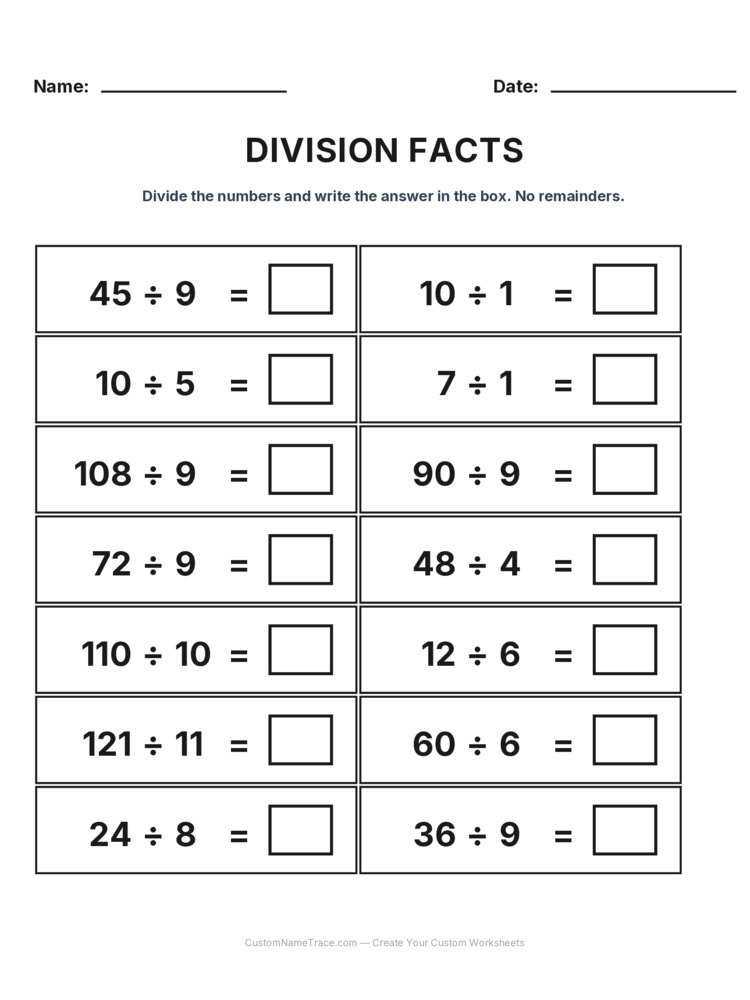
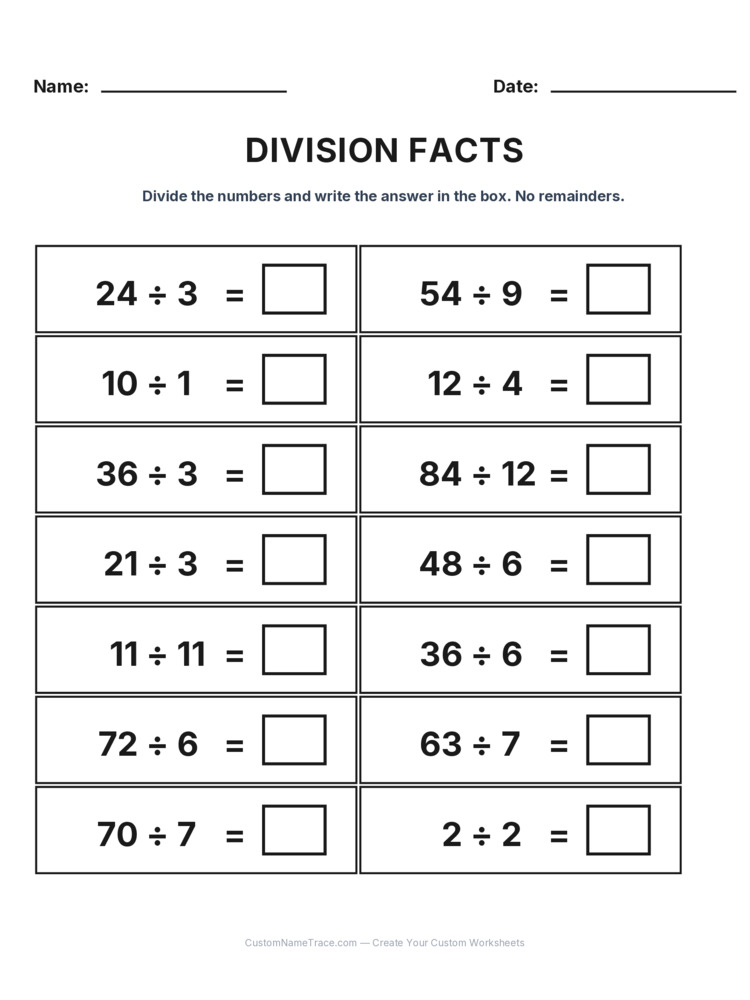
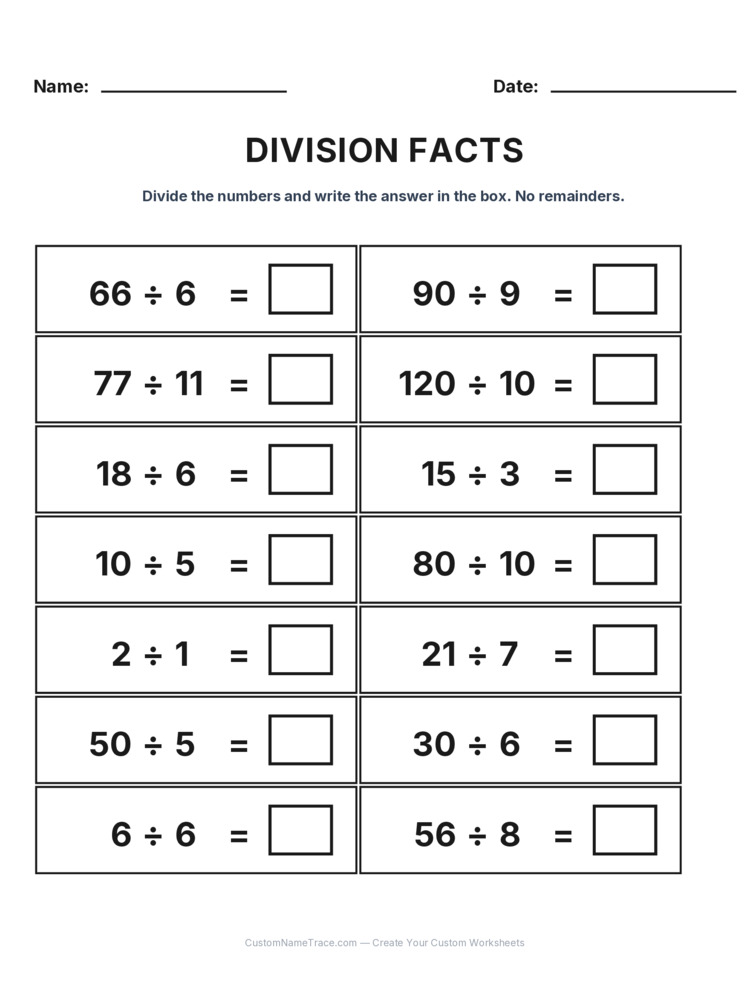
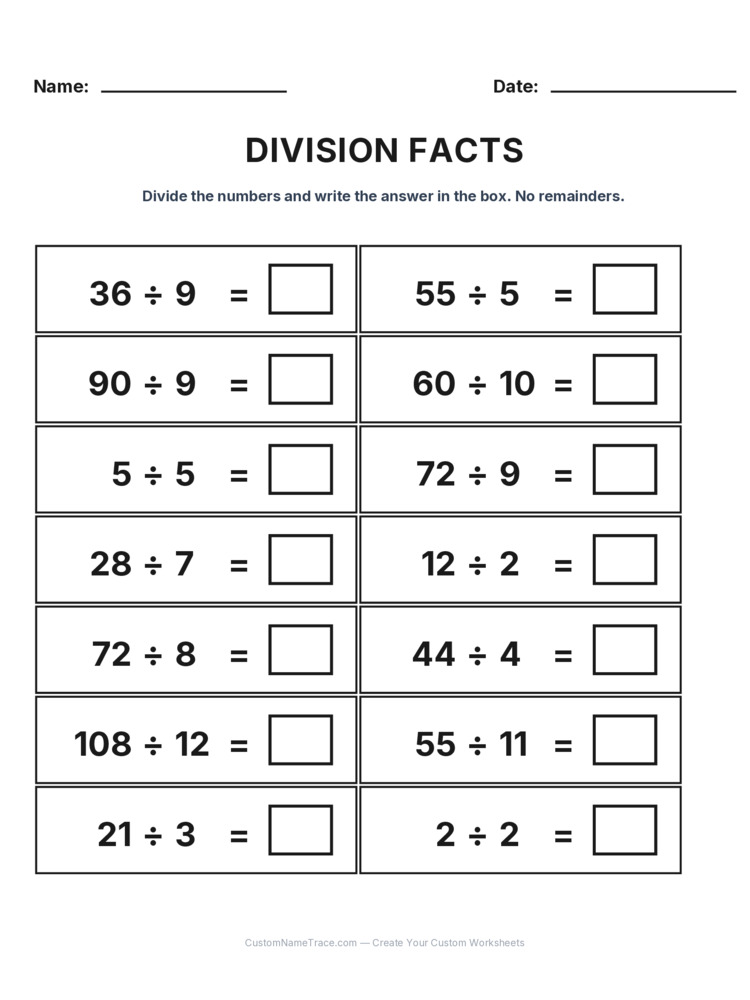
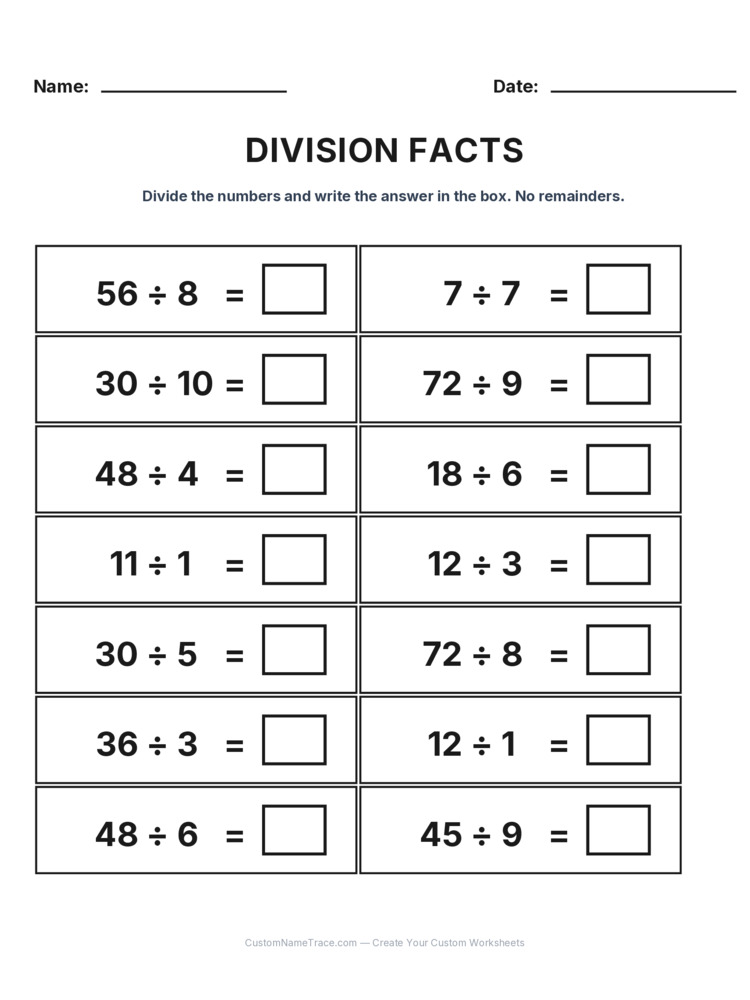
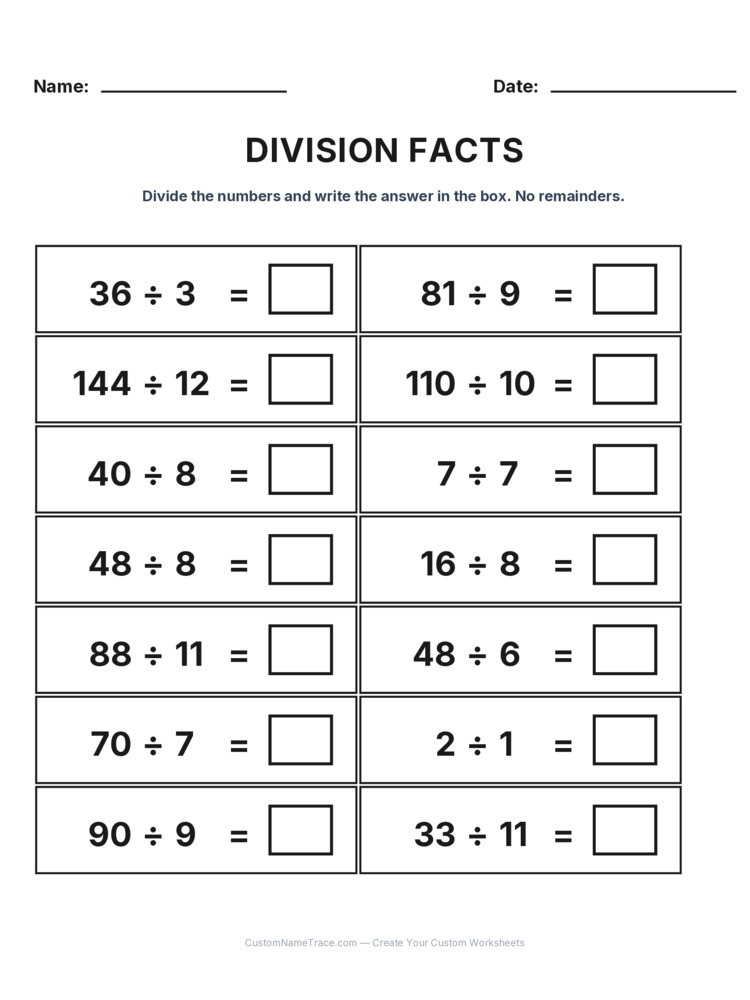
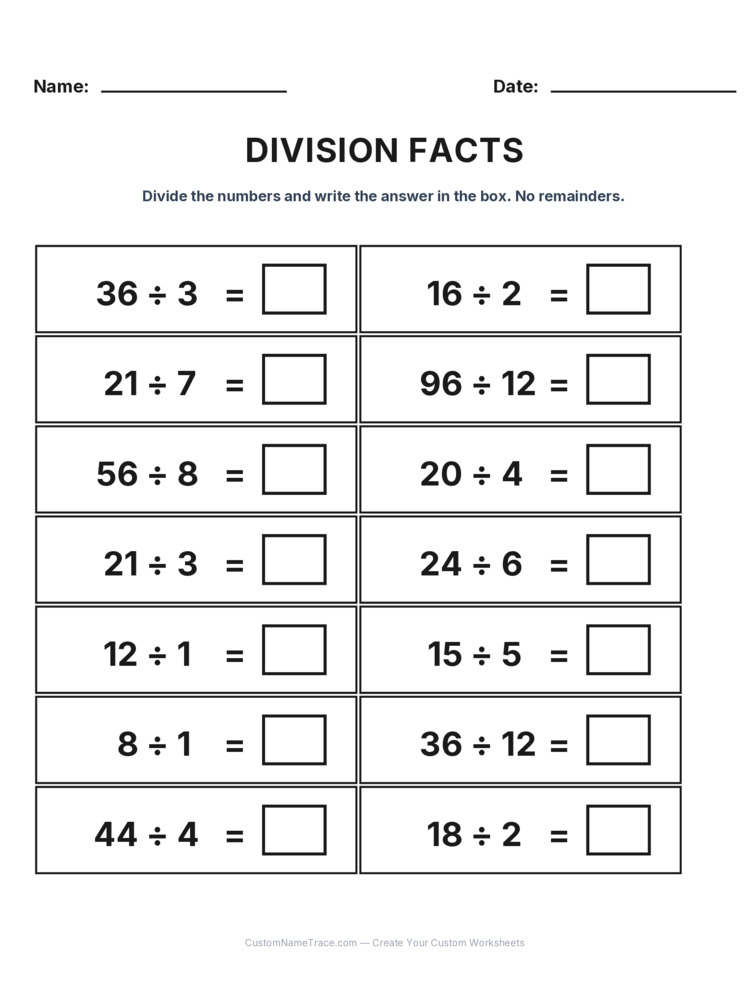
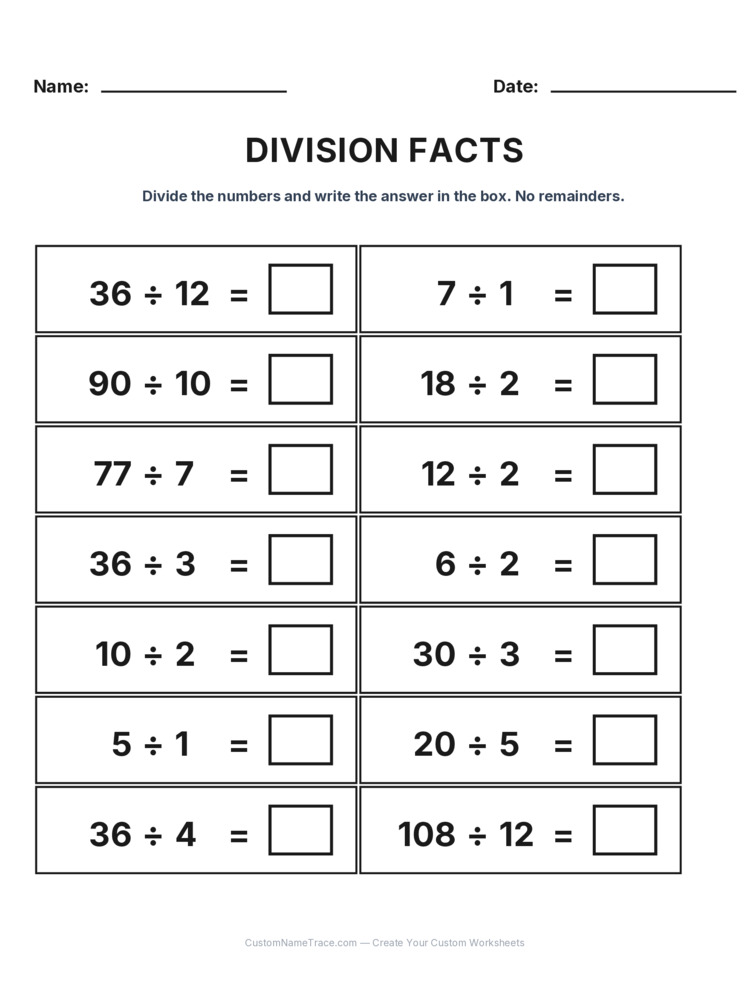
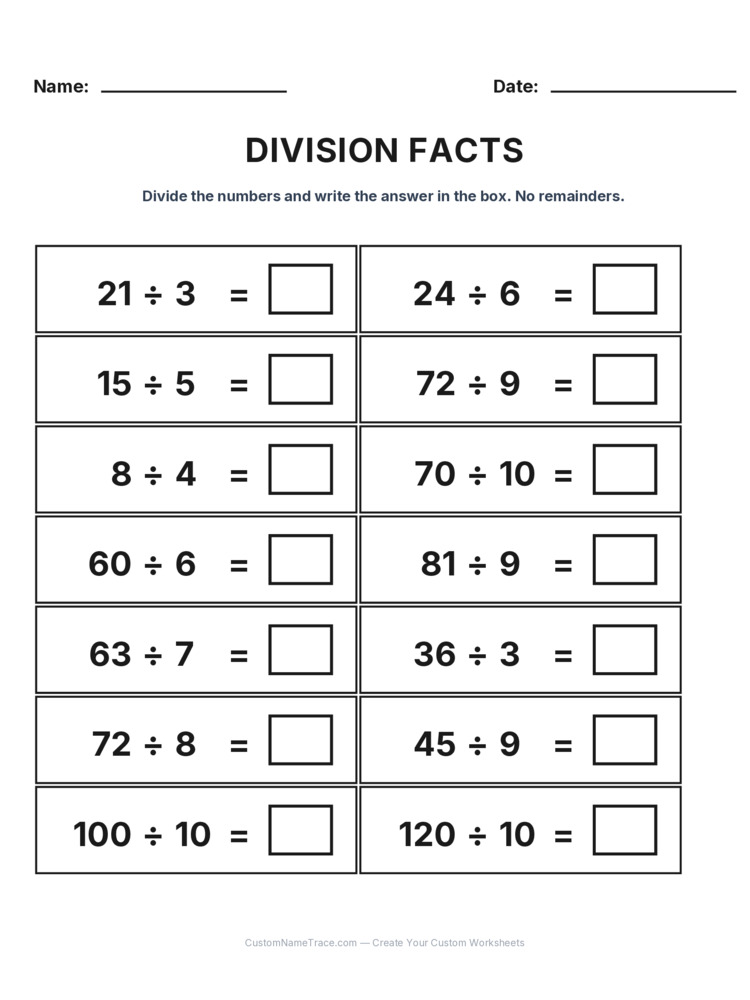
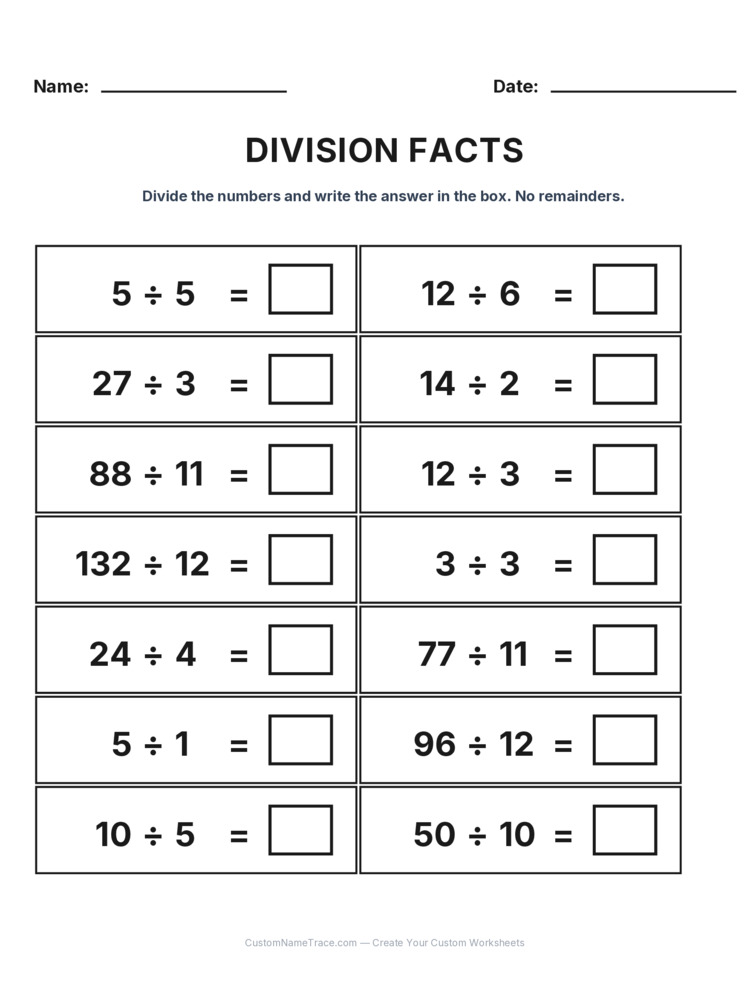
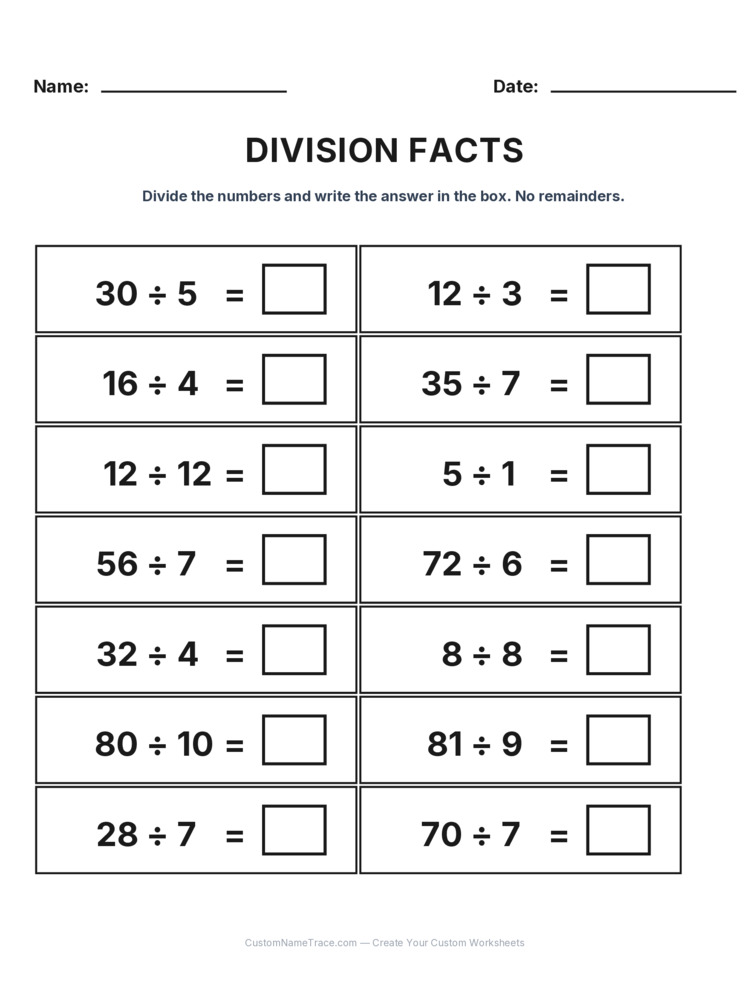
Grade 3 division focuses on facts with no remainders, deliberately kept as the clean inverse of the same 0-12 multiplication facts — a problem like 36 ÷ 6 is really just asking "what times 6 makes 36," reinforcing multiplication fluency from the other direction rather than introducing remainder concepts, which typically come later.
Fact families, and the ranges used at Grade 3
The division facts practiced here use divisors matched to the same factors introduced in this site's Multiplication worksheets at Grade 3, deliberately kept in sync — 2s, 5s, and 10s at the earliest stage, expanding to the fuller range at later grades. That alignment means a child never encounters a division fact whose multiplication counterpart hasn't already been practiced, keeping the multiplication-division relationship genuinely usable rather than aspirational.
The same four numbers in a multiplication-division fact family — say, 4, 5, and 20 — connect two multiplication facts and two division facts together (4×5=20, 5×4=20, 20÷5=4, 20÷4=5), and a child who's memorized any one of the four already has real footing on the other three. Working through a fact family as a connected group, rather than four isolated facts, tends to build genuinely faster, more durable fluency than practicing each operation in complete isolation.
Whenever a division fact feels stuck, returning to its multiplication counterpart first — rather than pushing forward on division alone — usually unlocks it faster, since multiplication fluency at Grade 3 is almost always more solid than division fluency built on top of it.
Helping a stuck child, hands-on
For a forgotten division fact, asking the multiplication question in reverse — "what number times 5 equals 20?" — usually unlocks the answer faster than trying to reason through division directly, since multiplication facts tend to be more solidly memorized first. Teaching that reversal explicitly, rather than expecting a child to discover it independently, turns division practice into an extension of multiplication fluency rather than a separate hurdle.
Splitting a real, countable group of small objects into equal piles — and specifically checking that every pile ends up the same size, redistributing if it doesn't — makes the "equal" part of equal-groups concrete in a way that matters more than it might seem. A child's early intuitive sense of splitting often ignores whether the groups actually end up equal, and this hands-on check catches that gap directly.
Splitting a small handful of real objects into equal groups and asking "how many groups, and how many end up in each one?" out loud, without writing anything down at all, reinforces the underlying concept in a lower-stakes, more playful way than the printed page alone, and it works well as a warm-up before or a short break during longer worksheet sessions.
What genuine mastery looks like
As with multiplication, real division mastery at this stage means reliable recall or reliable reconstruction from a known multiplication fact — not necessarily instant, effortless recall on every single problem. A child who still occasionally works a division fact out by reversing a multiplication fact they know solidly is using a completely legitimate strategy, not falling short of real mastery.
"20 cookies need to be shared equally among 5 friends — how many does each friend get?" is a division problem the moment a child recognizes an equal-sharing situation, even without the word "divide" appearing anywhere. This is genuinely one of the trickier operations for children to spot in word-problem form, since equal-sharing language varies widely ("shared equally," "split evenly," "how many groups"), and it's worth practicing that recognition explicitly rather than assuming it transfers automatically from worksheet practice alone.
Just as with multiplication, practicing division facts in a fixed, predictable sequence can create an illusion of fluency built on pattern-following rather than genuine recall. Every numbered worksheet variant here presents facts in a fresh, non-sequential order specifically to test and build the real thing, rather than letting a child glide through a page by anticipating what comes next from position alone.
The remainder-free division practiced at Grade 3 is intentionally the simpler half of the full picture — real-world division very often doesn't split evenly, and remainders become a genuinely important concept once this foundational, evenly-divisible stage is solid. There's no need to introduce that added complexity early; mastering clean, exact equal-groups division first gives a much sturdier foundation for handling remainders correctly once they're eventually introduced.
Where this leads
Every division problem at Grade 3 on this site is built to divide evenly, with no leftover remainder — remainders are a genuinely more advanced concept introduced once basic division facts are solid, and mixing them in early risks a child concluding their division answer is wrong when it's actually correct but simply has a leftover amount. Keeping this stage's practice remainder-free isolates the core equal-groups concept cleanly.
Physically splitting a group of real objects — counters, coins, small toys — into equal piles and counting how many end up in each pile makes the equal-groups idea concrete in a way the printed page alone sometimes doesn't, especially for a child encountering division for the first time. This hands-on version pairs naturally with the printed worksheet rather than replacing it.
Solid division facts at Grade 3's level are the direct foundation for long division, fractions, and eventually ratio and rate problems in later grades — all of which lean on the same equal-groups reasoning this worksheet practices, just applied to larger or less evenly divisible numbers. A child genuinely comfortable here has real footing for what comes next.
Division is often the last of the four basic operations a child grows genuinely comfortable with, and that's expected — it depends directly on multiplication fluency, which itself takes real time to build, so division naturally lags a step behind. There's no reason to rush it faster than a child's multiplication footing actually supports; solid division built on solid multiplication holds up far better than either rushed ahead of the other.
Equal-sharing situations show up constantly outside of schoolwork — splitting a bag of snacks evenly among friends, dividing chores fairly, sharing a stack of trading cards — and pointing out those everyday moments as division in disguise helps a child at Grade 3 see this operation as a genuinely useful, frequently-needed skill rather than an abstract worksheet exercise with no real-world connection at all.
Division is genuinely one of the harder operations at this stage, and a child who's struggling with it is not behind — they're working through material that reliably takes longer for most children than addition or subtraction did, and steady, patient practice at Grade 3's pace closes that gap just as reliably as it does for every other operation covered on this site.
Every division worksheet under Grade 3 is a free, print-ready PDF with no account required, correctly formatted for both Letter and A4 paper. Browse the specific skills below for the exact factor range matched to this grade.