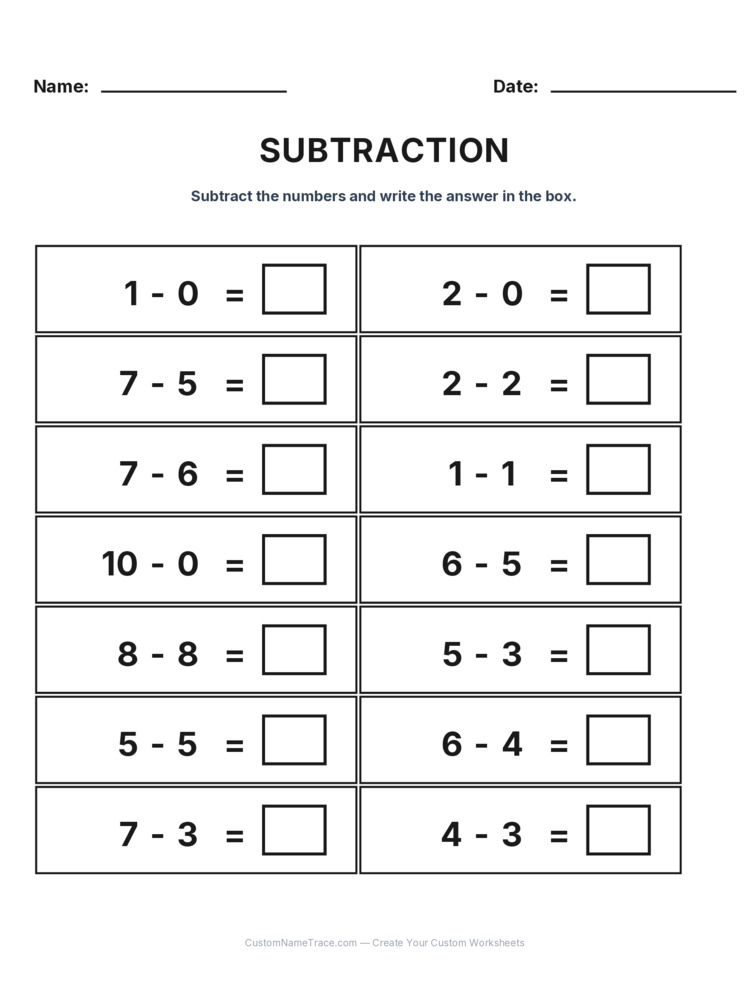
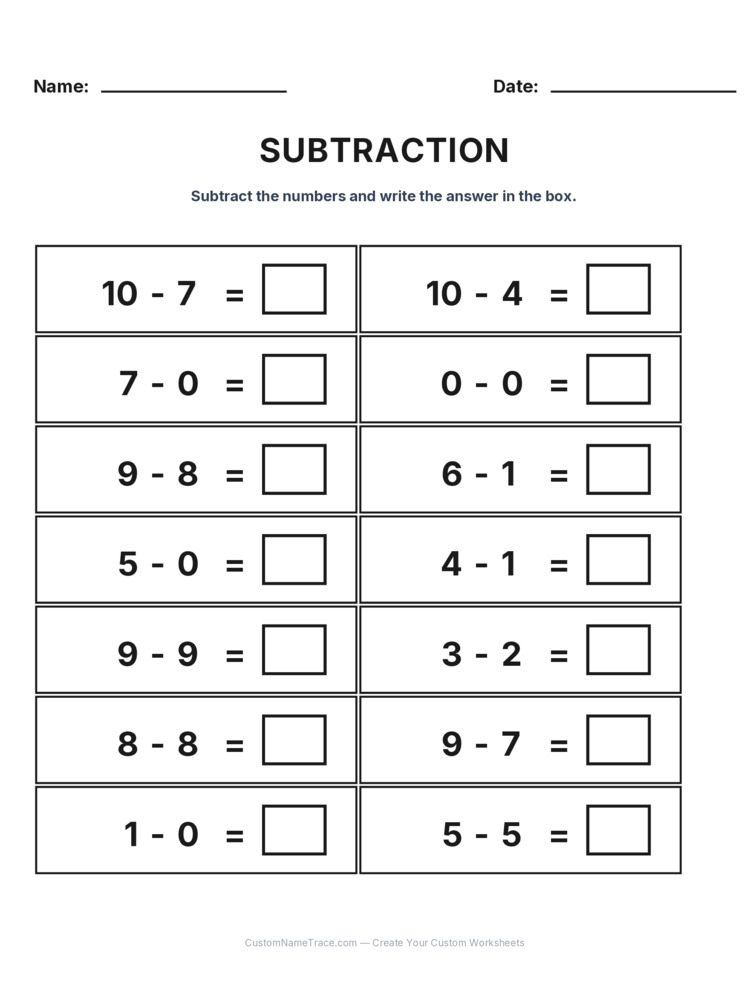
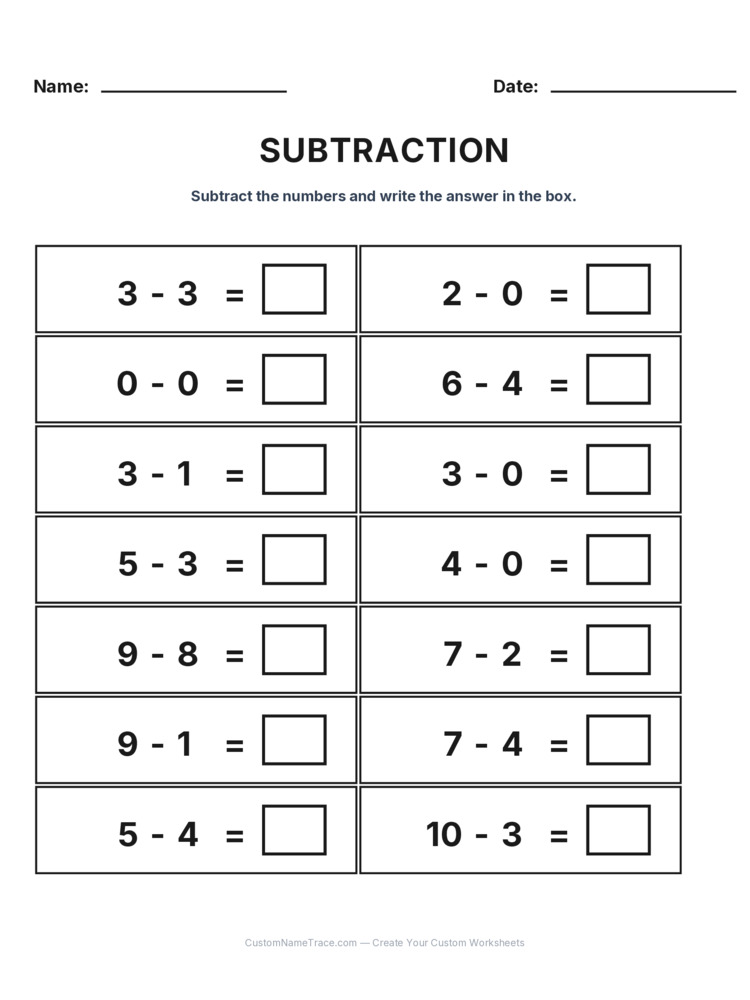
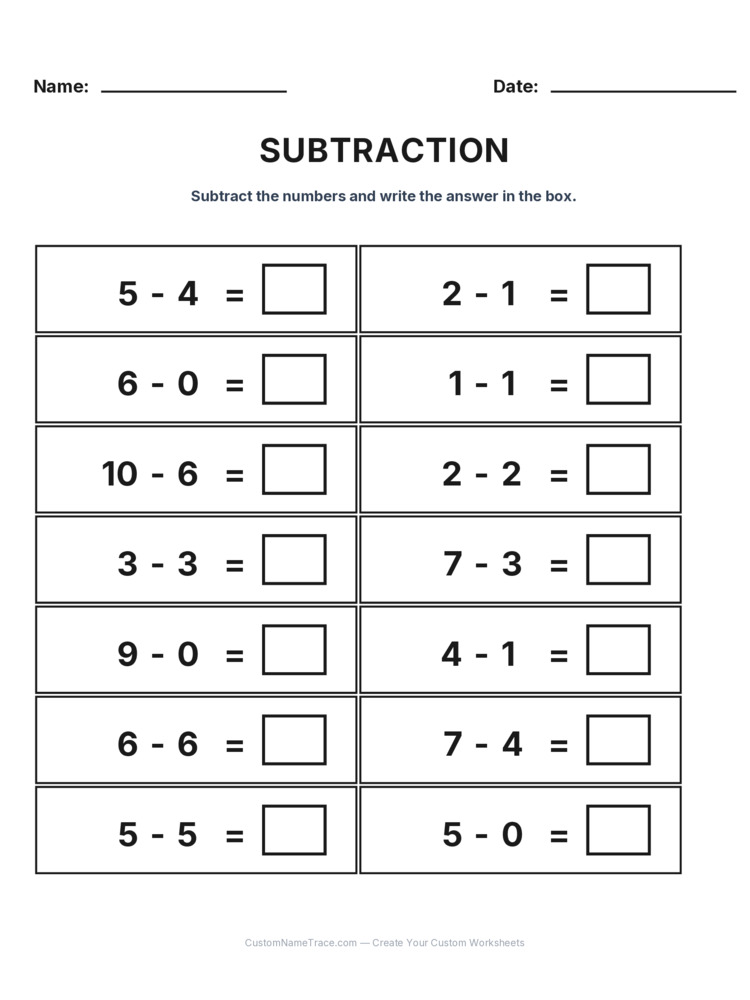
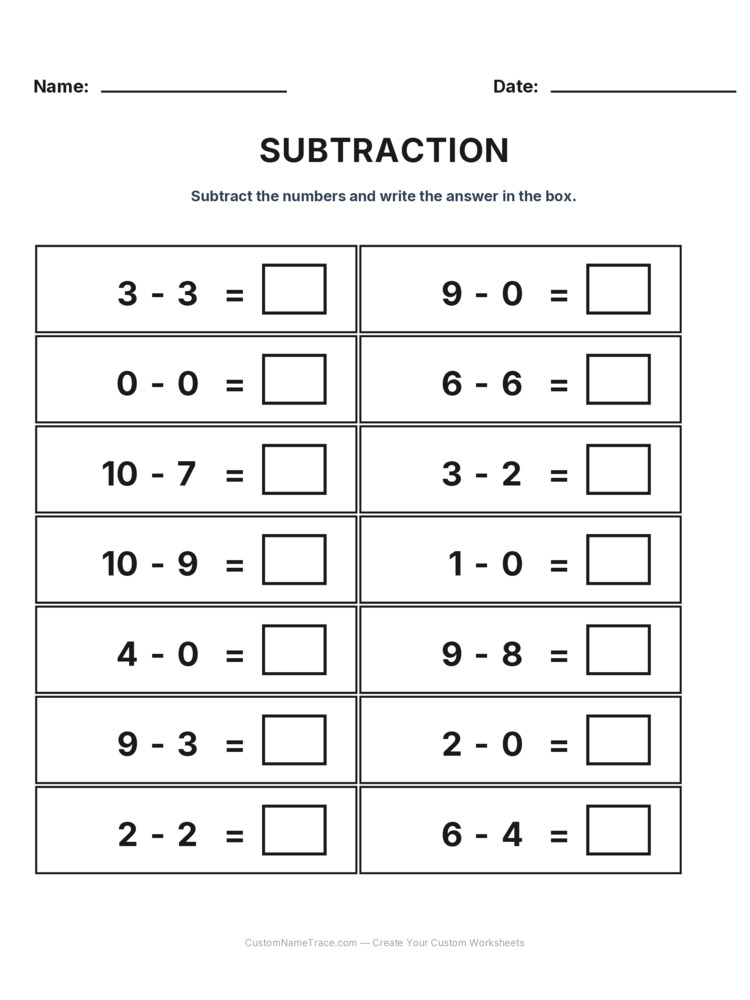
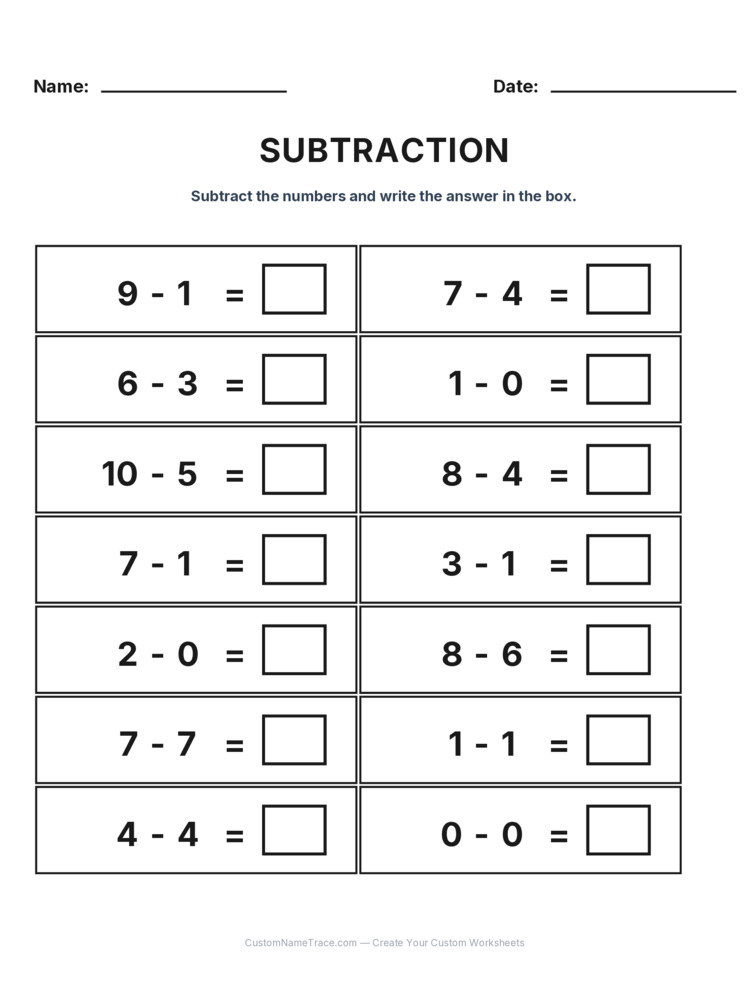
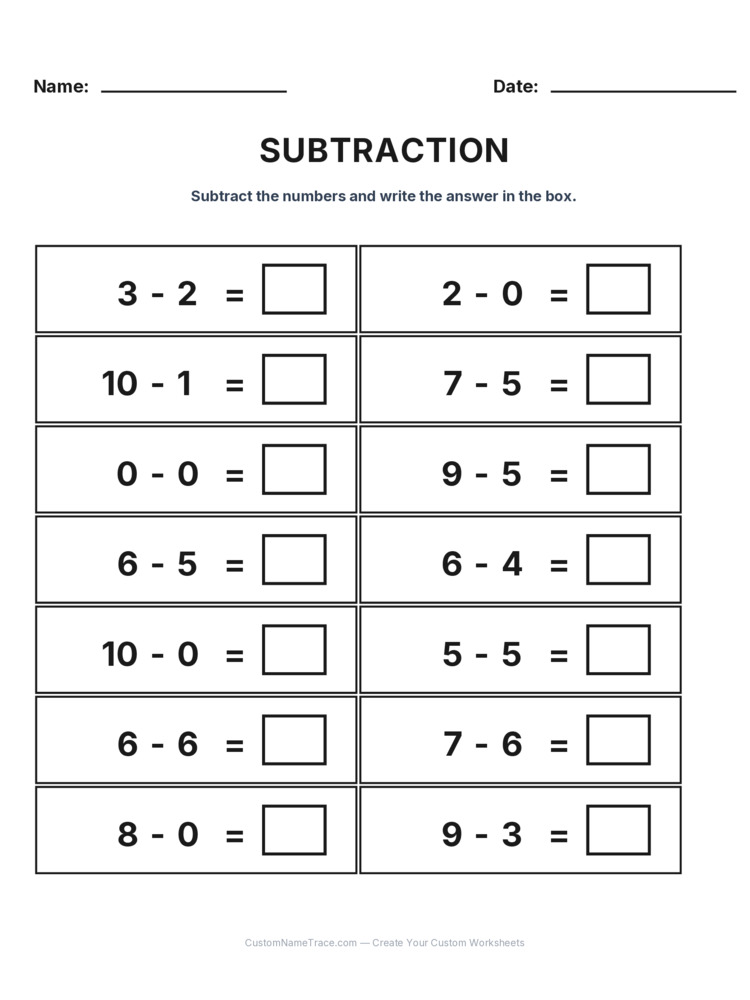
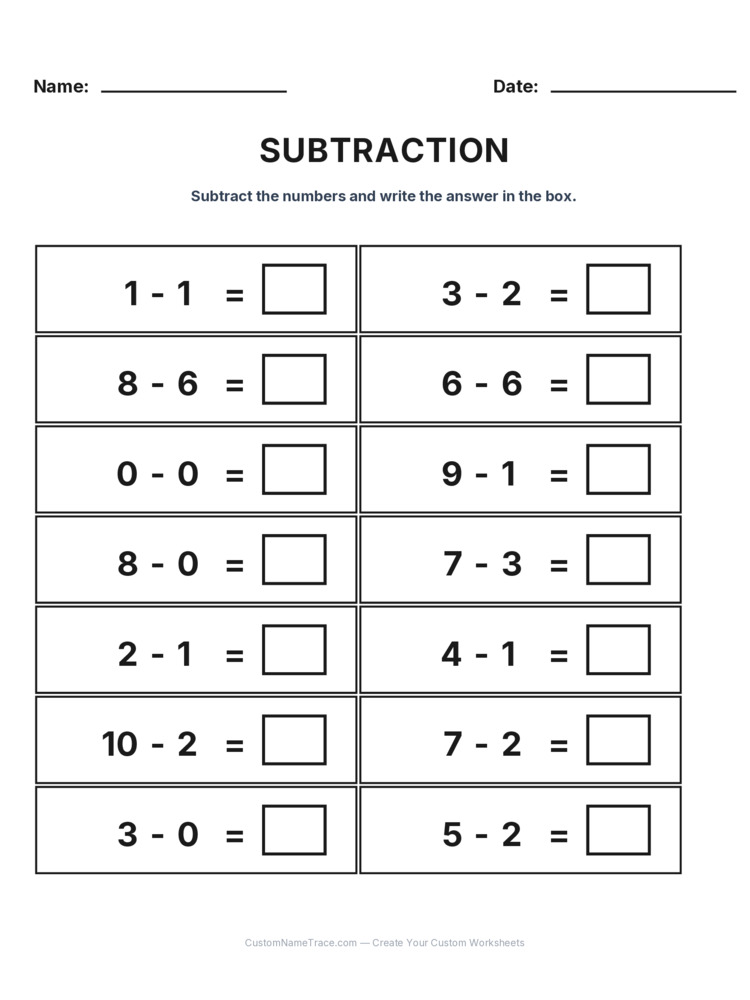
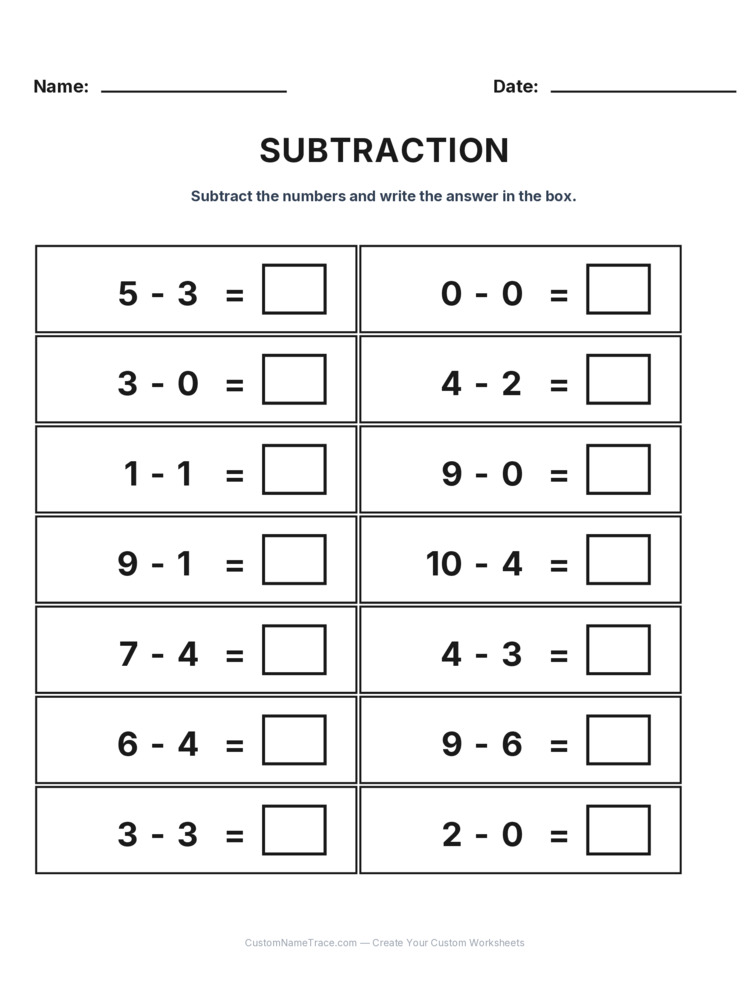
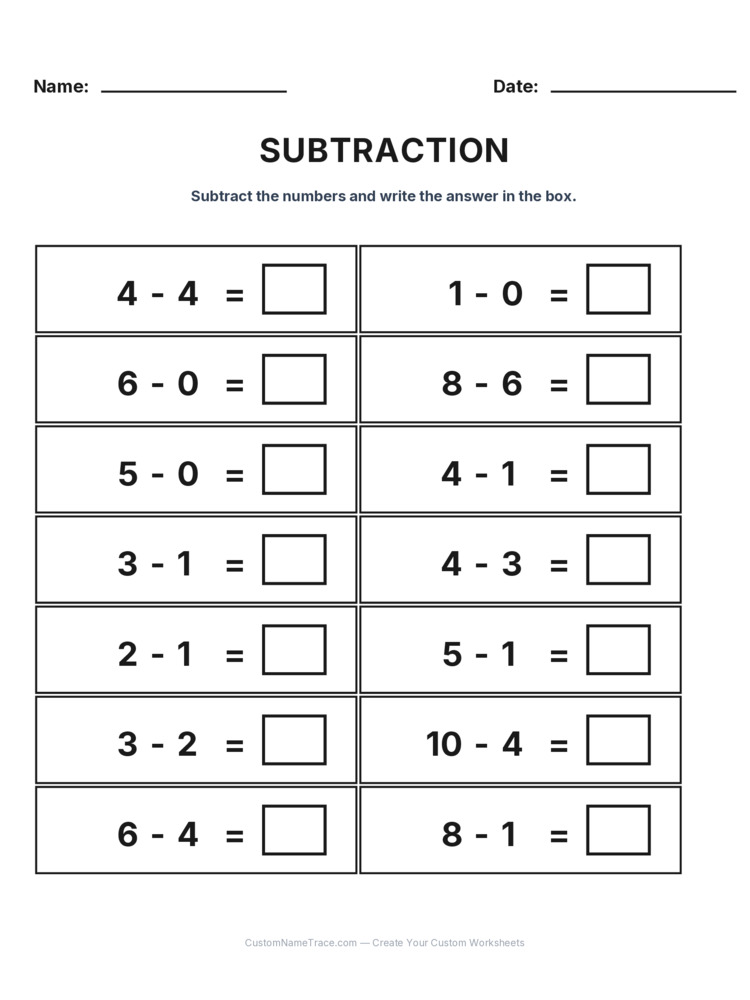
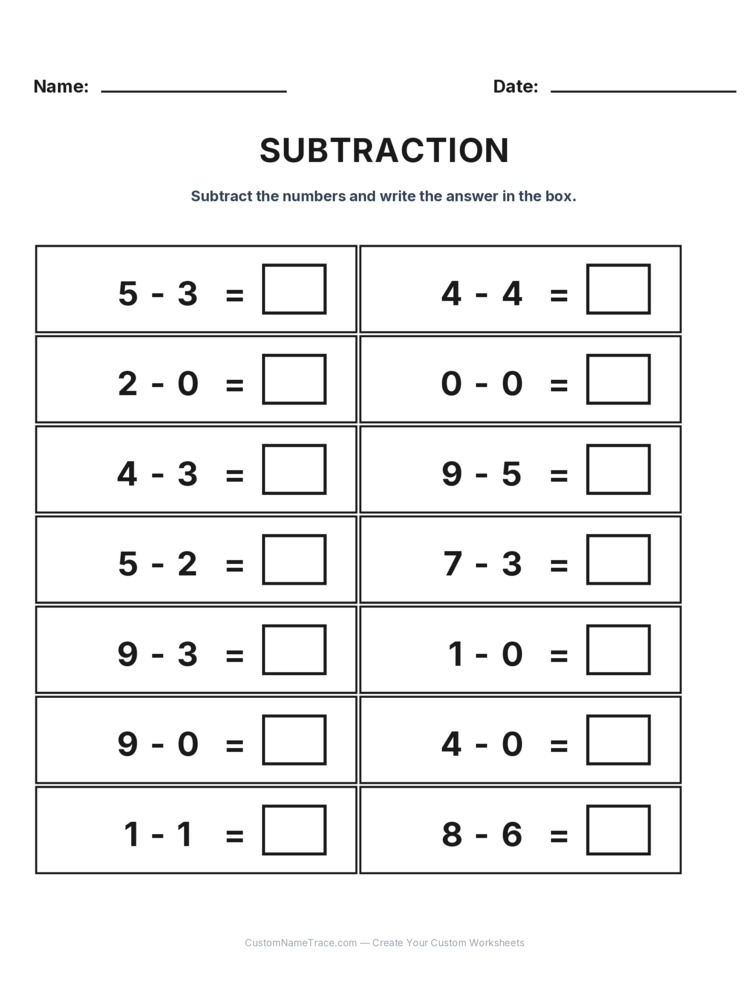
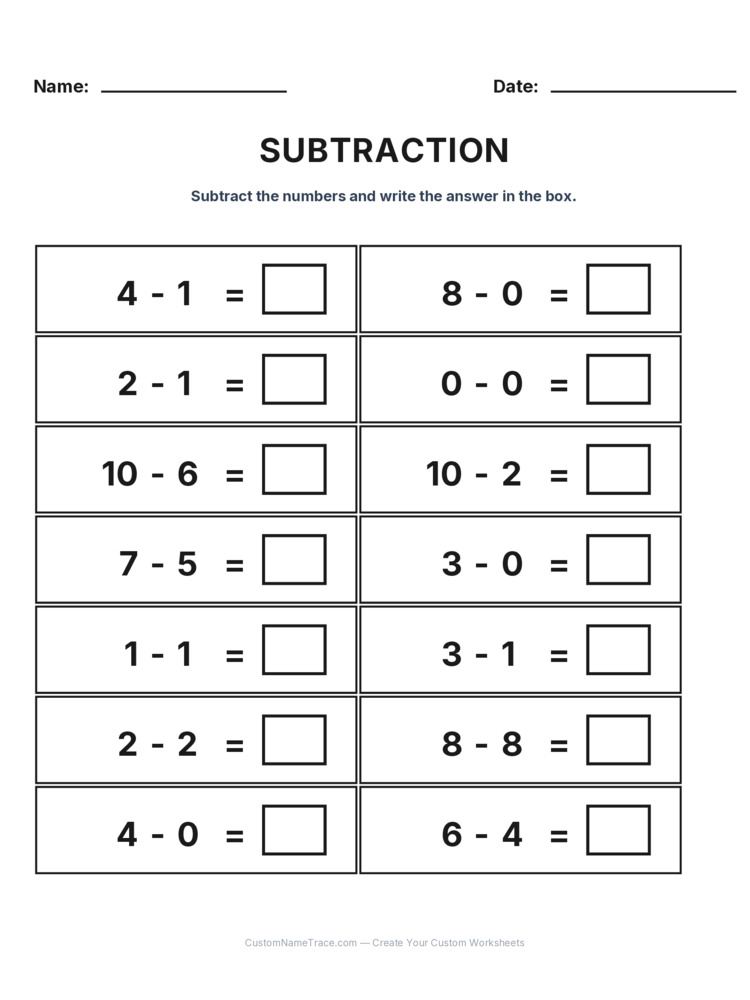
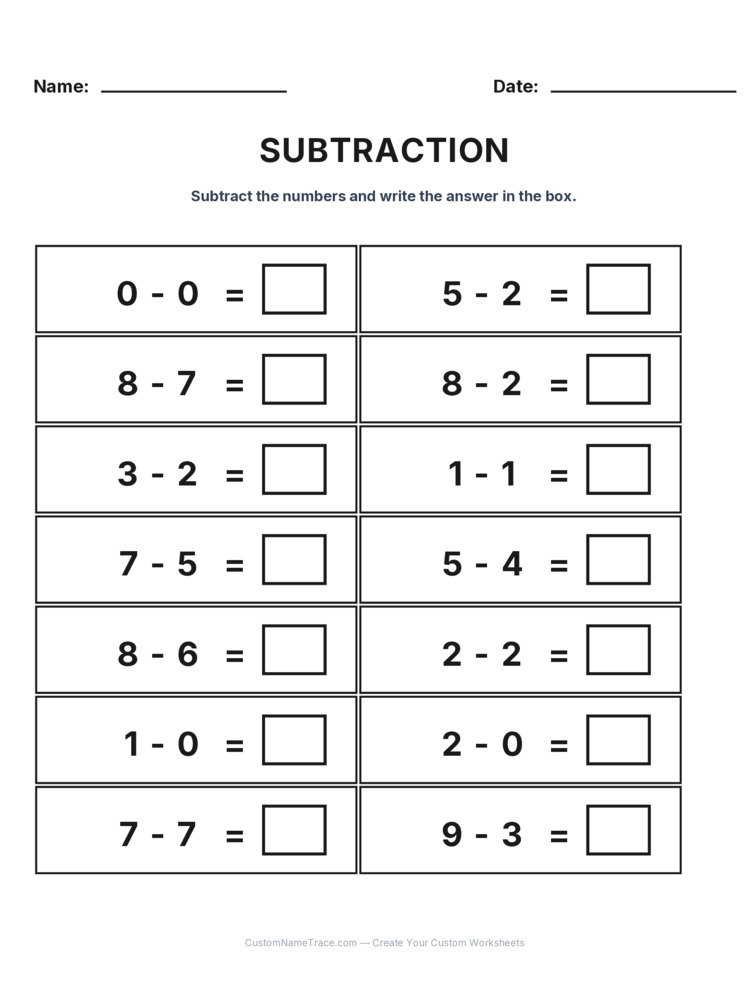
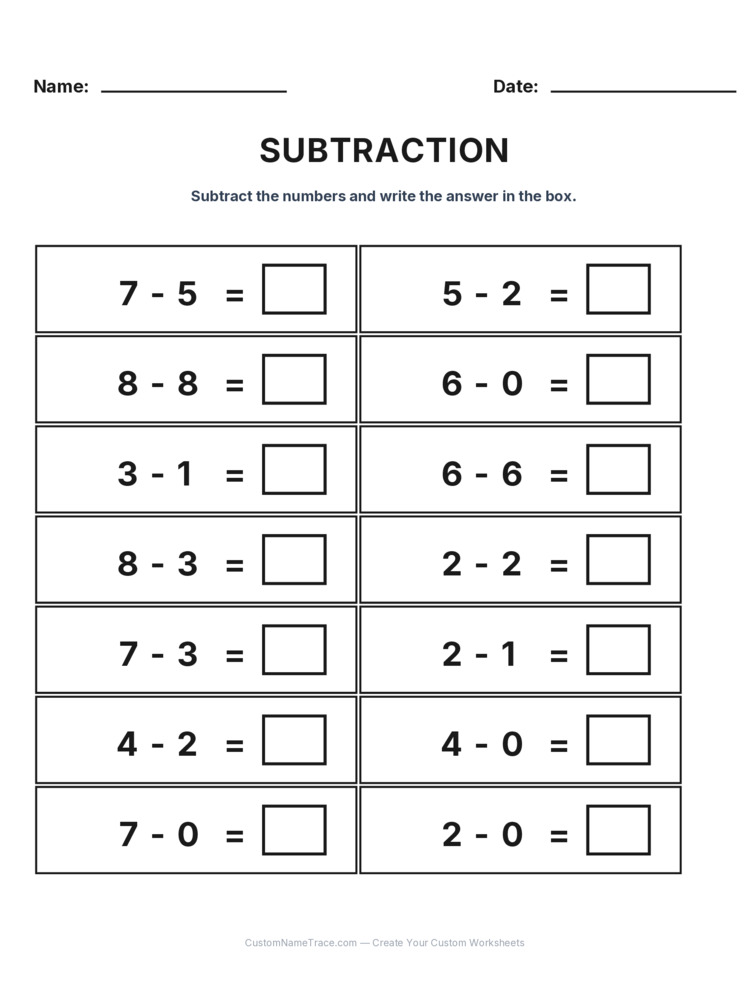
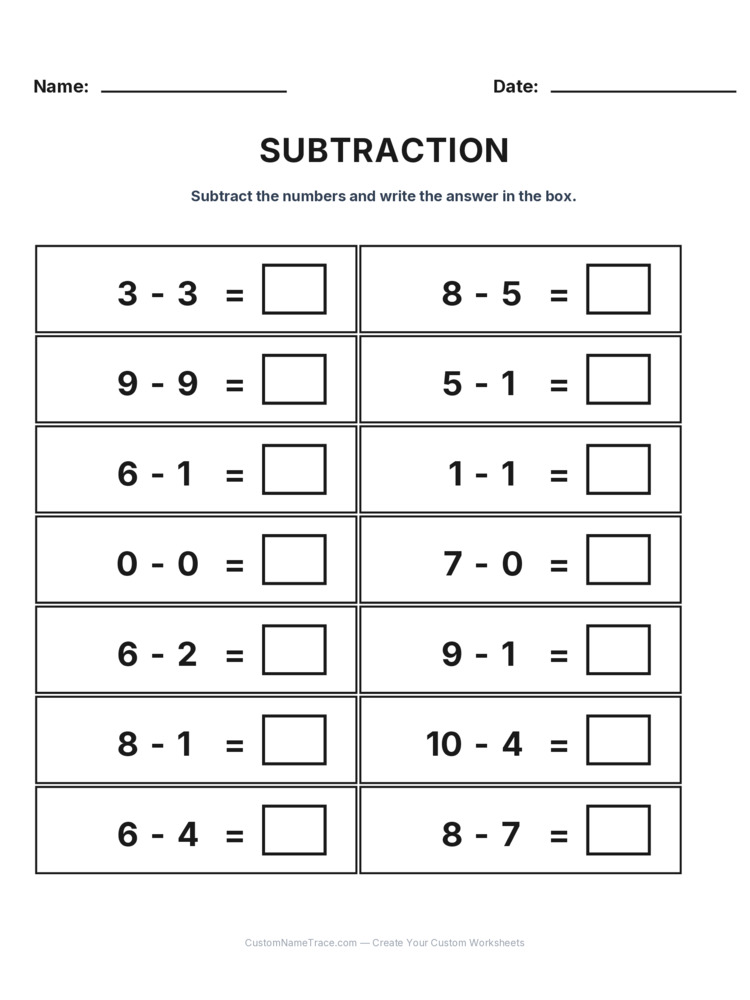
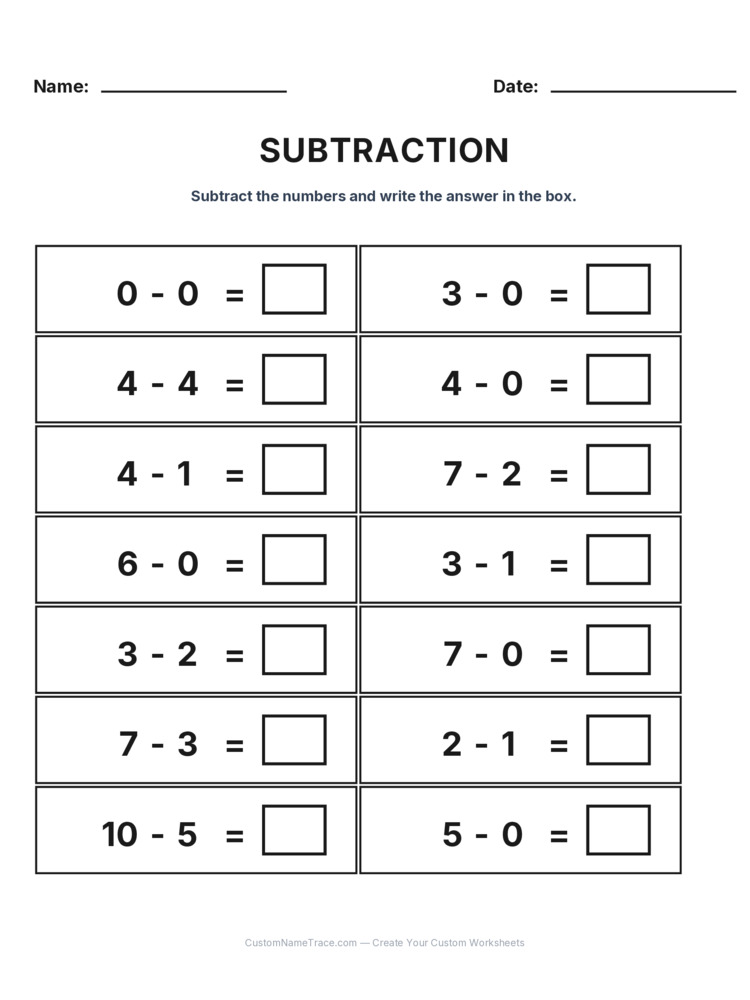
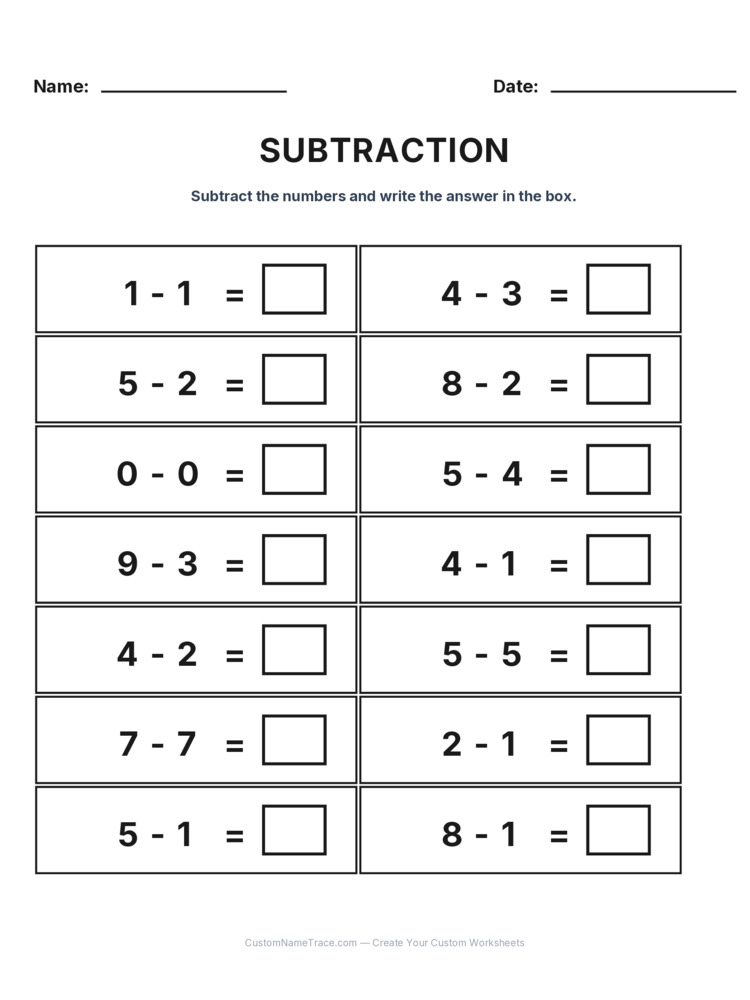
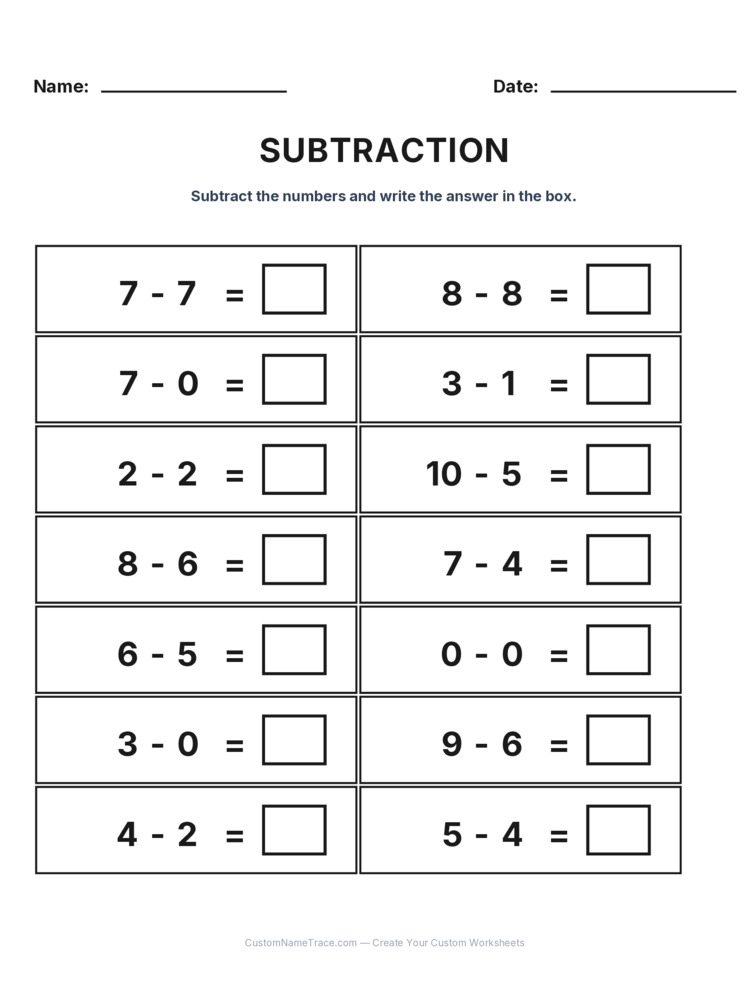
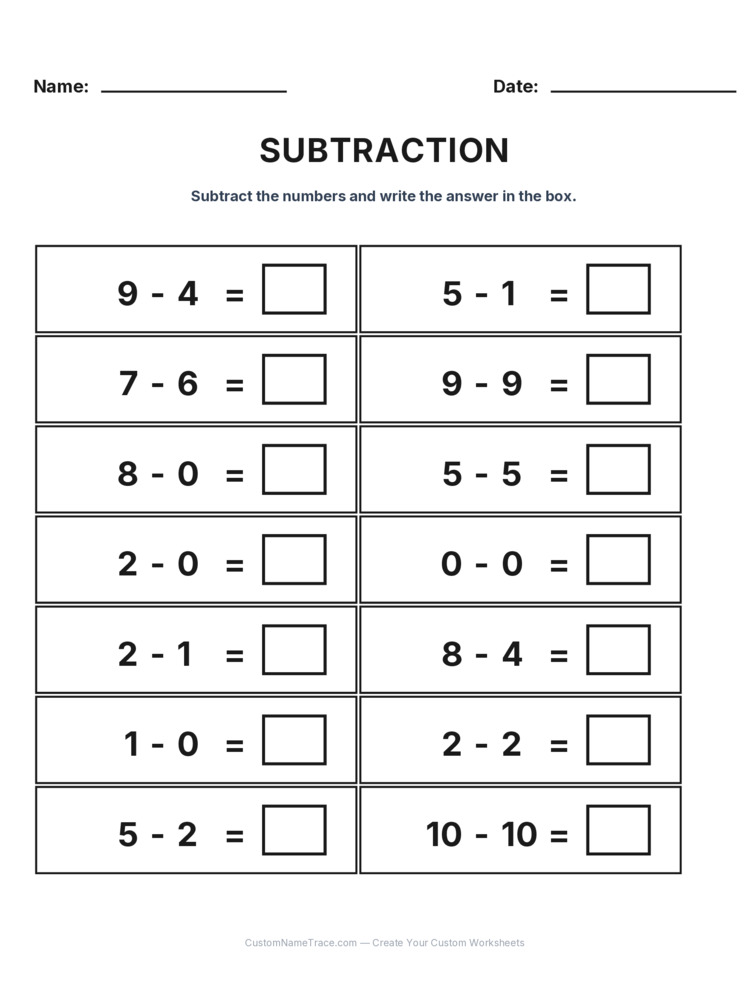
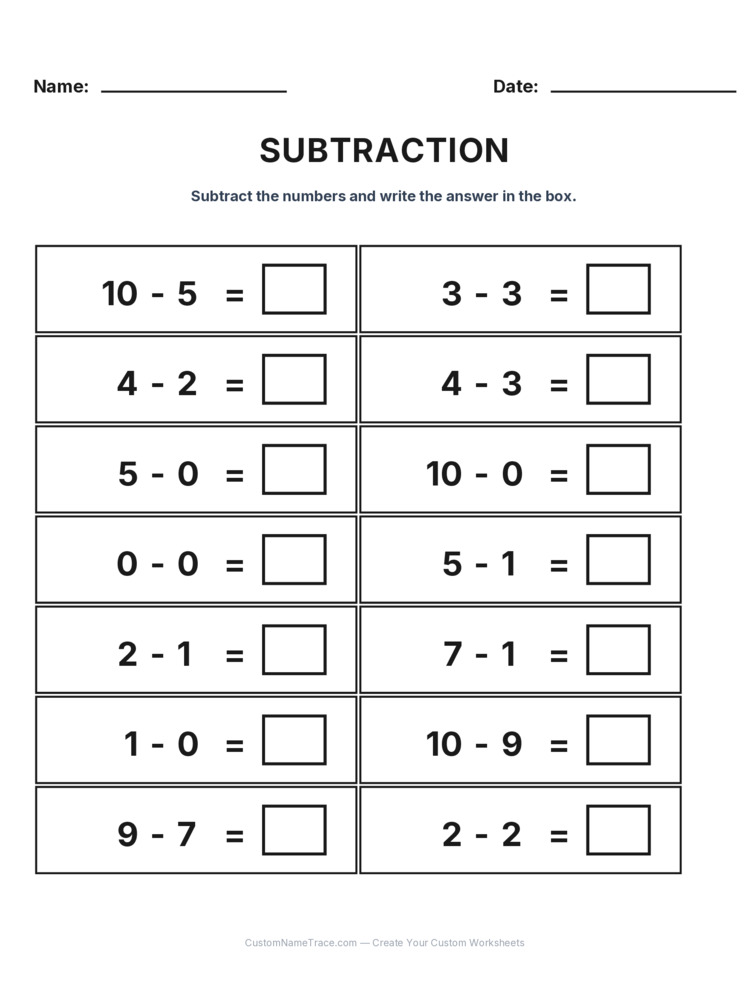
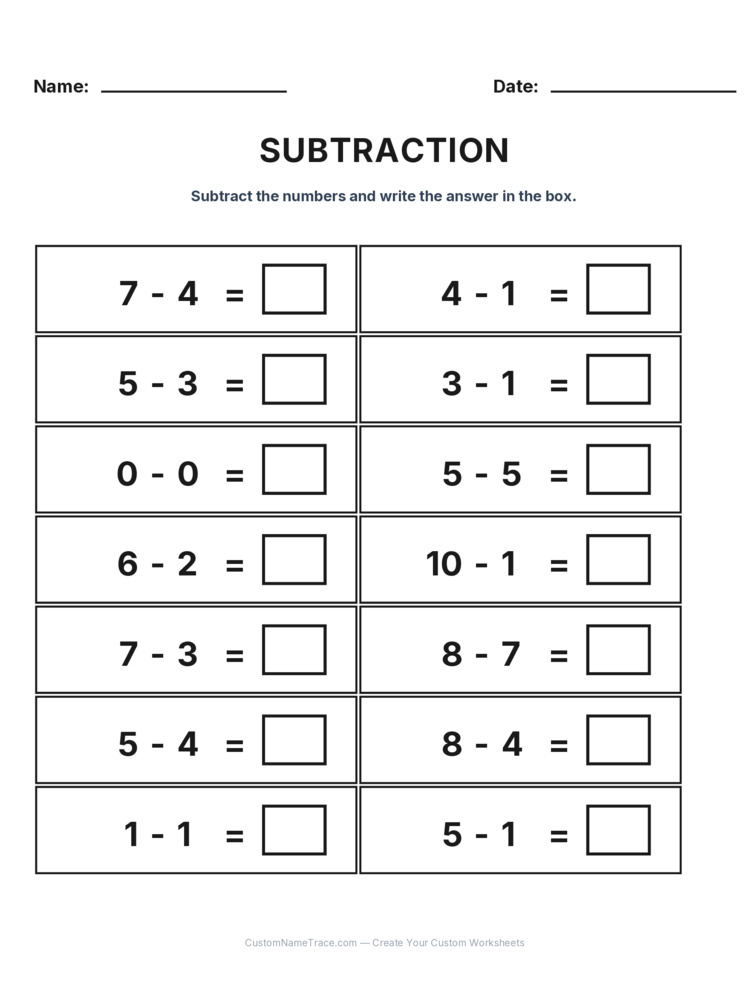
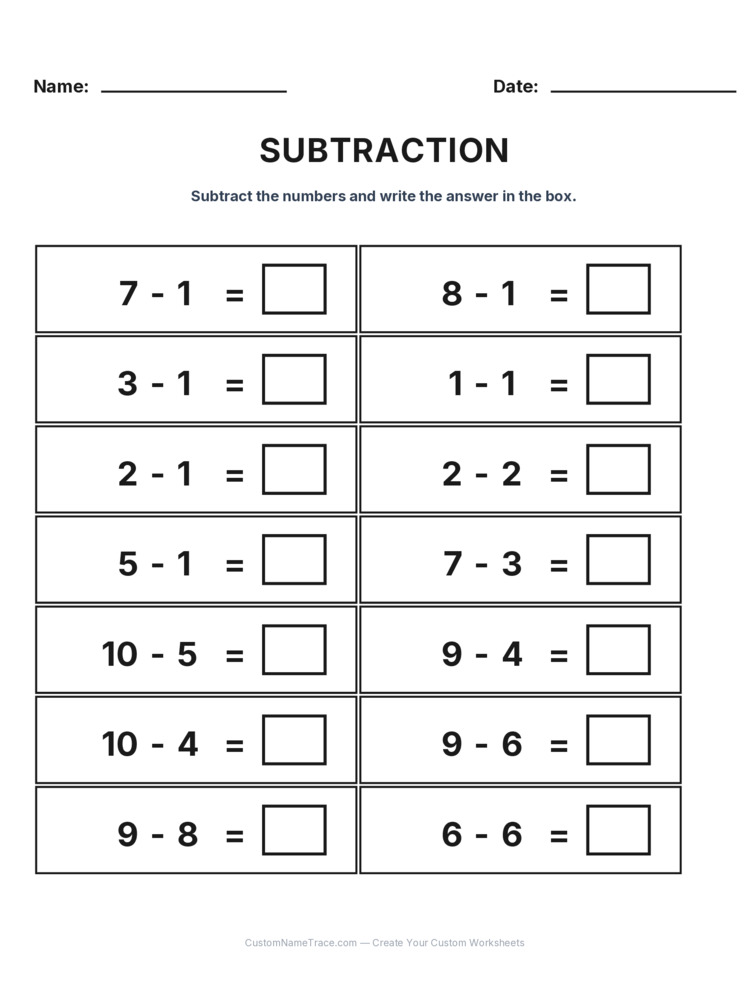
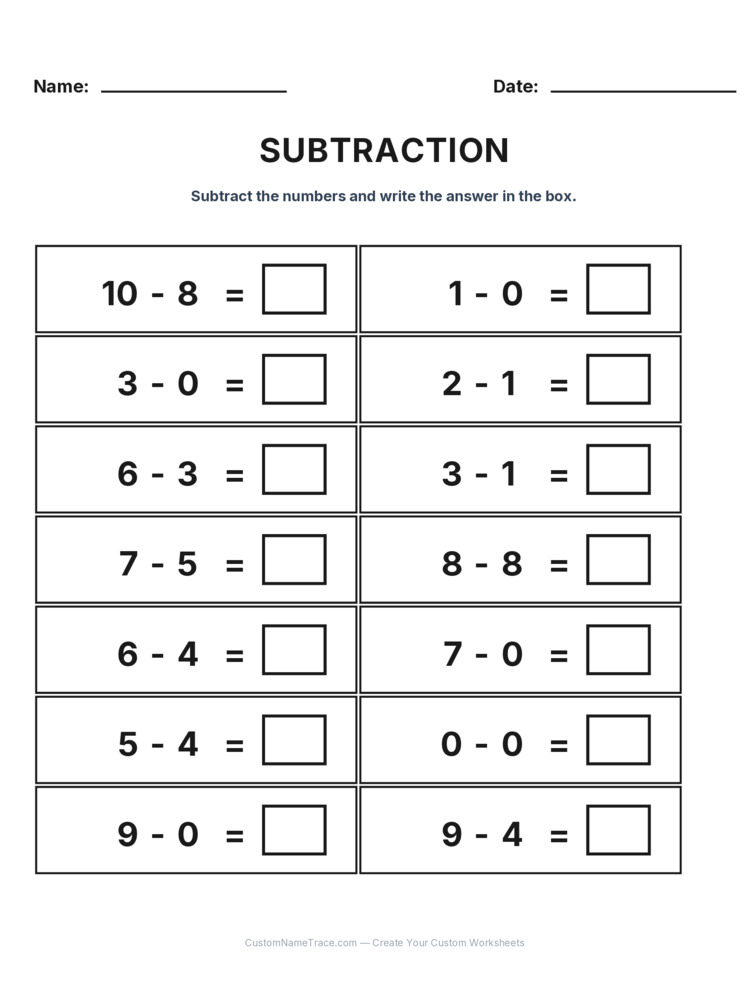
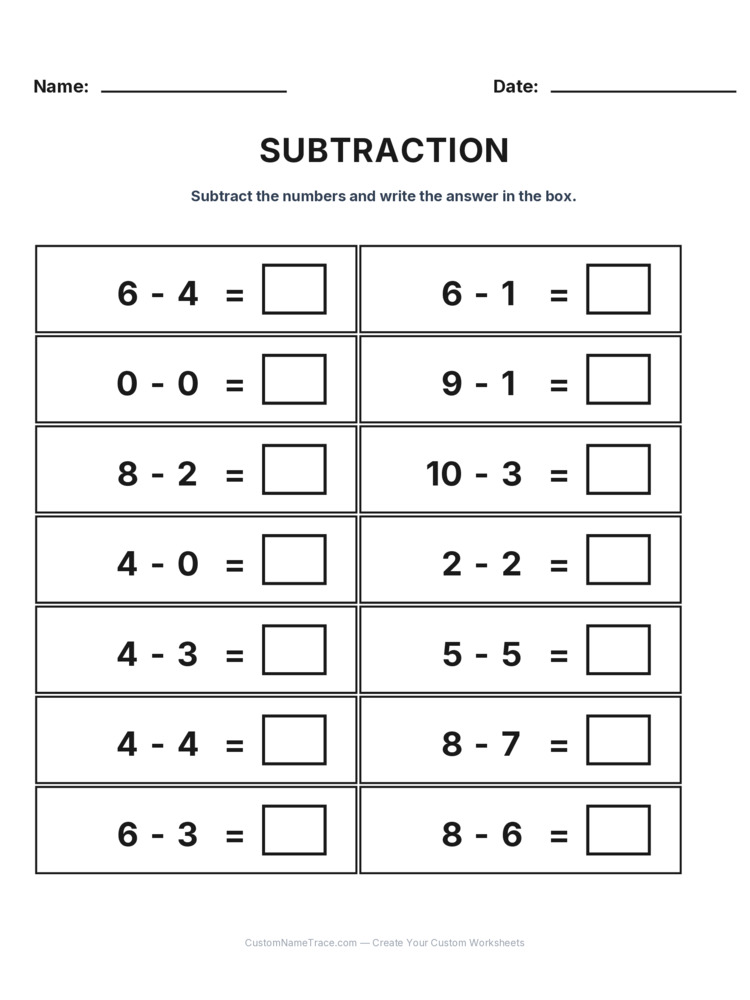
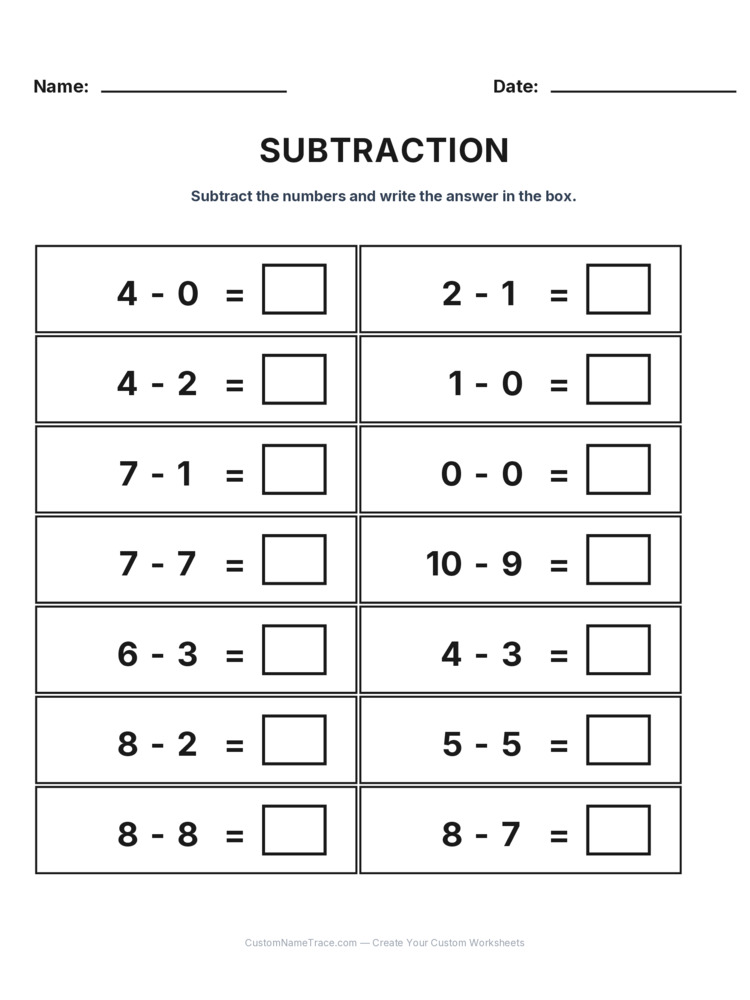
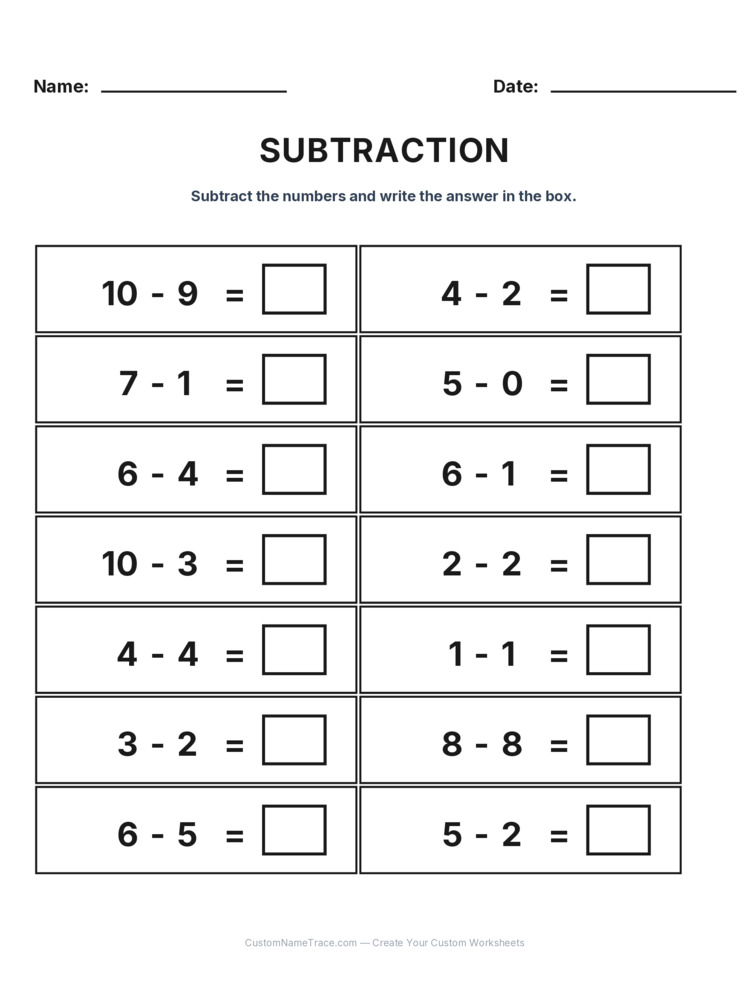
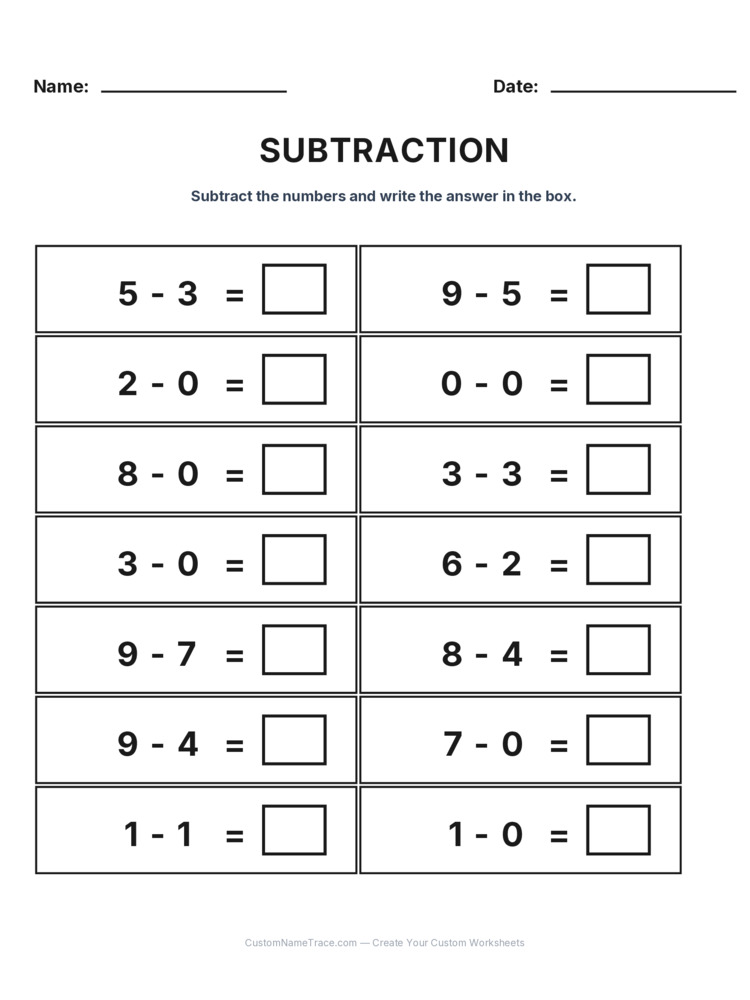
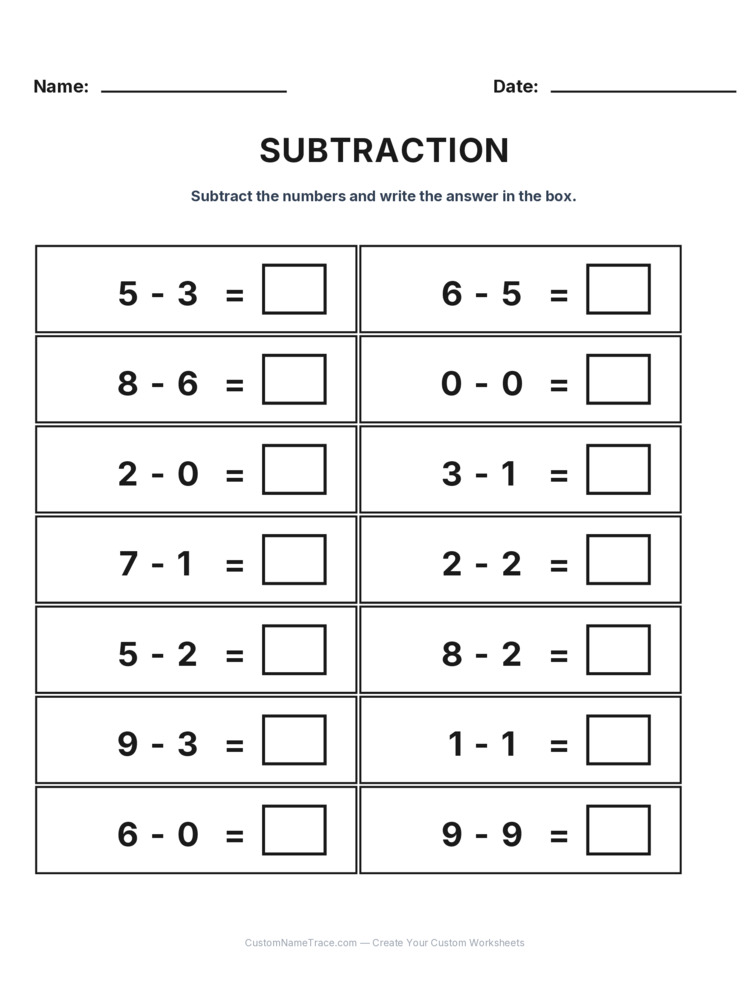
What subtraction looks like at Kindergarten
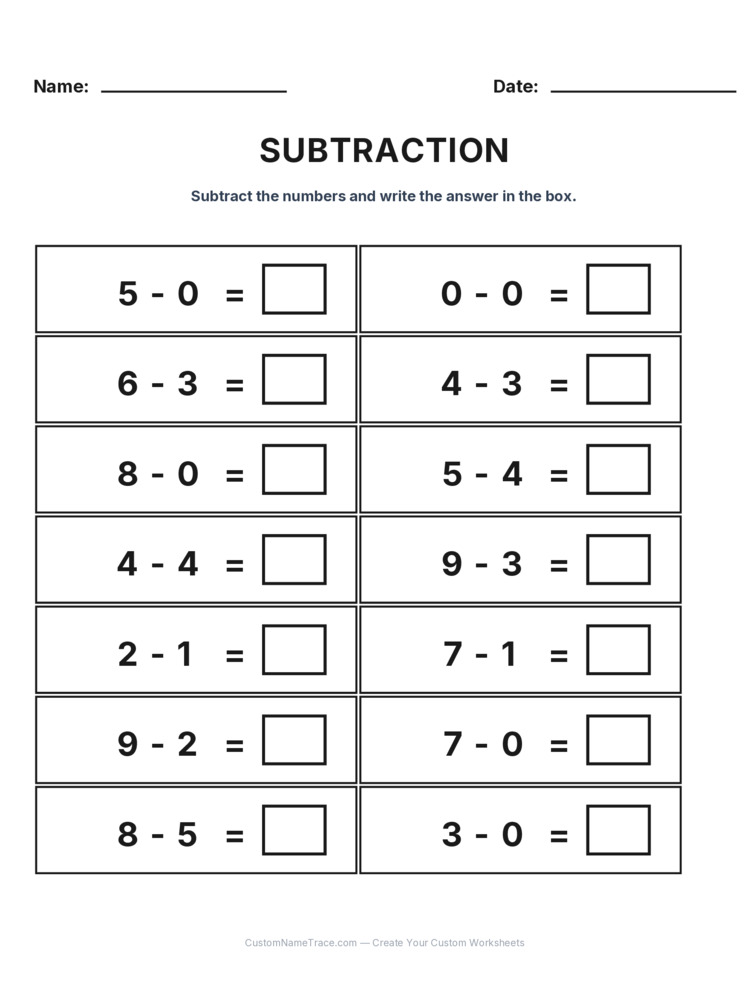
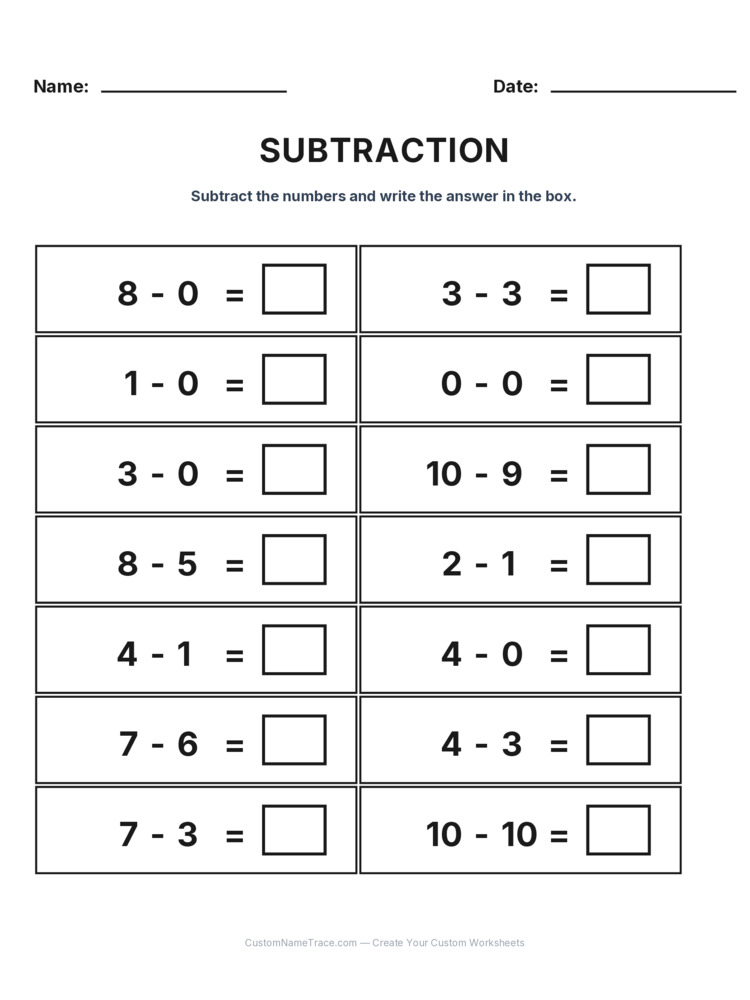
Every subtraction worksheet under Kindergarten uses number ranges and a format matched to what this grade's curriculum actually covers — small single-digit differences solved by counting backward at the earliest stages, up through multi-digit column subtraction requiring regrouping (commonly called borrowing) at later stages. Nothing here jumps ahead to a format or range Kindergarten hasn't been prepared for.
Like addition, subtraction at this site starts in a simple horizontal format and shifts to vertical, stacked columns once numbers are large enough to require regrouping — the vertical layout makes each place value's borrowing step visually explicit in a way horizontal format can't, which is exactly why it's introduced at that specific point in the progression rather than from the very beginning.
A problem like box − 4 = 9 asks a child to reason backward to an unknown starting number, rather than simply computing a known difference — a meaningfully different demand from 13 − 4 = box, even though the same numbers and relationship are involved. This format appears specifically where Kindergarten's curriculum calls for it, building toward the same algebraic reasoning this site's Addition worksheets introduce from the other direction.
What Kindergarten specifically covers within subtraction
Kindergarten subtraction mirrors the addition work exactly, staying within 10 and framed as "taking away" from a group a child can still picture or count directly. Most Kindergarten curricula introduce subtraction only after addition feels solid, since understanding that a group can shrink is a slightly harder reversal of the "groups combine" idea addition already established.
Counting strategies, and the cross-ten trouble spot
Many children find it easier to solve a subtraction problem by counting forward from the smaller number to the larger one, rather than counting backward from the larger number — for 12 − 9, counting up from 9 to 12 (just 3 steps) is often faster and less error-prone than counting down 9 steps from 12. This is a legitimate, genuinely efficient strategy worth actively teaching rather than assuming counting backward is the only correct approach.
Problems like 13 − 5, where the answer requires crossing below the nearest multiple of ten, are consistently harder for children at this stage than problems that don't cross that boundary, like 13 − 3. If a child does well on most subtraction but consistently stumbles specifically on cross-ten problems, that's a known, common, and specifically addressable gap — not a sign of broader subtraction difficulty — and extra practice concentrated on exactly that boundary tends to resolve it faster than general review.
Drawing the starting quantity, crossing out the amount being subtracted, and counting what remains gives subtraction a physical, visible form that a purely numeric worksheet doesn't provide on its own — this is especially useful for a child new to the concept, or returning to it after the vertical, regrouping-heavy format has made it feel more abstract again than it needs to.
Checking answers, and why subtraction feels harder
Every subtraction problem has a built-in check: adding the answer back to the number that was subtracted should return the original starting number. Teaching a child to verify their own subtraction answers this way — 13 − 5 = 8, so does 8 + 5 really equal 13? — builds the addition-subtraction relationship directly into the habit of checking work, rather than treating verification as a separate skill.
A child genuinely comfortable moving between an addition fact and its matching subtraction fact — not just solving each in isolation — has a real, durable advantage over one who's practiced them as entirely separate skills, since that flexibility is exactly what later, harder problems increasingly depend on, well beyond Kindergarten's own curriculum.
Addition combines two known quantities into a new total, which most children find intuitive fairly quickly; subtraction requires reasoning about a quantity being taken away or a gap between two numbers, which is a genuinely less concrete idea for a young child to hold onto. It's normal, not a sign of a problem, for subtraction practice at Kindergarten to take longer to feel comfortable than addition practice at the same numeric range did.
Beyond the conceptual difficulty, subtraction can feel more frustrating to a child simply because mistakes are less forgiving — an addition slip often still lands close to a plausible answer, while a subtraction slip (especially miscounting backward) can land far from the actual answer, which sometimes reads to a child as "I'm bad at this" rather than "I made one specific counting error." Naming that distinction explicitly — a wrong answer here is usually one small slip, not a sign of not understanding subtraction — helps keep a frustrated child from generalizing one mistake into a broader belief about their own ability.
Regrouping, mastery, and word problems
At the grades where multi-digit subtraction is introduced, some problems require regrouping — borrowing from a higher place value when the digit being subtracted from is smaller than the digit being subtracted. This is one of the more mechanically demanding steps in elementary math, and worksheets at Kindergarten that include it are built specifically to give focused, repeated practice with that exact mechanic rather than mixing it unpredictably with problems that don't need it.
As with addition, real mastery at this level means solving Kindergarten's subtraction range accurately using a strategy that makes sense to the child, not necessarily at high speed. A child who reliably gets correct answers by counting up, counting back, or using a known fact family has mastered the material just as genuinely as one who recalls facts instantly — speed is a natural byproduct of continued practice, not a prerequisite for calling the skill learned.
A subtraction situation described in words doesn't always use an obvious word like "minus" or "take away" — "Maria had 9 apples and gave 3 to a friend" is subtraction, but so is the less obvious "Maria had some apples, gave away 3, and had 6 left — how many did she start with?" which is actually a missing-number subtraction problem in disguise. Working through a few word problems together and asking specifically what's being removed, compared, or left over builds that recognition before a child encounters it unprepared on a real assessment.
Not every subtraction situation involves something being taken away — "how many more apples does Maria have than Jake?" is subtraction too, just comparing two separate quantities rather than removing anything from one of them. This comparison form of subtraction is genuinely one of the harder types for children to recognize as subtraction at all, since nothing in the situation is literally disappearing, and it's worth naming explicitly the first few times it comes up.
Using this effectively
Reviewing wrong answers together, rather than only marking them incorrect, tends to reveal whether a child made a simple counting slip or has a genuine gap in the underlying strategy — the fix for each is completely different, and treating both the same way (more repetition) only reliably helps with the first kind of mistake.
The same spaced-repetition principle that builds durable addition fluency applies just as directly to subtraction — brief, consistent daily practice at Kindergarten's range builds more lasting recall than the same total practice compressed into one long, occasional session. Because subtraction often takes longer to feel comfortable than addition at the same numeric range, consistency matters even more here than it does for addition alone.
Subtraction genuinely takes longer than addition for most children to feel solid with at the same numeric range, and that's expected rather than a warning sign — steady, low-pressure practice over time reliably closes that gap without needing to be rushed.
Subtraction leans especially heavily on the same base-ten sense this site's Place Value worksheets build directly — recognizing that borrowing across a ten during regrouping is really just the reverse of the bundling those worksheets practice makes the mechanics of multi-digit subtraction feel like an extension of something already familiar, rather than an unrelated new procedure to memorize from scratch.
Every subtraction worksheet under Kindergarten is a clean, print-ready PDF, free with no account required, correctly formatted for both Letter and A4 paper. Browse the specific skills below for the exact range and format matched to where a child currently stands.