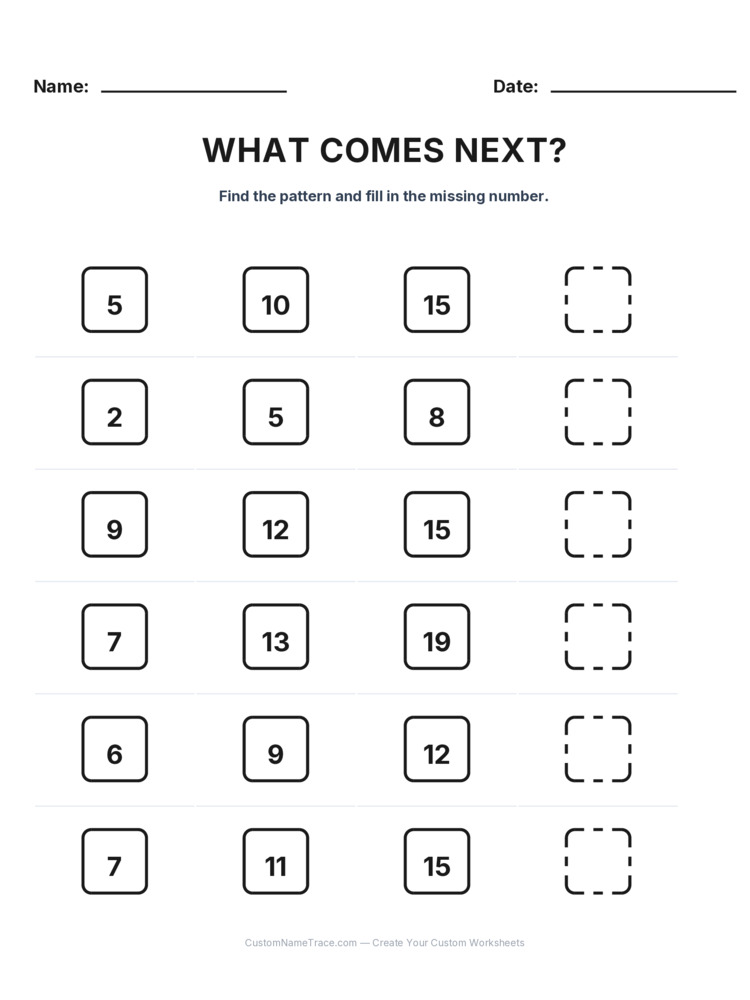
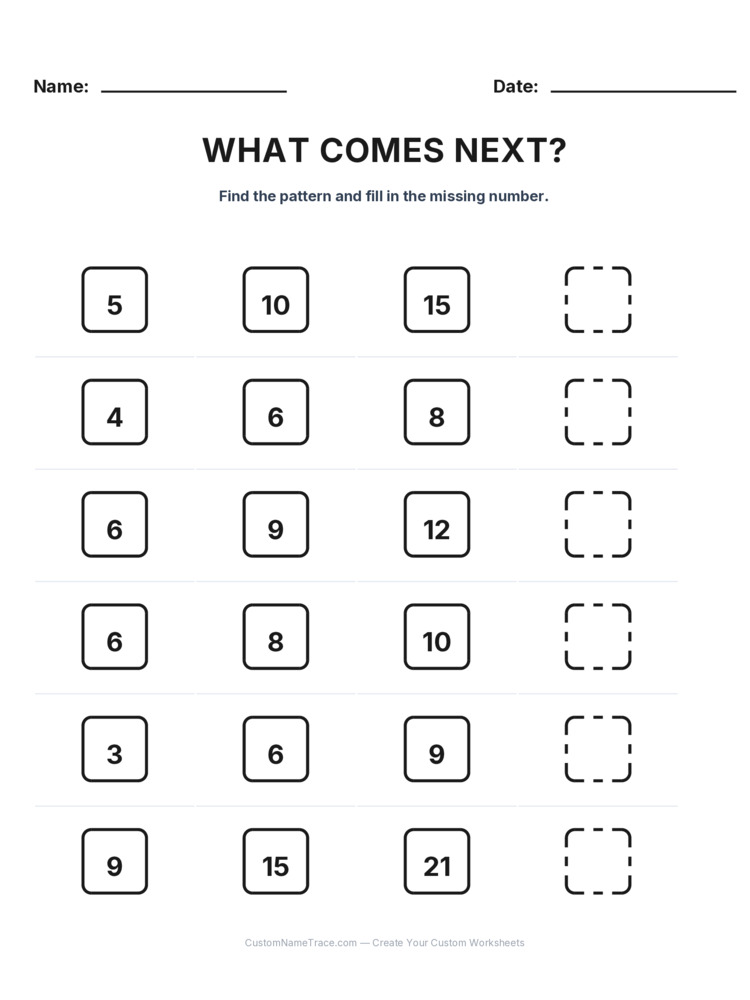
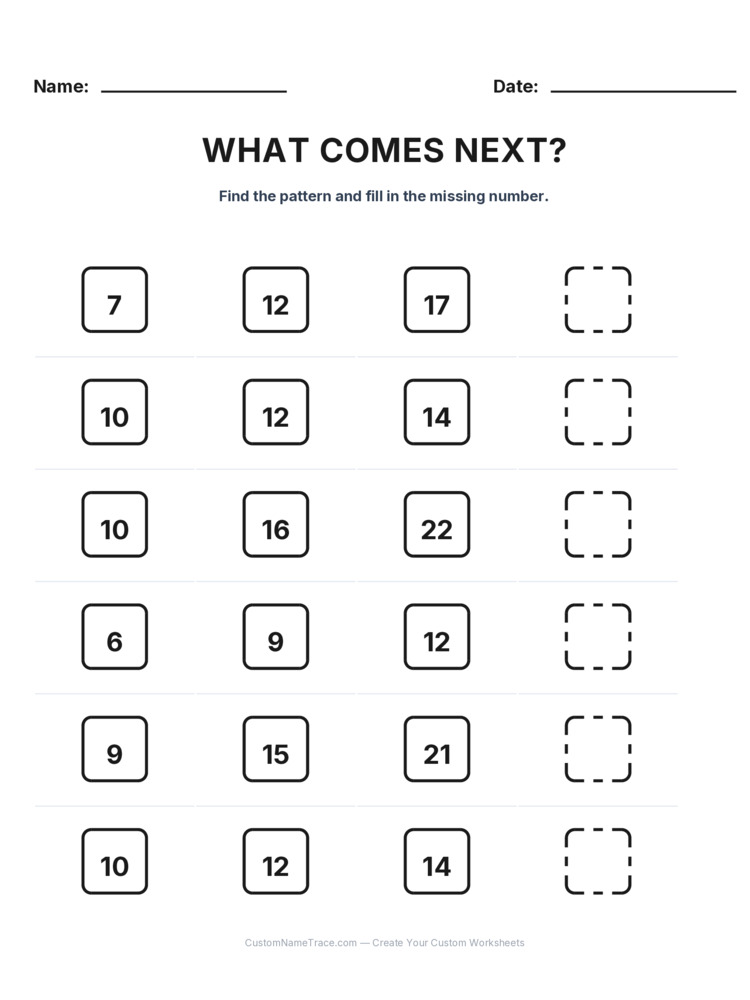
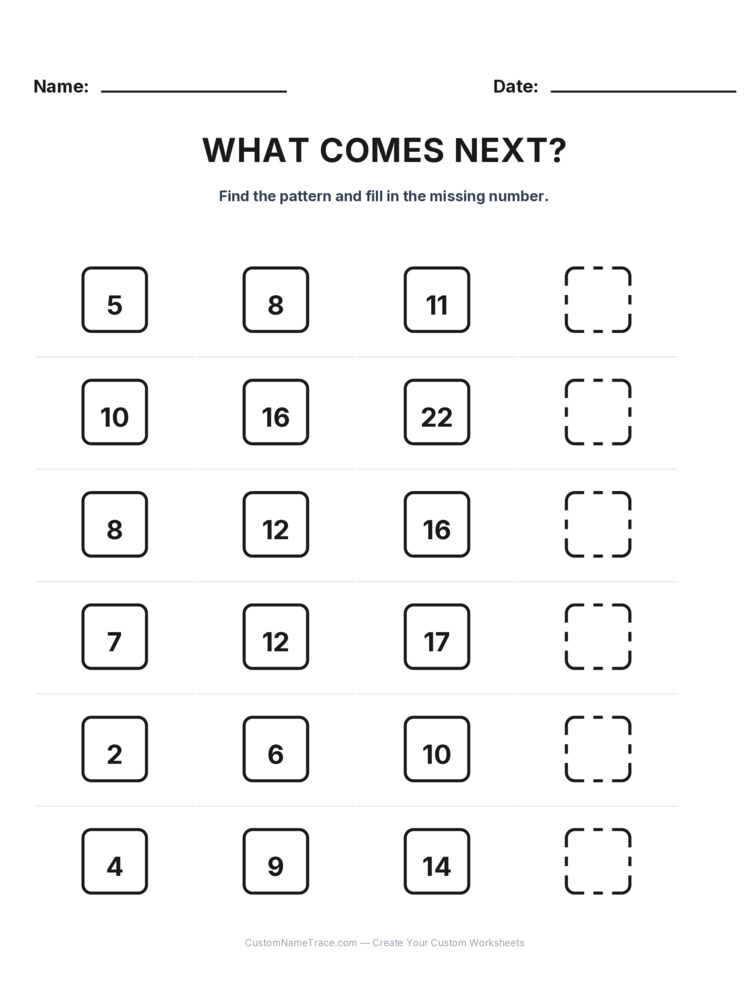
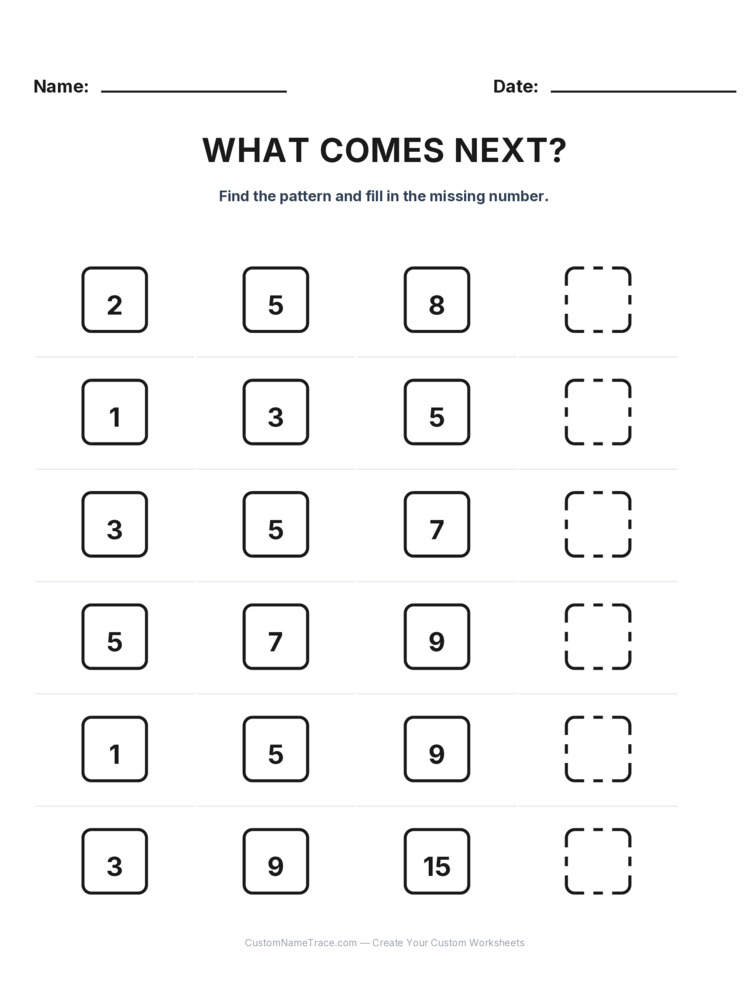
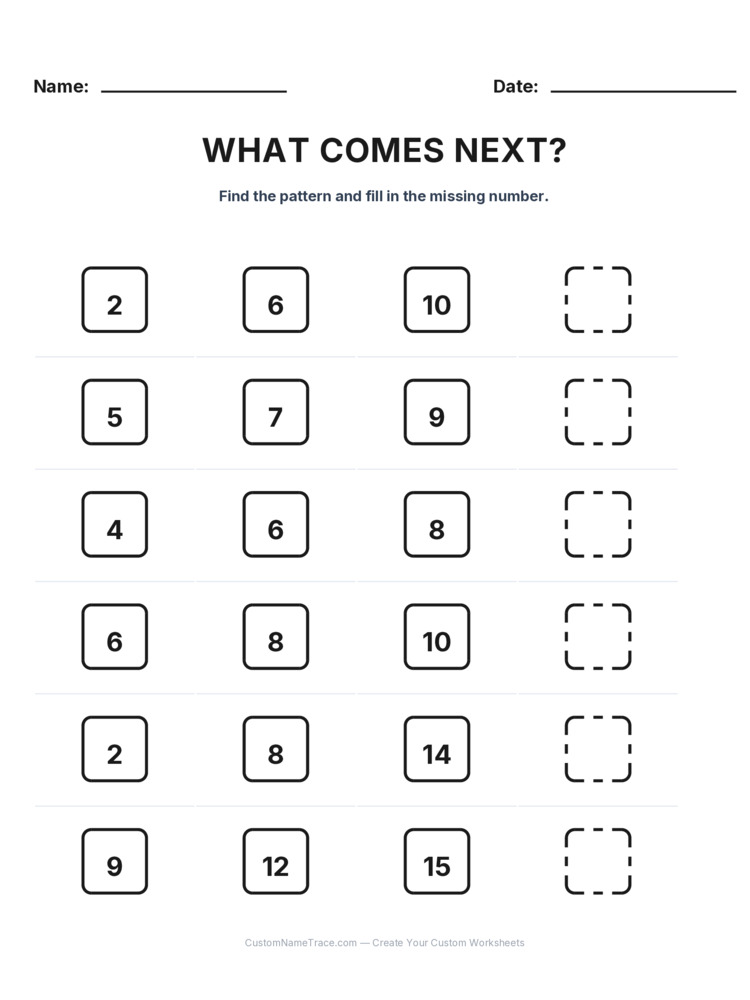
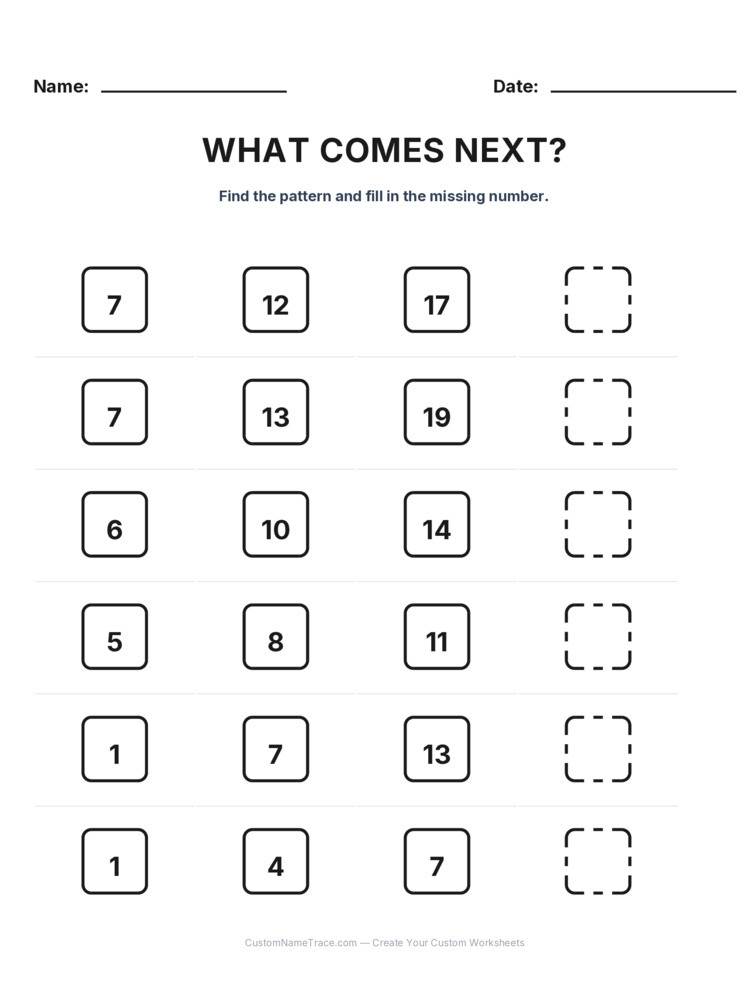
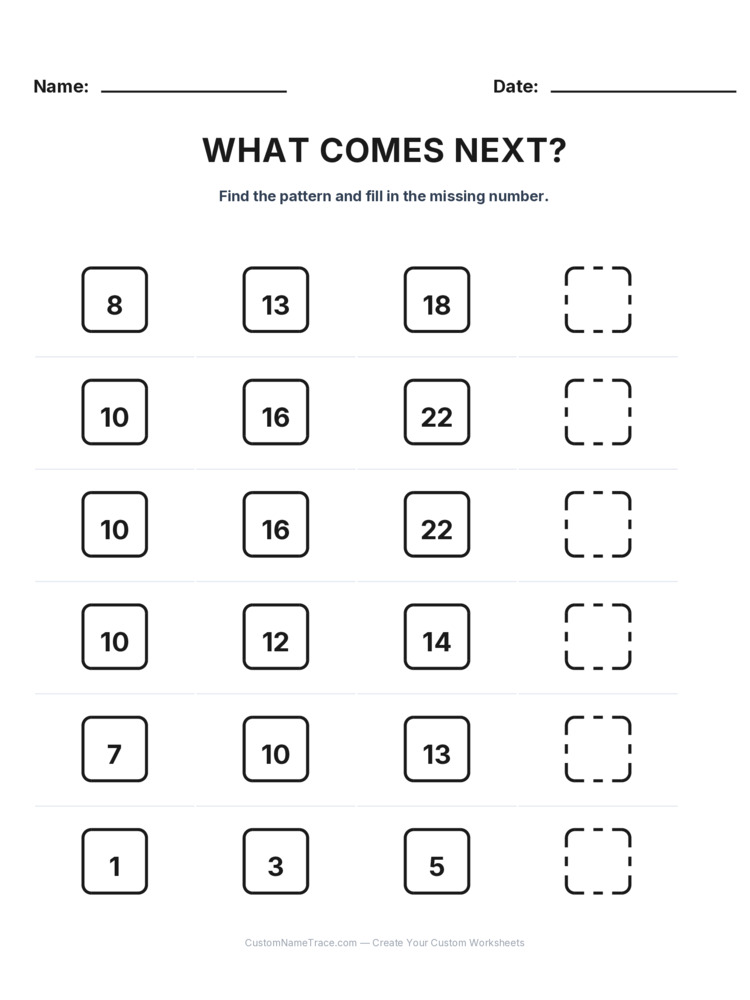
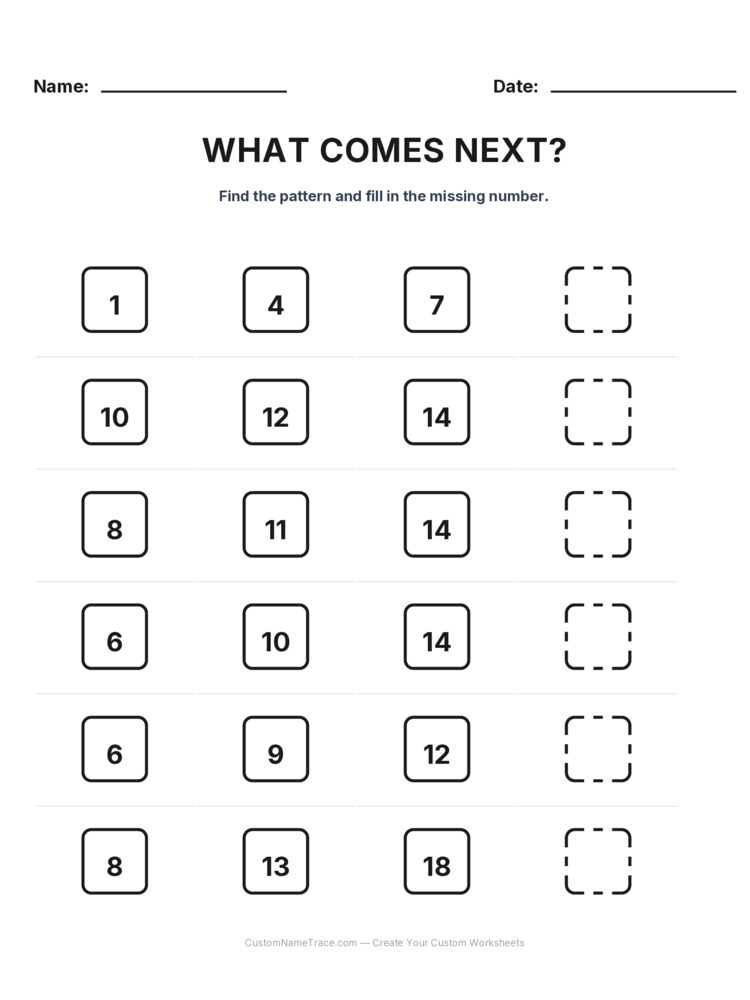
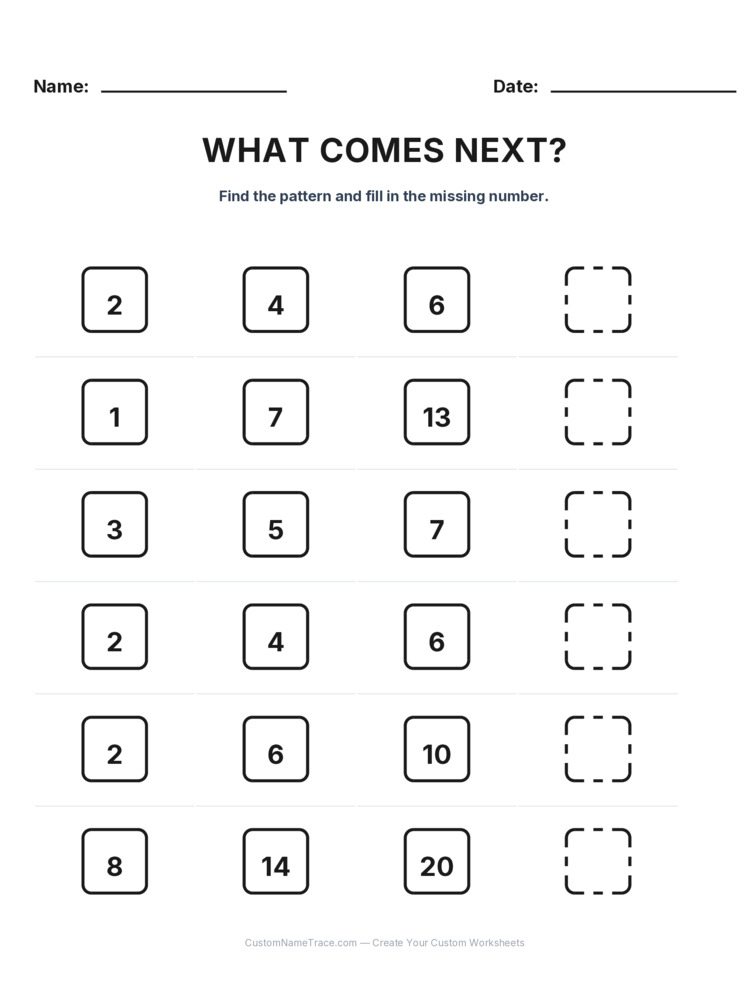
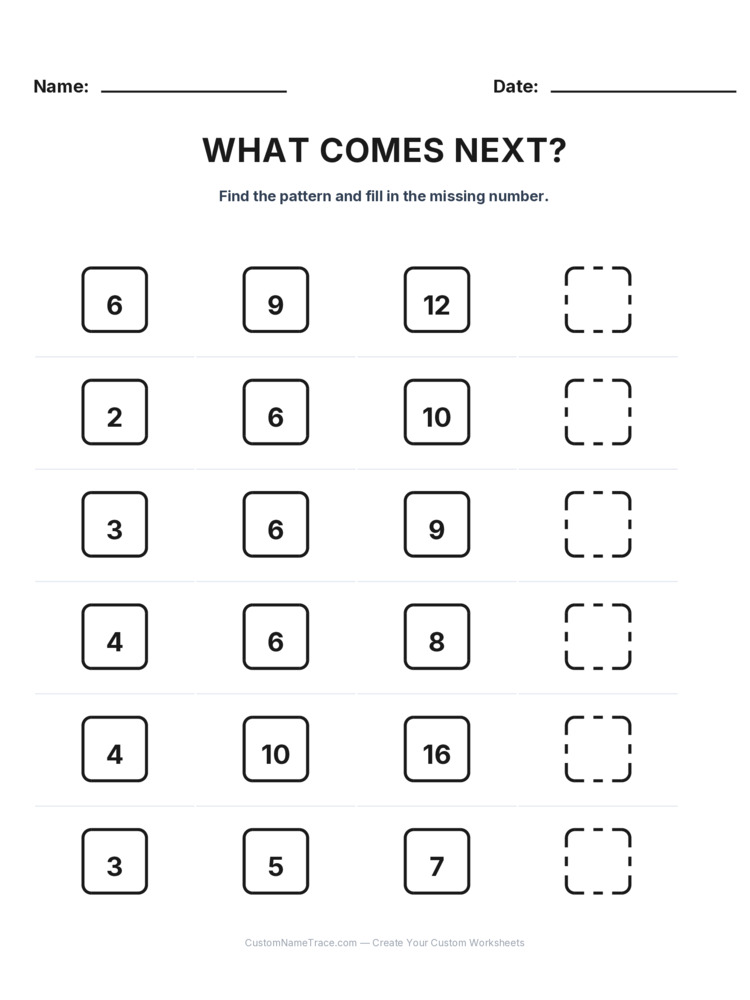
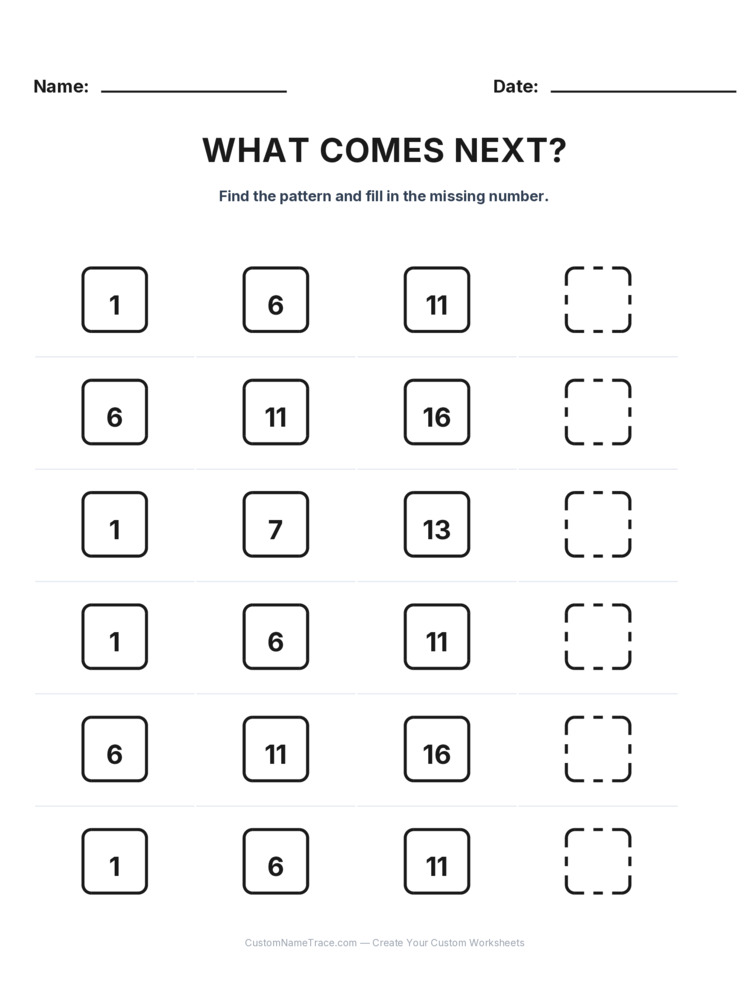
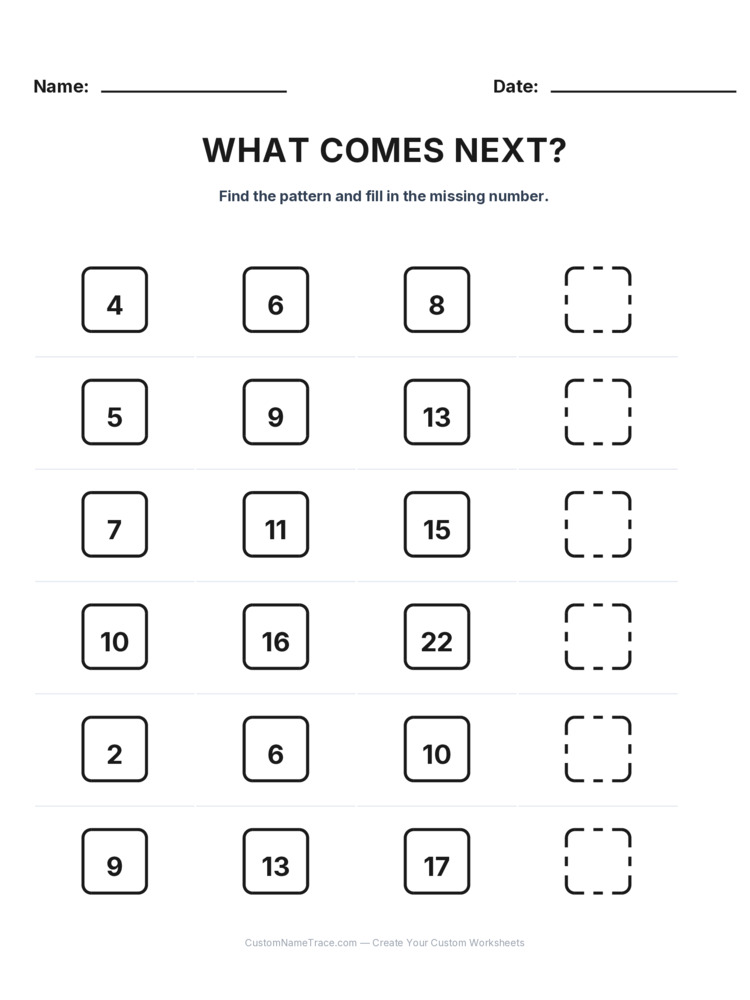
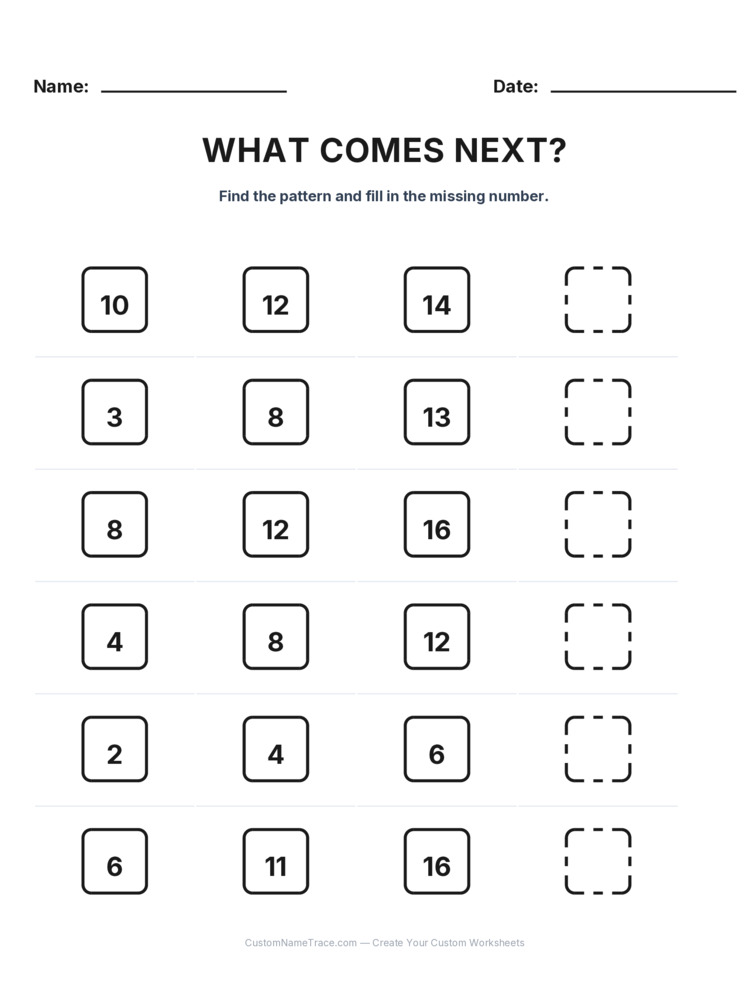
An early, concrete form of algebraic thinking
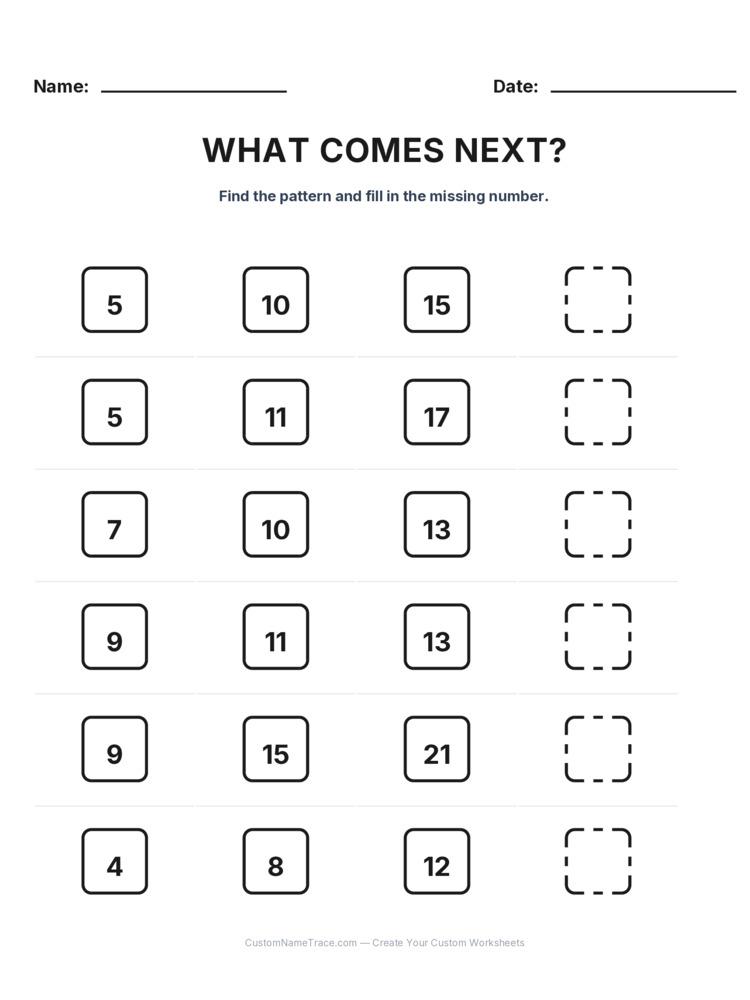
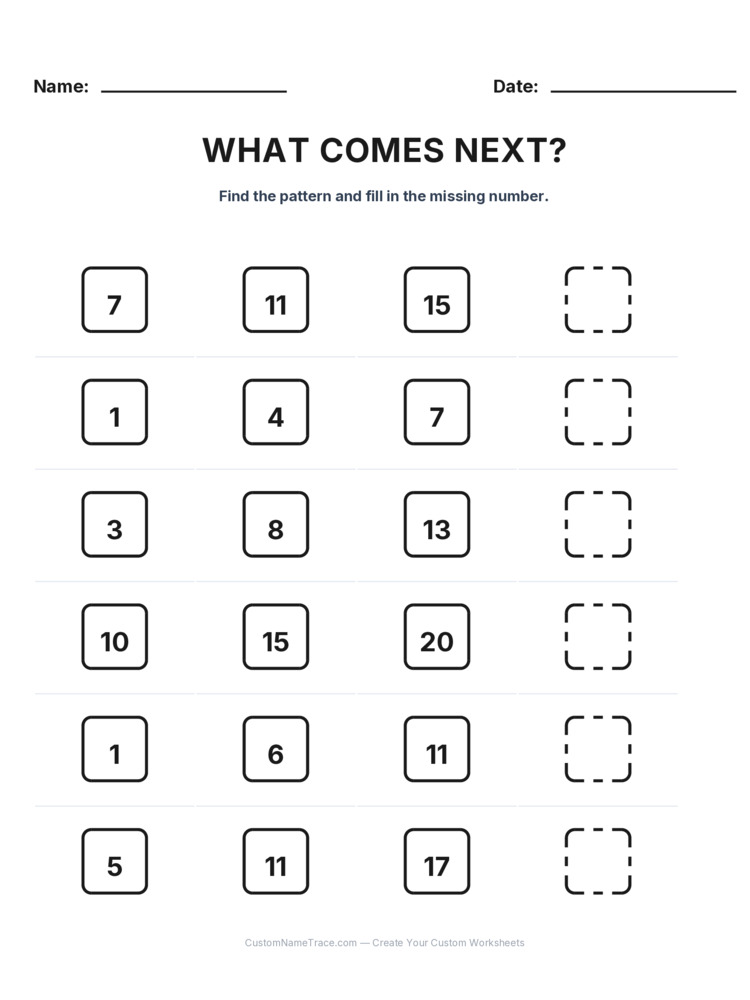
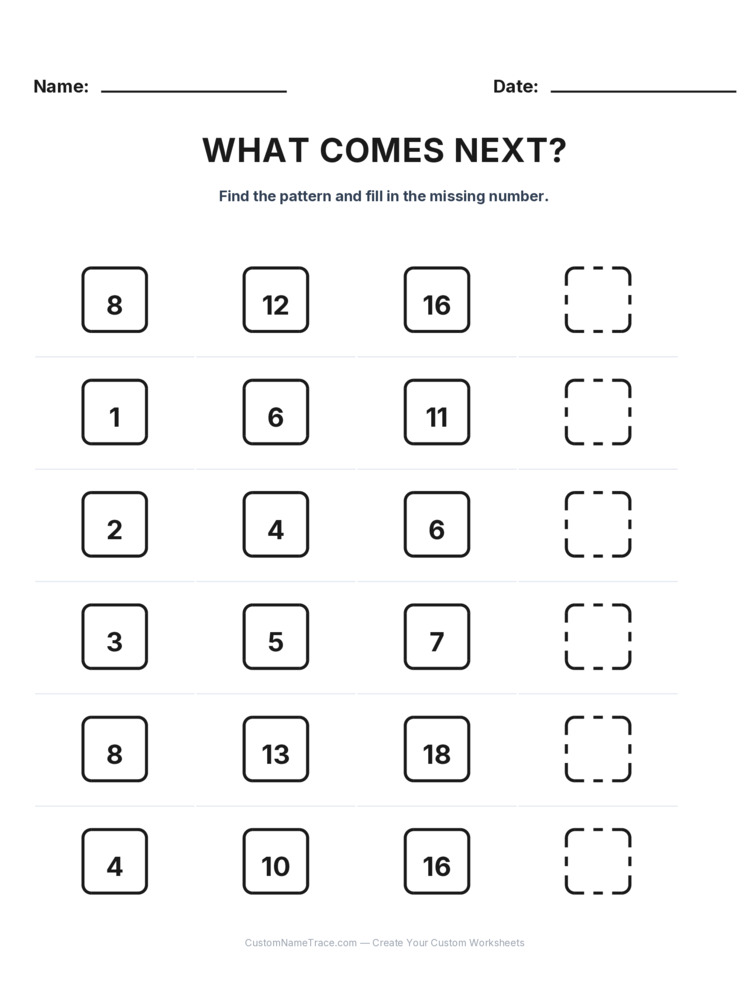
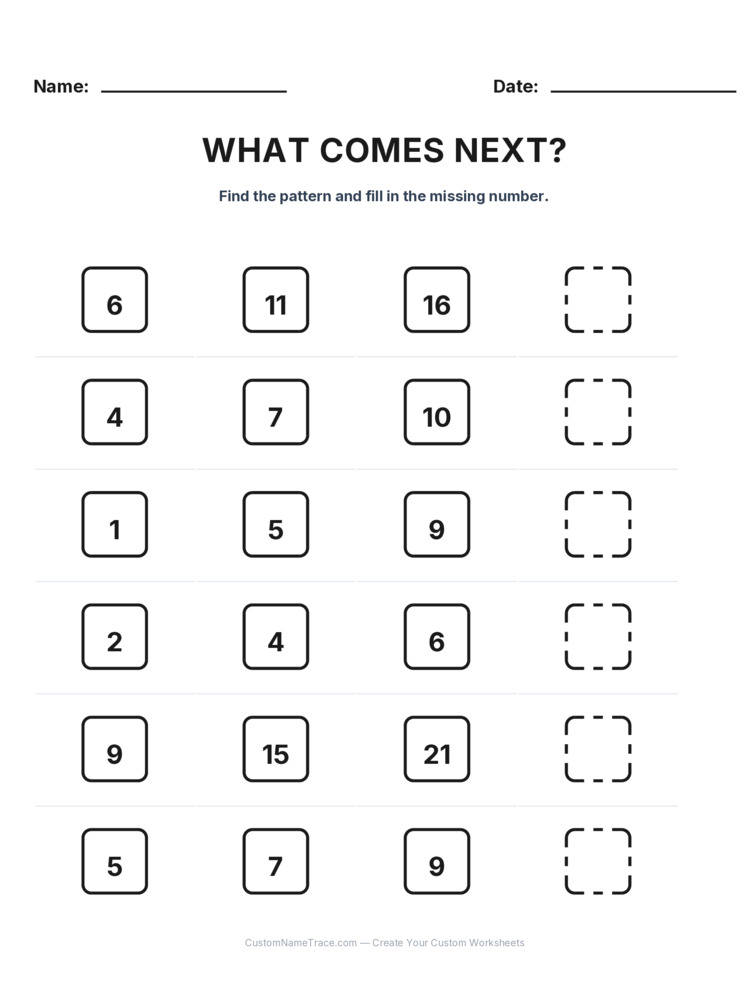
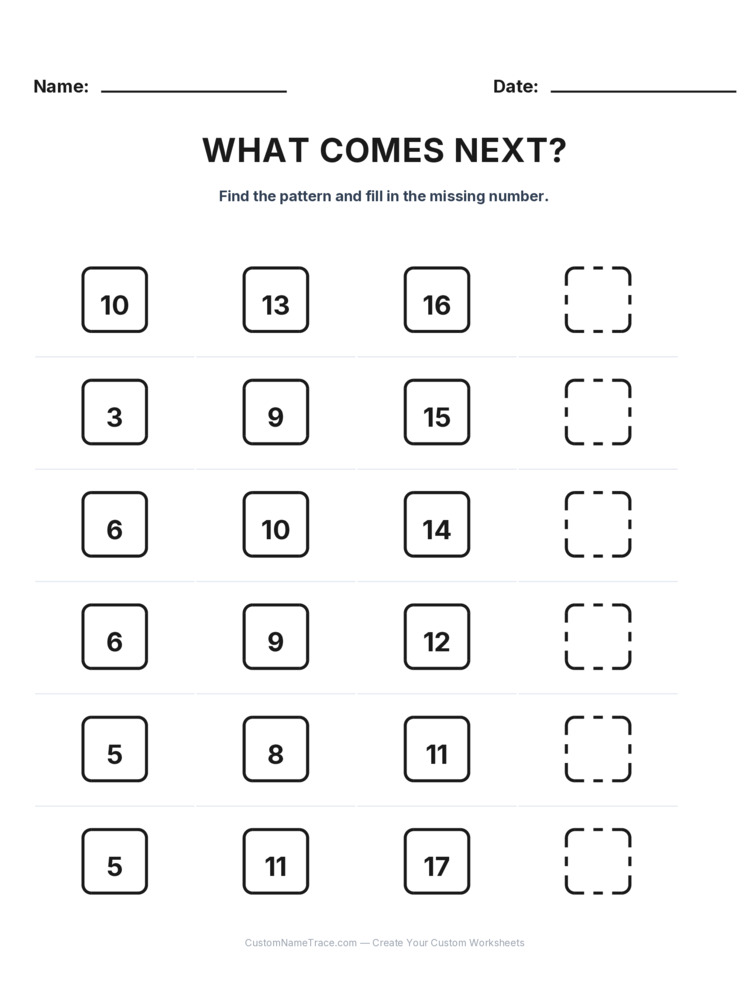
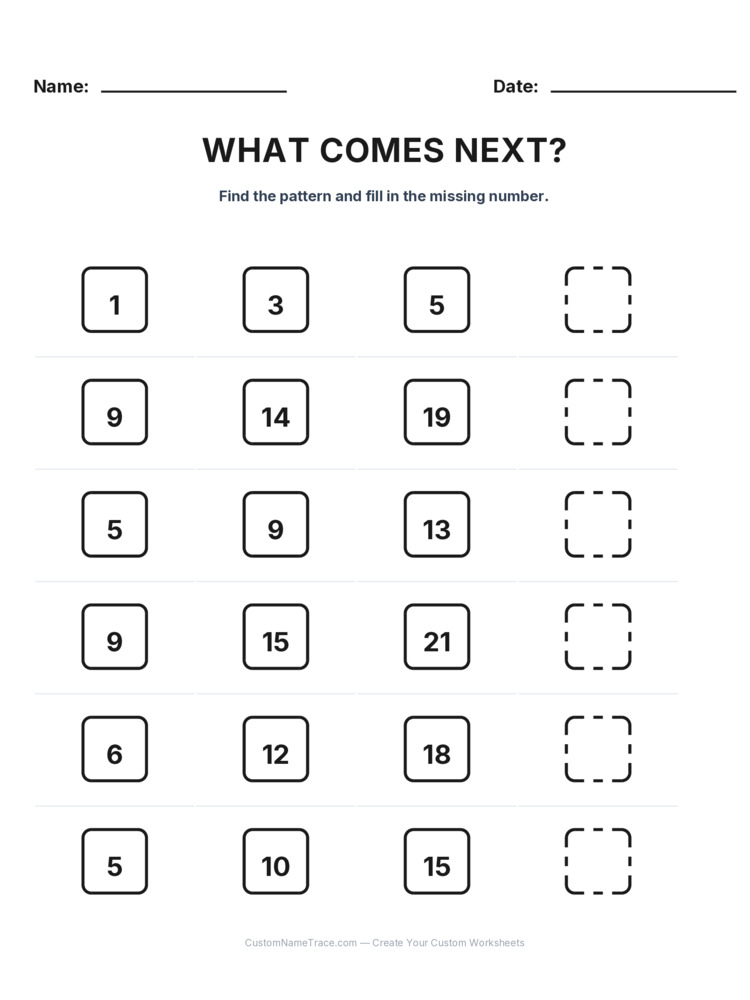
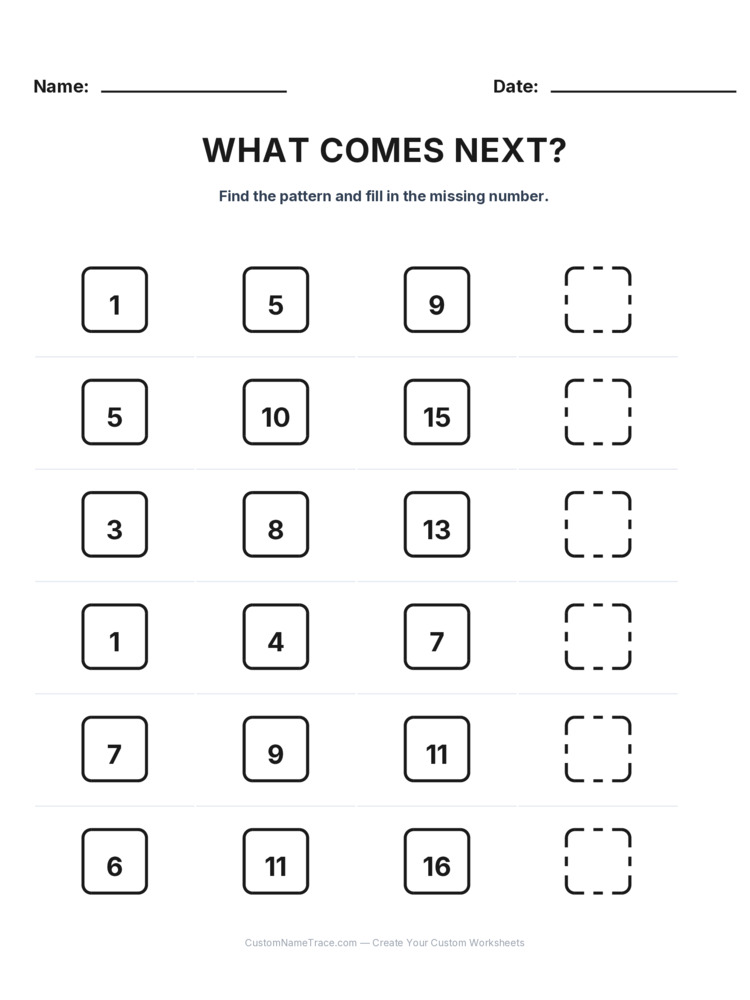
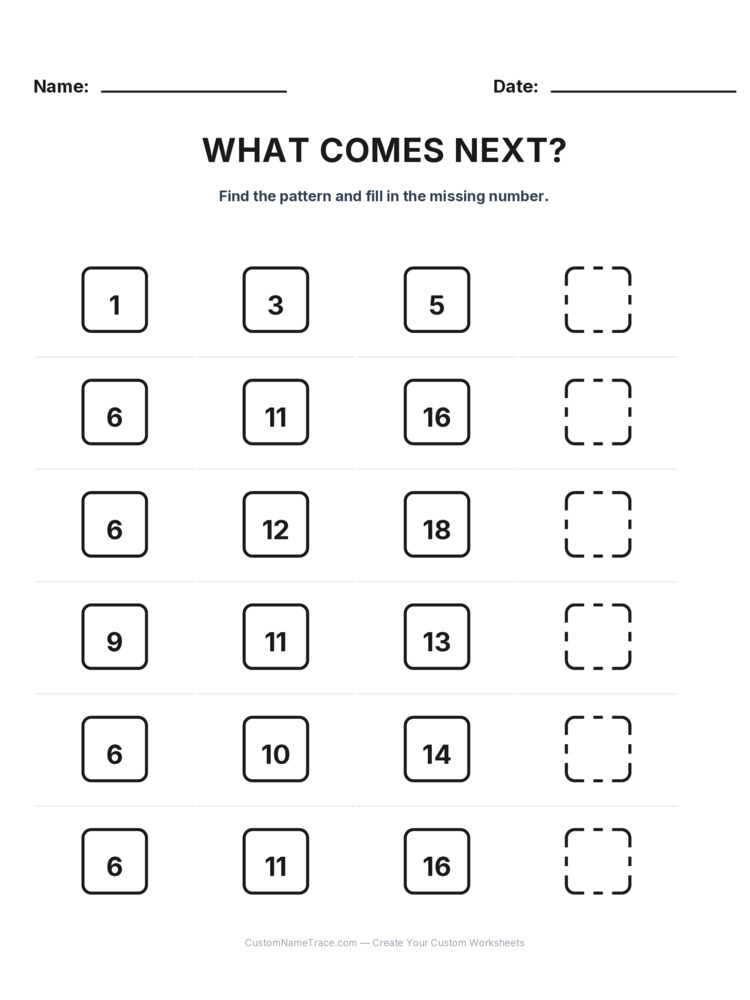
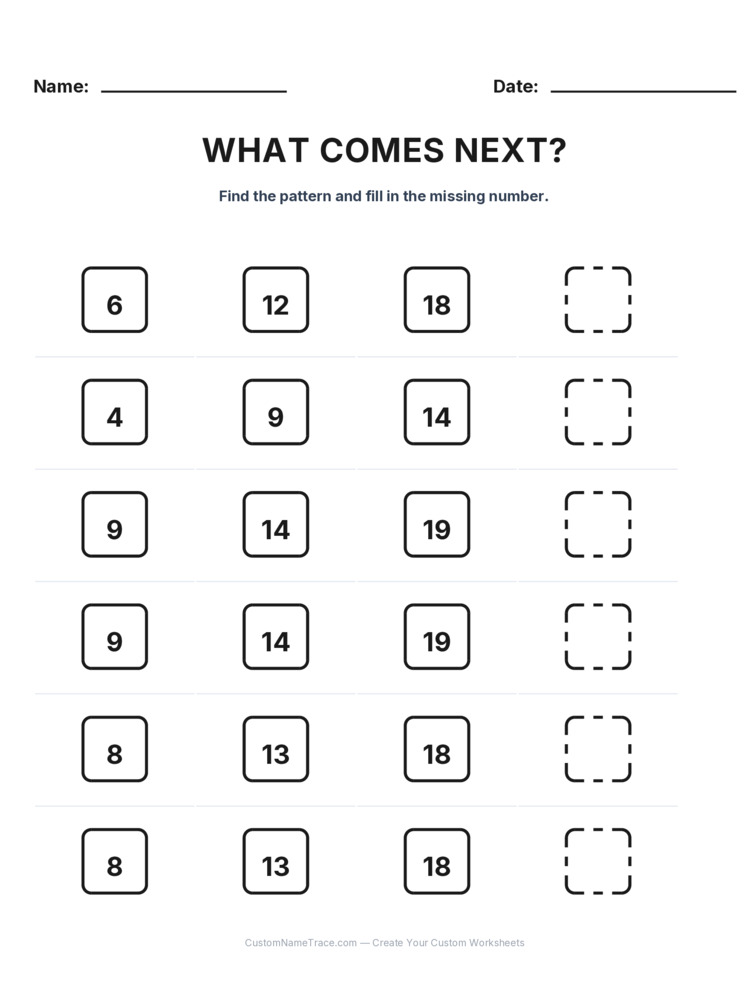
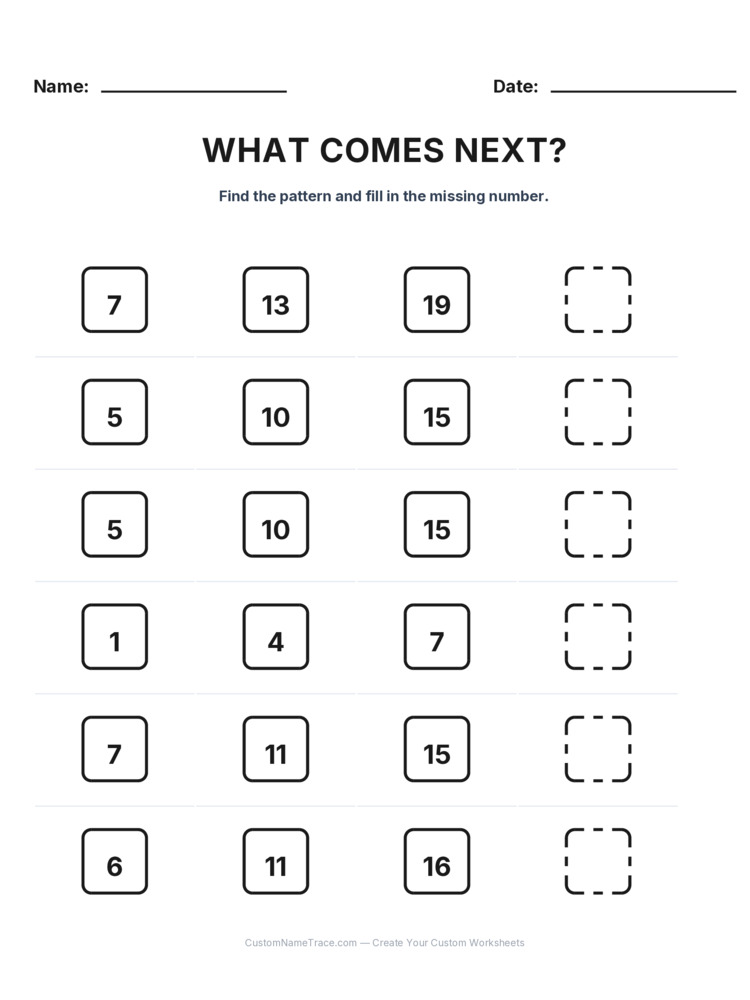
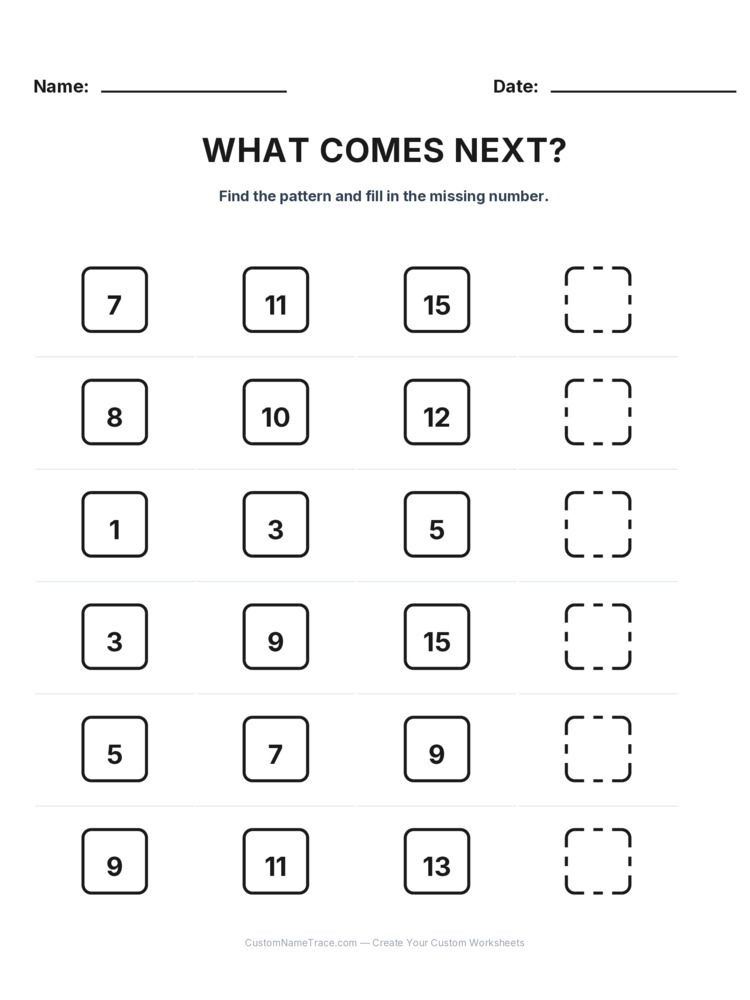
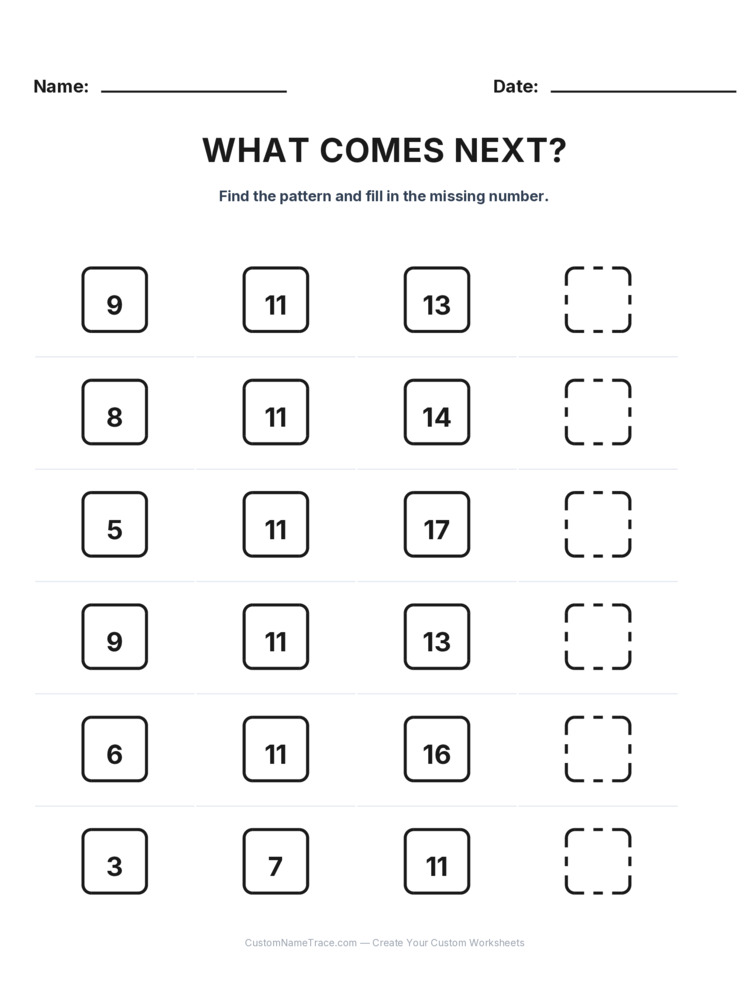
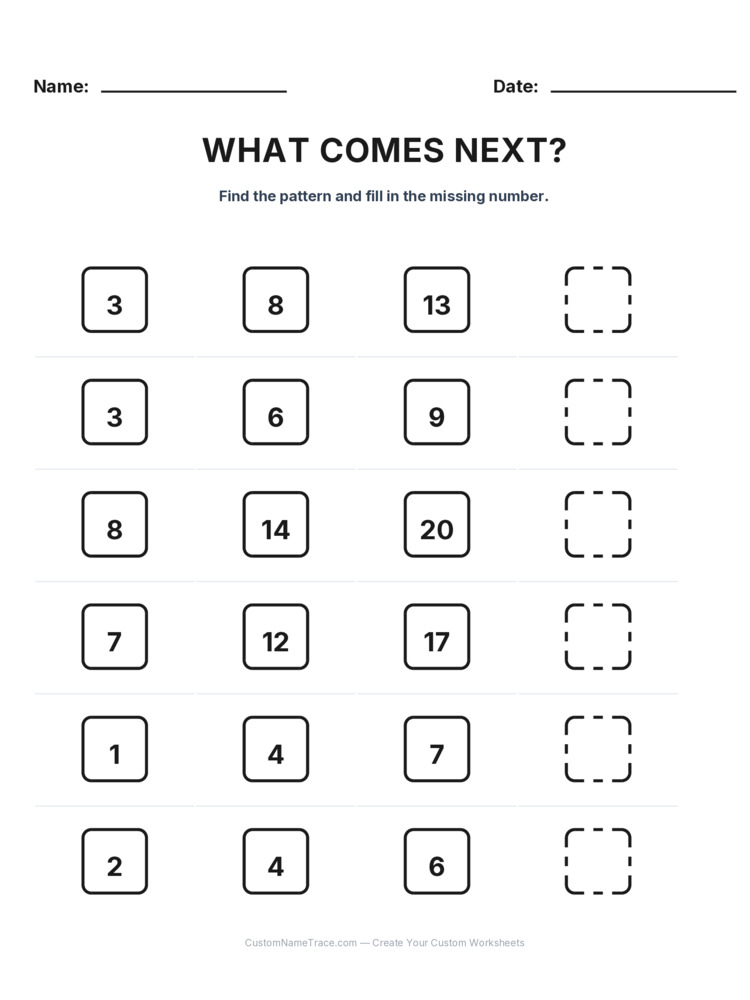
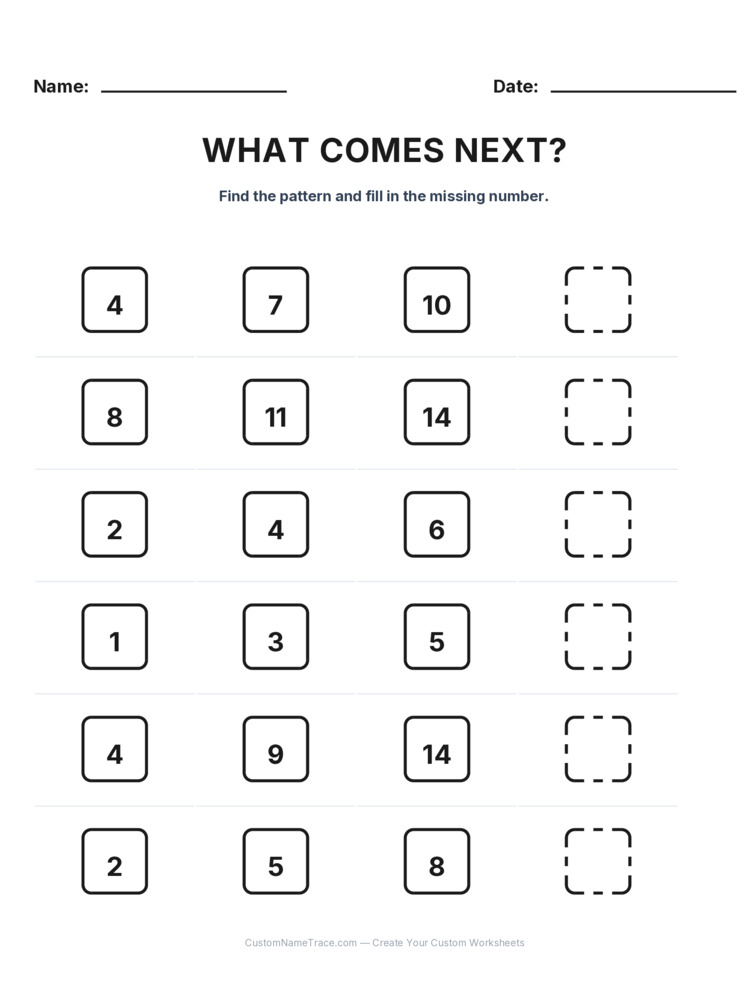
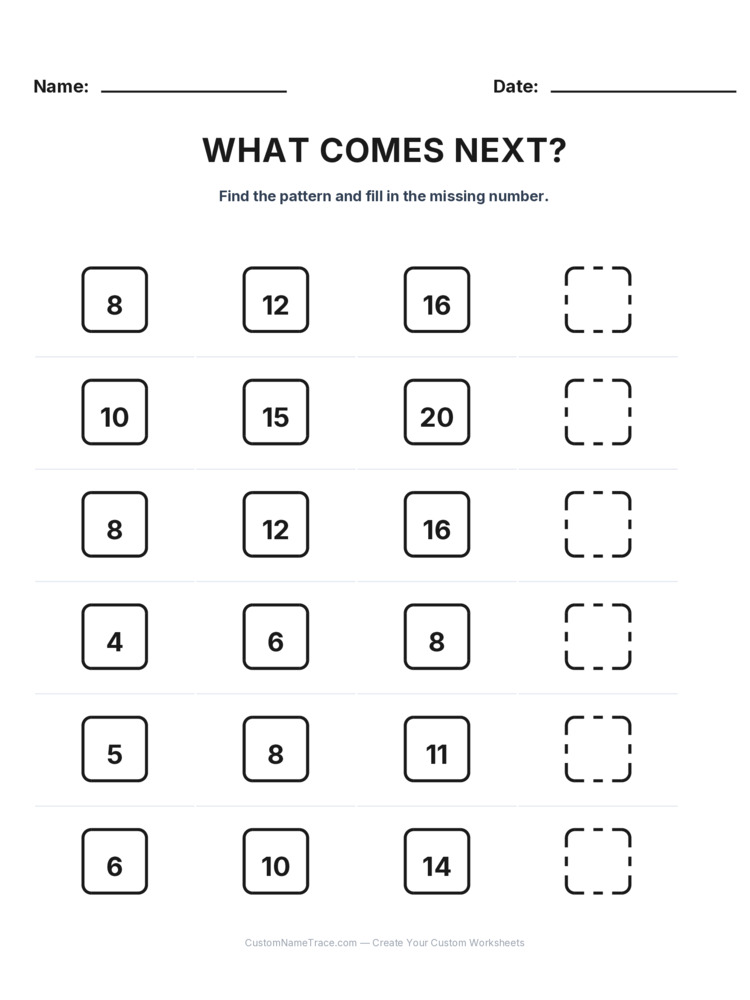
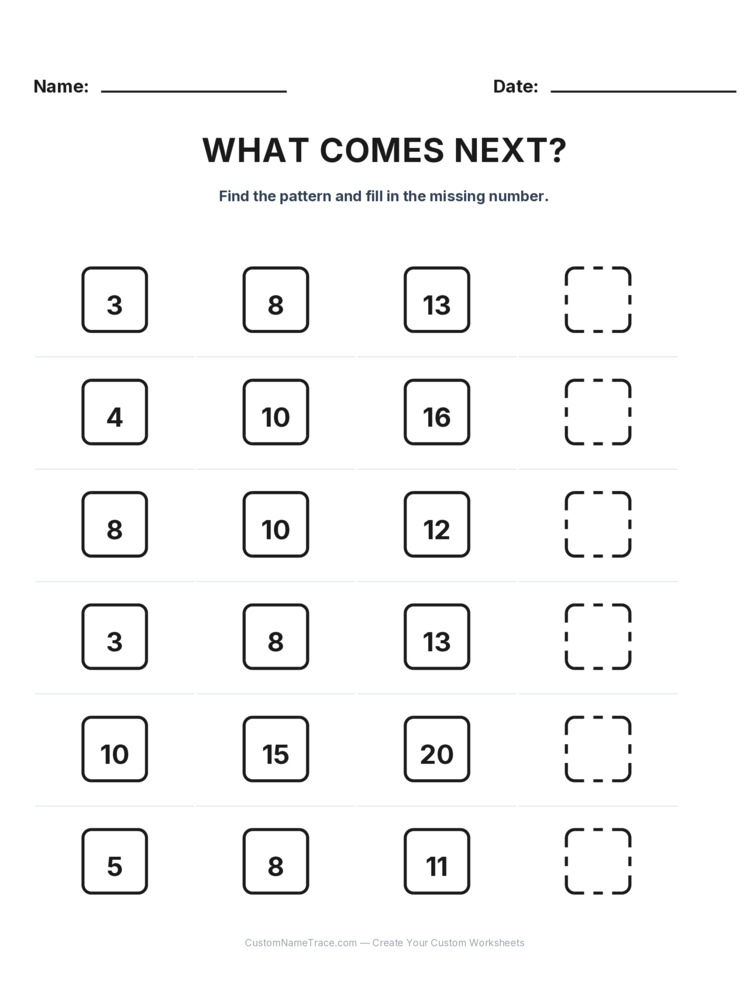
A short row of numbers follows one consistent rule — always adding the same amount, or always adding a growing amount — with the final box left blank for a child to fill in. That's a genuinely early form of algebraic reasoning, even though nothing here looks like algebra: spotting a rule from a handful of examples and predicting what comes next is the exact same underlying move that later shows up as solving for an unknown, just with visible numbers instead of a variable standing in for one.
The number range and how obvious the step size is are both calibrated specifically to Grade 1 — not a generic difficulty label, but a real match to what a child at this level can reason through independently. As the grade level rises, the ranges widen and the step sizes become less immediately obvious, so the underlying skill deepens even though the puzzle format stays exactly the same.
The unknown number always sits at the end of the sequence rather than buried in the middle. That's deliberate: filling in a missing middle number requires reasoning both forward from the numbers before it and backward from the numbers after it simultaneously, which is a meaningfully harder task. Placing the blank last keeps the puzzle to a single, clear direction of reasoning — look at what's given, find the rule, extend it one more step — appropriate for where this sits in the overall Logic Worksheets progression.
A strategy that works, taught explicitly
Find the difference between the first two numbers, then check whether that same difference holds between the next pair — if it does, the rule is confirmed and the answer is one more step of it; if it doesn't, the growth itself is changing and needs a second look. Teaching that two-step check (find a candidate rule, then confirm it against a second pair before trusting it) prevents the single most common mistake on this worksheet: locking onto a rule after checking only one pair of numbers.
Before writing a final answer, having a child say the completed sequence out loud from the very first number through the new one they've added catches the rare case where an otherwise-correct rule was applied starting from the wrong number, and it's a habit worth keeping even once the puzzles start feeling easy, since it costs seconds and reliably catches this one specific kind of mistake.
For a child who reasons well out loud but still makes written errors, writing the difference between each pair of numbers directly above the arrows connecting them — turning the mental math into something visible on the page — externalizes a step that's otherwise easy to lose track of silently. This small habit, jotting the "+2" or "+3" above each gap before answering, catches inconsistent step sizes that a purely mental check sometimes misses.
What mistakes reveal, and knowing when to move on
A child who answers incorrectly has almost always checked only the first pair of numbers in the row and assumed the rule holds without confirming it against the rest. Ask them to point to each pair of adjacent numbers in turn and say the difference out loud — "from 3 to 5 is plus 2, from 5 to 7 is plus 2" — before committing to an answer. That habit of confirming a pattern across multiple examples, not just one, is the transferable skill, far more than any individual sequence.
Not every sequence on this worksheet necessarily grows — some subtract a consistent amount instead, which trips up a child who's only practiced adding. The same two-step check (find the difference between the first pair, confirm it against the next pair) works identically whether the numbers are climbing or falling; the only change is that the "difference" is negative. Pointing this out explicitly the first time a decreasing sequence appears prevents a child from assuming every pattern must go up.
A child who solves several variants of this worksheet quickly and confidently, without needing to write out the difference between every pair, is likely ready to move to this same format at the next grade level, where the number range widens and the step size becomes less immediately obvious. Rushing that transition before the current level feels genuinely easy risks turning a confidence-building exercise into a frustrating one — there's no harm in staying at one level longer than expected.
Building the skill beyond the worksheet
Counting objects out loud in a consistent step — every second stair on the way upstairs, every third tile on a floor — builds the same pattern-in-motion sense this worksheet asks for on paper, just embodied rather than written. Skip-counting games like this, played casually and often, tend to make the paper version feel like a familiar exercise rather than a cold test the first time a child sits down with it.
This puzzle doesn't require paper at all to practice — reciting a short sequence out loud ("2, 4, 6, ...") and asking a child to say what comes next works in a car, at a table, or anywhere a spare minute appears, and it isolates the exact same rule-finding skill without any of the writing. This verbal version is also a fast, low-pressure way to check whether a child is ready for a wider number range before handing them a new printed worksheet.
Pointing out real growing sequences a child encounters outside of worksheets — a calendar's dates increasing by one each day, a clock's minute marks increasing by five, coins stacking in value — grounds the abstract idea of "a number pattern" in things a child already sees and uses regularly. Once a child recognizes that the skip-counting pattern on this worksheet is the same kind of thing as the numbers on a calendar or a clock face, the worksheet stops feeling like an isolated school exercise and starts feeling like a formal version of something they already partly understand.
This same what-comes-next reasoning shows up constantly in early-elementary homework outside of dedicated logic worksheets — a skip-counting math assignment, a word problem describing a repeating routine, even a science worksheet describing a growth pattern over several days. Recognizing when a homework problem is secretly asking for this exact skill, and saying so out loud ("this is the same as the number pattern game"), helps a child transfer what they've practiced here into contexts that don't look like a logic puzzle on the surface but rely on the identical reasoning underneath.
Where this leads
This exact puzzle format appears at more than one grade level on this site, using wider ranges and less obvious step sizes as the grade rises — deliberately, since deepening a skill a child already has with harder numbers is a genuinely different kind of practice than an easier version relabeled. A child moving up a grade level on this worksheet is extending a skill they've already built, not learning something unrelated from scratch.
Every sequence on this worksheet grows by consistent addition — the same amount added each step — rather than by multiplication, which is a deliberate choice matched to what Grade 1 is working with in regular math instruction. That restriction keeps the puzzle's difficulty focused entirely on spotting and confirming the step size, rather than introducing a fundamentally different kind of growth a child hasn't been formally taught yet; multiplicative growing patterns are a natural, harder extension for later, once addition-based sequences feel completely automatic.
Every numbered variant generates a fresh sequence testing the same underlying skill, so a child who wants more practice at Grade 1's level never re-solves a sequence they already have memorized. For a sibling or classmate at a different grade, this same Growing Sequence format exists at other grade levels on this site with a range matched to that grade instead.