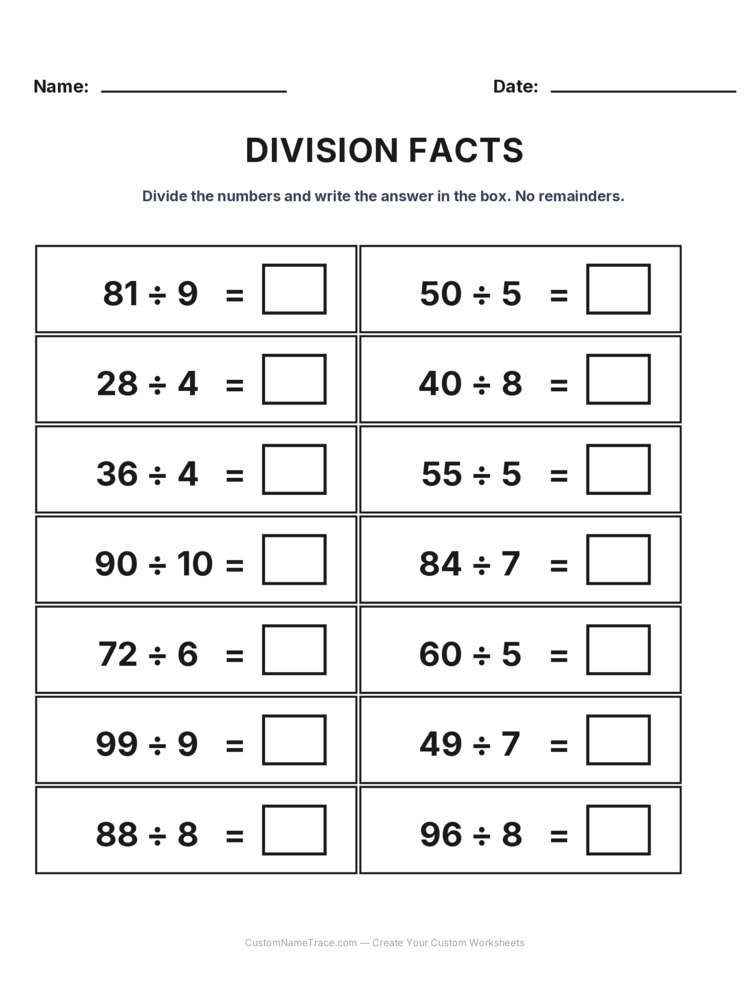
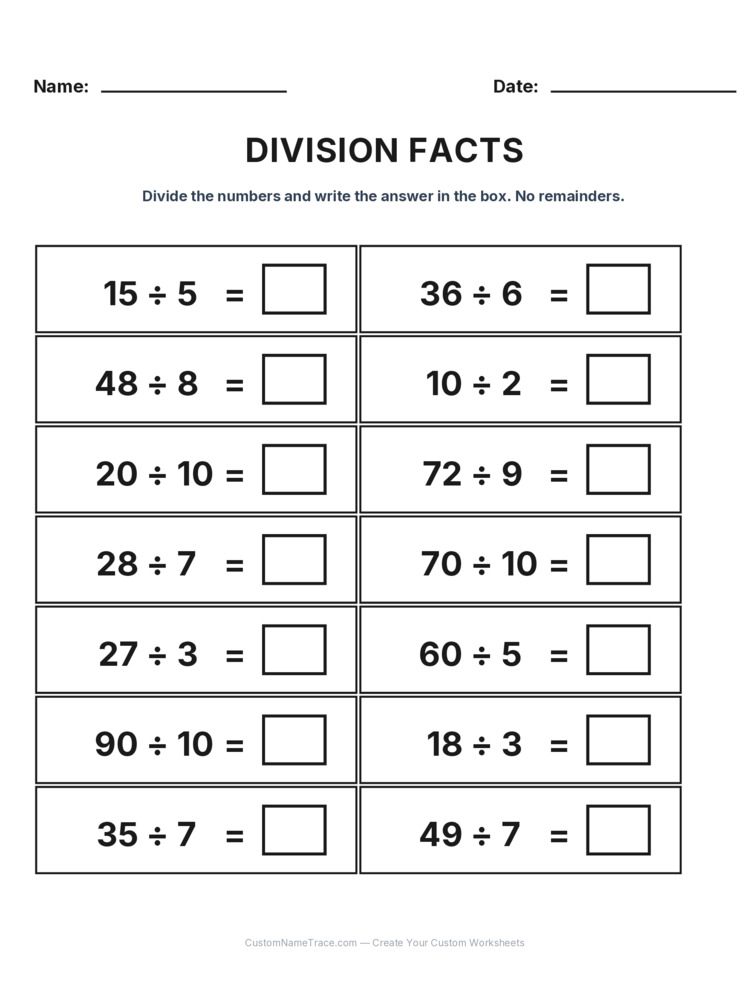
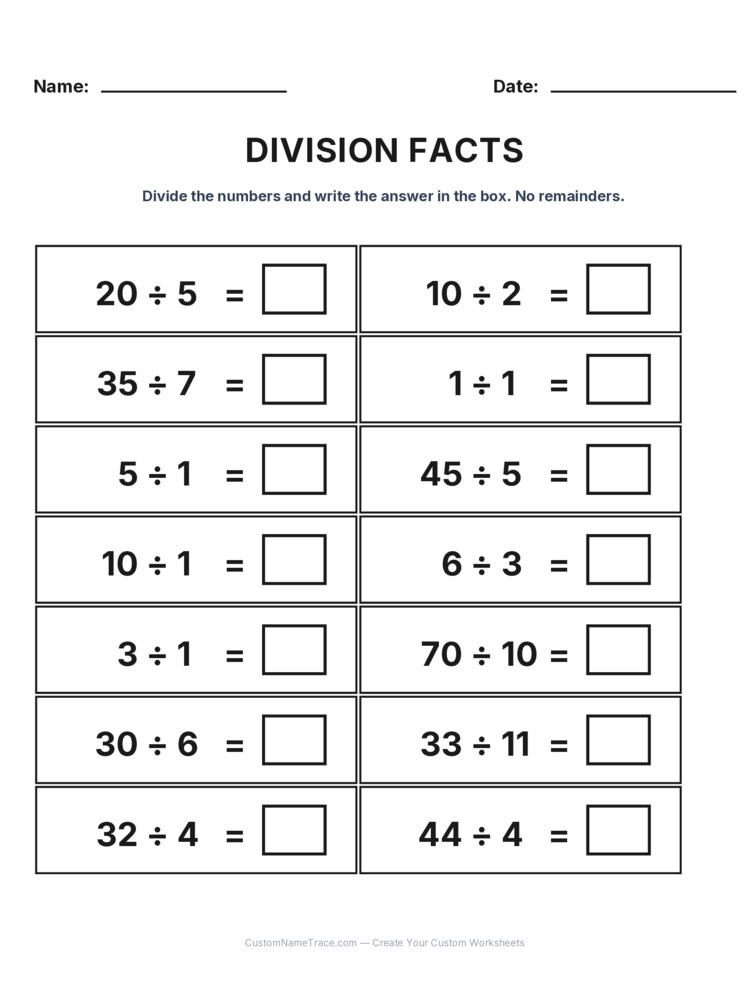
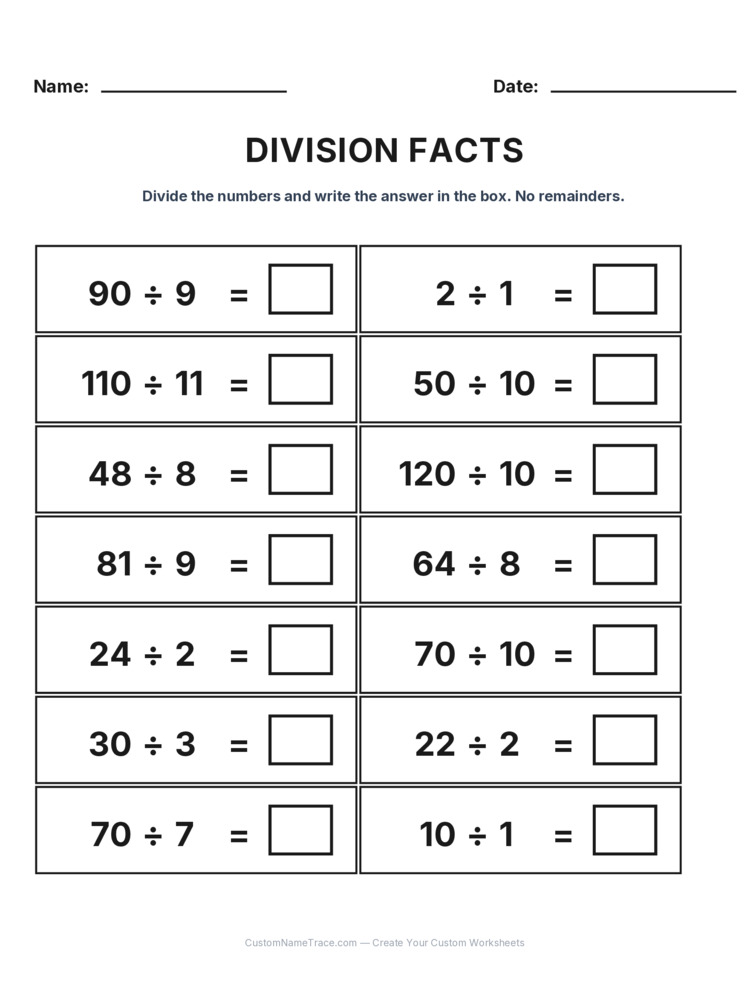
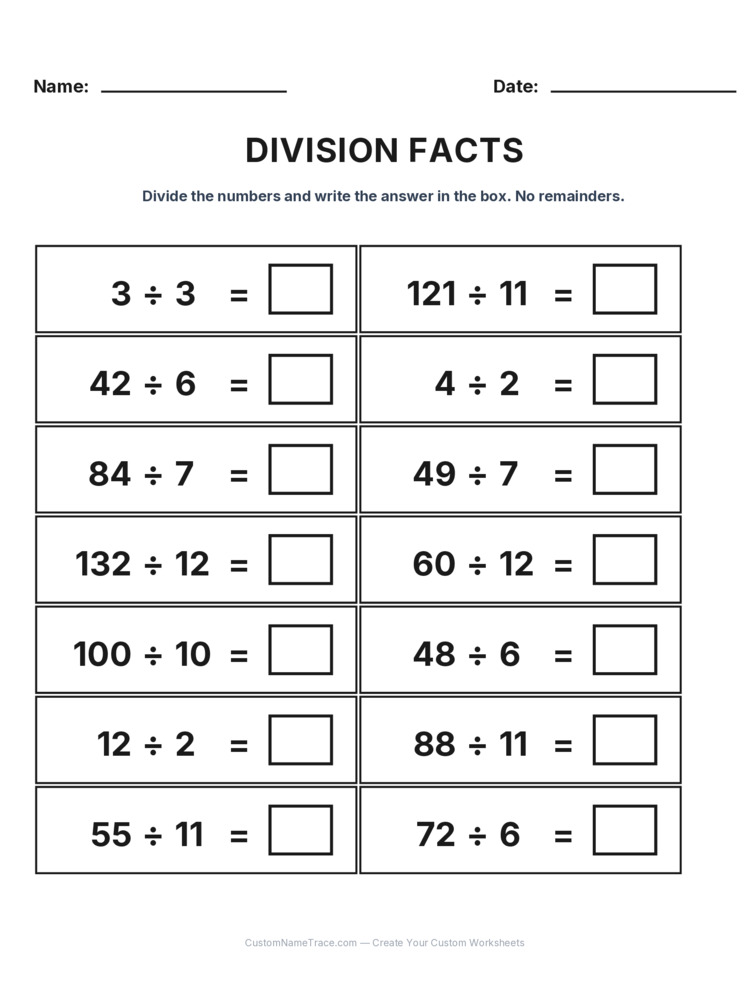
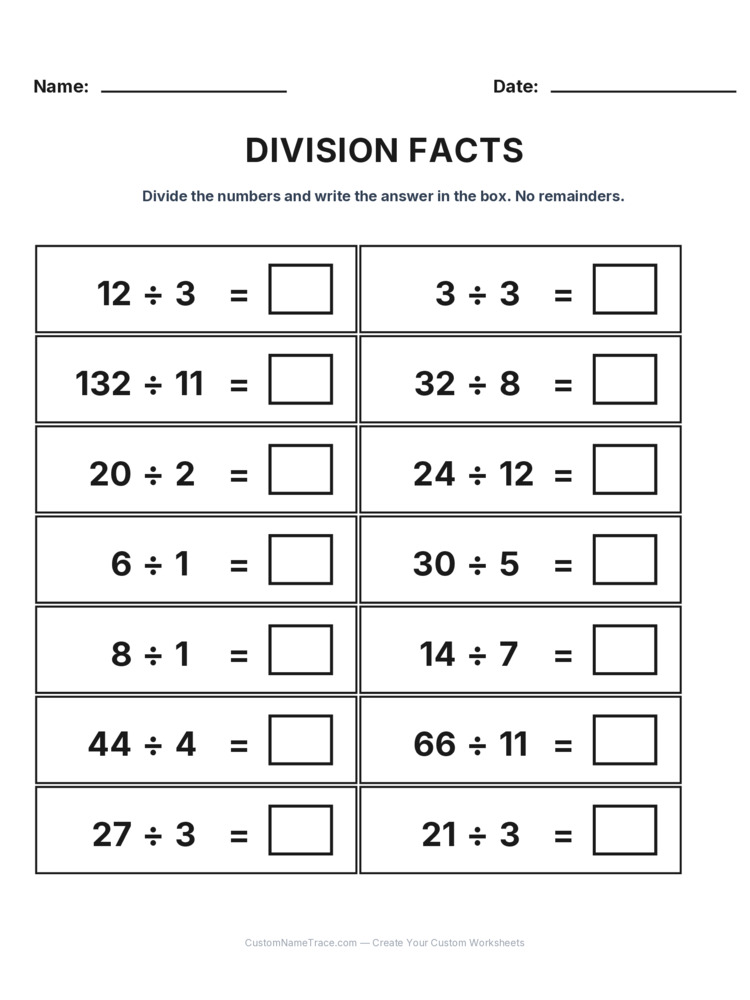
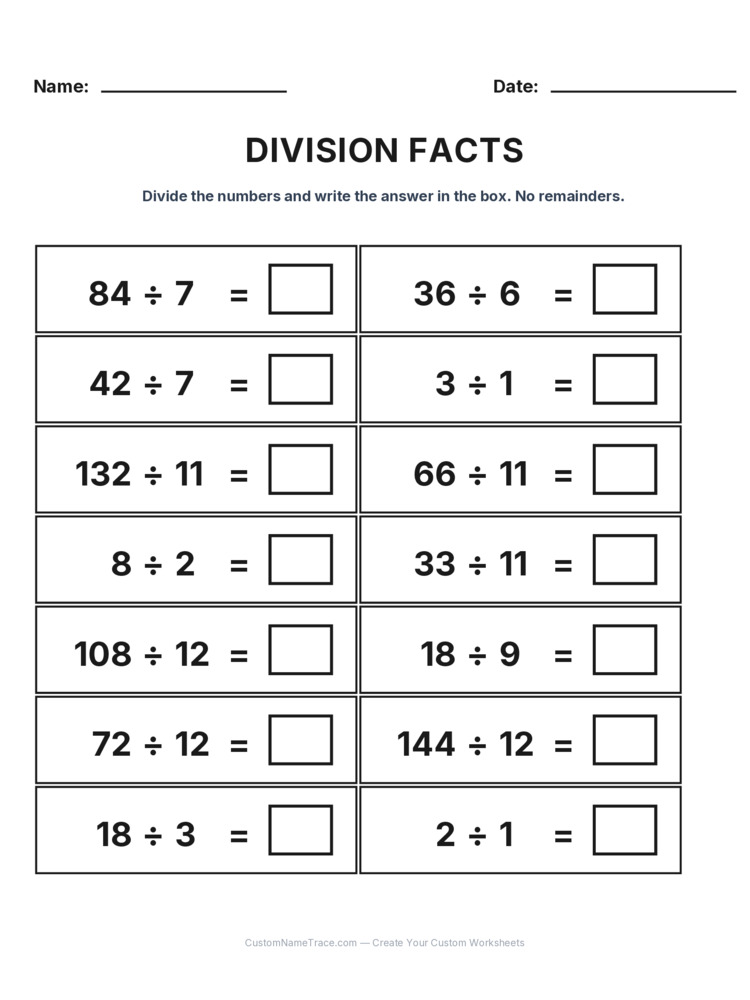
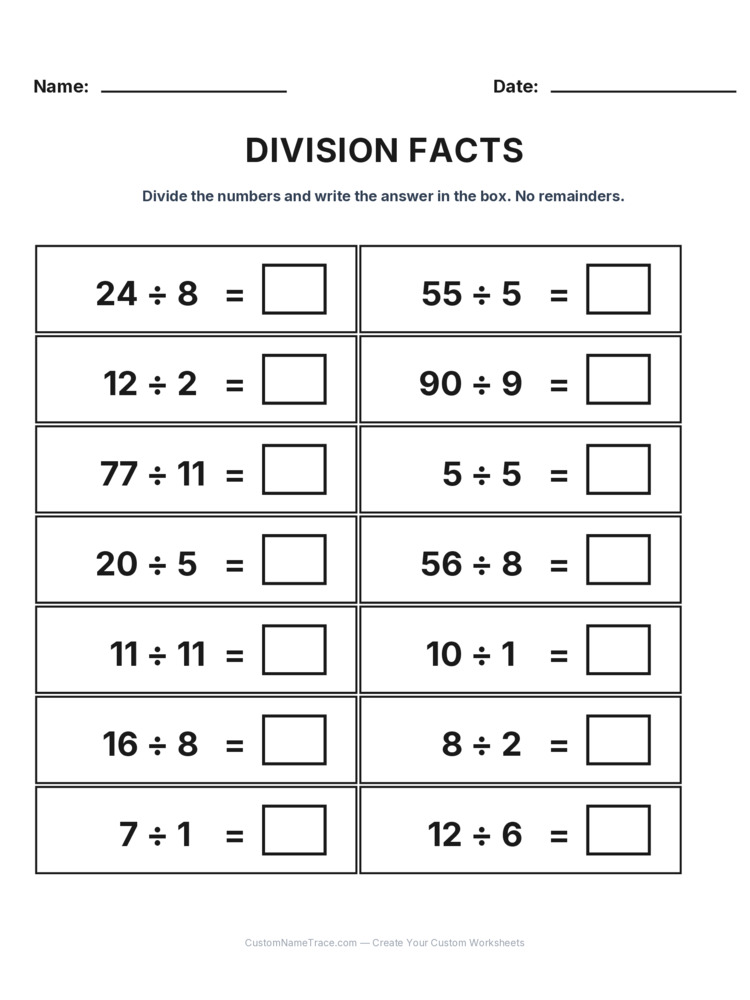
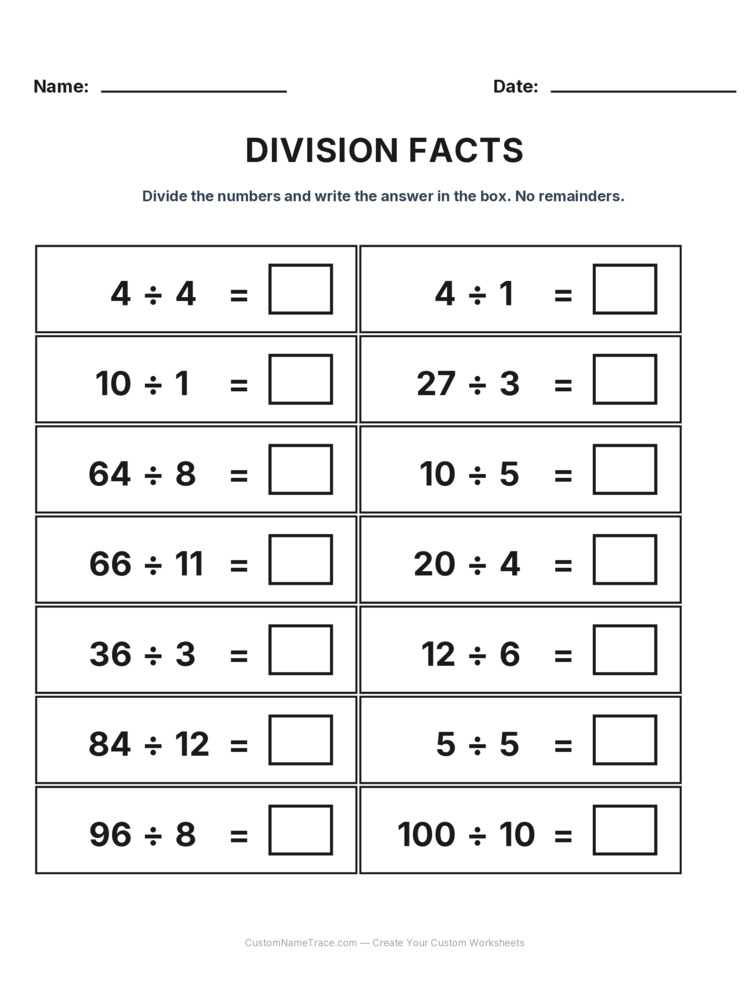
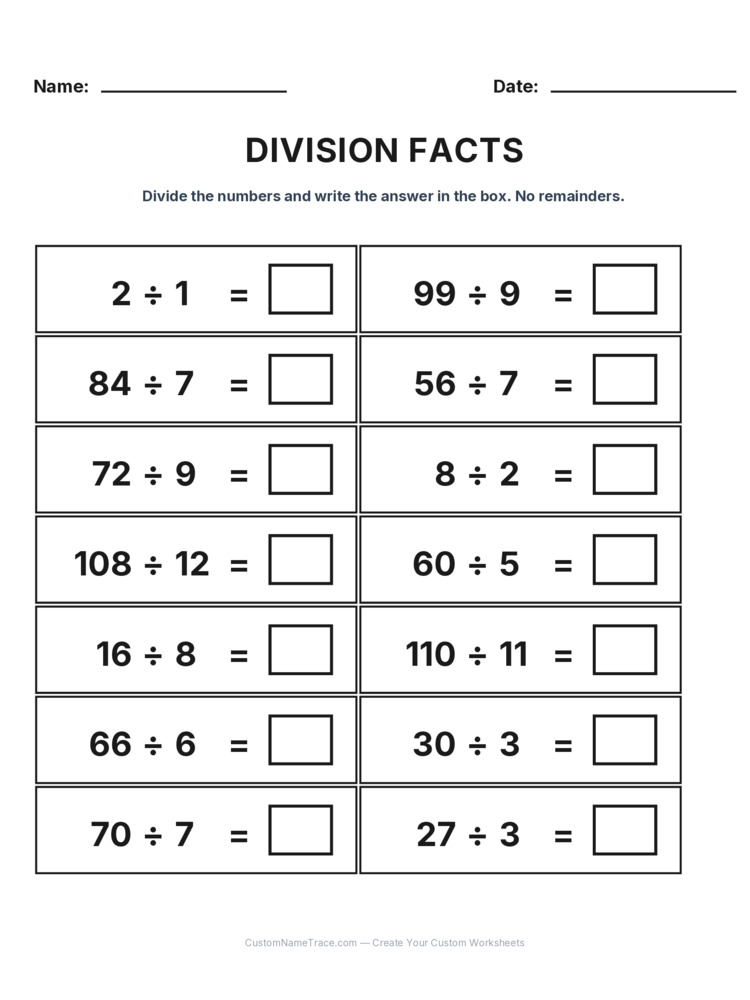
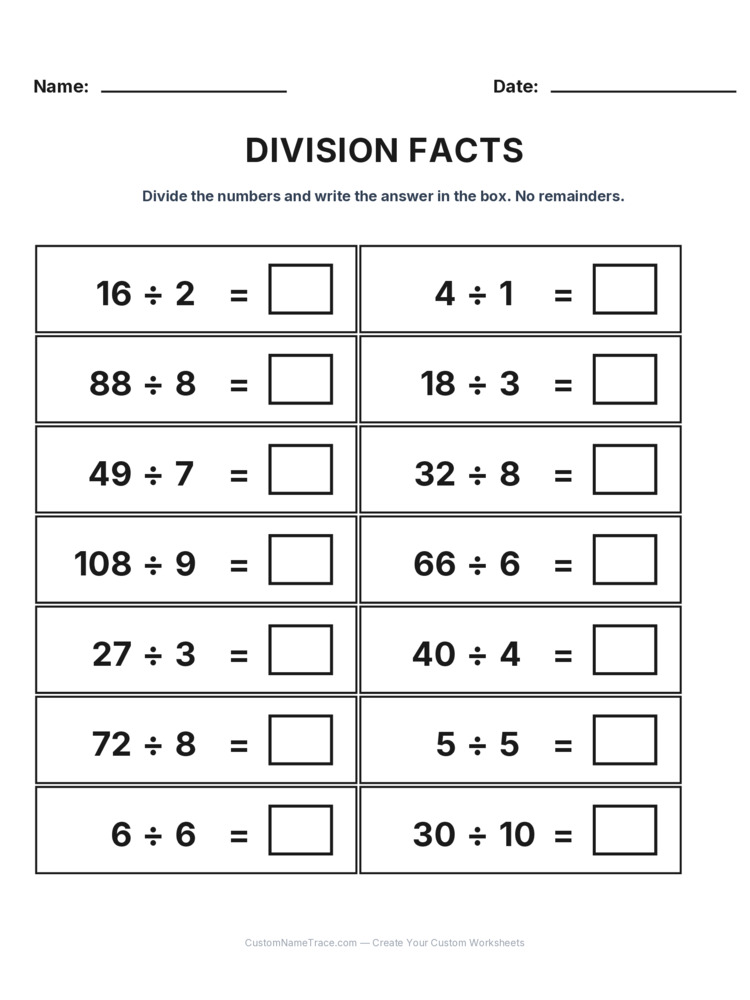
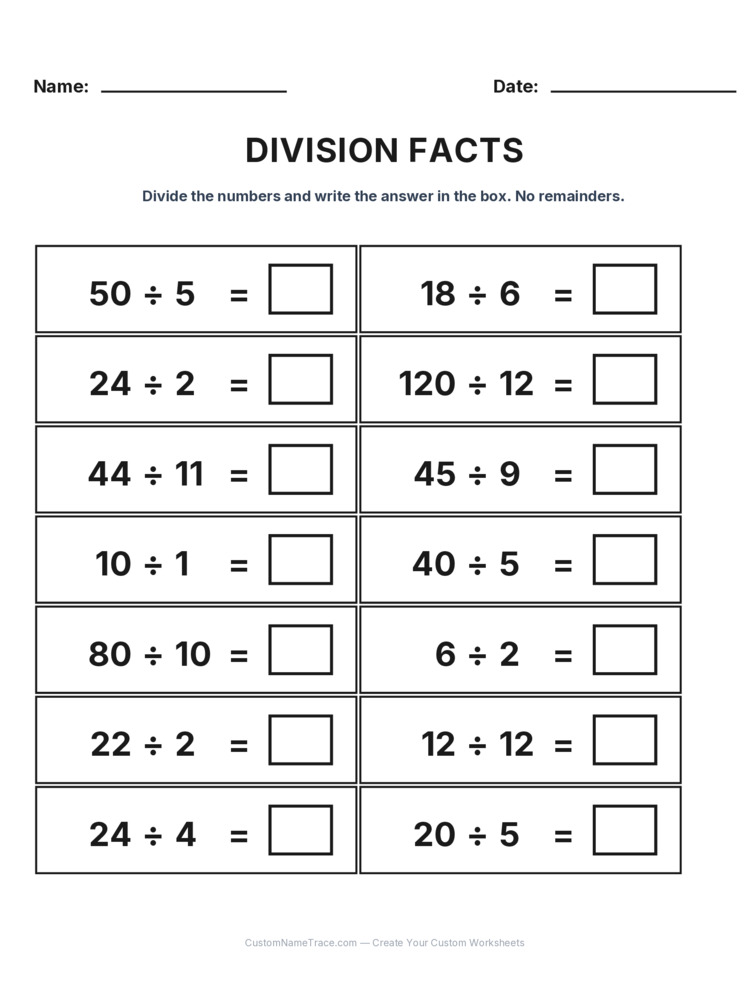
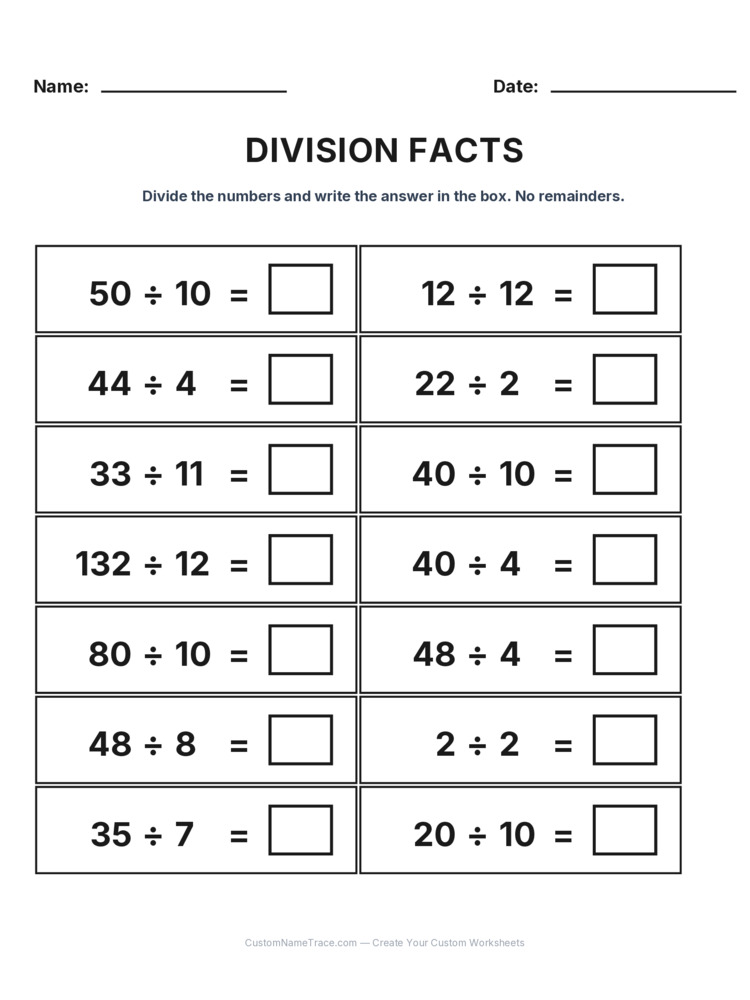
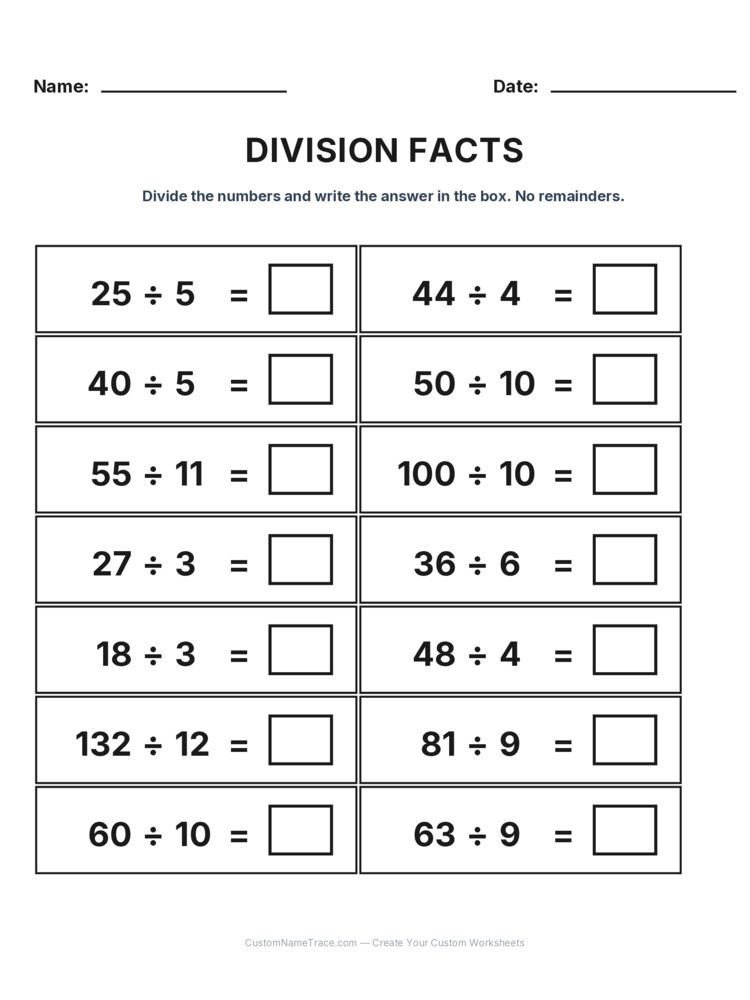
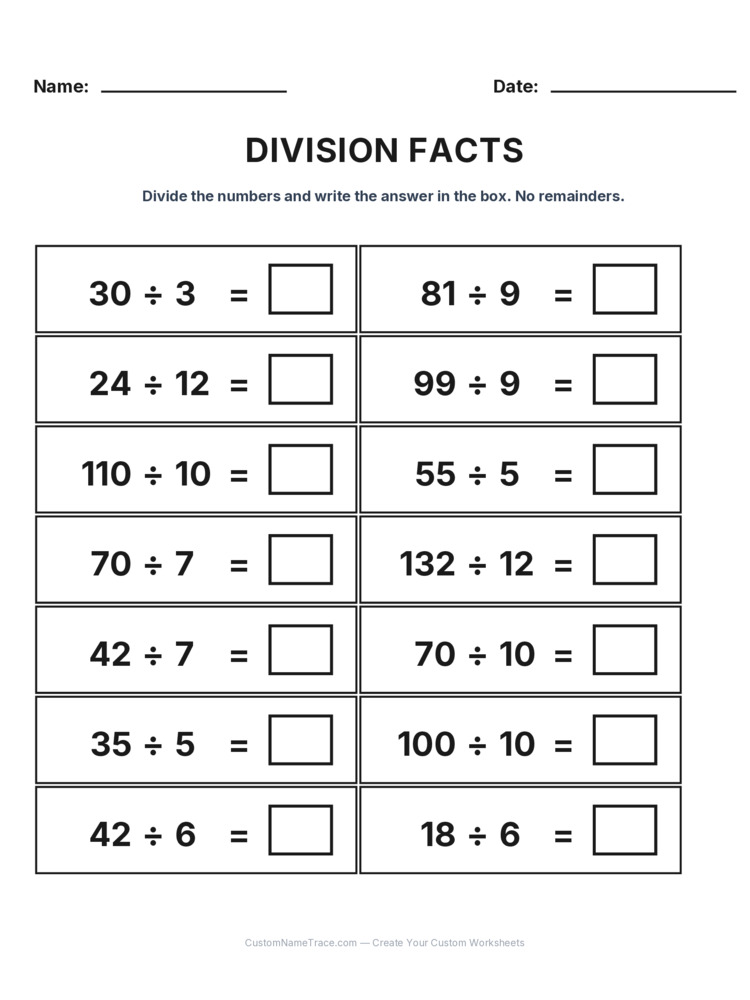
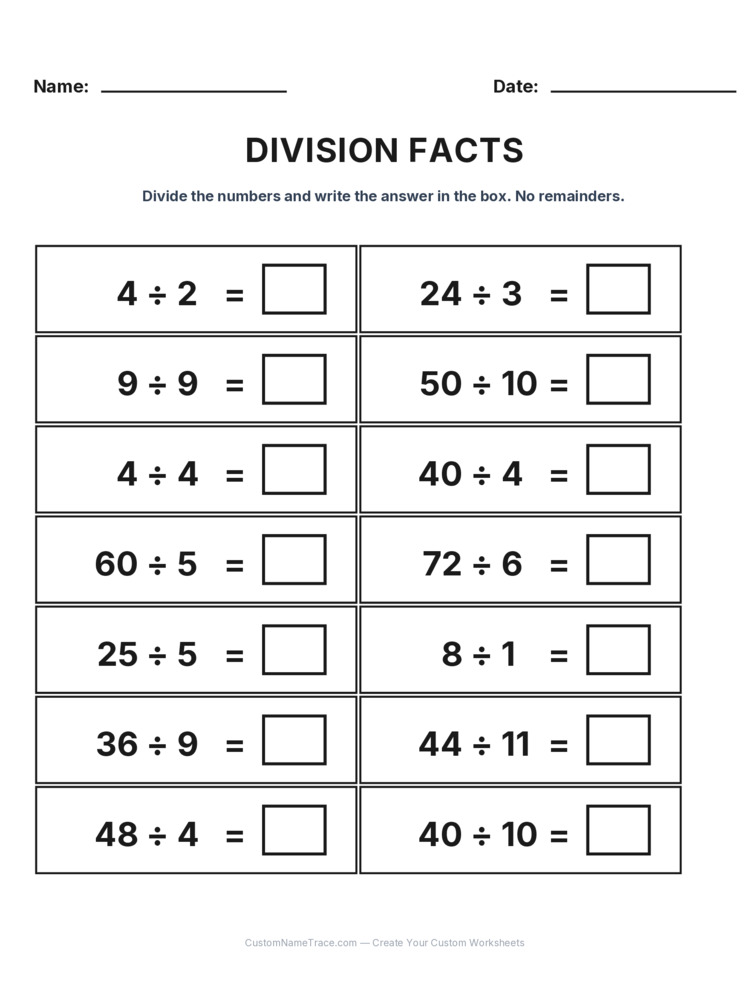
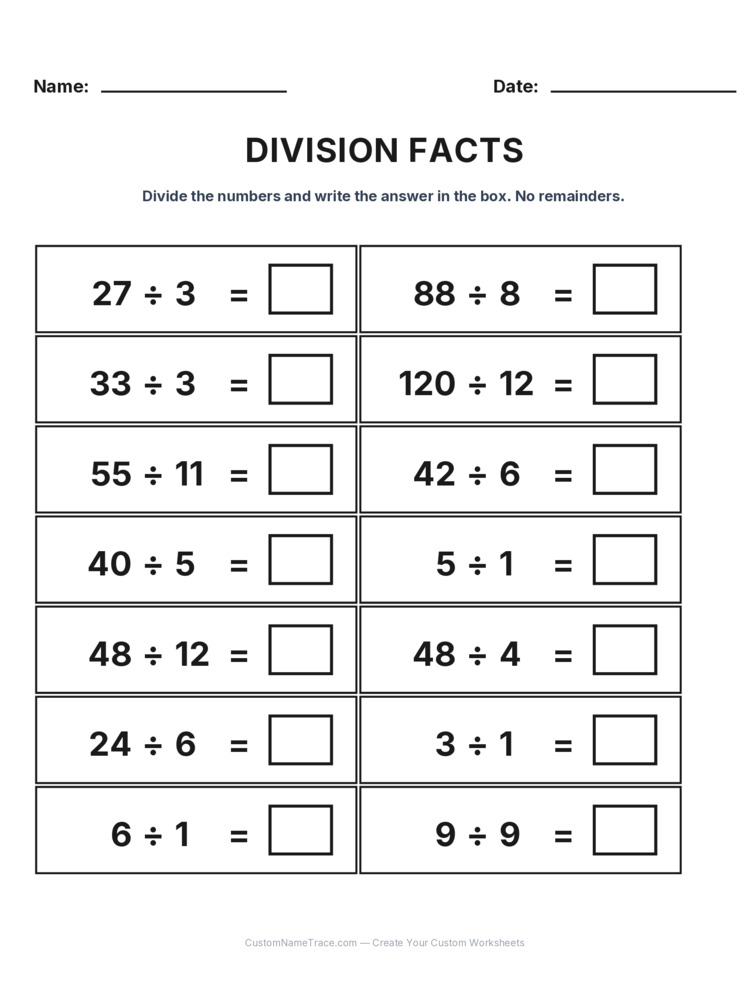
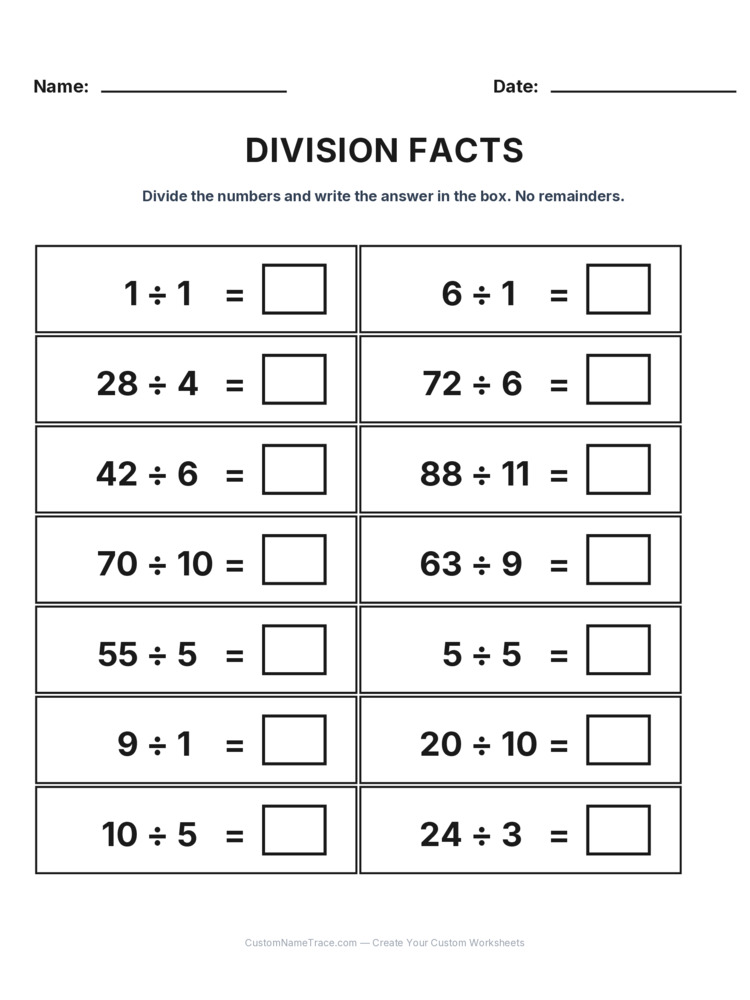
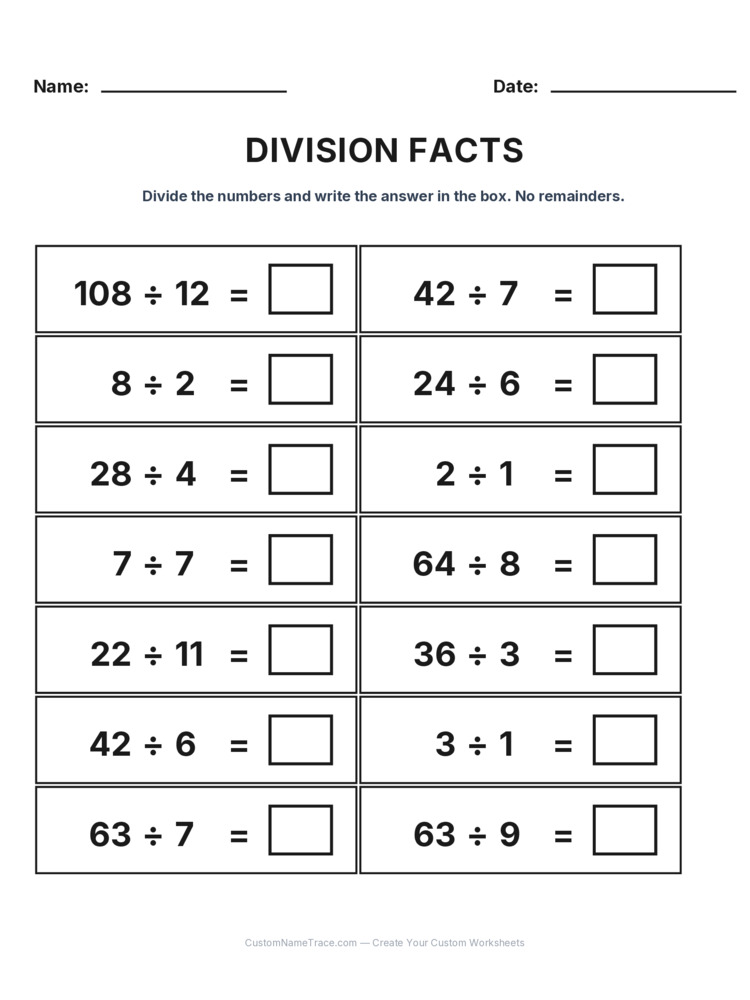
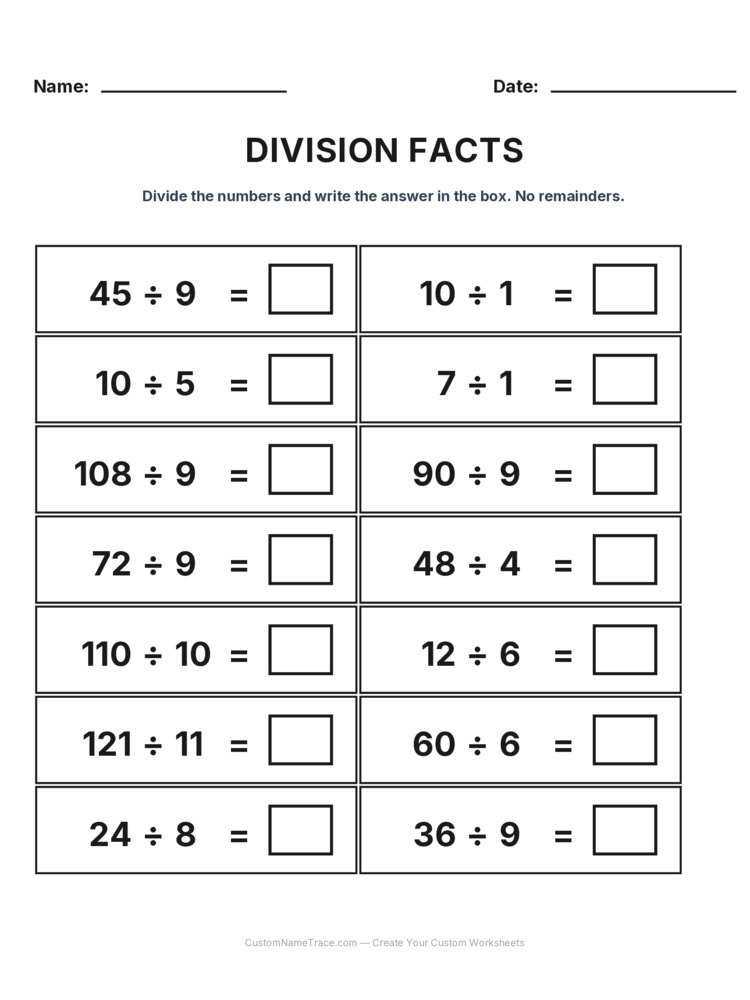
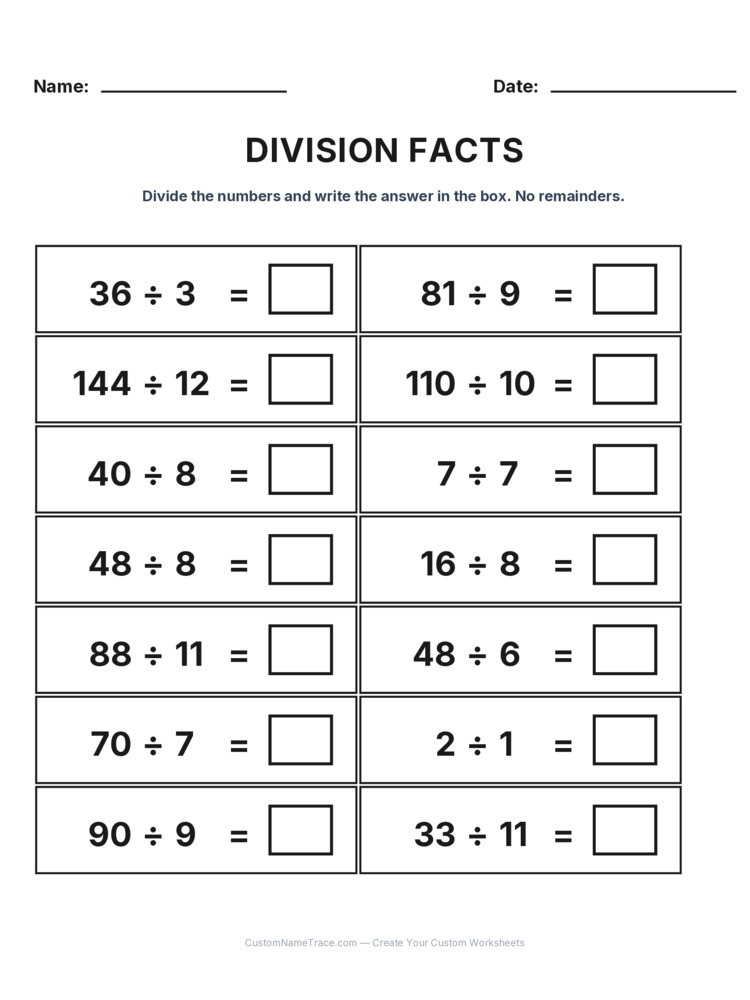
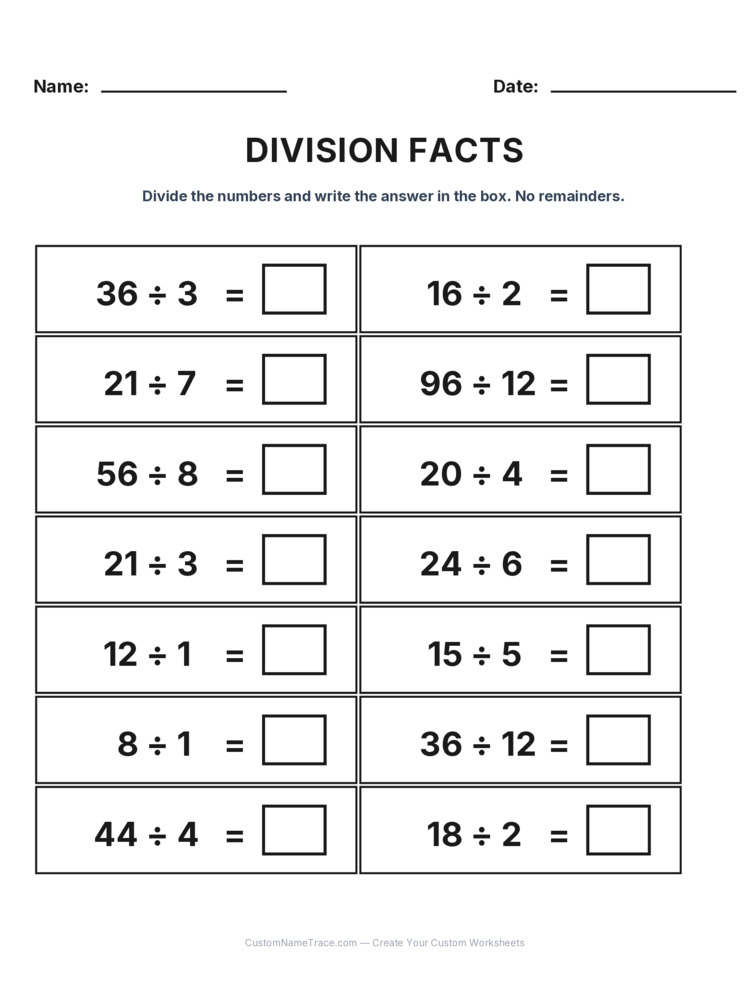
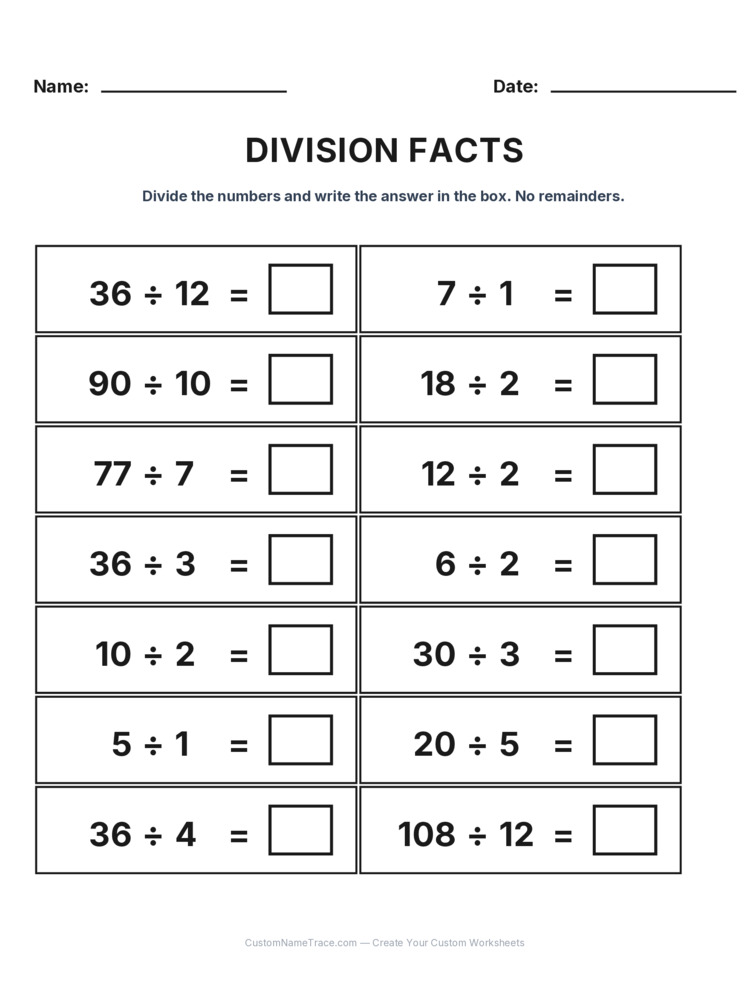
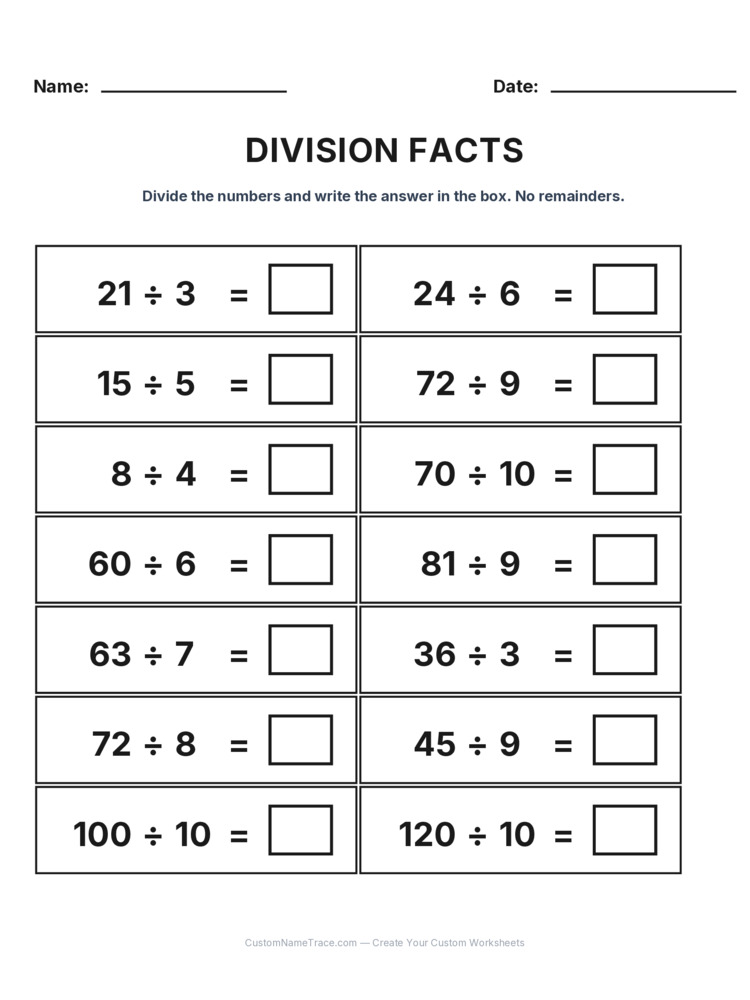
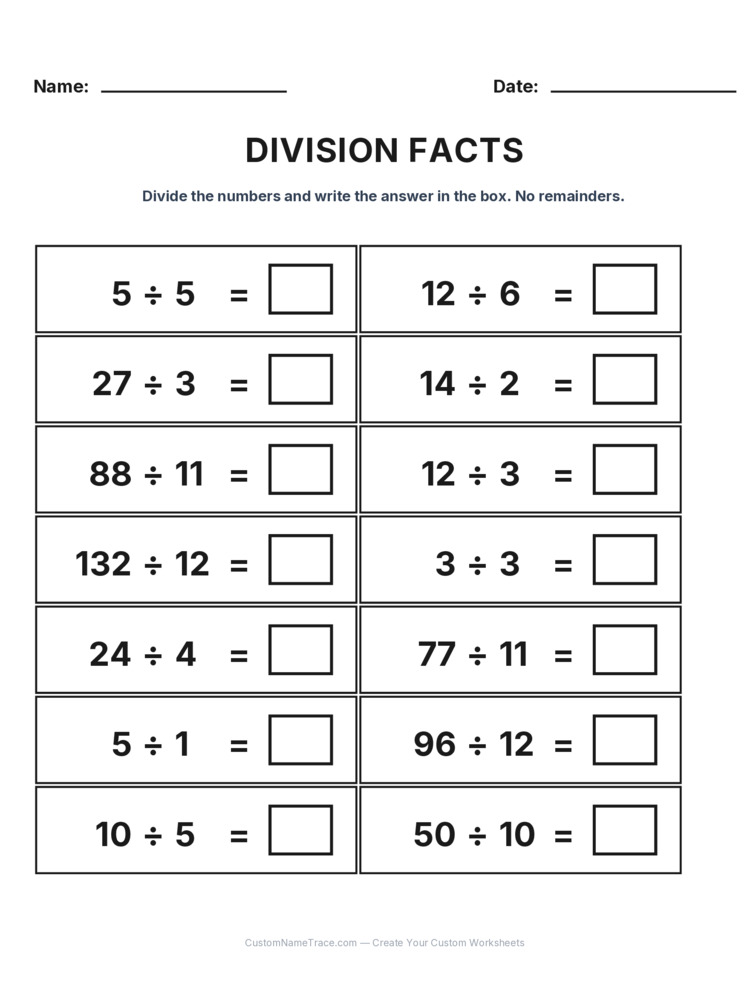
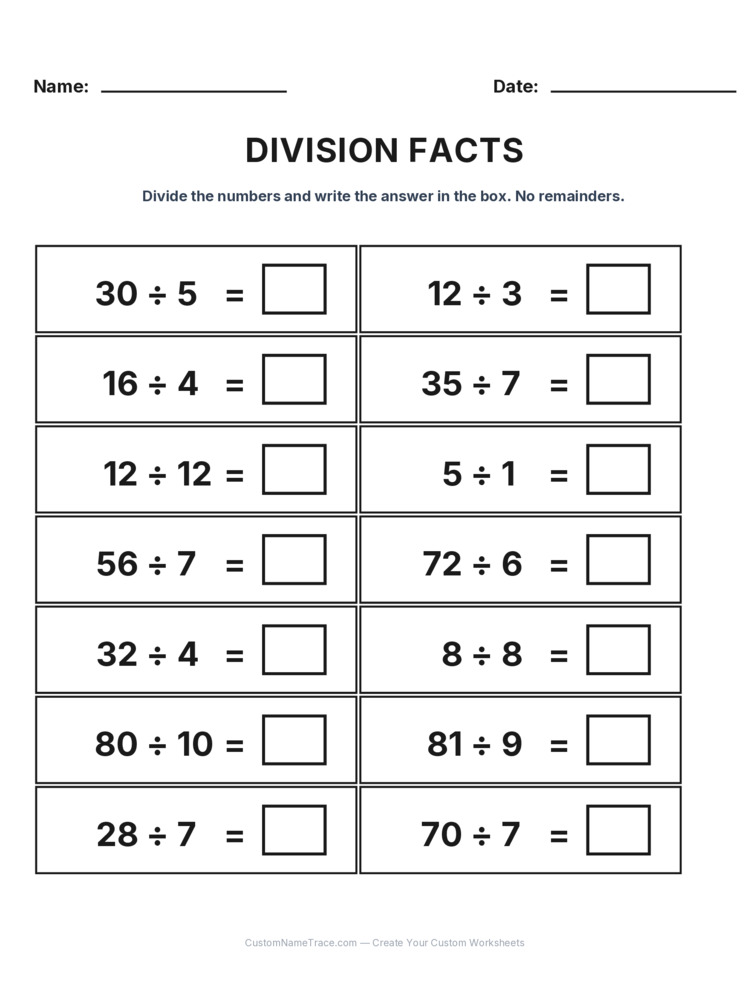
Why these facts follow directly from multiplication
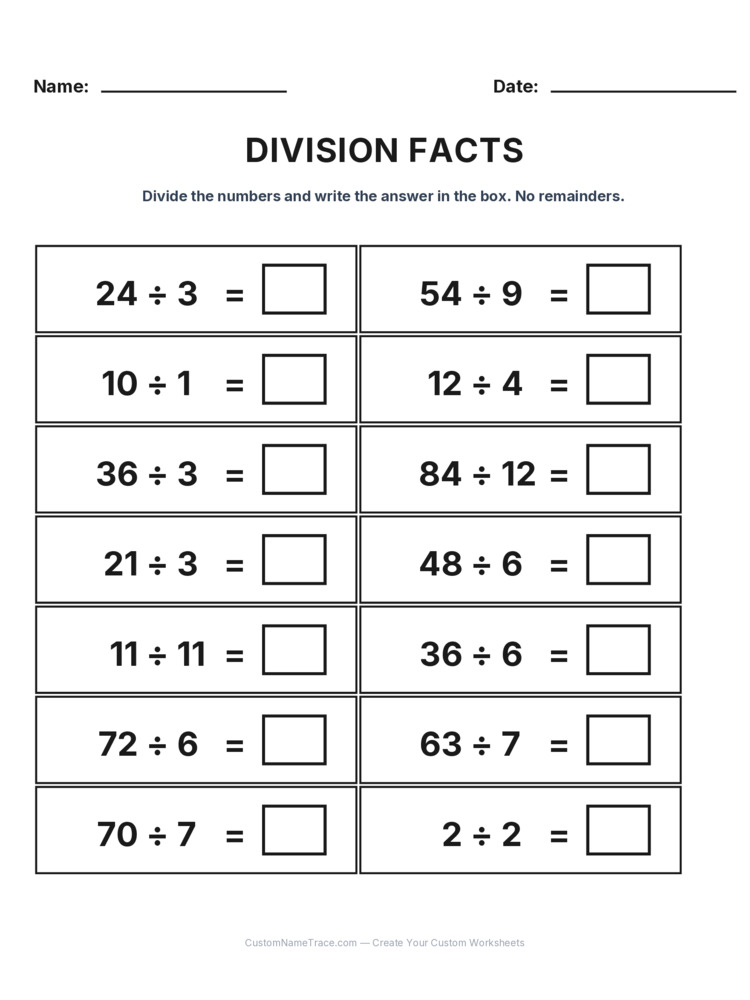
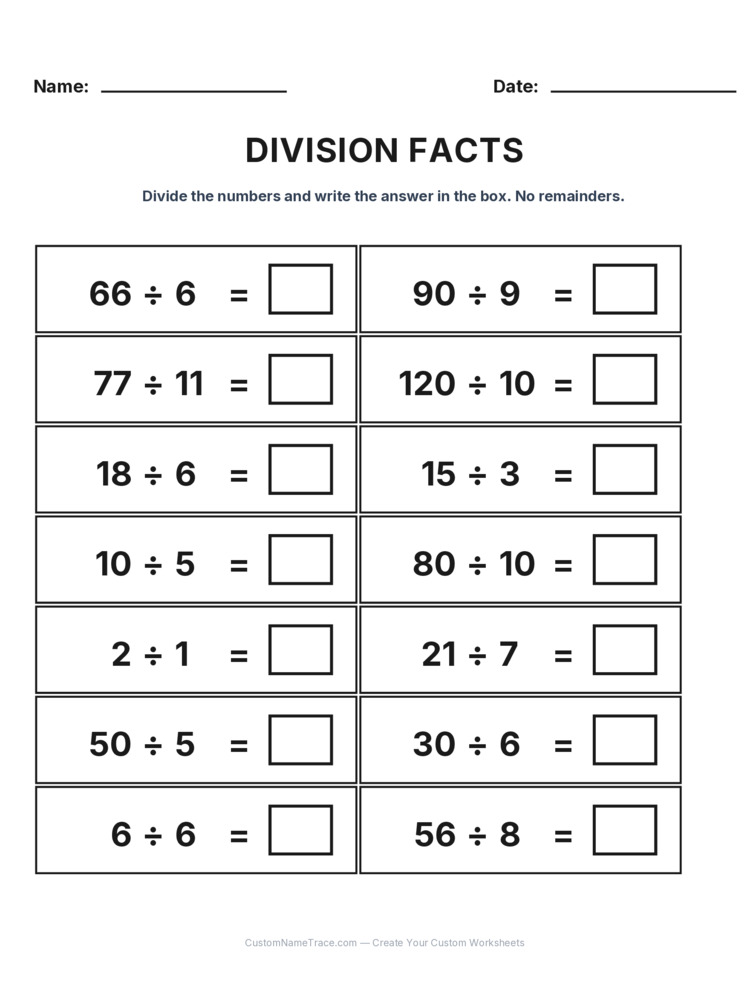
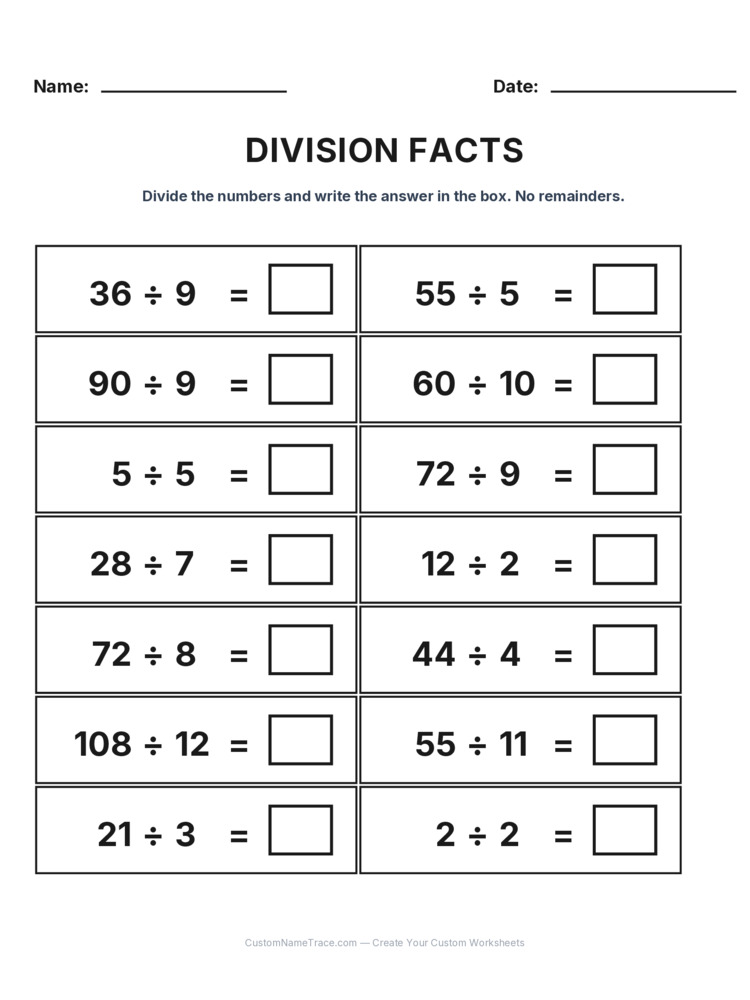
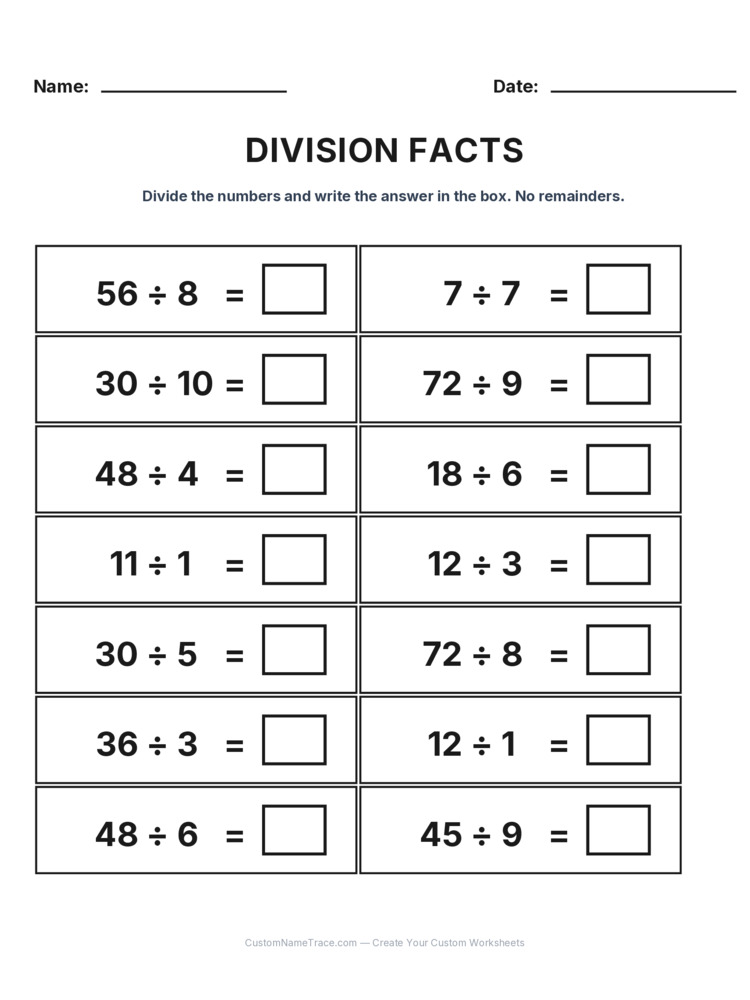
Every division fact on this worksheet is a multiplication fact viewed in reverse — 84 divided by 12 asks the identical underlying question as 12 times what equals 84, just approached from the opposite direction. This worksheet is introduced only once a child has real, solid footing in this site's Multiplication Facts (0-12) practice, since a child without that foundation has nothing reliable to reason from when a division problem gets genuinely difficult.
Every problem here divides evenly, with no leftover remainder — remainders are a meaningfully more advanced concept, introduced only once these clean, evenly-divisible facts are solid, and mixing them in early would risk a child concluding a correct answer is wrong simply because it doesn't feel finished.
The fastest strategy for a forgotten fact
Asking the matching multiplication question in reverse — "what number times 9 equals 63?" — reliably unlocks a stuck division fact faster than trying to reason through the division directly, since multiplication facts at this range tend to be more solidly memorized first. Teaching that reversal explicitly, rather than expecting a child to discover it independently, turns division practice into a direct extension of multiplication fluency instead of a separate, harder hurdle to climb from scratch.
Fact families — the same four numbers connecting two multiplication facts and two division facts (7×9=63, 9×7=63, 63÷9=7, 63÷7=9) — are worth working through as a connected group rather than four isolated facts; a child who's memorized any one of the four already has real footing on the other three.
Building the equal-groups concept hands-on
Splitting a real, countable group of small objects into equal piles — specifically checking that every pile ends up the same size, redistributing if it doesn't — makes the "equal" part of equal-groups concrete in a way that matters more than it might seem. A child's early intuitive sense of splitting a group often skips checking whether the resulting groups are actually equal, and this hands-on check catches that specific gap directly, reinforcing what the abstract division fact is actually representing.
This also gives a child two genuinely different questions division can answer using the same numbers — splitting 24 into groups of 6 to find how many groups result, versus splitting 24 into 6 equal groups to find how big each one is — both of which use the identical fact, 24÷6=4, just framed differently.
What genuine mastery at Grade 3 looks like
Mastery here means reliable recall or reliable reconstruction from a known multiplication fact, not necessarily instant, effortless recall on every single problem. A child who occasionally works out a division fact by reversing a multiplication fact they know solidly is using a completely legitimate strategy, not falling short of genuine mastery — the same standard this site applies to multiplication fluency itself.
Real-world equal-sharing situations — splitting a bag of snacks evenly among friends, dividing chores fairly — are division in disguise, and pointing those moments out reinforces that this skill is genuinely useful day to day, not just an abstract worksheet exercise disconnected from anything outside it.
Using this worksheet effectively
Every numbered variant presents facts in a fresh, non-sequential order, the same principle applied to this site's multiplication practice, so genuine recall — not pattern-following from position — is what's being tested and built here too. Whenever a specific fact feels stuck, returning to its multiplication counterpart first, rather than pushing forward on division alone, usually unlocks it fastest.
Every worksheet here downloads as a free, print-ready PDF with no account required, and works well as a companion to continued multiplication fact practice at the same range.