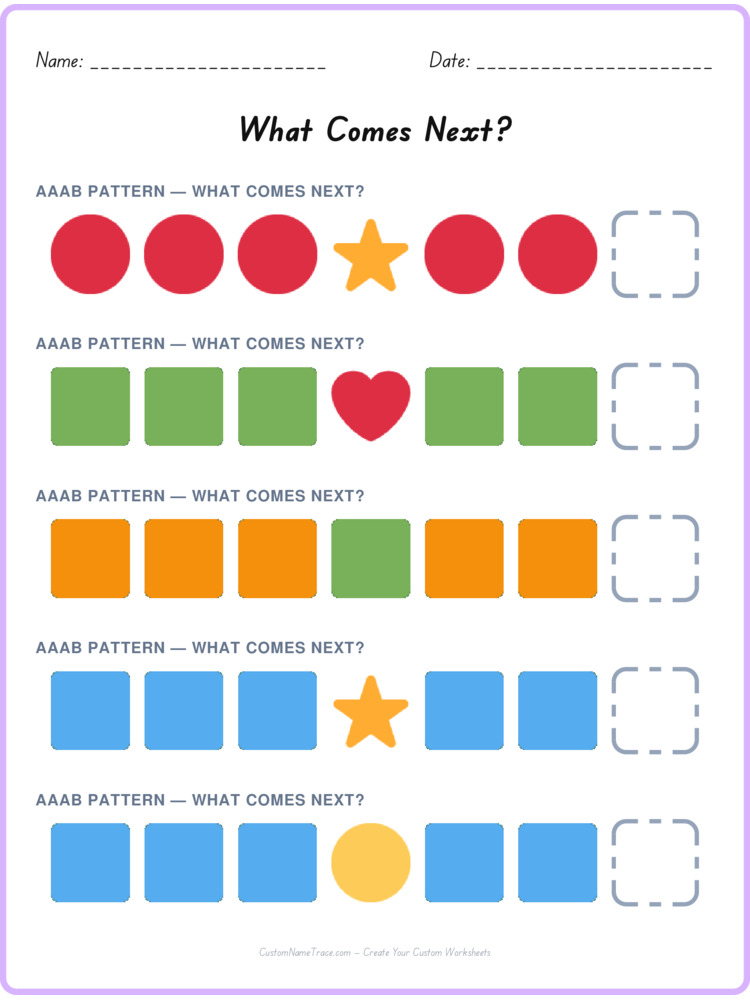
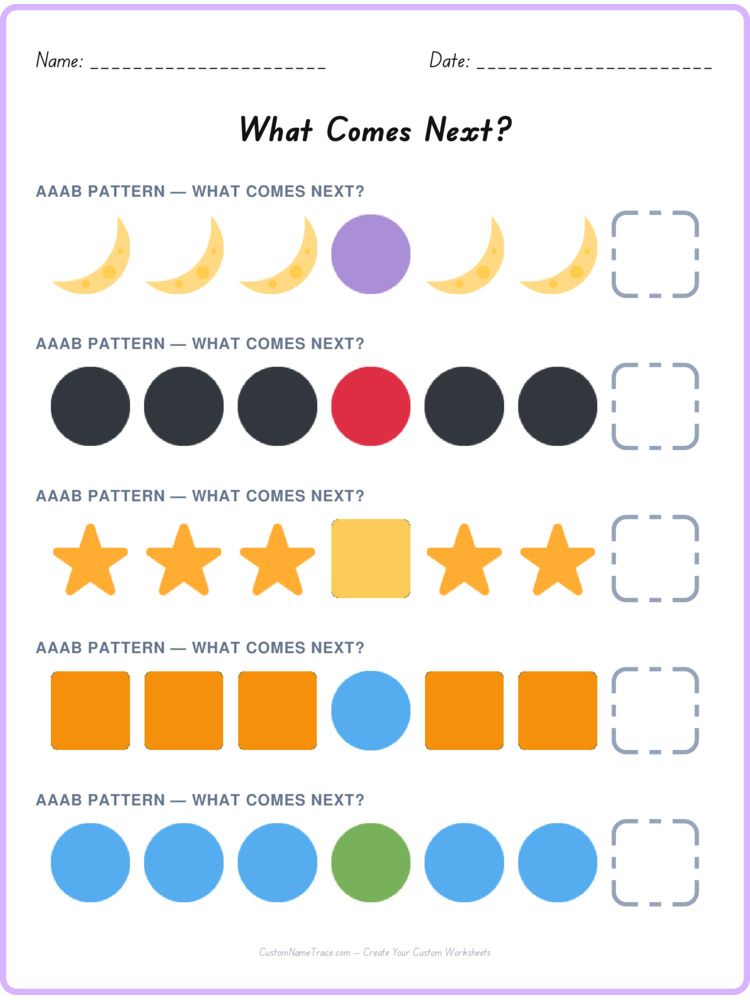
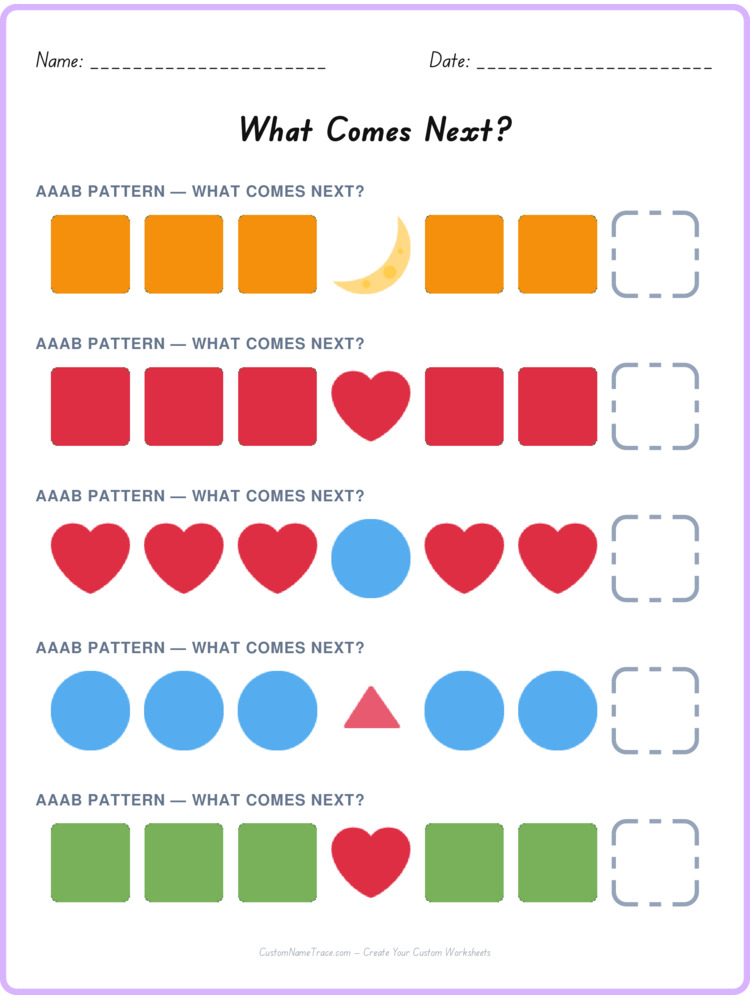
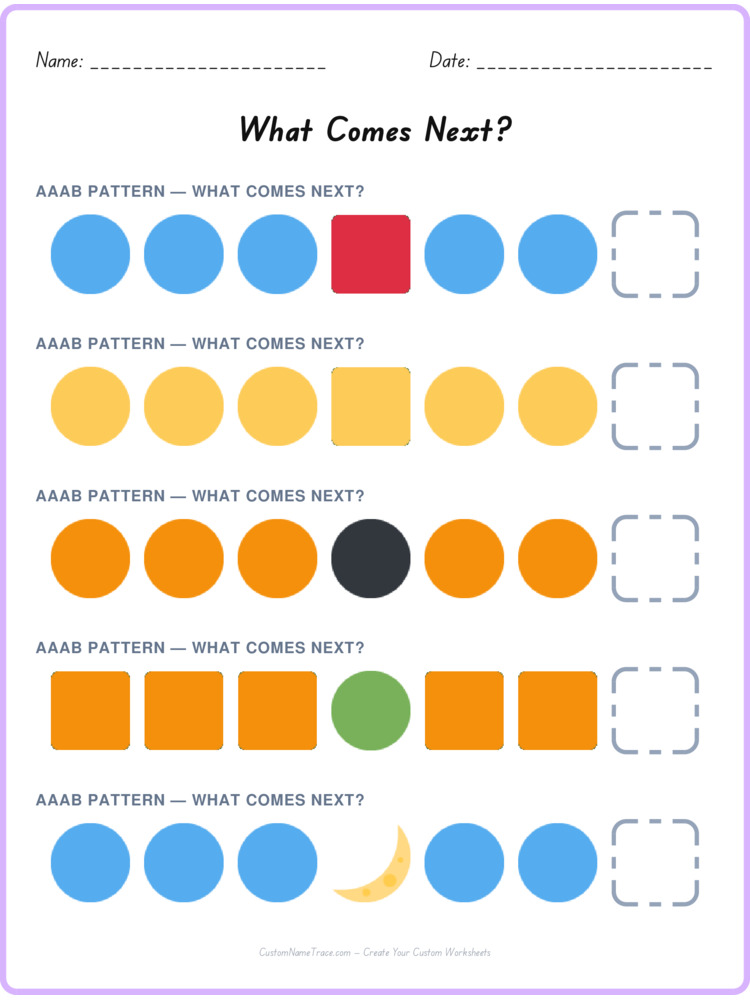
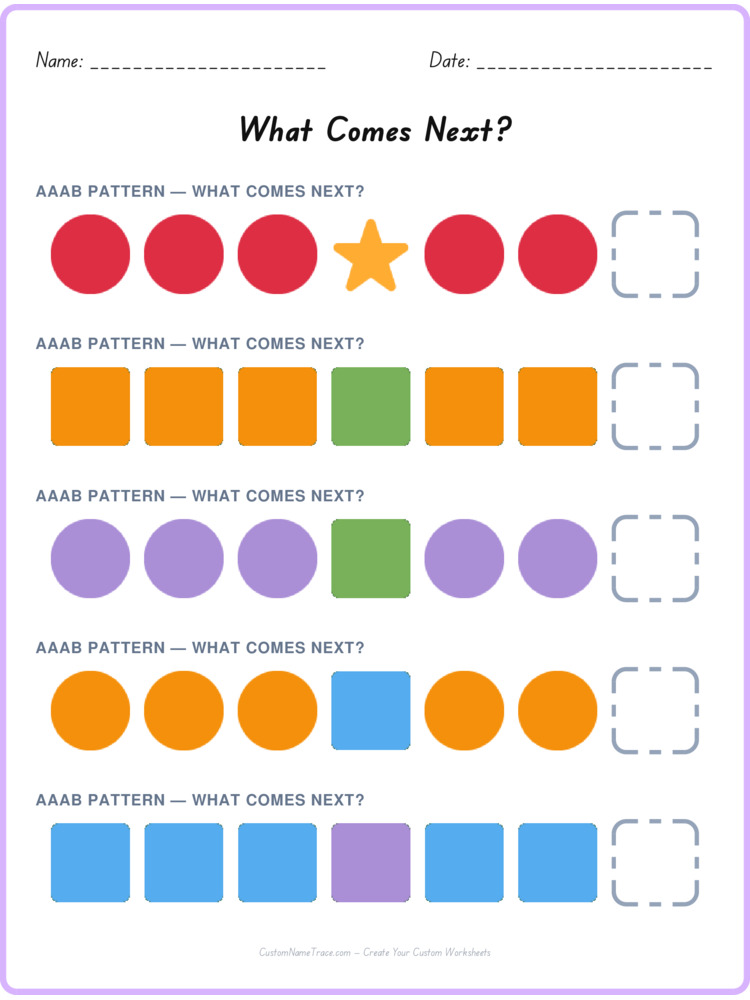
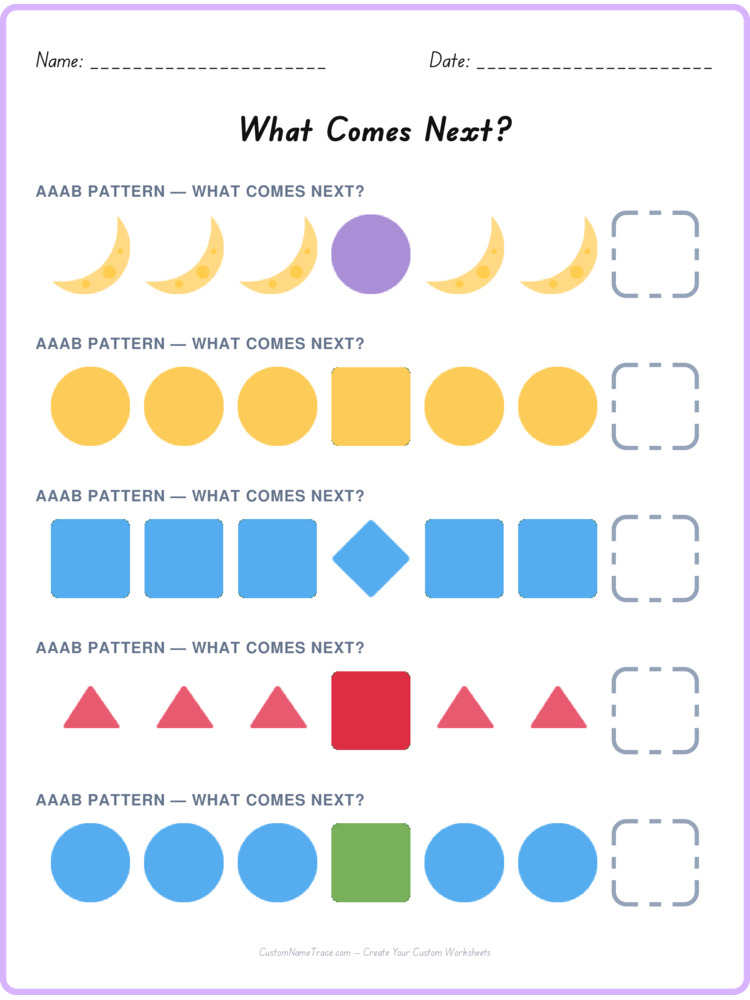
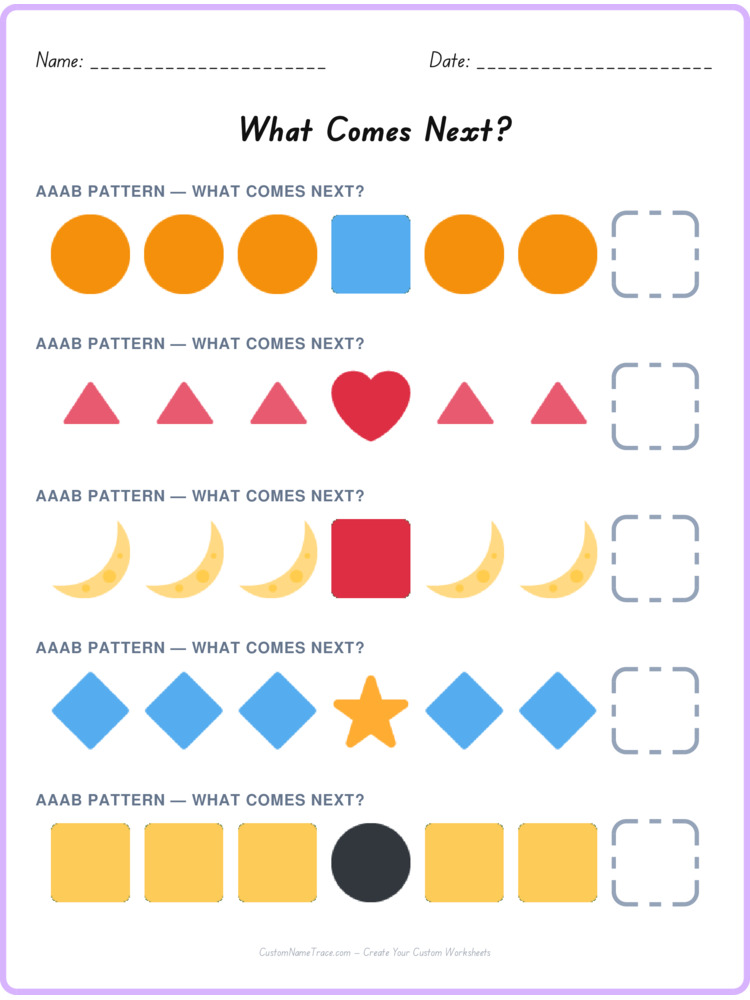
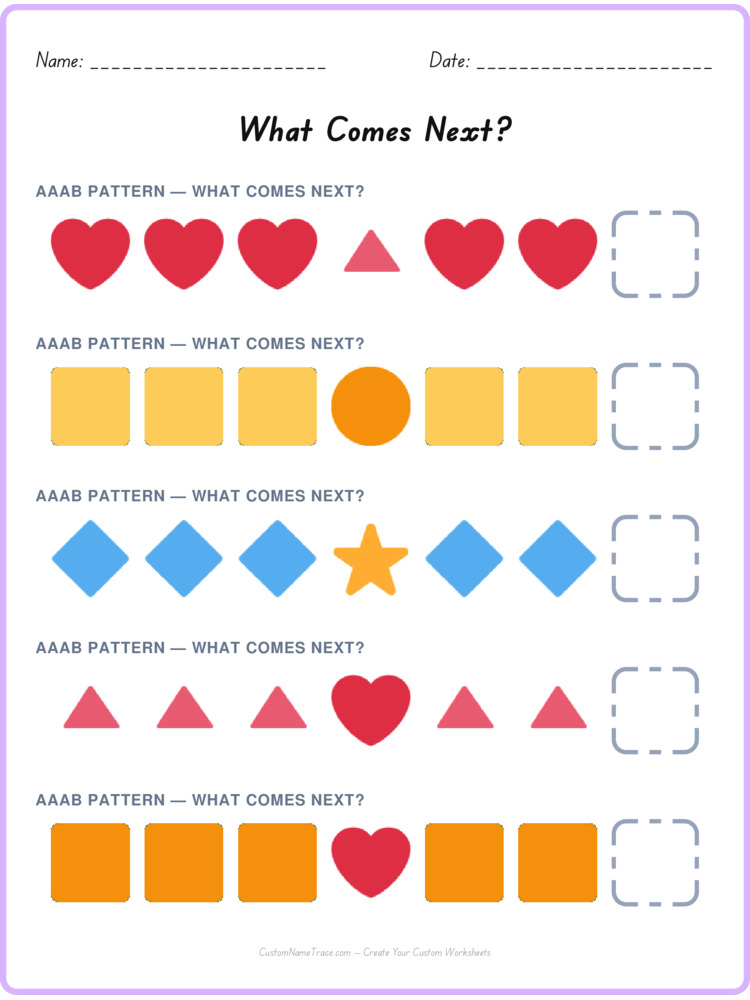
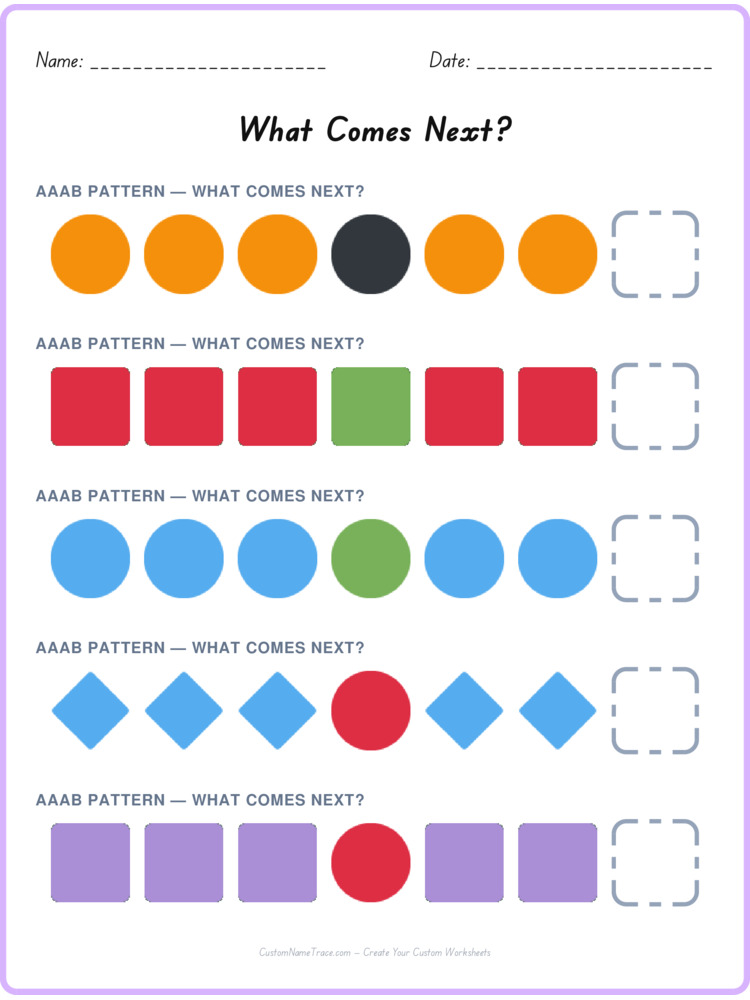
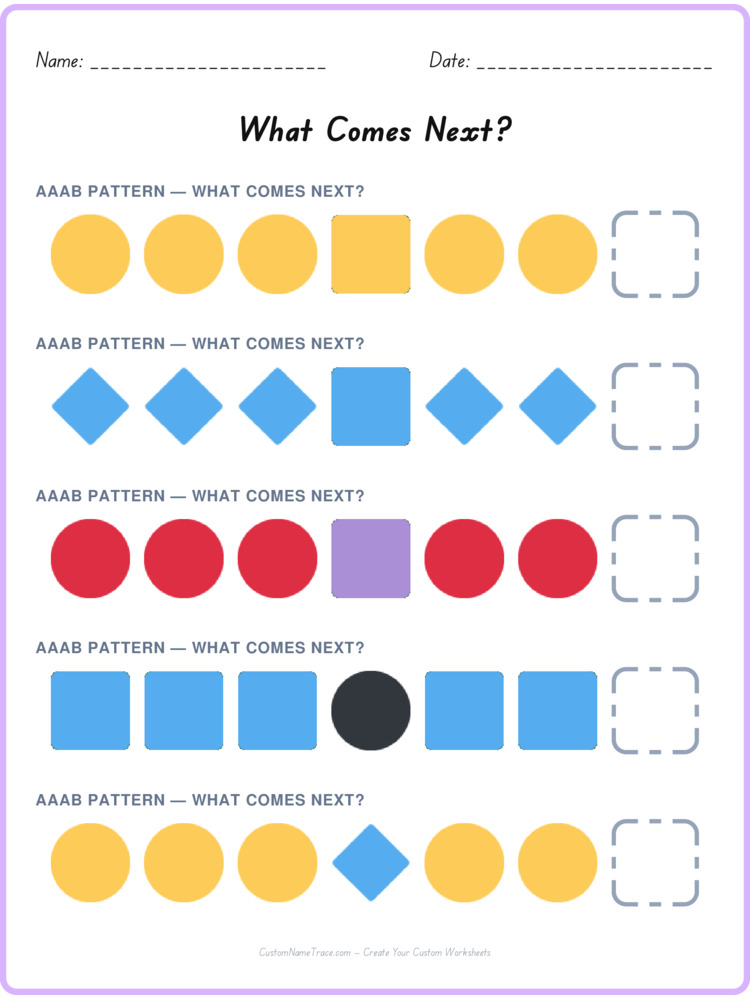
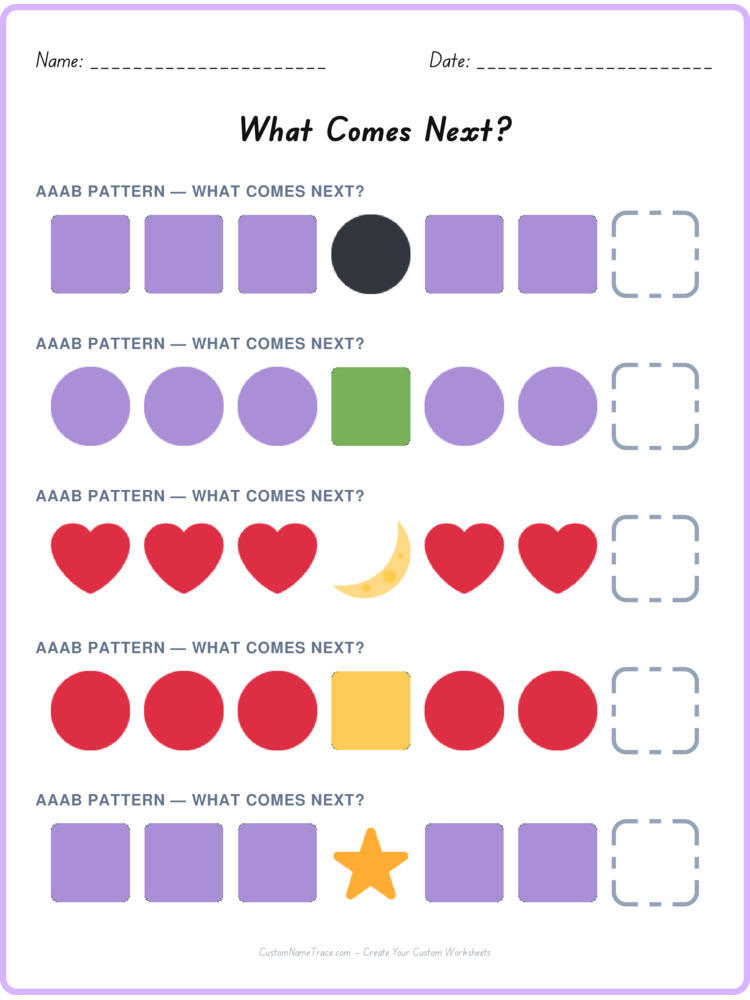
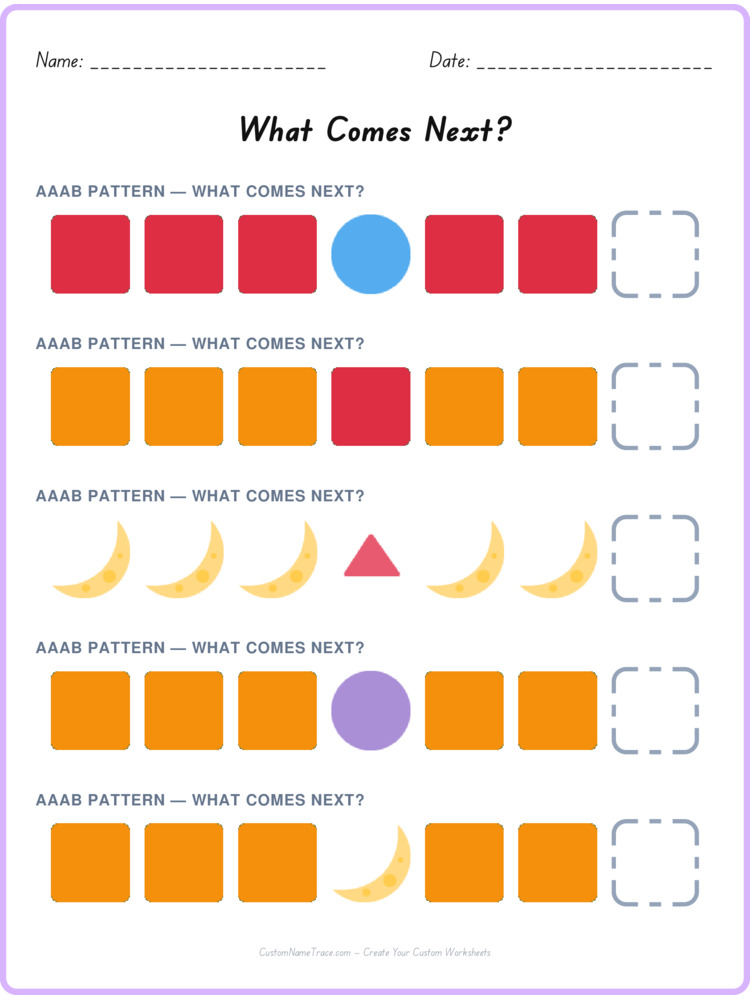
Why this page is only AAAB, nothing else
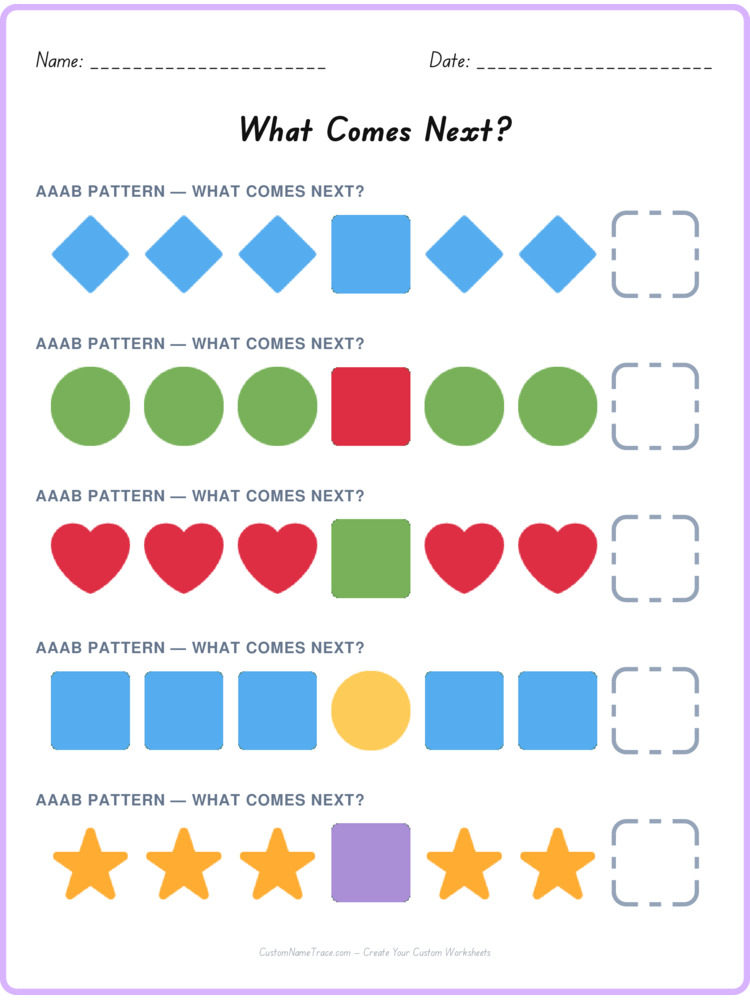
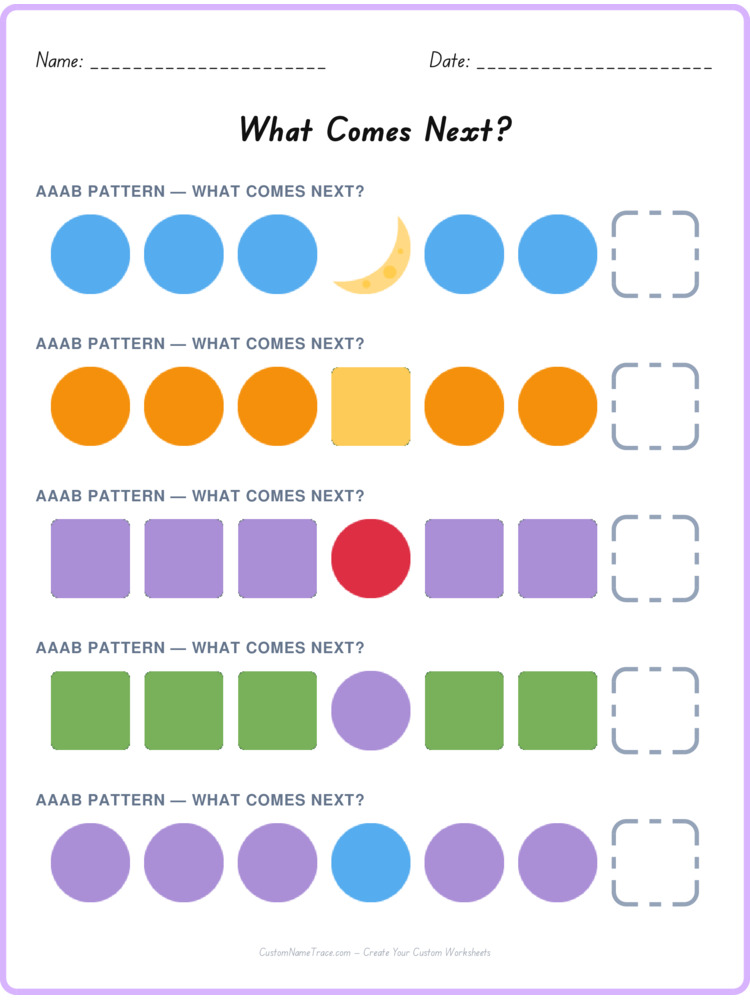
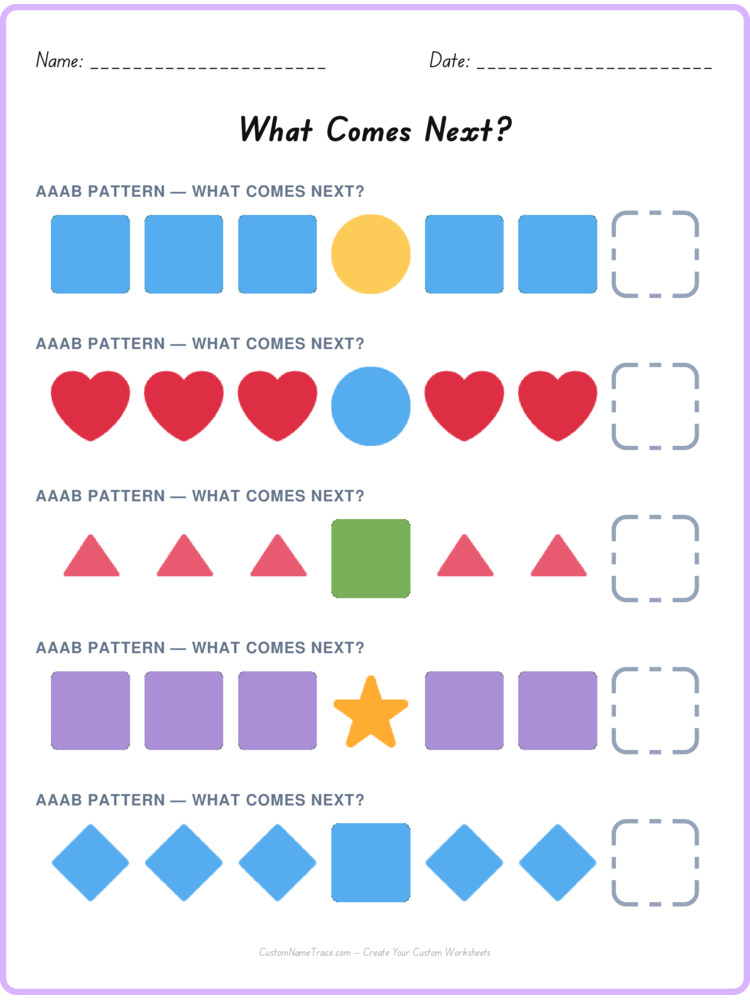
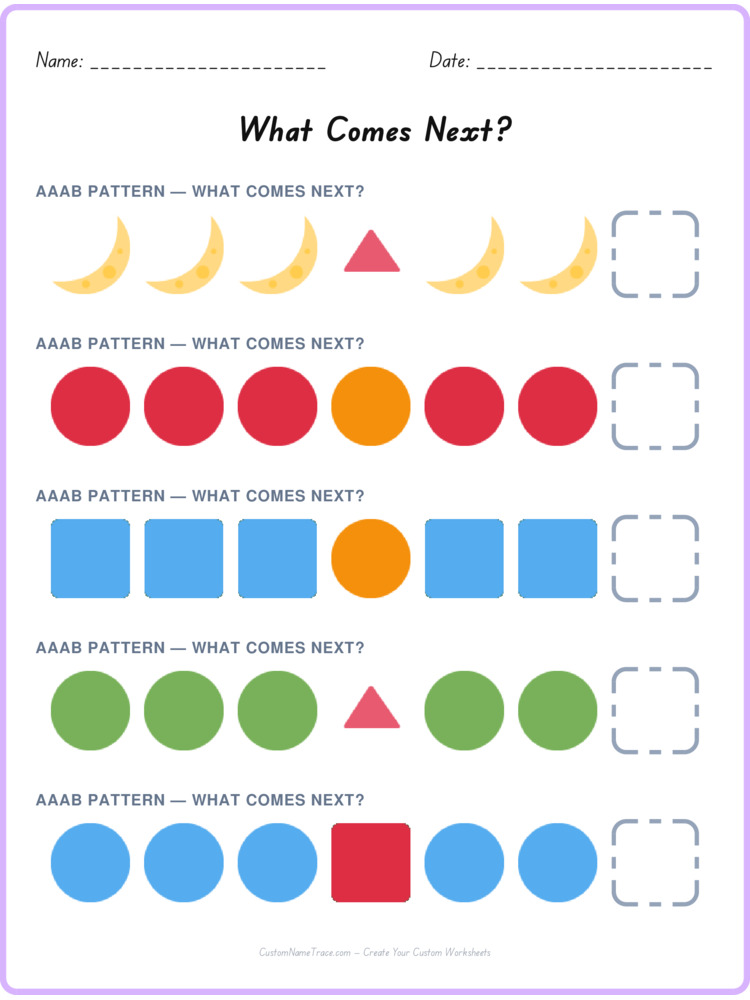
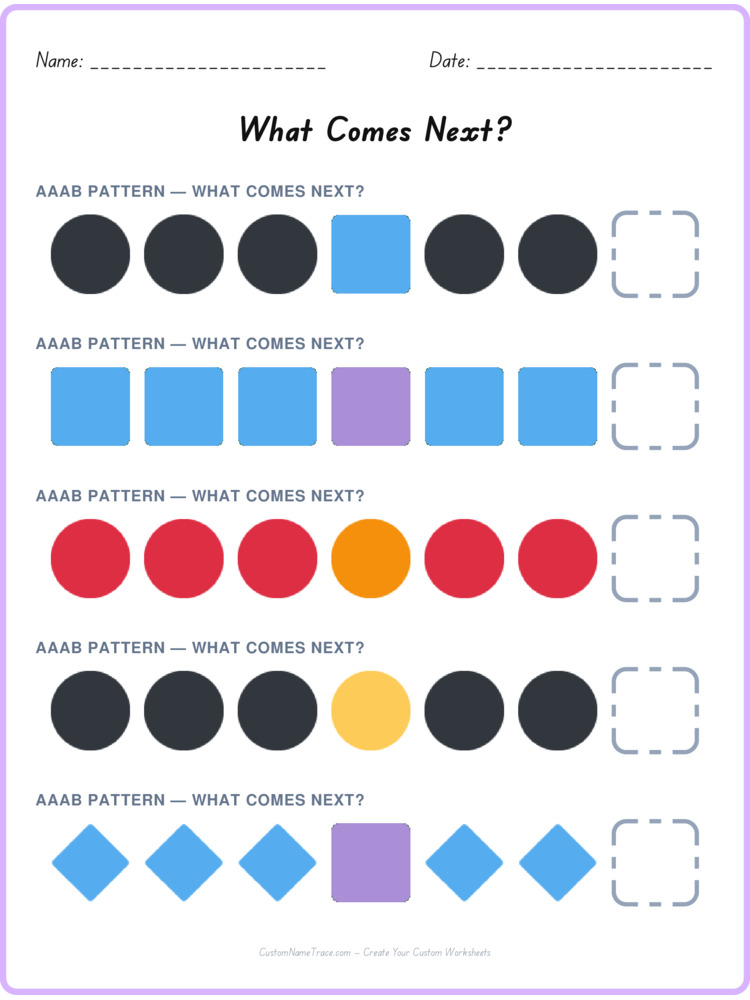
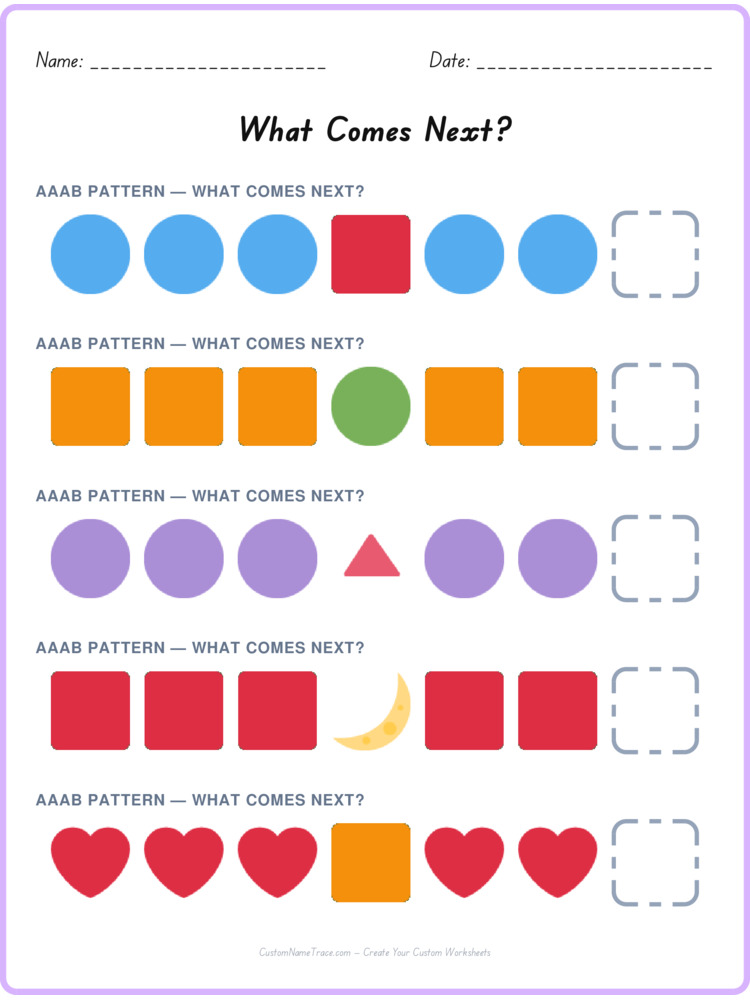
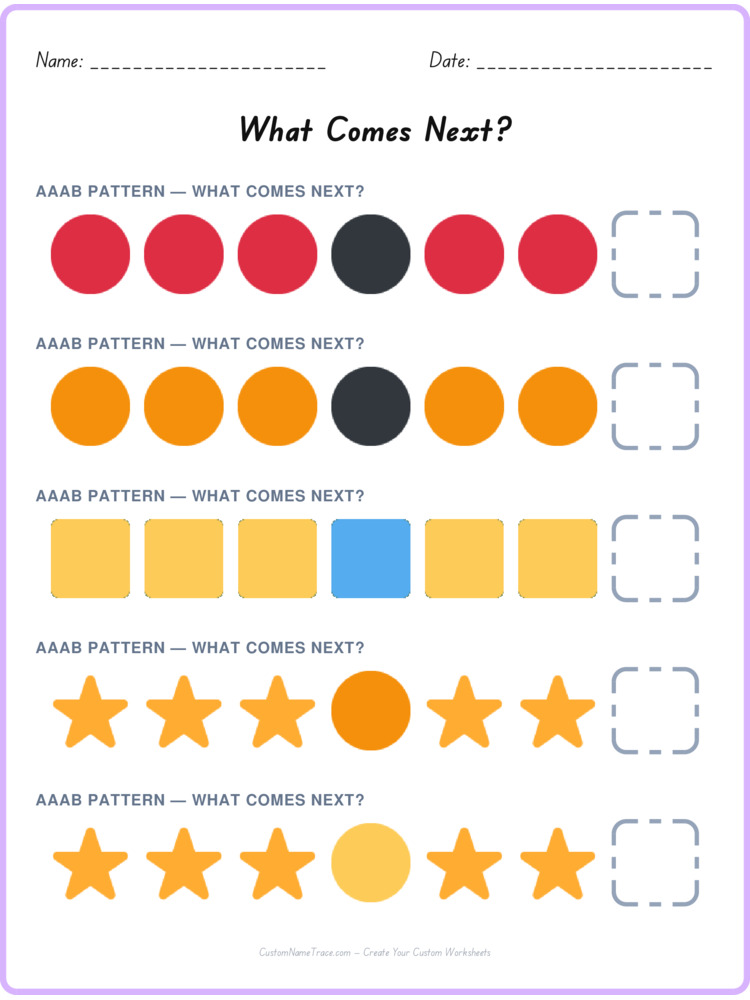
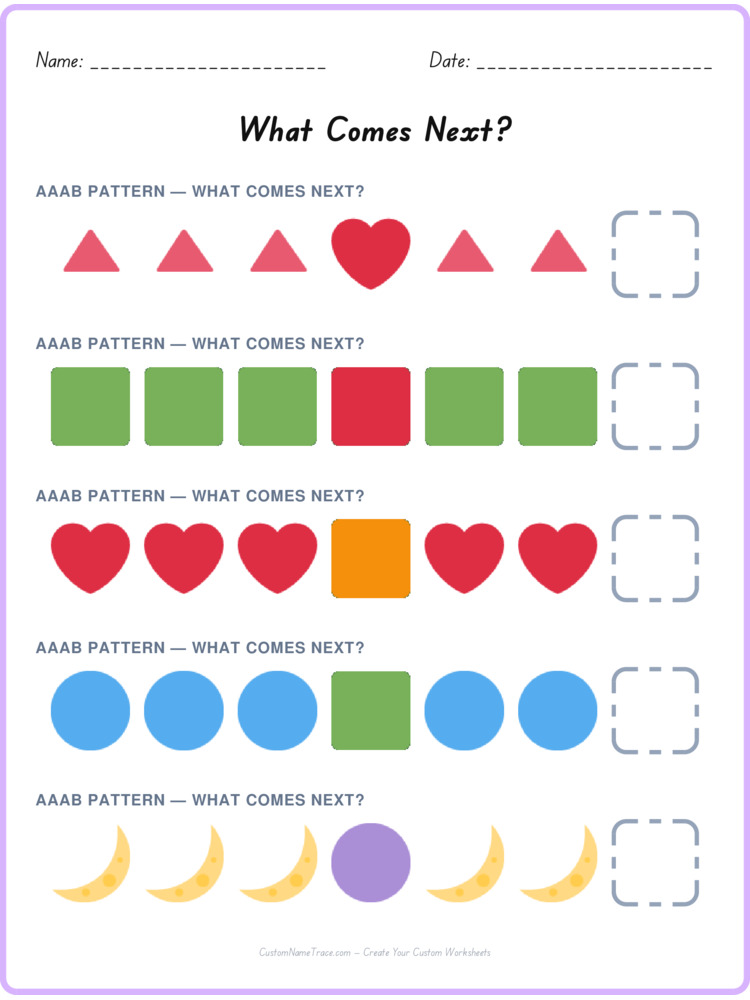
Every row below follows the same AAAB rule, just with a different set of icons each time. That repetition is deliberate, not a shortcut — seeing one rule several times, with the specific pictures changing underneath it, is what actually lets a child generalize the rule itself rather than memorizing one example of it. A page that mixed AAAB in with several other pattern types would be testing something different — whether a child can keep more than one rule straight at once — which is a real skill, but not the one this specific page is built to practice. If that's what you're looking for, the Advanced (Kindergarten & Up) level hub above links to a Mixed Review page that does exactly that.
How to read the AAAB code
Every letter in AAAB stands for one icon in a fixed position within the repeating group, and the same letter showing up more than once just means that icon appears again before the sequence moves on to a new one. Reading the code from left to right is the same motion as reading a row from left to right: decode AAAB once, out loud if it helps, and every row on this page follows that exact same shape — only the concrete icons change from row to row, never the underlying rule the letters describe.
Why AAAB matters beyond this one worksheet
Predicting what comes next in AAAB is a small-scale version of a much bigger skill: noticing a rule in a sequence of information and using it to predict what hasn't happened yet. That's the same underlying move behind skip-counting, multiplication tables, telling time, and reading music, long before a child is old enough to connect this worksheet to any of those. None of that needs to be pointed out for the practice to matter — a child working through AAAB correctly is exercising the exact mental habit those later, more abstract skills are built on top of.
What counts as actually understanding AAAB
The real signal isn't a correct answer on one row — it's a child predicting the blank and explaining why, consistently, across several rows that use completely different icons from each other. A child who gets the first row right by luck but can't explain their reasoning on the second or third hasn't fully generalized AAAB yet, and that's worth noticing before moving on to a different pattern type. Getting one row right proves nothing on its own; getting several right in a row, with different icons each time, is the actual evidence the rule has stuck.
Fresh icons, same rule, every variant
Every numbered version of this worksheet tests the exact same AAAB rule with a different set of icons, picked so that the same combination doesn't repeat identically across variants. That matters for two practical reasons: a child who needs more repetition on AAAB specifically can work through several variants in a row without ever seeing the identical page twice, and two students sitting next to each other in a classroom can be handed visibly different pages while practicing the exact same underlying skill.
AAAB within the Advanced (Kindergarten & Up) level
AAAB is one of the pattern types included at the Advanced (Kindergarten & Up) level (Kindergarten/Grade 1/2/3), grouped there because of how many distinct icons it asks a child to track and how the sequence behaves once it's decoded, not just because of how long it looks written out. If AAAB feels too easy, the Advanced (Kindergarten & Up) level hub lists every other pattern type at this same stage, along with a Mixed Review page for once several of them feel solid together. If it feels too hard, it's worth stepping back to a simpler pattern first rather than pushing through — a rule practiced until it's automatic is worth more than one that's rushed.
The most common mistake with AAAB
It's rarely a random guess. The more common error is applying a different, simpler rule than the one actually shown — assuming a plain back-and-forth alternation when AAAB actually repeats an icon more than once, or losing track partway through and skipping a distinct icon the sequence still needed. Reading the letters in AAAB out loud before starting a row, and pointing at each icon in the row as it's said, catches most of that before a wrong answer ever gets marked down.
Using this page at home or in a classroom
At home, work through a couple of rows at a time and ask your child to say the rule back before checking their answer, rather than racing through the whole page in one pass. In a classroom or small-group setting, this dedicated page is the right tool when a specific group of students is stuck on AAAB in particular, rather than needing review across several rules at once — hand out a couple of different numbered variants so no two students are copying off the same page. Every worksheet downloads as a clean, print-ready PDF in both Letter and A4 sizes, with no watermark or sign-up step in the way.
Where to go after AAAB
Once AAAB feels solid across a few different variants and icon sets, the Advanced (Kindergarten & Up) level hub above lists every other pattern type at this stage to try next, plus a Mixed Review page once a handful of them are solid together and it's worth checking that they don't blur into each other. There's no required order beyond what a specific child is ready for — moving to a new pattern type before this one is fully automatic usually just means more time spent relearning it later.
Who typically works on AAAB, and why the Kindergarten/Grade 1/2/3 range
AAAB is grouped into the Advanced (Kindergarten & Up) level because of what it demands — how many distinct icons a child has to track and how the sequence unfolds — matched against what's typical for Kindergarten/Grade 1/2/3. That's a starting reference based on how these skills tend to develop, not a strict requirement any individual child has to hit on schedule. A child working above or below that typical range on AAAB specifically isn't unusual; pattern recognition develops unevenly even within a single child, faster on some rule shapes than others, which is exactly why this site breaks patterns out individually instead of bundling everything into one generic "patterns" worksheet.
A quick way to check readiness before starting AAAB
Before printing a full page, it's worth trying AAAB out loud with real objects first — two kinds of blocks, two colors of socks, whatever's on hand — using the same rule the worksheet uses. If a child can predict what comes next with physical objects in front of them, moving to the printed icons is usually a smooth step down in difficulty rather than a jump up. If the spoken version is already a struggle, that's useful information before a whole page gets filled in incorrectly: it usually means a simpler pattern type is the better place to spend today's practice time.
Printing enough AAAB practice for a whole week
Because every numbered variant below tests the identical AAAB rule with a fresh set of icons, it's easy to print a short stack for the week rather than one page at a time — three or four variants covers several short sessions without ever repeating a worksheet a child has already seen. That's a different use of the numbering than the classroom case above: instead of spreading variants across different students on the same day, one family spreads them across different days, which keeps AAAB feeling like ongoing practice rather than a single pass-or-fail test.
Two icon themes for AAAB
AAAB is available in both the Shapes theme and the Faces theme, using the exact same rule underneath. Shapes tend to work well first since the icons are visually unambiguous — a circle is never confused for a square. Faces add a small extra layer once AAAB feels solid, since telling a laughing face from a smiling one asks for a touch more attention than telling shapes apart, even though the rule itself hasn't changed at all.