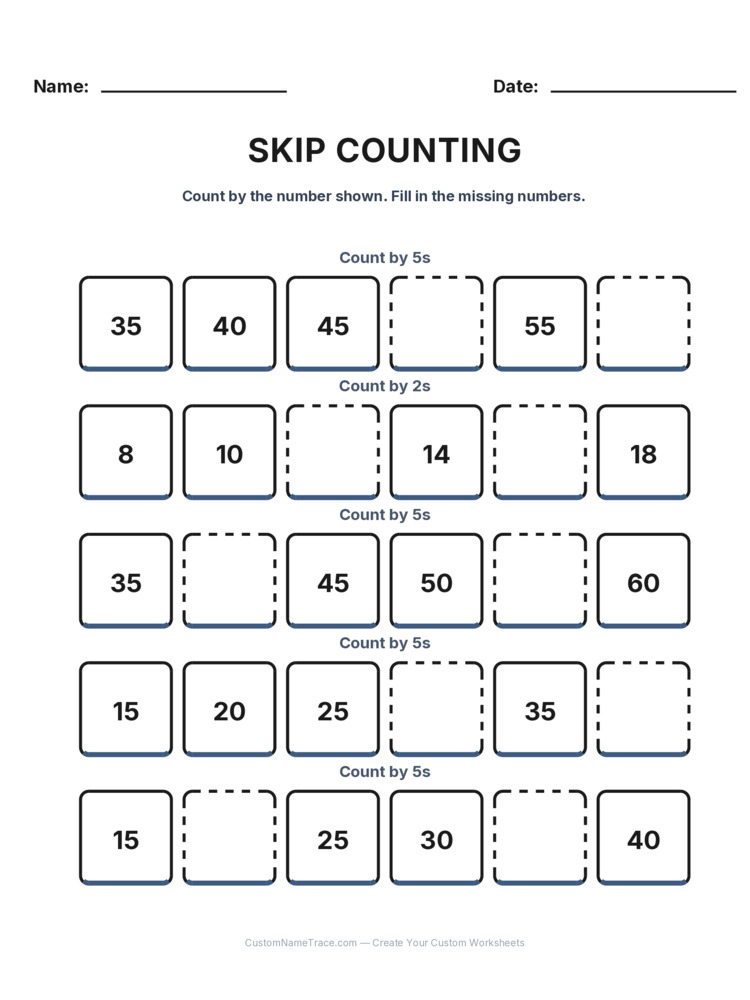
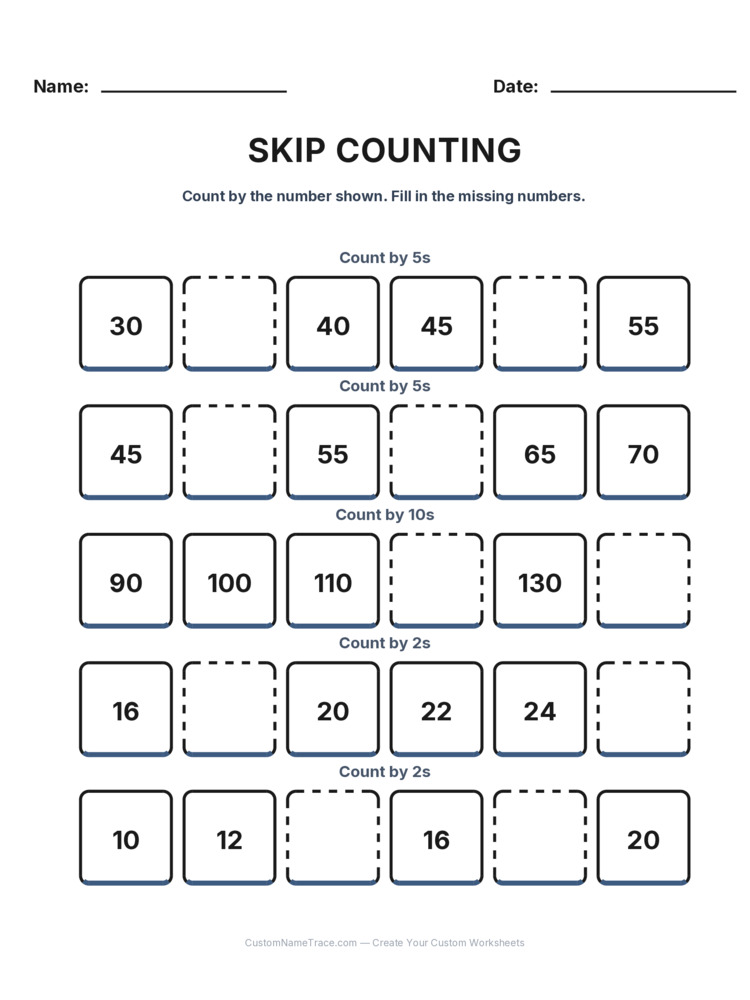
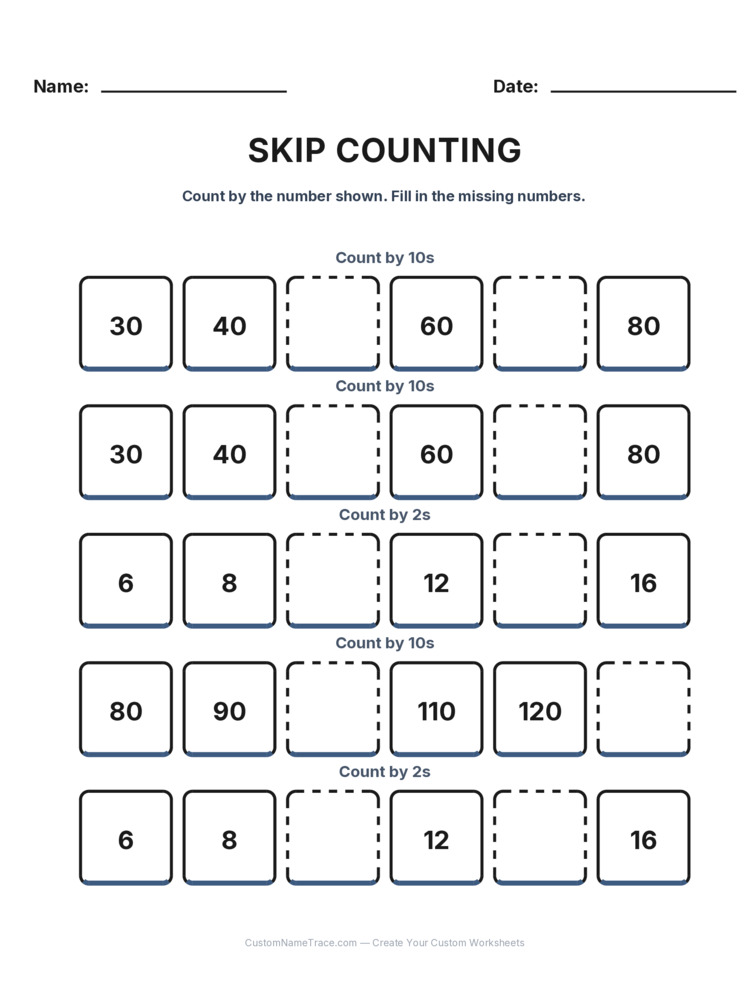
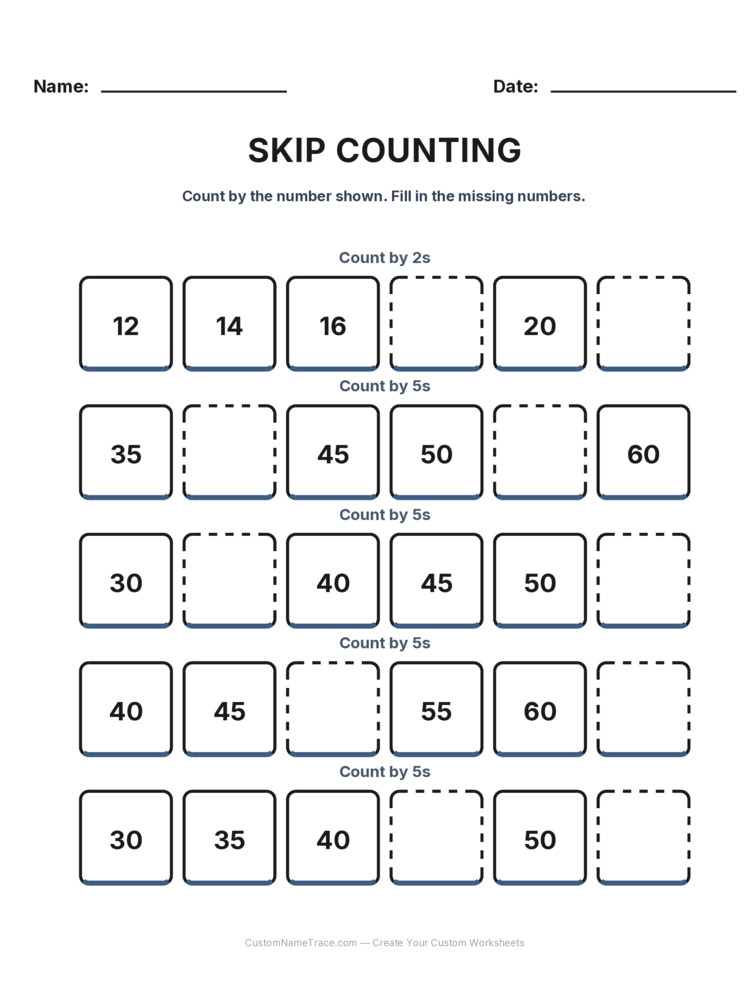
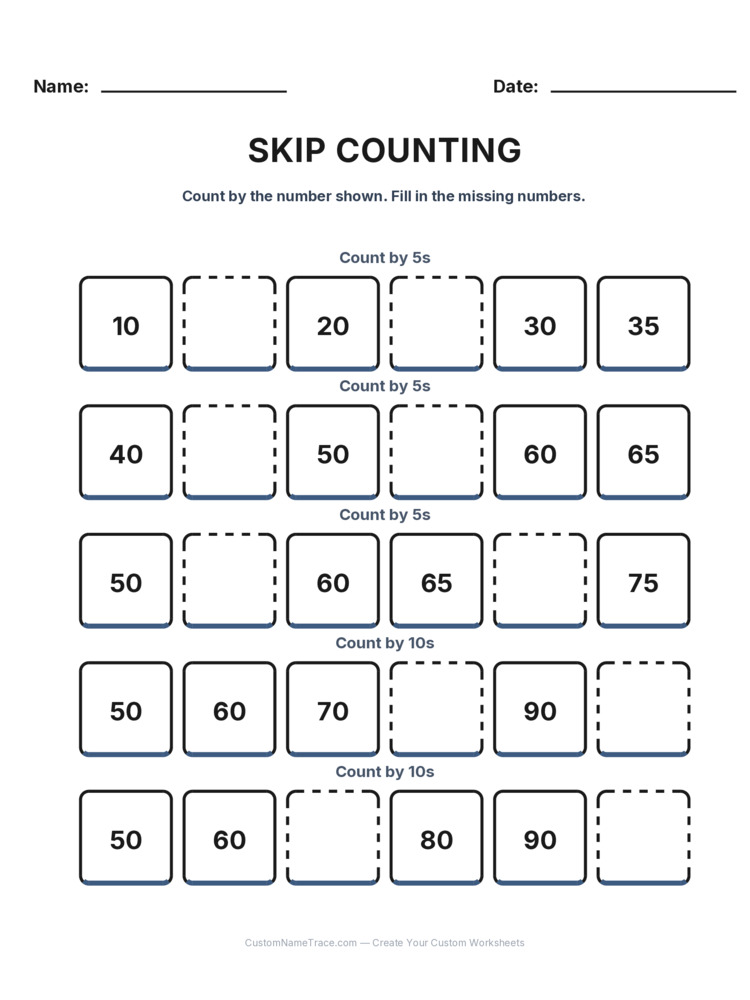
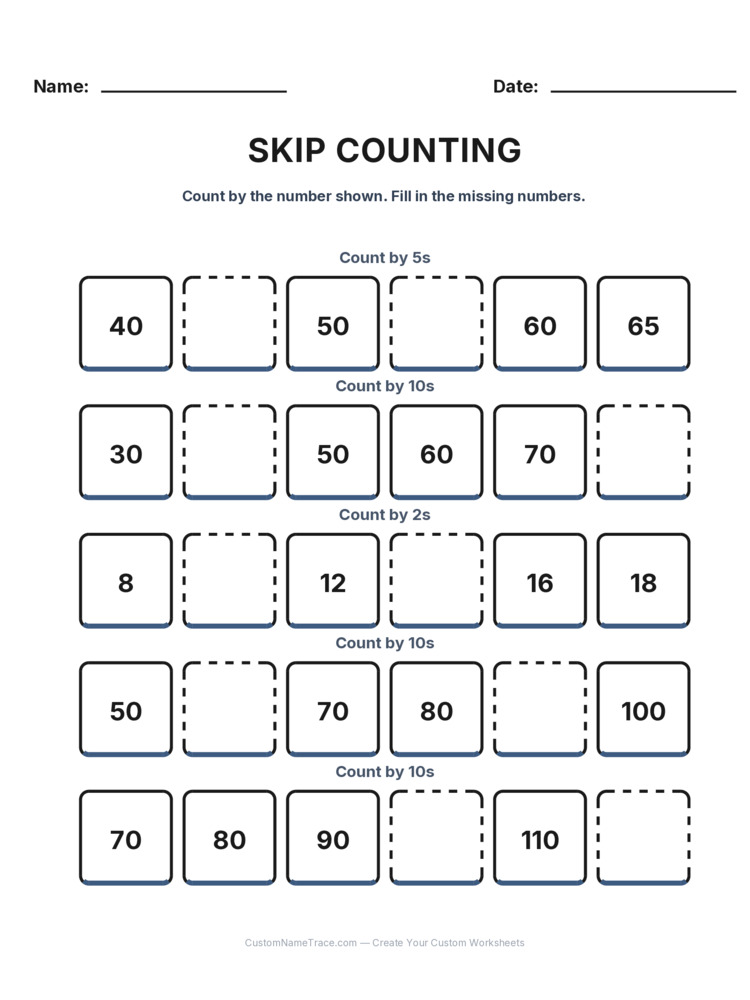
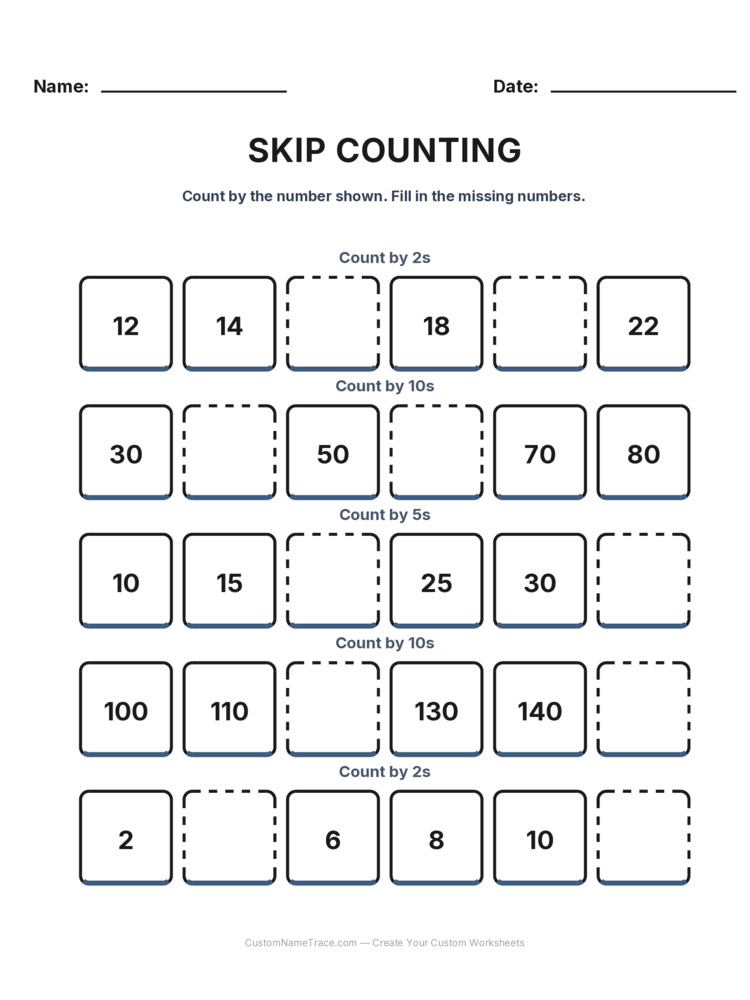
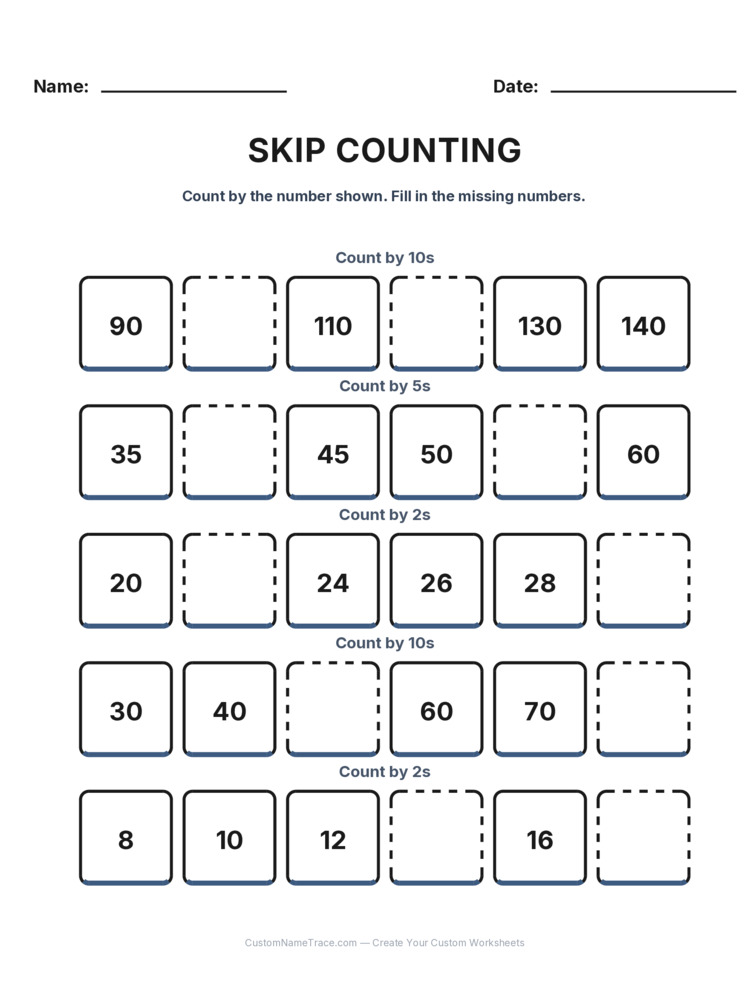
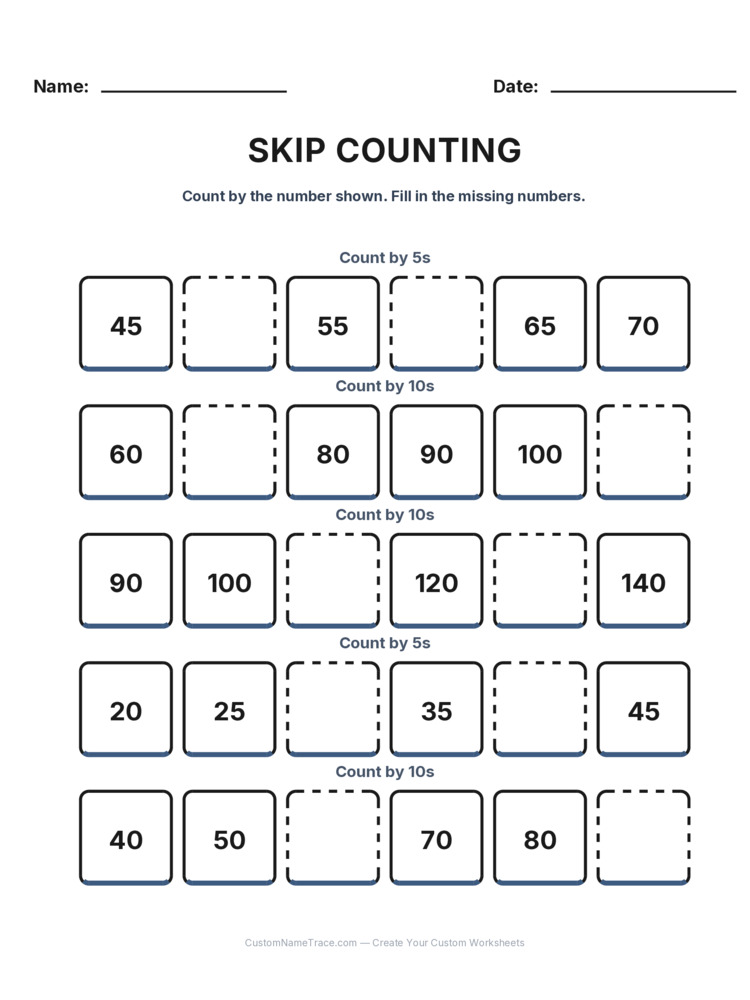
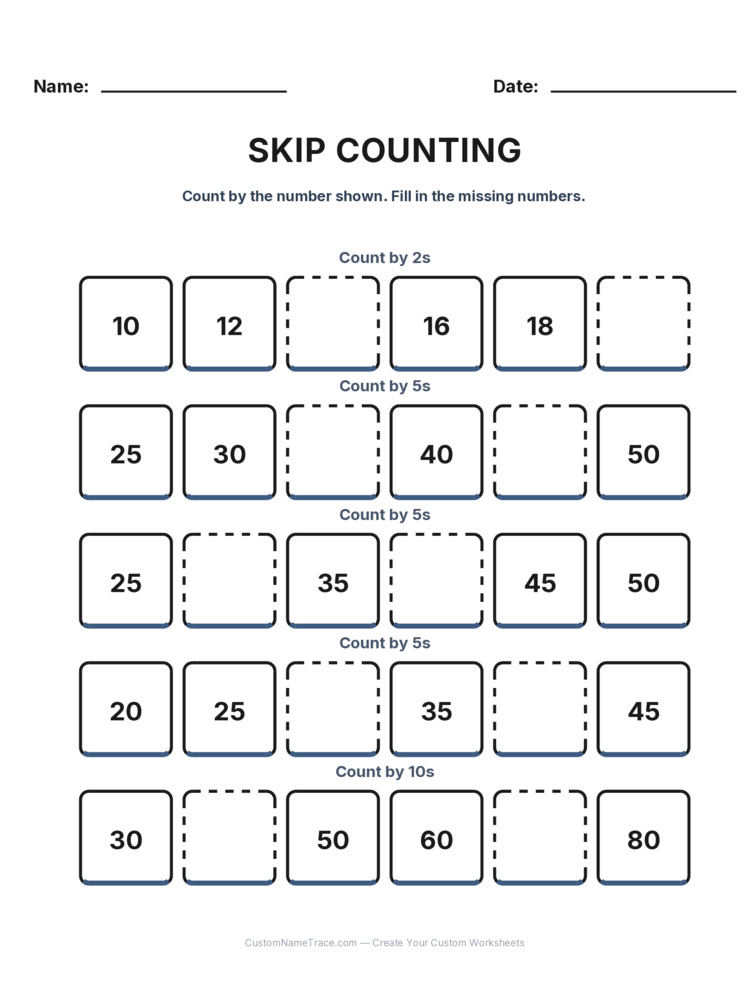
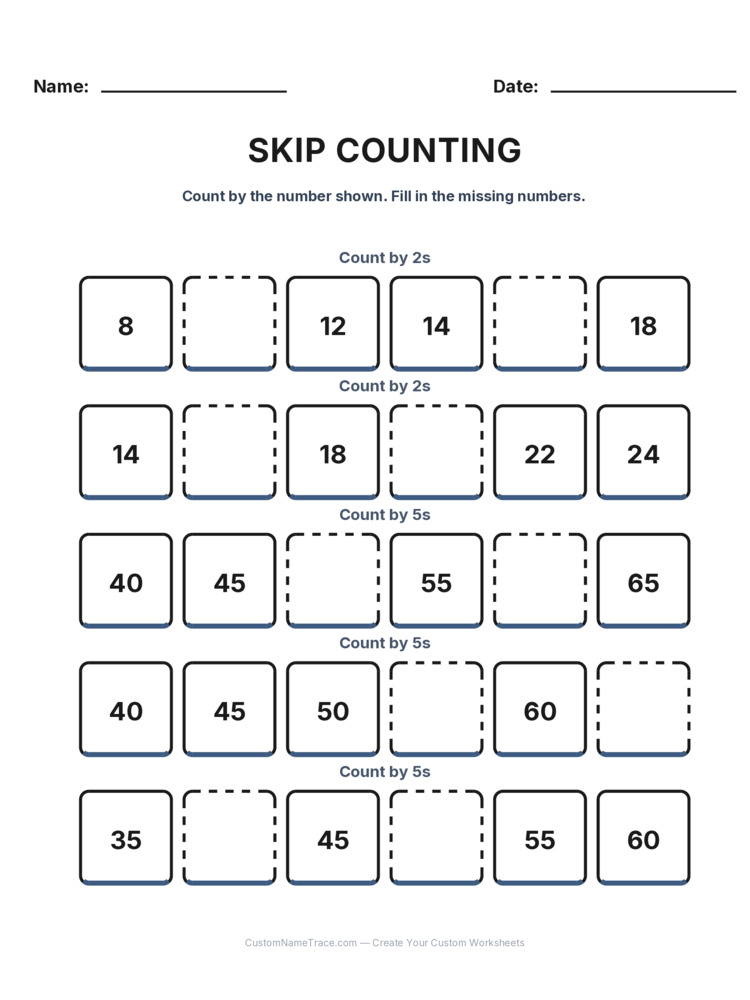
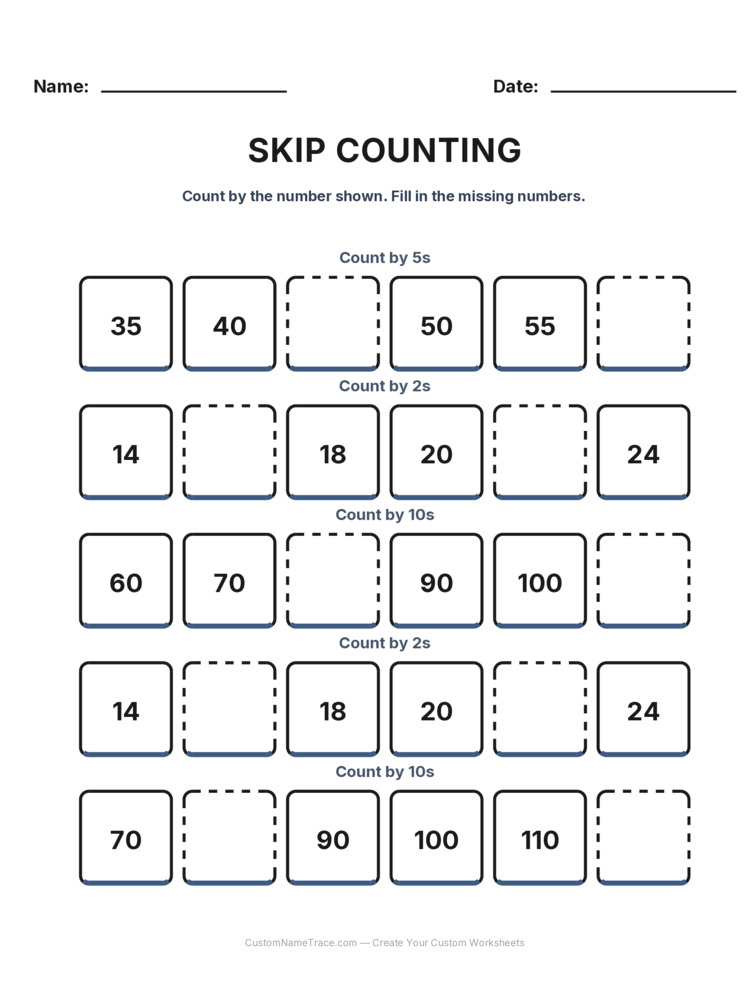
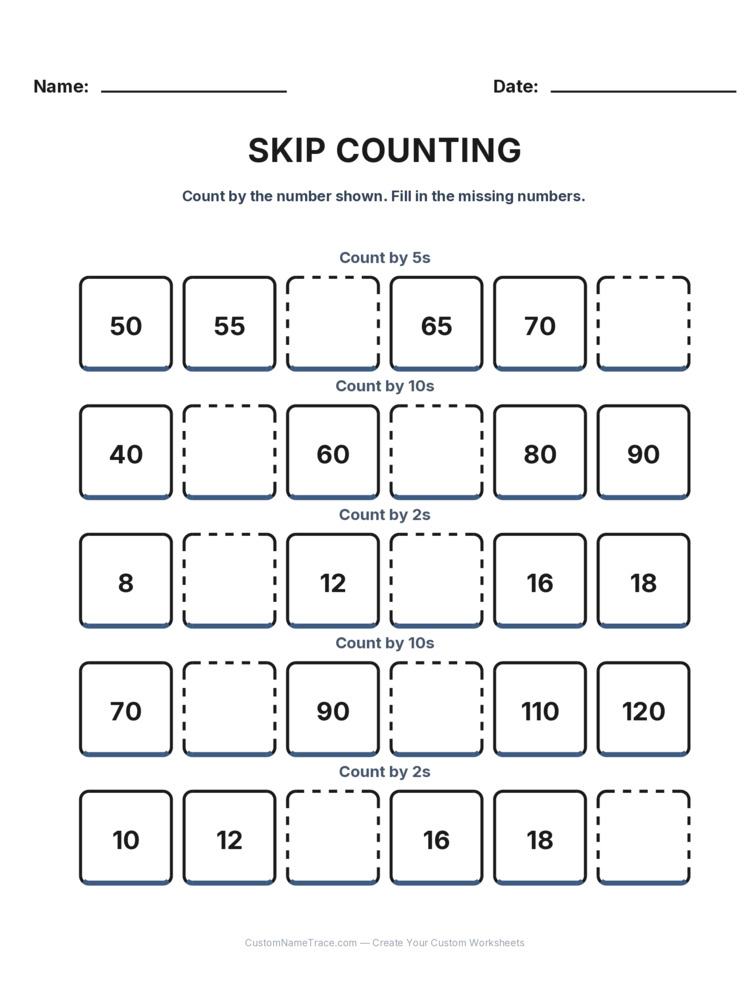
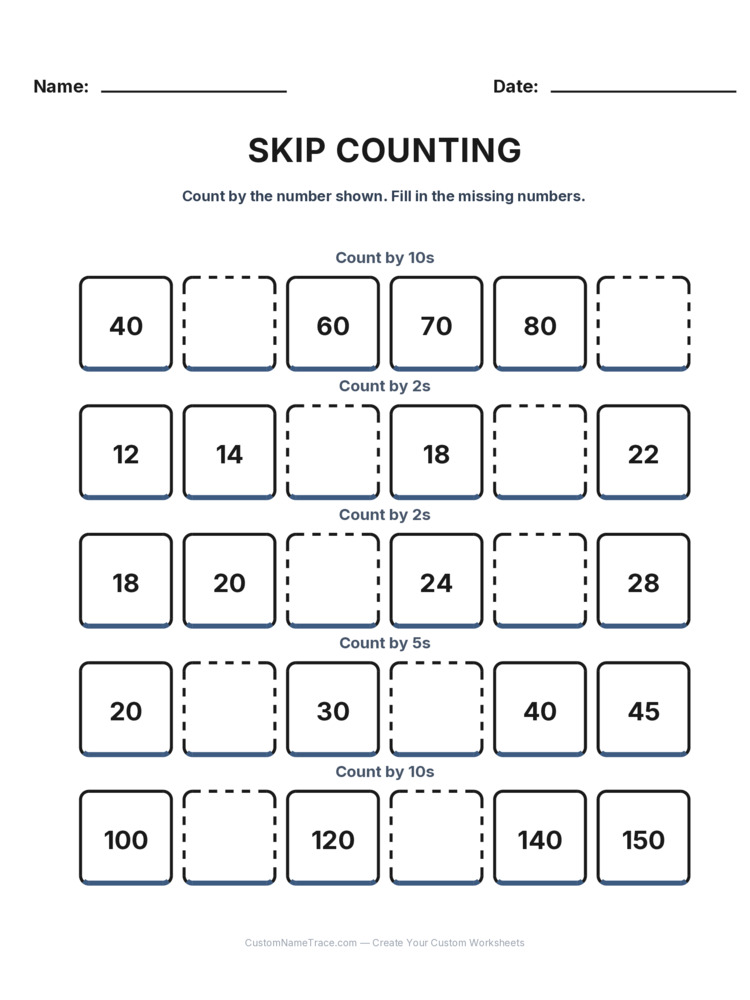
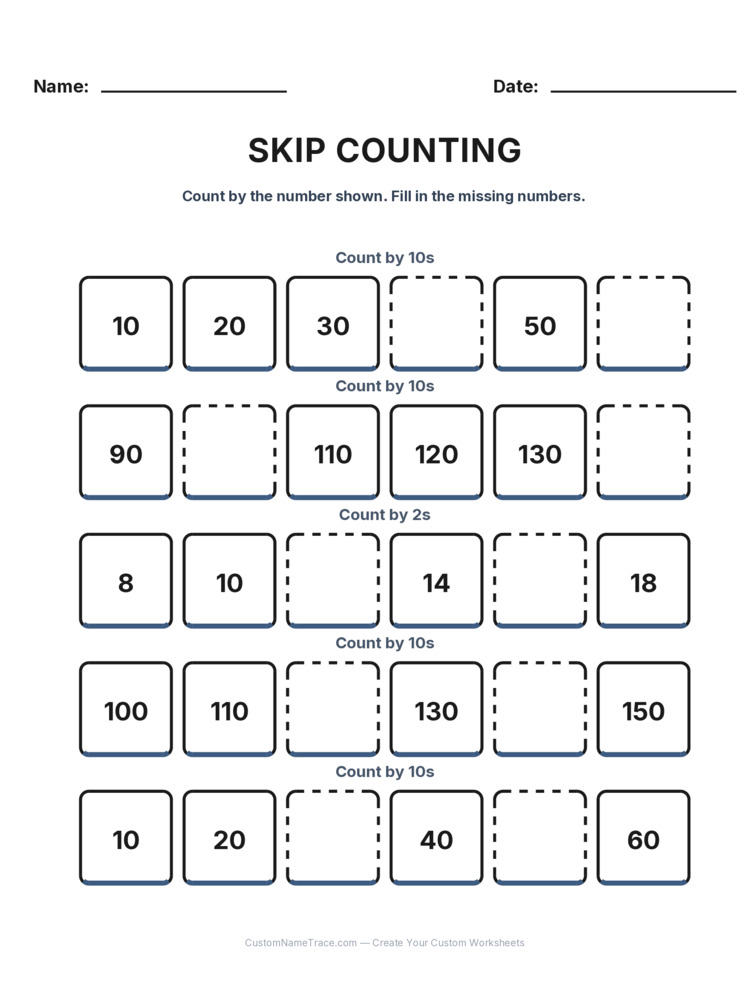
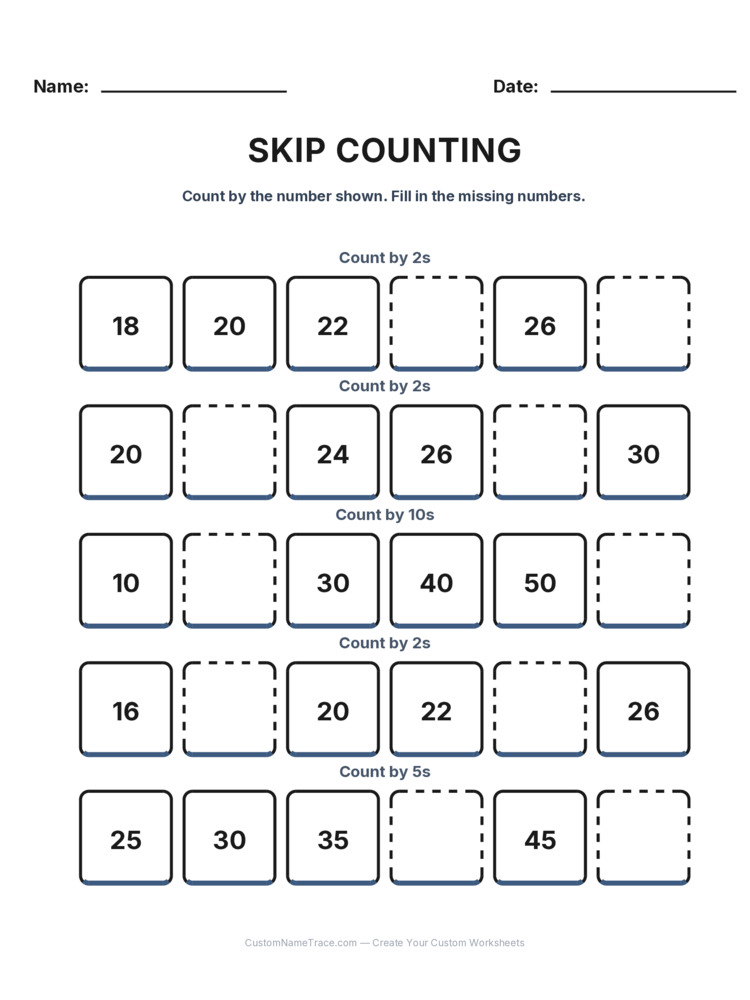
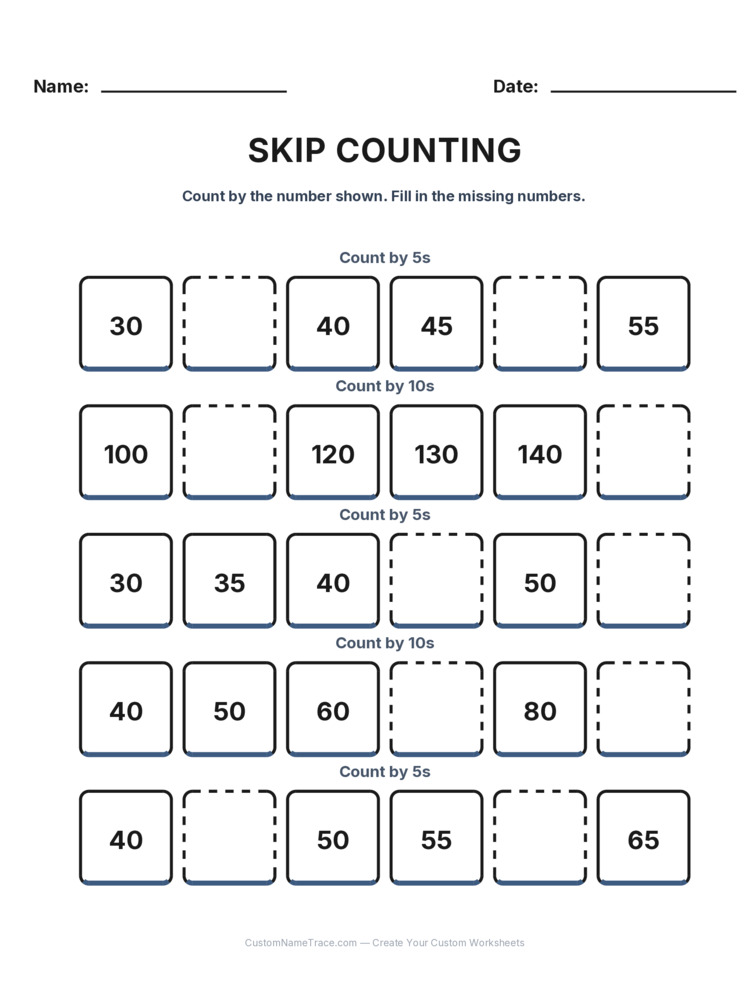
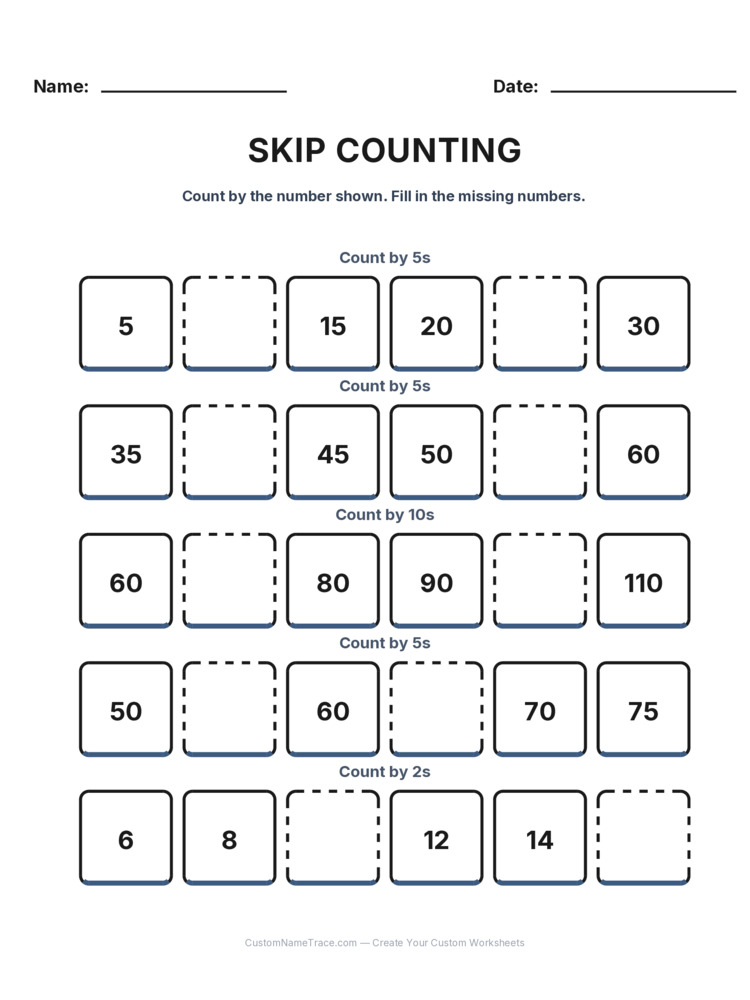
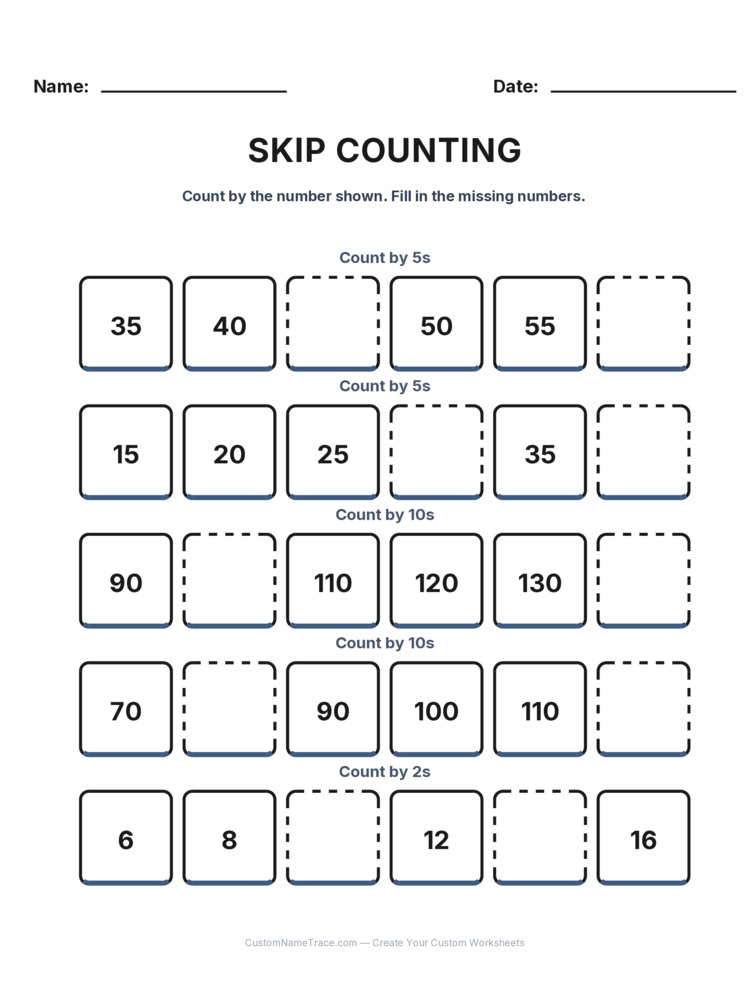
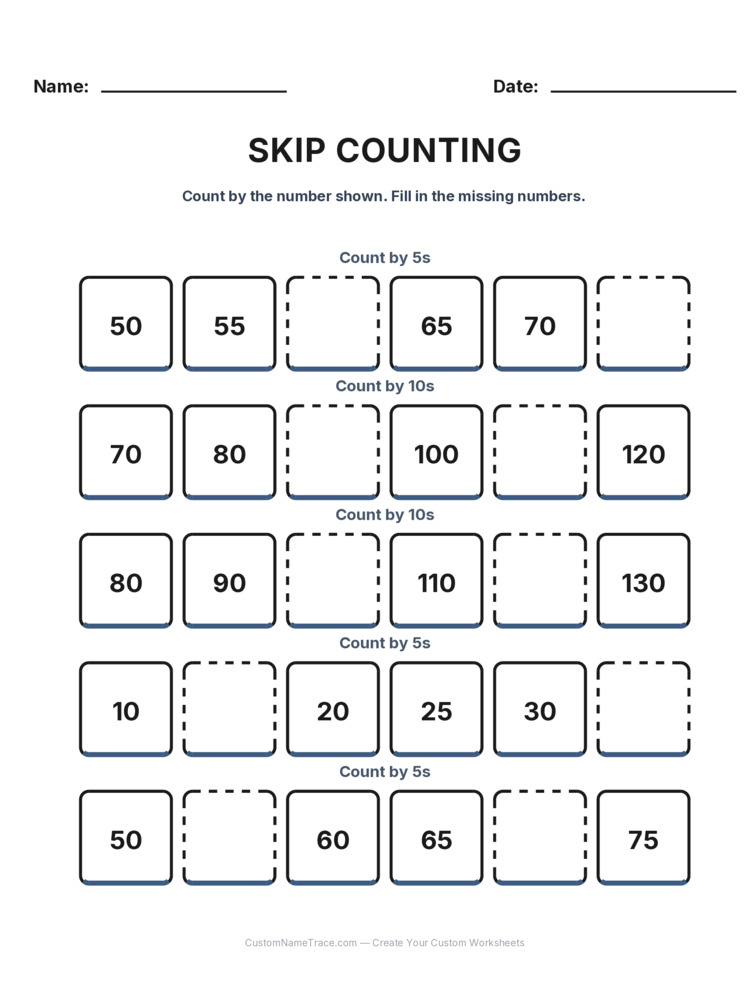
What skip counting actually is
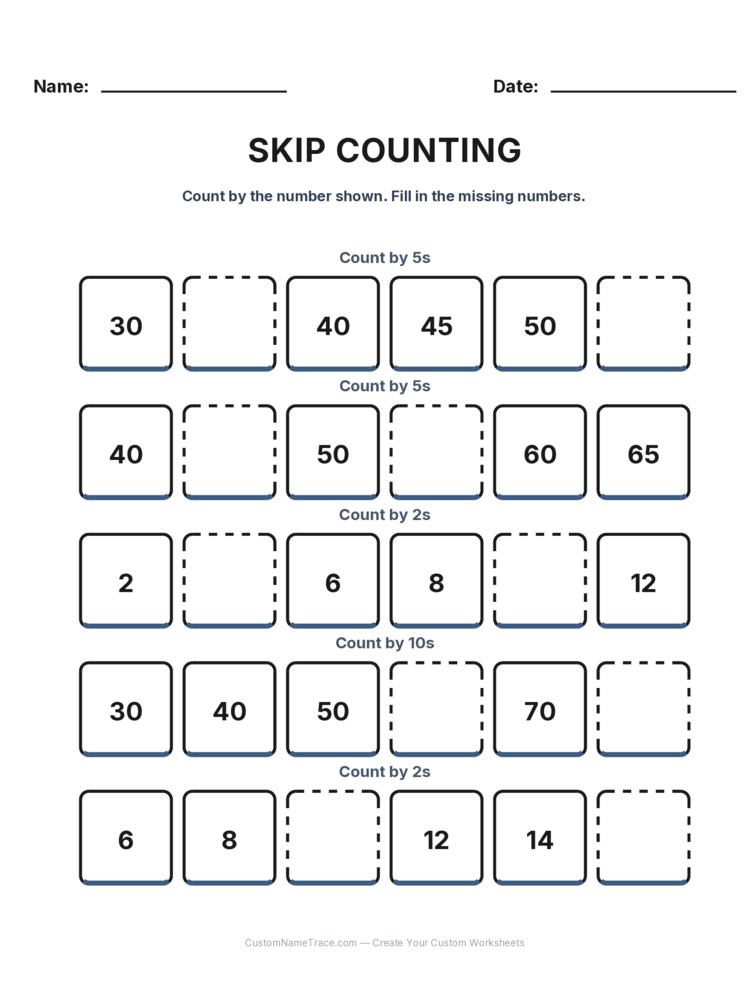
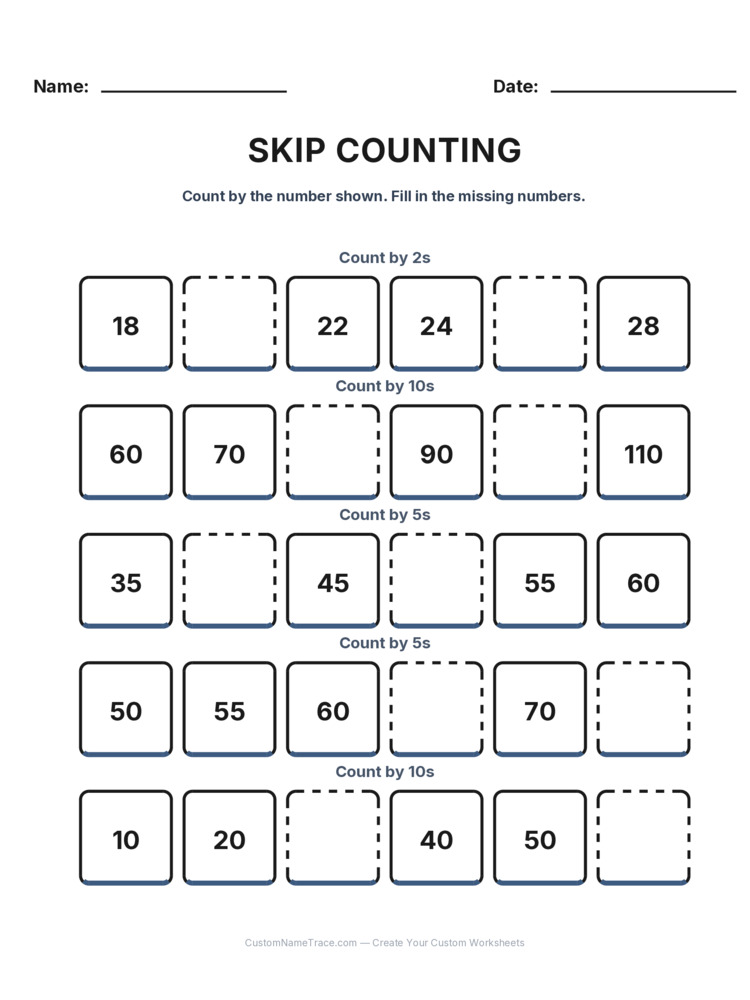
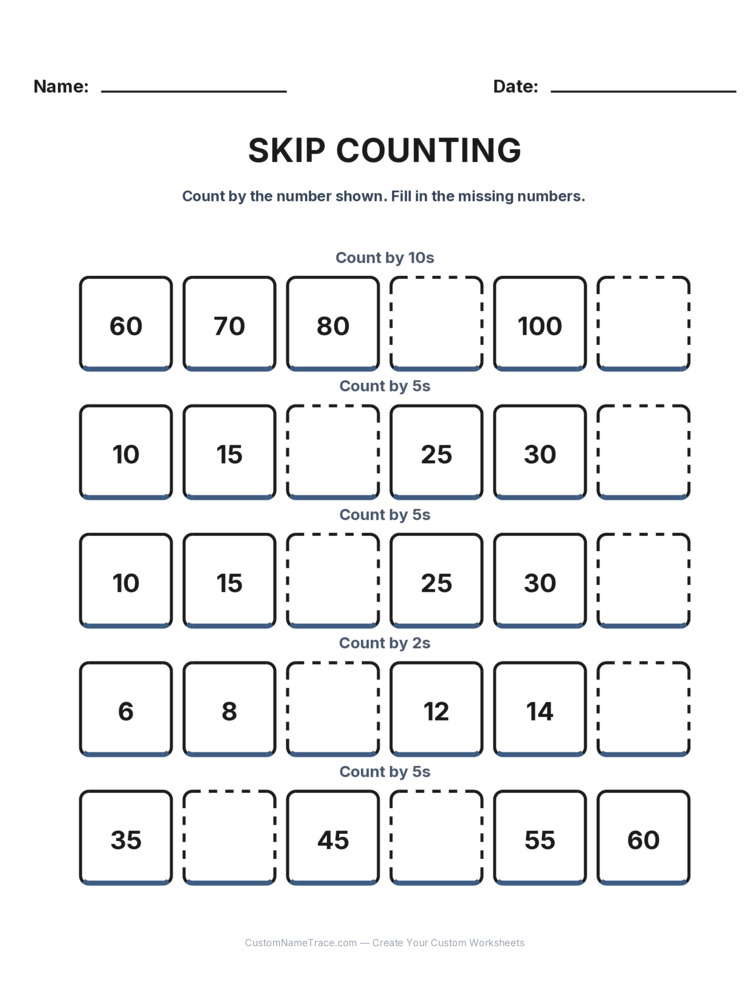
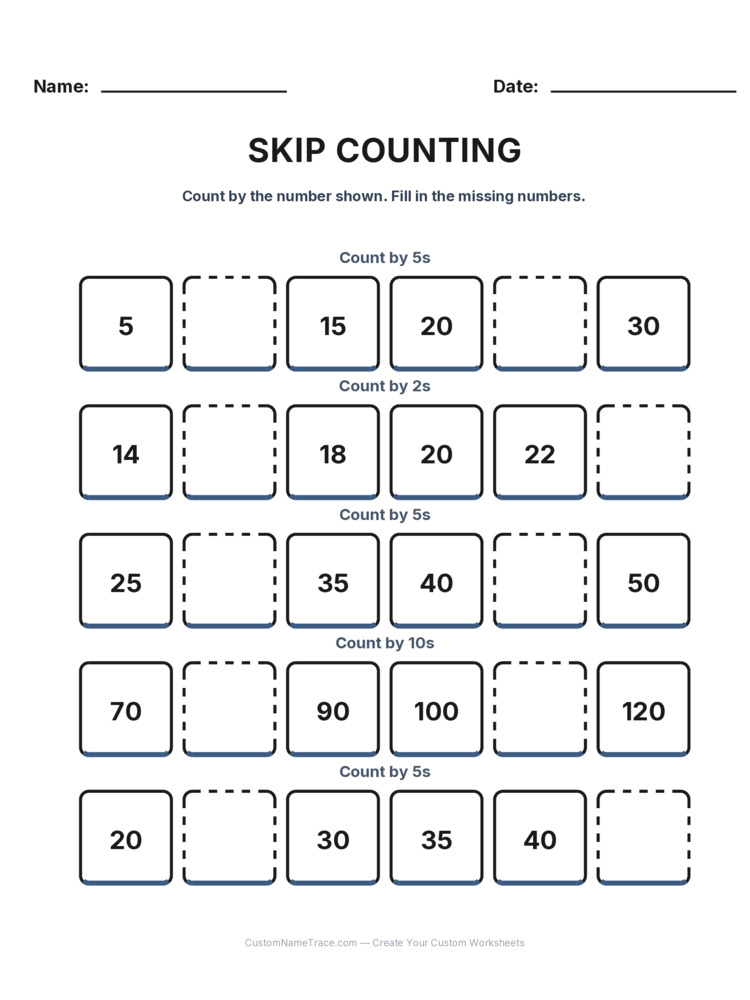
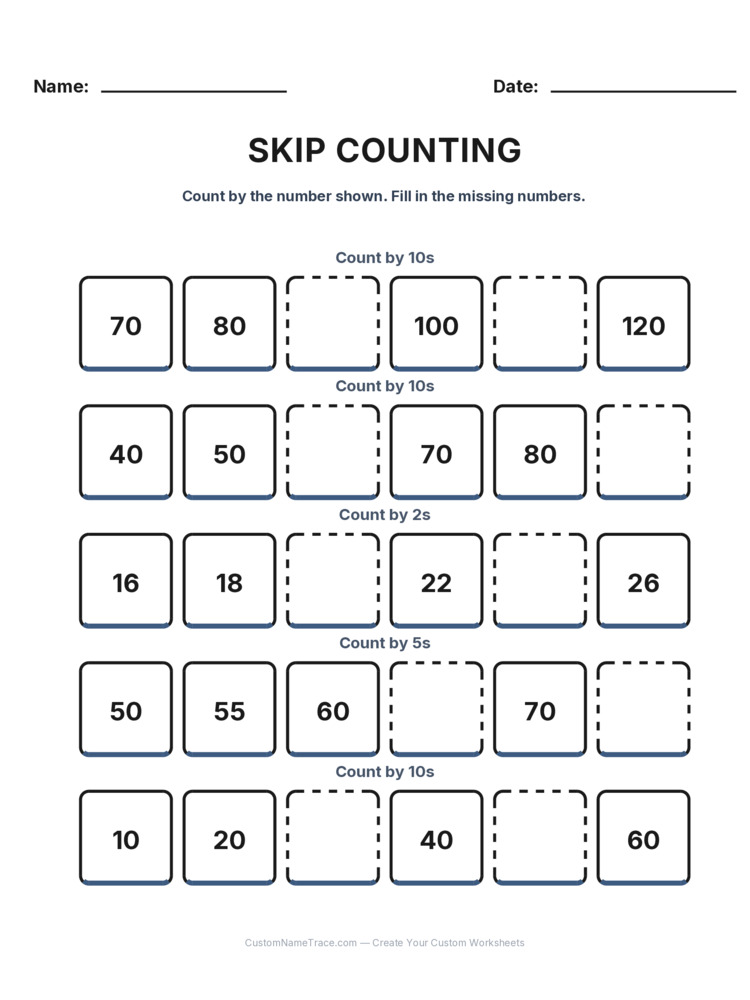
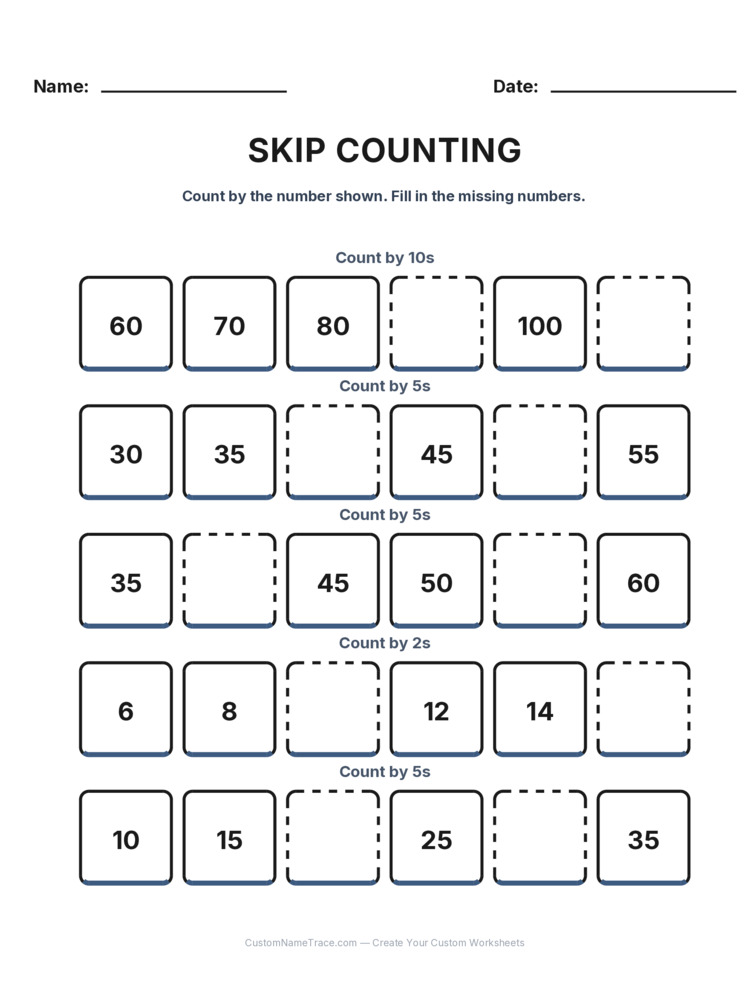
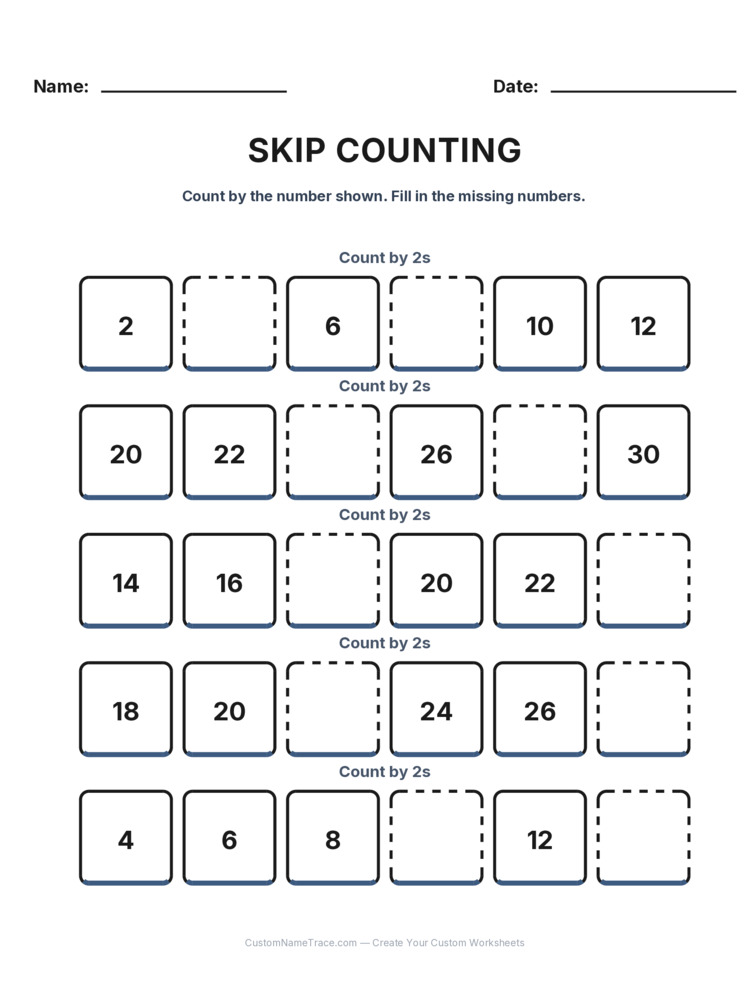
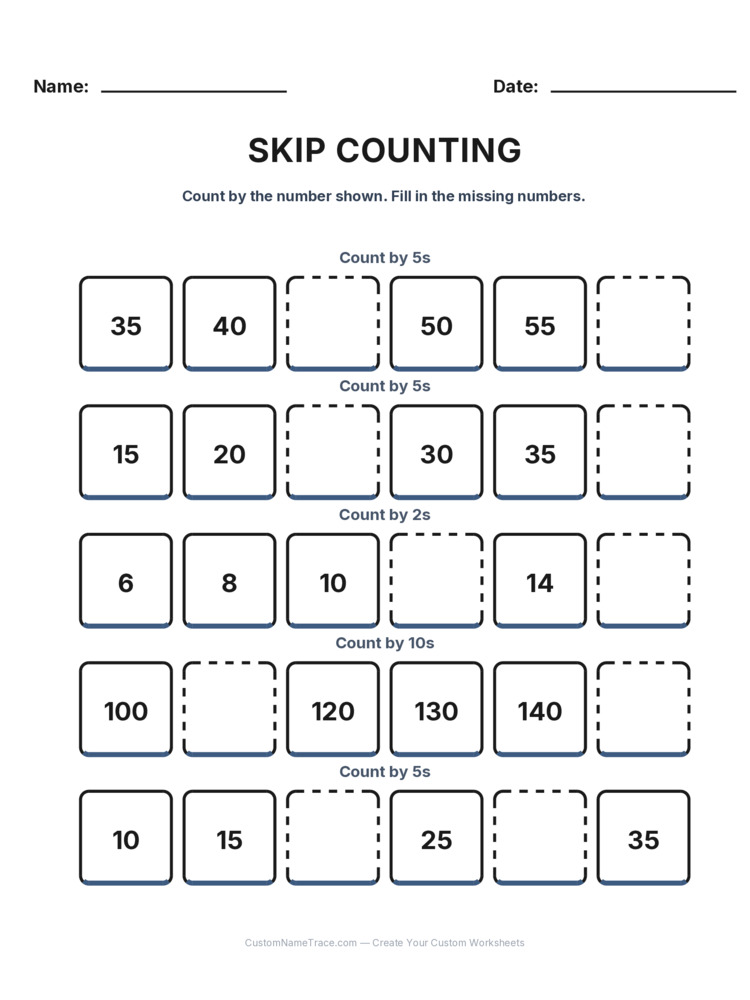
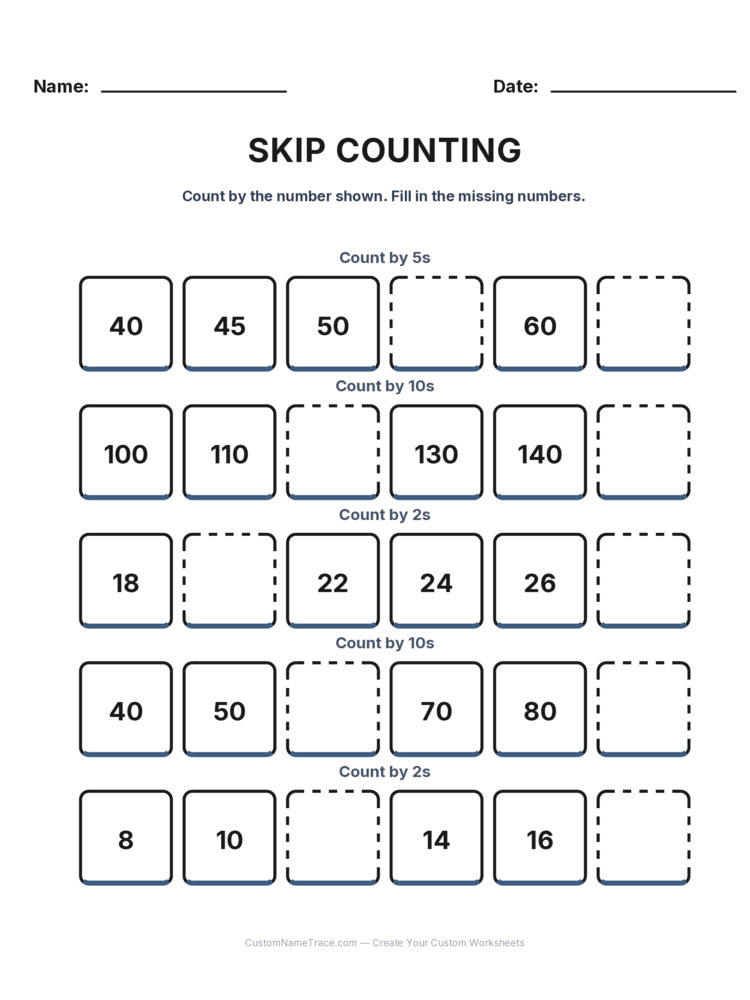
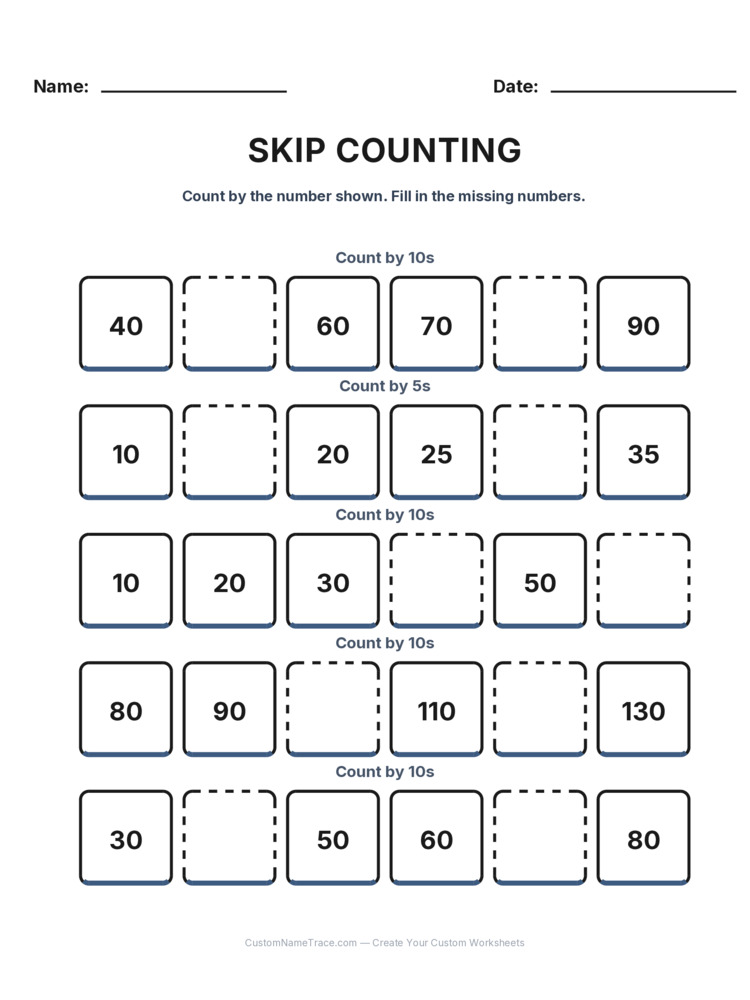
Skip counting means counting forward by a fixed amount other than one — by twos, fives, or tens, for instance — and this worksheet shows a sequence with some numbers filled in and some left blank for a child to complete, once they've identified which number is being counted by. It's a deceptively simple-looking exercise that quietly does a lot of foundational work: skip counting is the direct precursor to both multiplication (counting by threes five times is the same as three times five) and to reading a number line or clock face fluently.
Counting by ones is largely a memorized sequence a child recites; skip counting by a larger number requires actually tracking a jump size and applying it consistently, which is a real step up in what's being asked. A child who can recite '2, 4, 6, 8' by memory hasn't necessarily internalized the *by twos* structure the way a child who can correctly continue an unfamiliar skip-counting sequence — say, by sevens — clearly has. This worksheet is built to test and build the actual jump-size reasoning, not just memorized sequences a child has heard recited before.
The specific number being counted by, and how many blanks appear in the sequence, are matched to Grade 1's level — an early introduction uses smaller, more familiar jump sizes with fewer blanks, while a more advanced version widens the range and asks a child to fill in more of the sequence independently. The underlying skill — track a consistent jump, apply it to fill a gap — stays exactly the same throughout; what changes is how much support the given numbers provide.
A strategy that works, and what mistakes reveal
The most reliable approach is to find two consecutive given numbers in the sequence, work out the exact difference between them, and then check that same difference against a second consecutive pair before trusting it — the same confirm-before-you-trust habit this site's Growing Sequence logic puzzles build in a slightly different format. A child who locks onto a jump size after checking only one pair of numbers is the single most common source of an otherwise-avoidable wrong answer here.
A single wrong number in an otherwise-correct sequence often means a child correctly identified the jump size but made a basic addition error applying it — worth checking with simple addition first before assuming the counting concept itself wasn's understood. A sequence that goes wrong from partway through and stays wrong for every number after that point, however, usually means the jump size itself was misidentified partway through and needs a full recheck from the beginning, not just a fix to one number.
Before handing over a worksheet using a jump size a child hasn't practiced before, counting out loud together for just the first four or five numbers — modeling the jump size directly rather than expecting a child to infer it purely from a printed sequence's given numbers — tends to make the rest of the worksheet go far more smoothly. Once the specific jump size feels familiar out loud, transferring that same counting rhythm to filling in written blanks is a much smaller step than learning both the jump size and the written format at the same time.
Why some jump sizes feel harder, and knowing when to move on
Counting by twos, fives, or tens tends to come easily since those patterns show up constantly in daily life — fingers, coins, toes — while an unfamiliar jump size, like counting by threes or fours, doesn't have the same everyday reinforcement and usually takes noticeably more repetition to feel automatic. That difference in difficulty isn't a sign anything is wrong; it simply reflects how much outside-the-worksheet practice a child has already had with that specific number, which varies naturally from one jump size to another.
A child who fills in a given jump size's blanks instantly, without visibly pausing to check the difference between numbers, has likely mastered that specific sequence and is ready either for a less familiar jump size at the same grade level or for the wider ranges used at the next grade level on this site. There's real value in briefly revisiting an already-mastered jump size occasionally even after moving on, since skip counting fluency tends to fade a little without any use, the same way any memorized skill does.
Once a child is confident counting forward by a given jump size, counting the same sequence backward — starting from a larger given number and subtracting the jump size repeatedly — builds a related but genuinely different skill, since it requires the same jump-size tracking in the opposite, less rehearsed direction. This isn't part of the standard worksheet itself, but it's a natural, worthwhile extension once the forward version stops presenting any real challenge, and it previews subtraction reasoning a child will need directly once formal subtraction is introduced.
Practicing this beyond the worksheet
Skip counting out loud together — while walking up stairs two at a time, or clapping out a rhythm every fifth beat — reinforces the same jump-tracking skill without any worksheet needed, and it's a natural way to build fluency with a specific jump size before or alongside the printed practice. This verbal version also works well as a quick check: a child who can skip count out loud confidently but still makes written errors is dealing with a writing or attention issue, not a conceptual one.
Marking each number in a skip-counted sequence on a simple hand-drawn number line, rather than only filling blanks in a row, adds a visual sense of the equal-sized jumps between each number — seeing the identical gap repeated across a line reinforces that a consistent jump size, not a shrinking or growing gap, is what defines this kind of sequence, which some children pick up faster visually than from the row-of-numbers format alone, especially early on before the pattern feels fully automatic.
Coins are the clearest everyday application — counting a stack of nickels means skip counting by five, and a stack of dimes means skip counting by ten — and pointing that out directly turns an abstract worksheet skill into something a child can immediately use the next time real coins are on the table. Clock faces are a second common example, since the minute hand's markings are read in skip-counted fives around the entire face.
Where this leads
Every skip-counting sequence a child practices here is, functionally, an early multiplication table recited out loud — counting by fives five times lands on 25, the same fact five times five equals twenty-five states directly. Pointing that connection out explicitly once a child is confident with a specific jump size ("you just counted by fives four times, and that's the same as four times five") plants an early seed for formal multiplication well before it's introduced as its own subject.
The single habit worth reinforcing above all others on this worksheet is checking the jump size against more than one pair of numbers before trusting it — that one small discipline prevents the majority of mistakes a child makes here, regardless of which specific number is being counted by, and it's worth repeating out loud as a rule of thumb until it becomes second nature rather than something that needs re-explaining on every new worksheet.
Every numbered variant generates a fresh sequence testing the same Grade 1-level jump size and blank pattern, so a child who wants more practice always works through a genuinely new sequence rather than one they might recall. Print at full size so the given numbers and blanks stay clearly spaced and easy to fill in by hand.