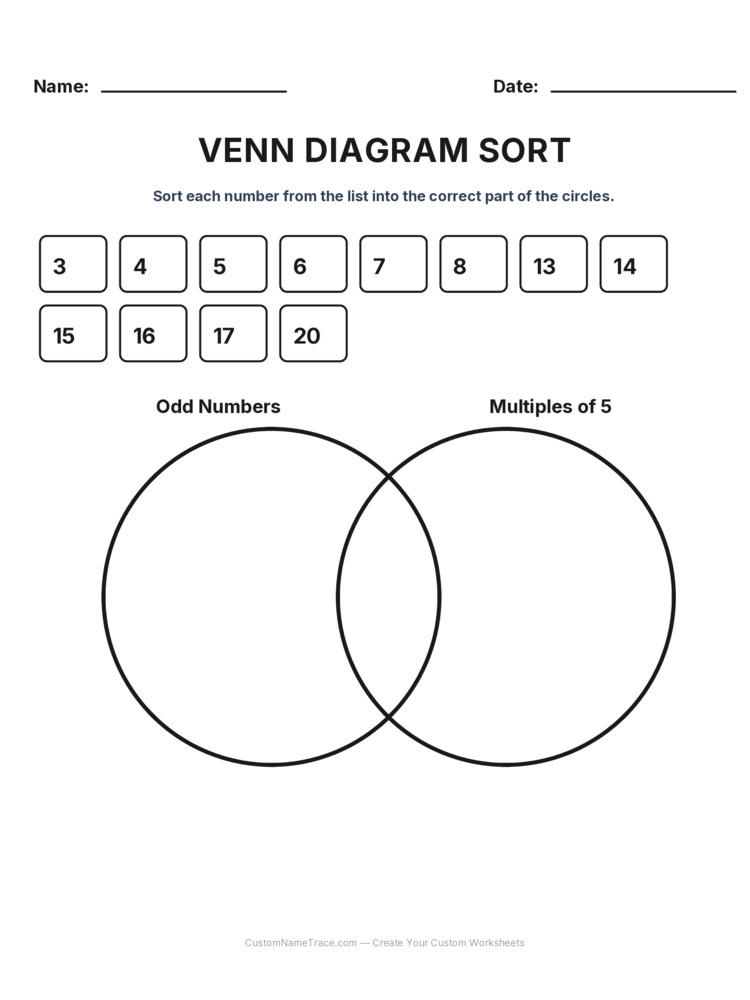
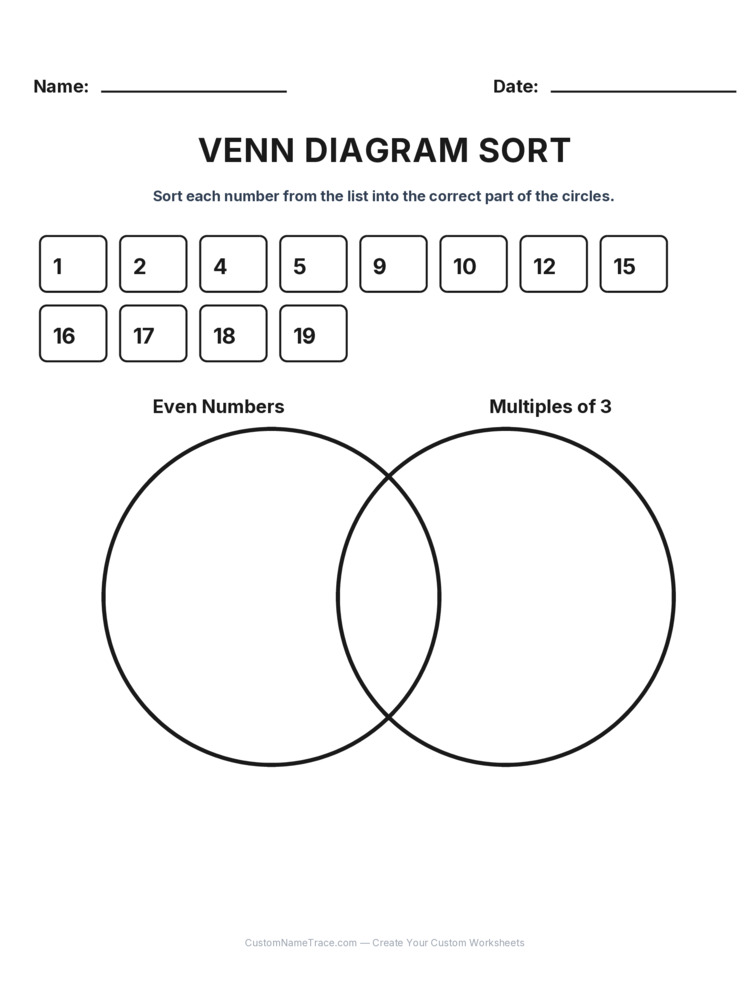
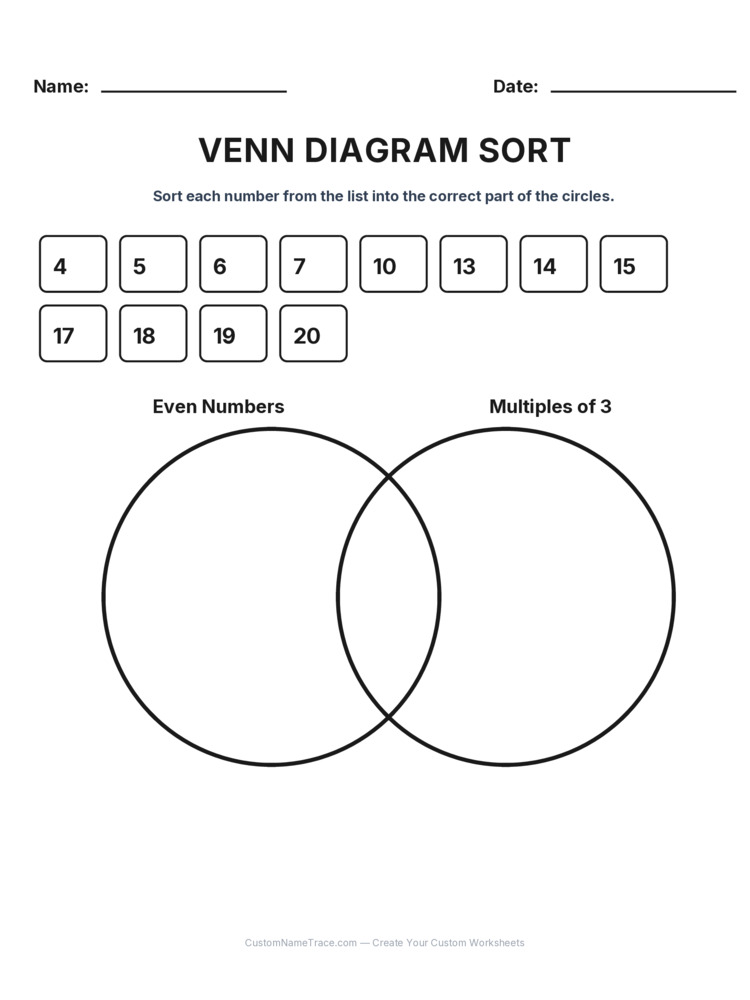
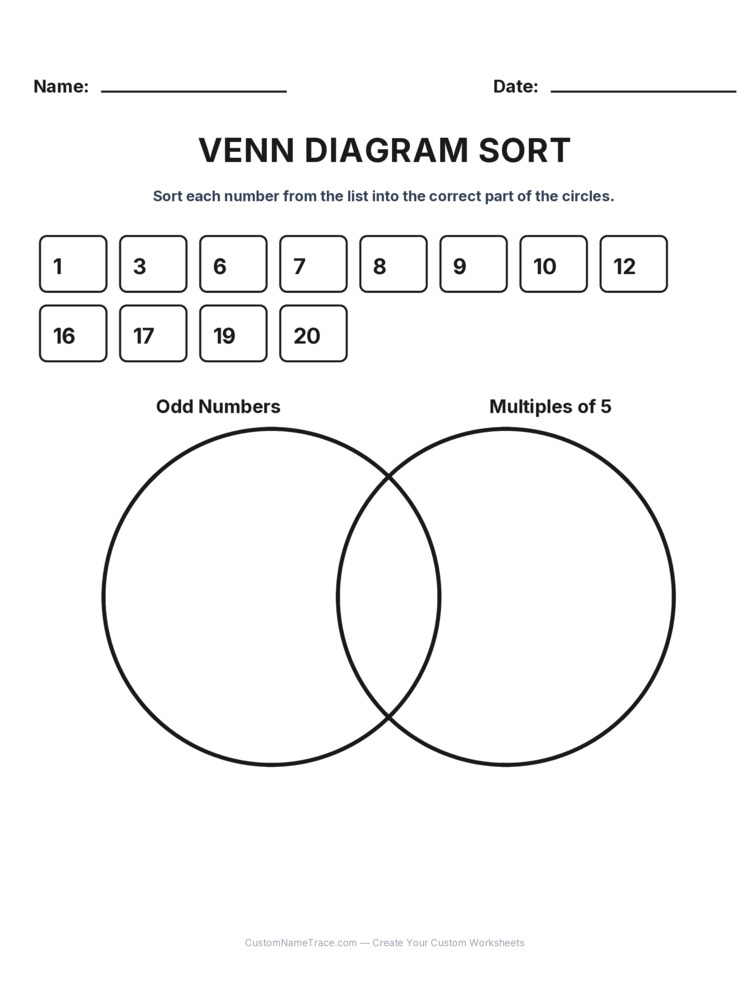
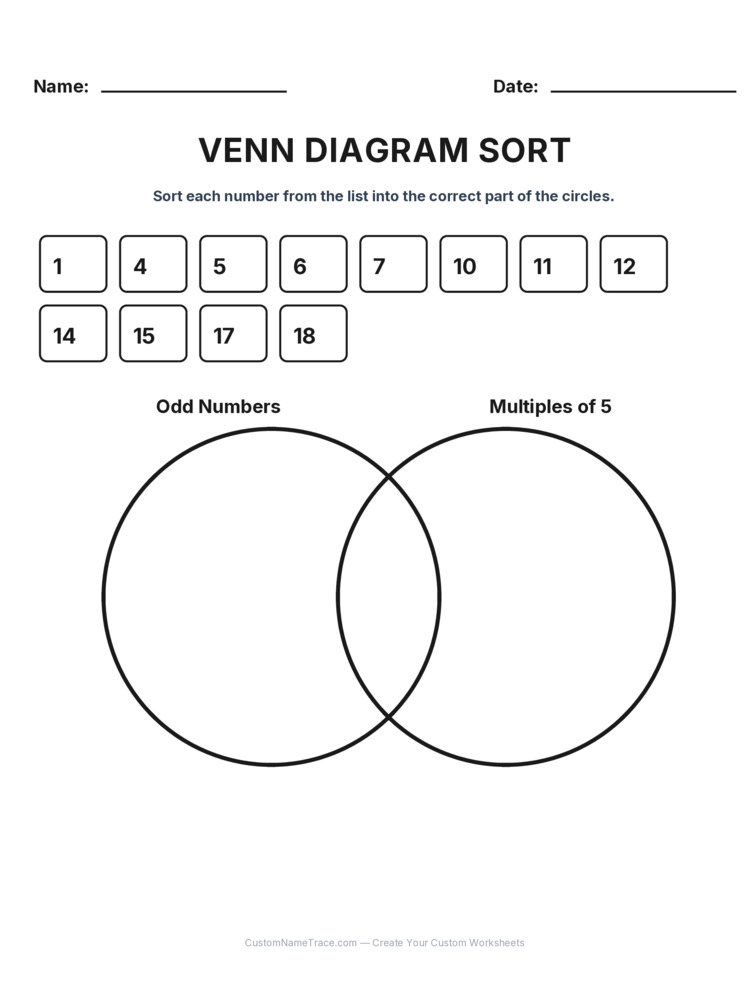
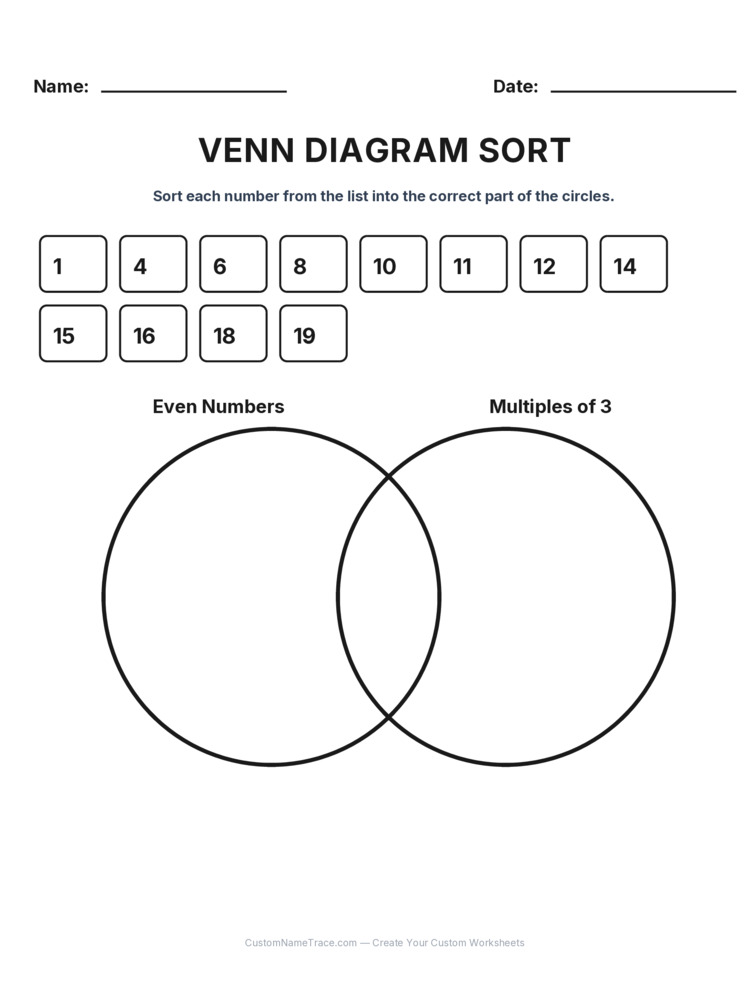
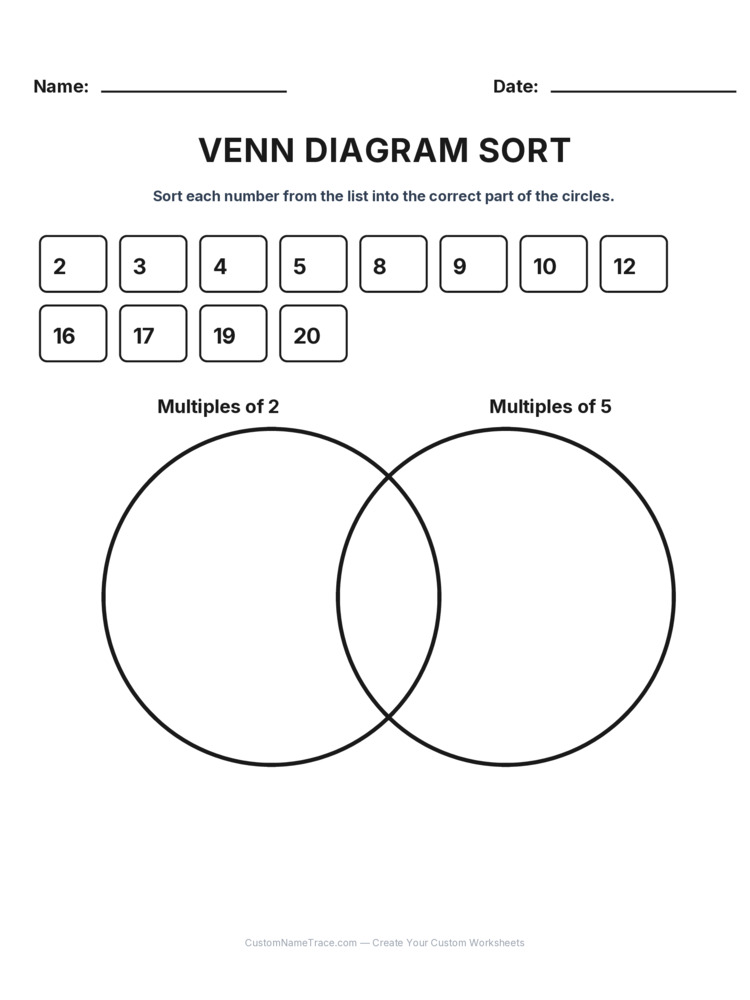
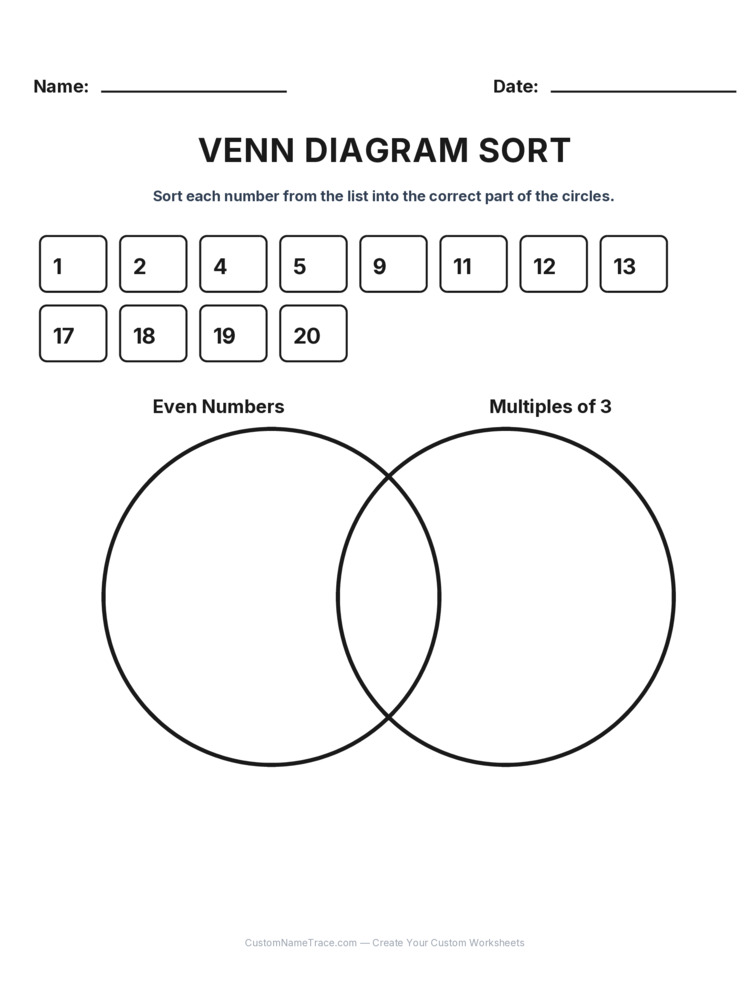
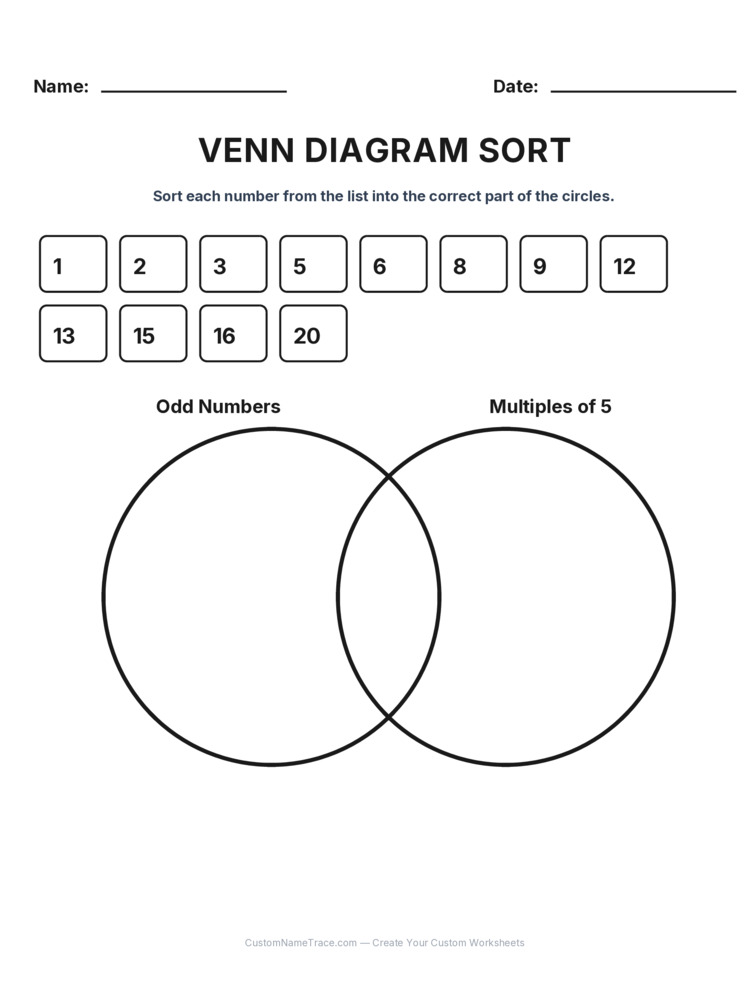
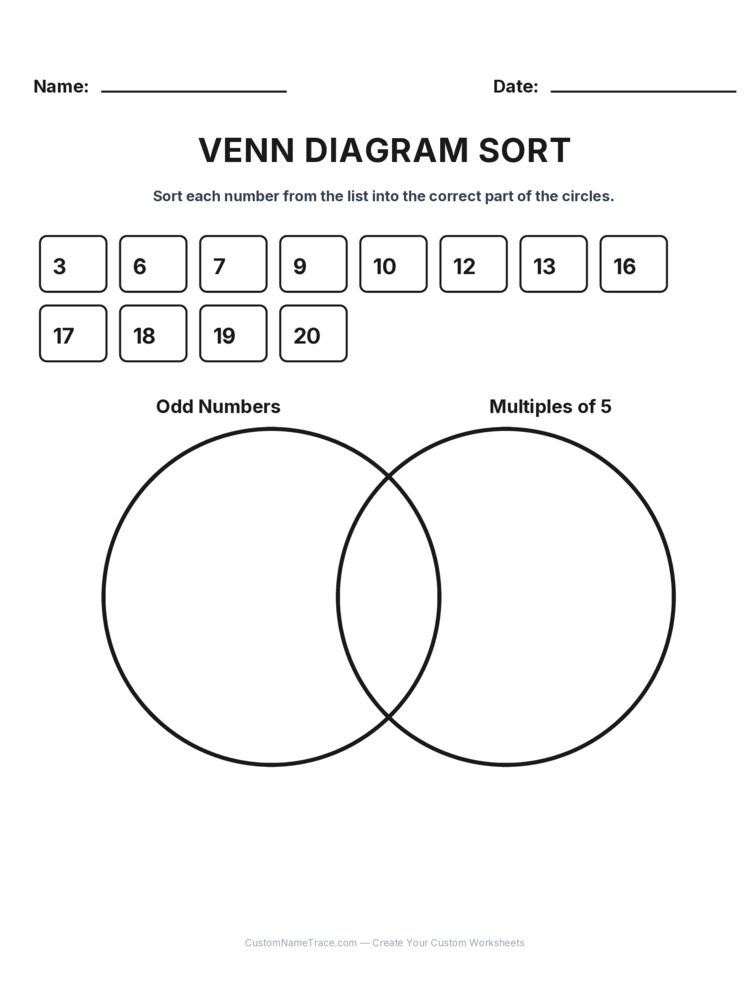
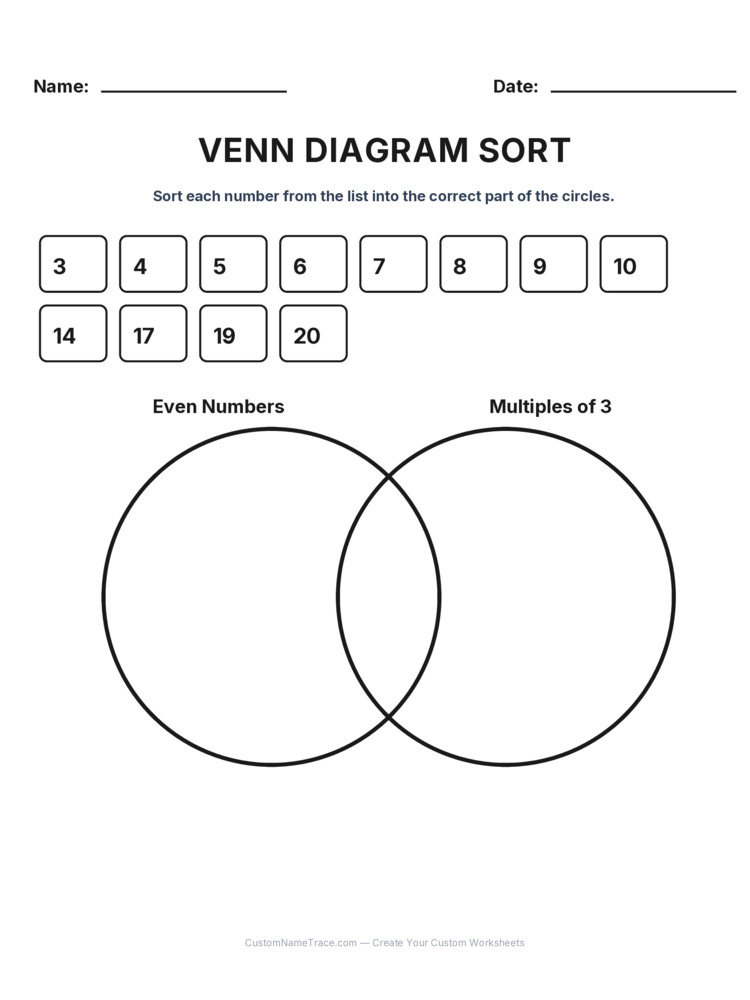
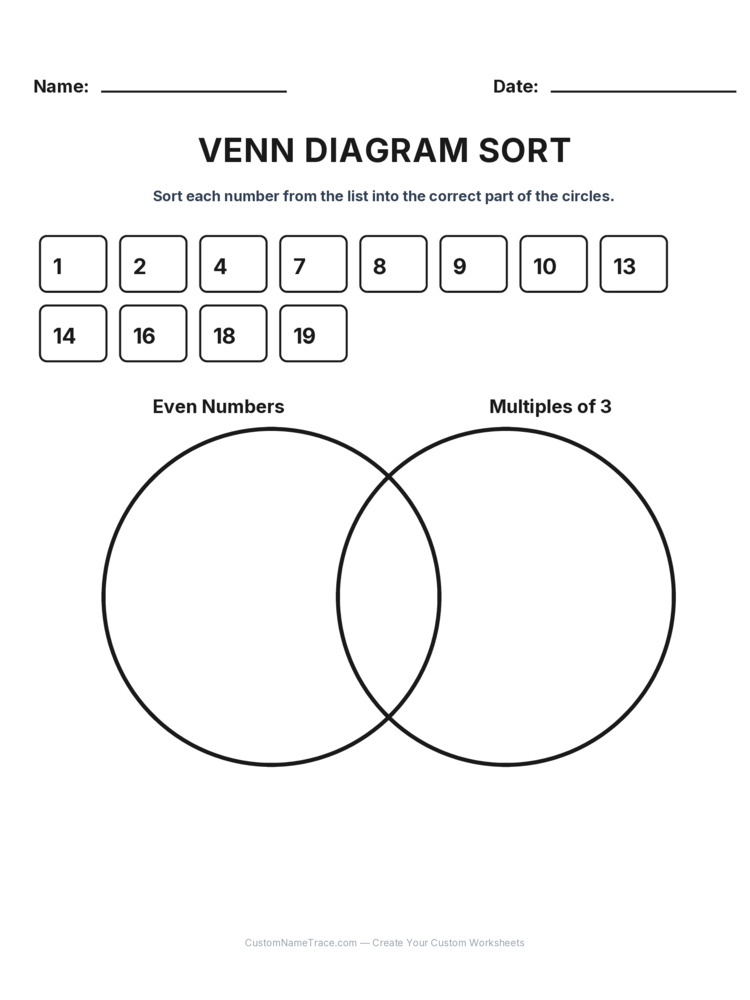
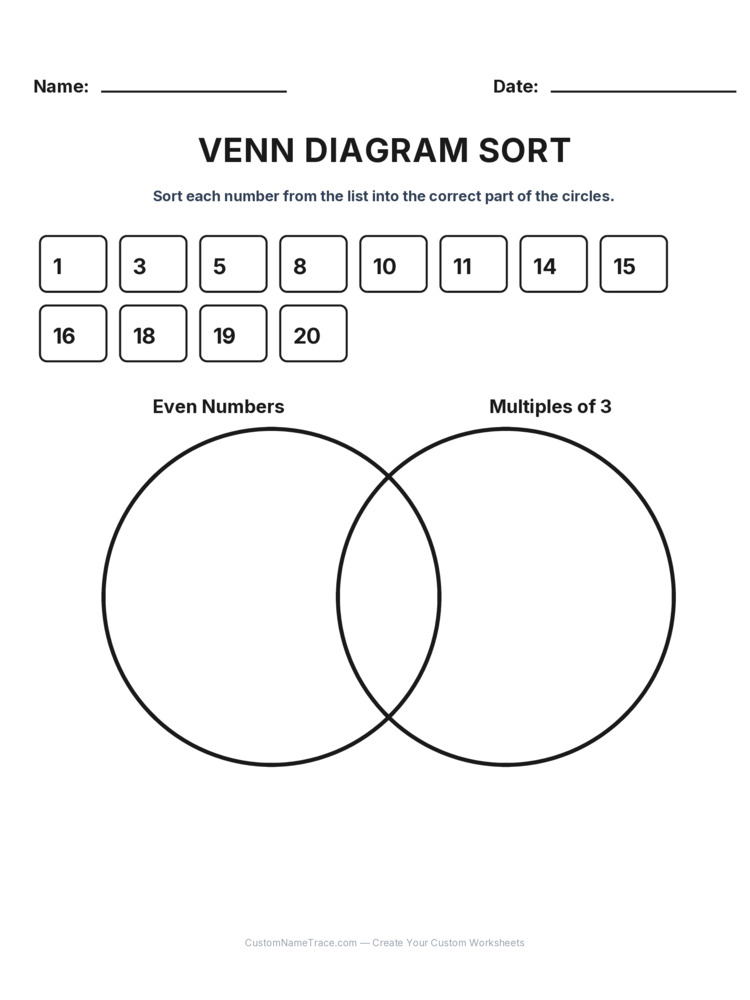
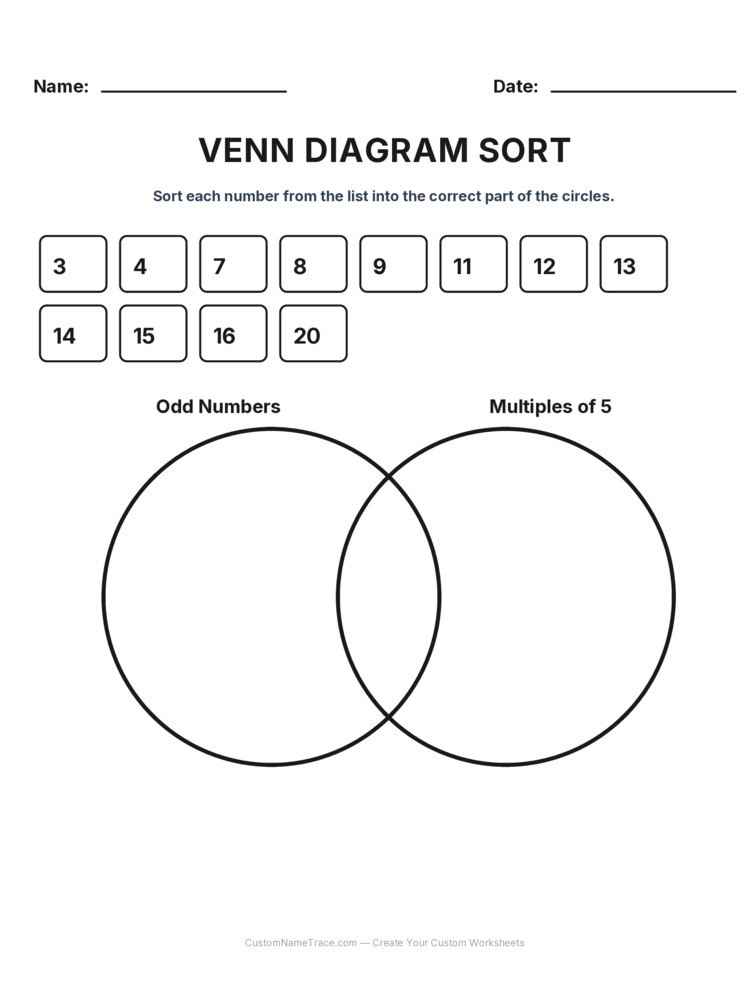
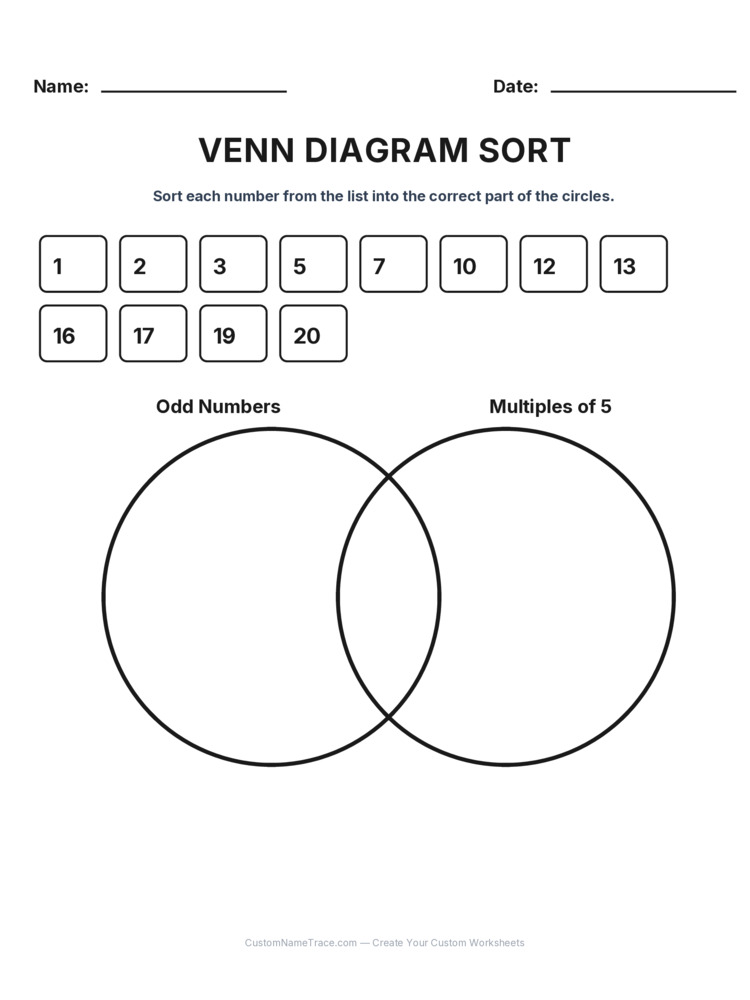
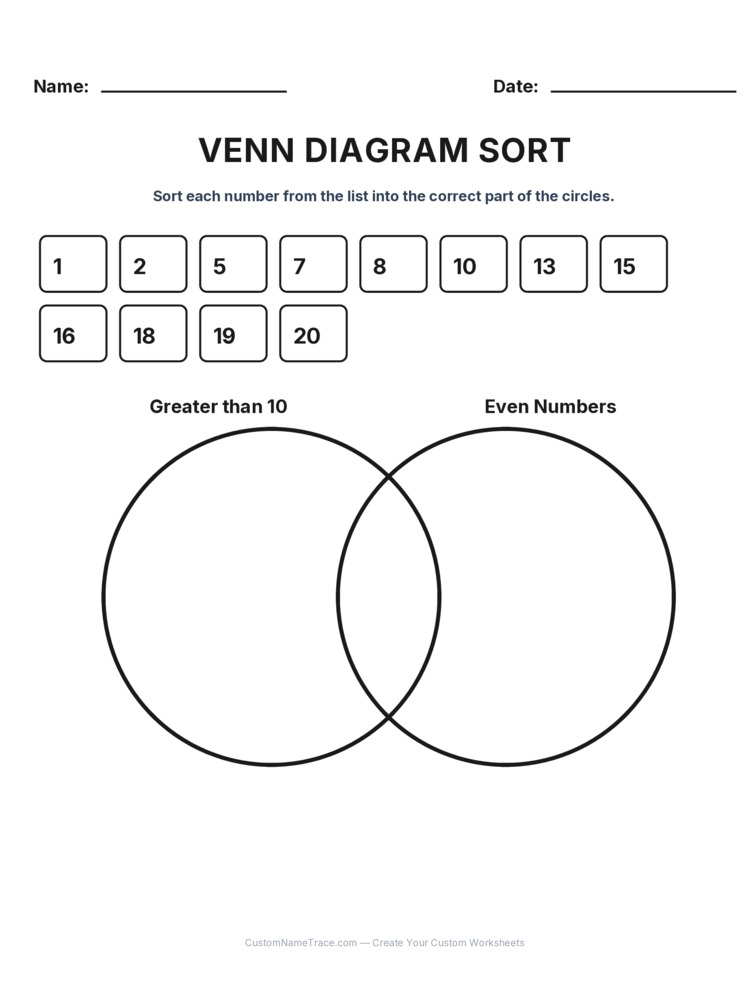
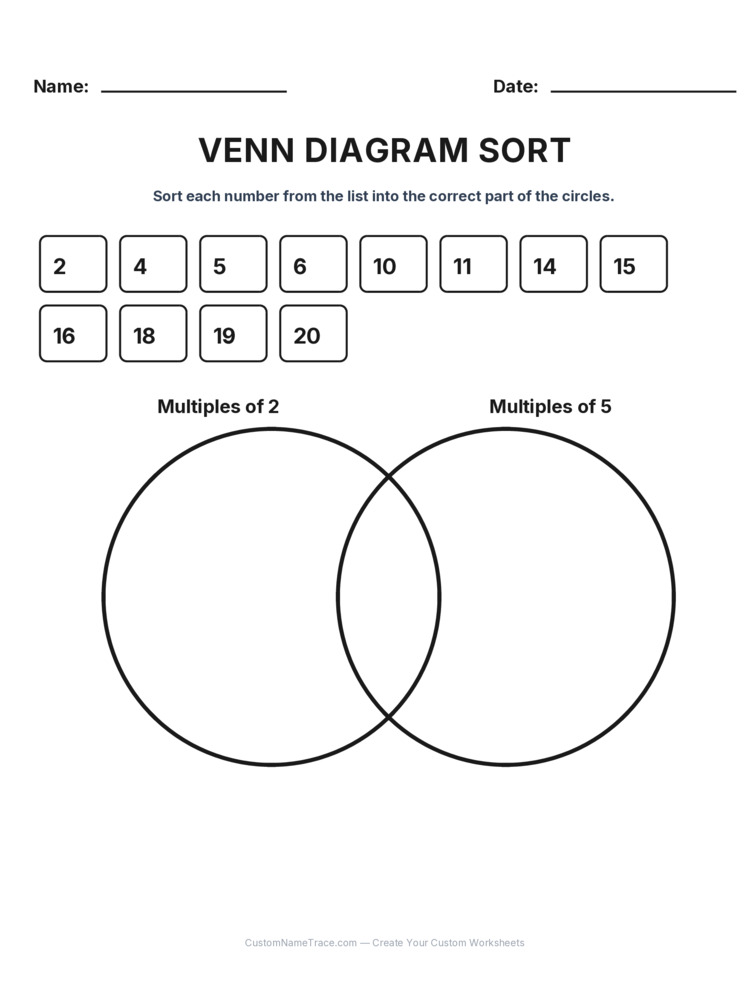
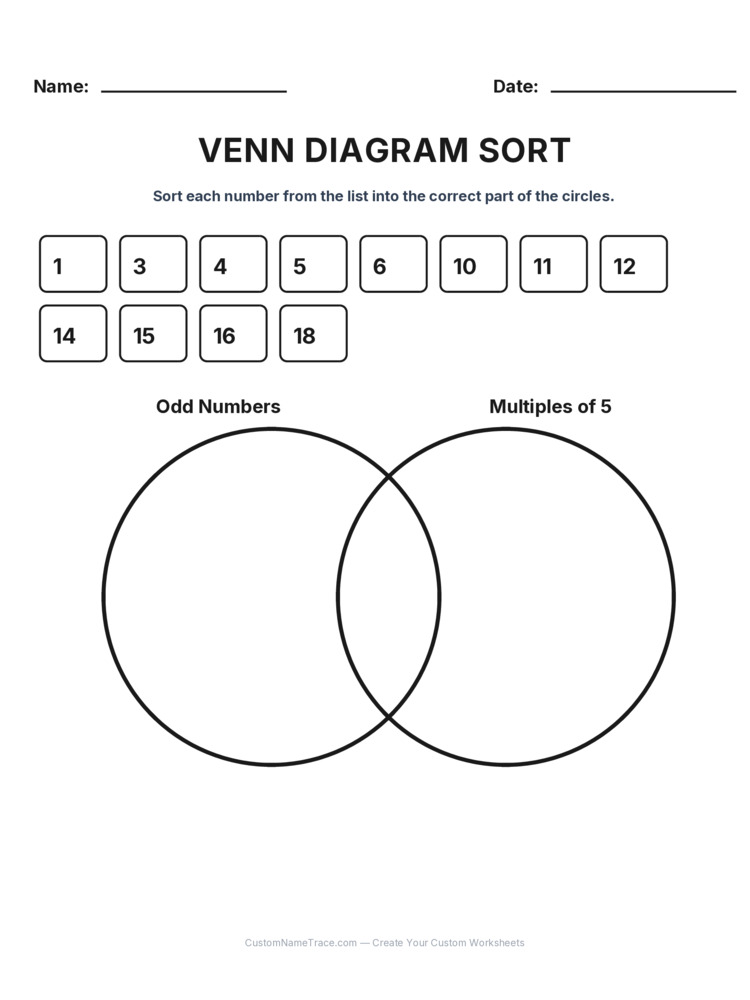
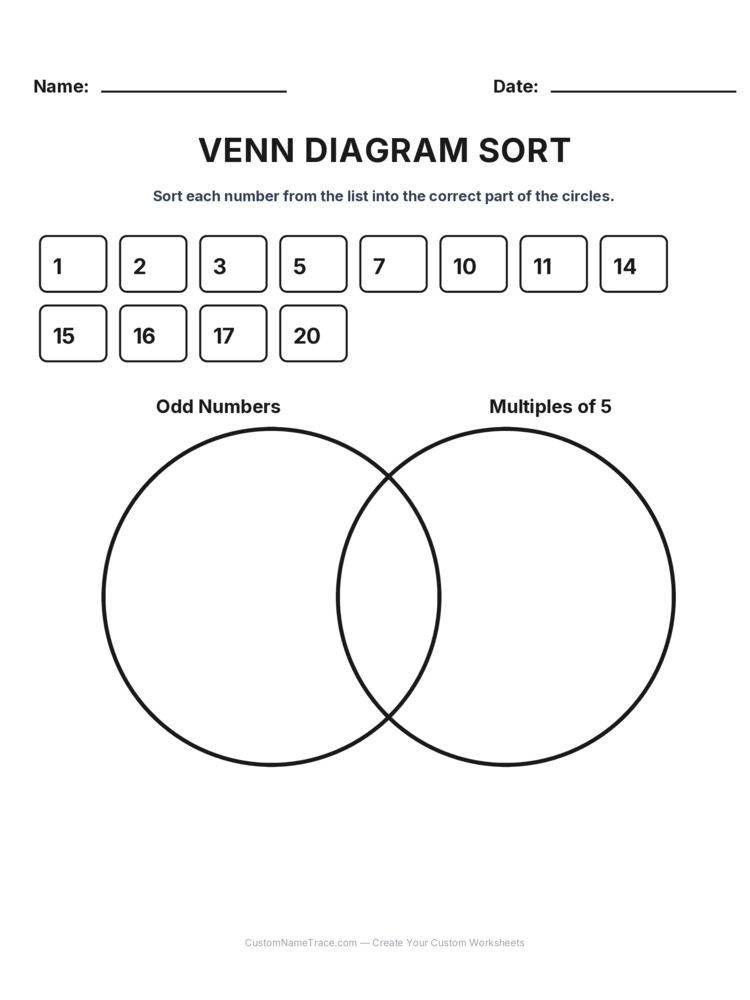
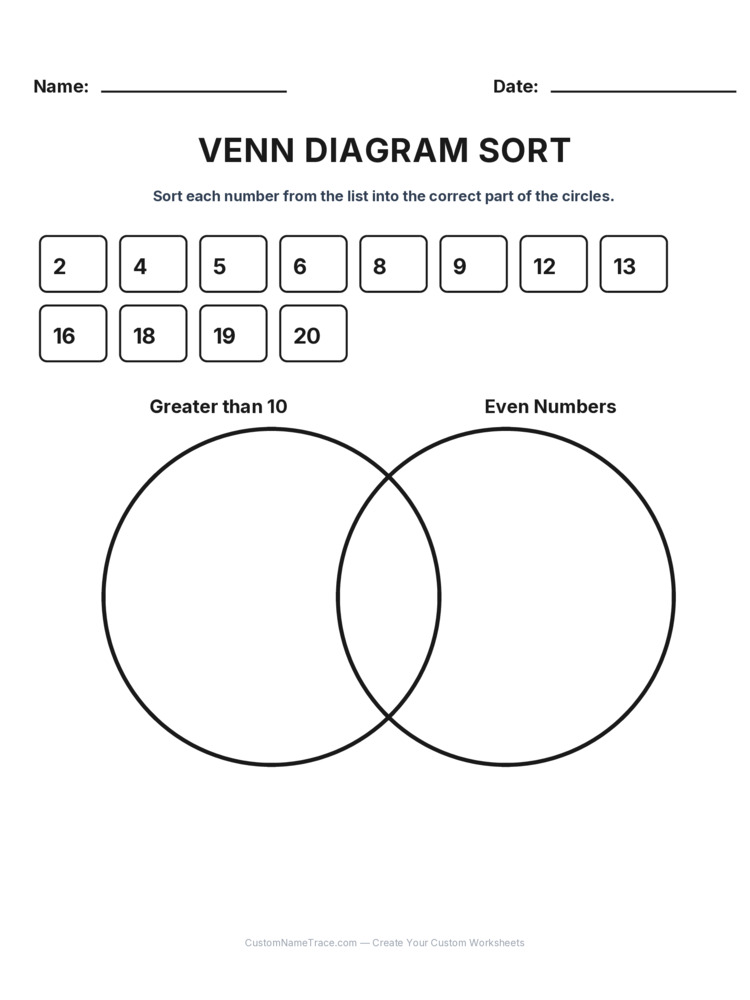
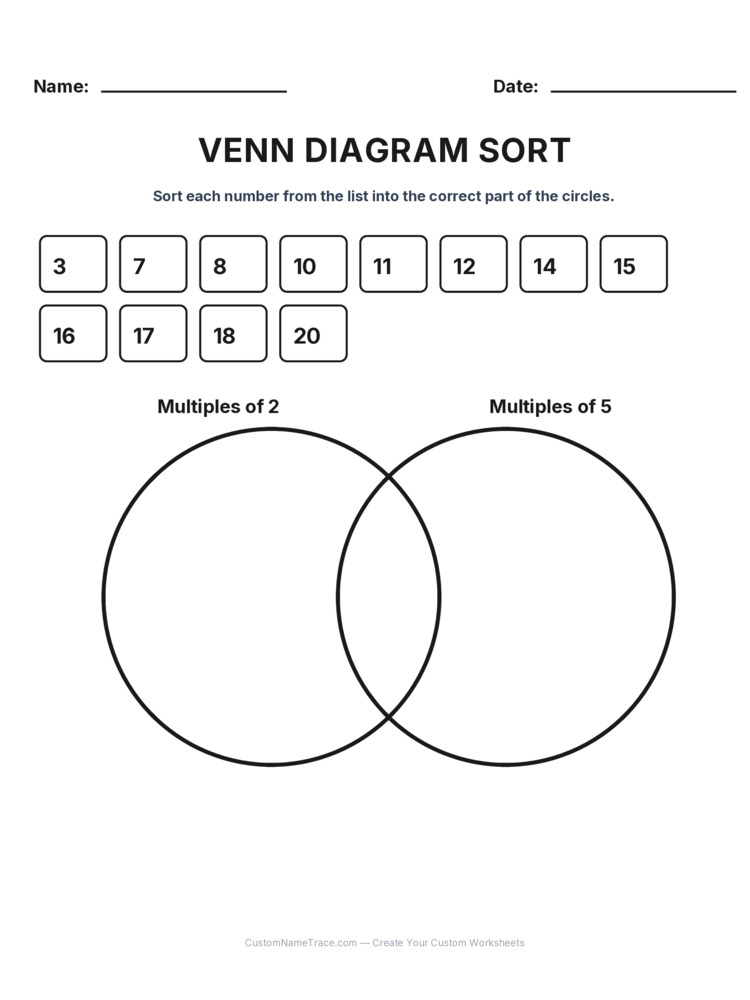
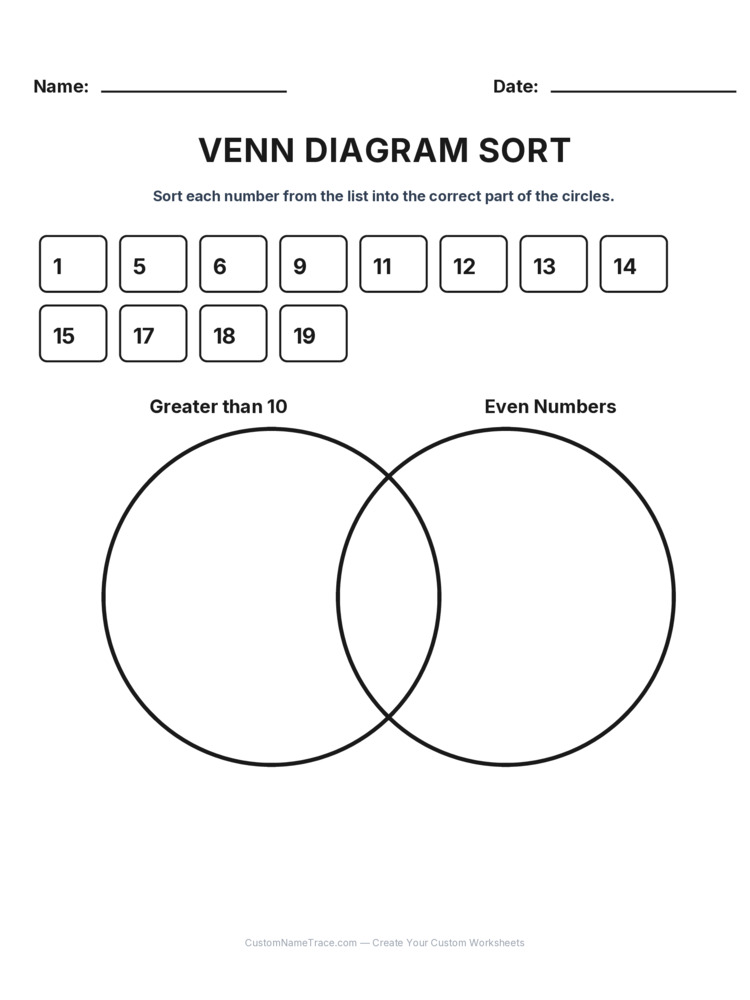
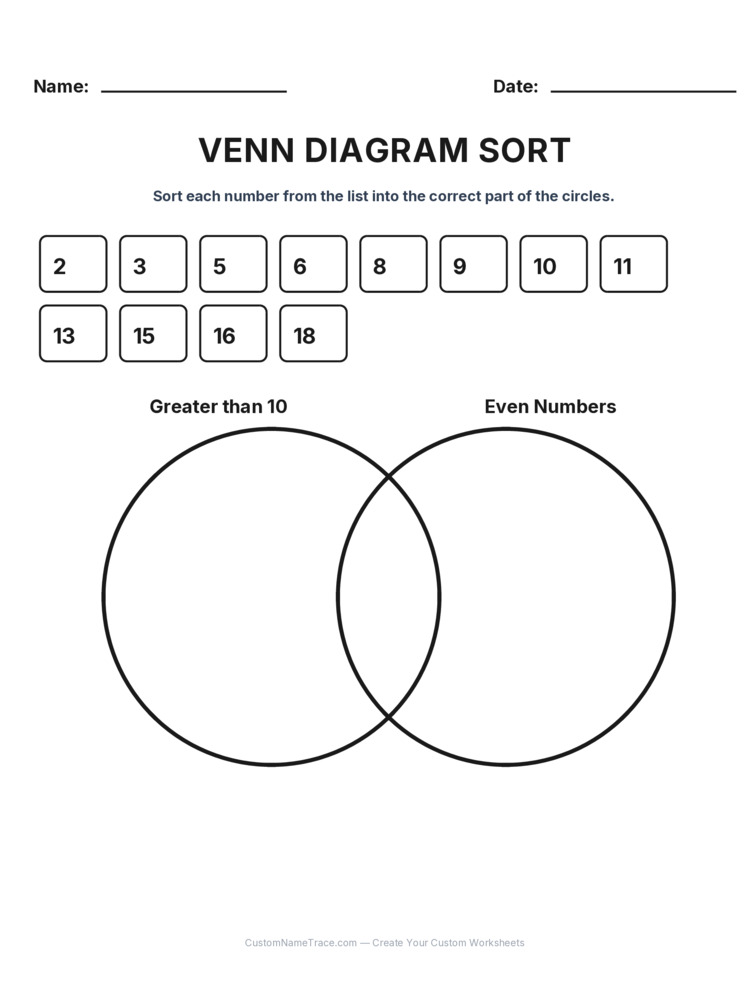
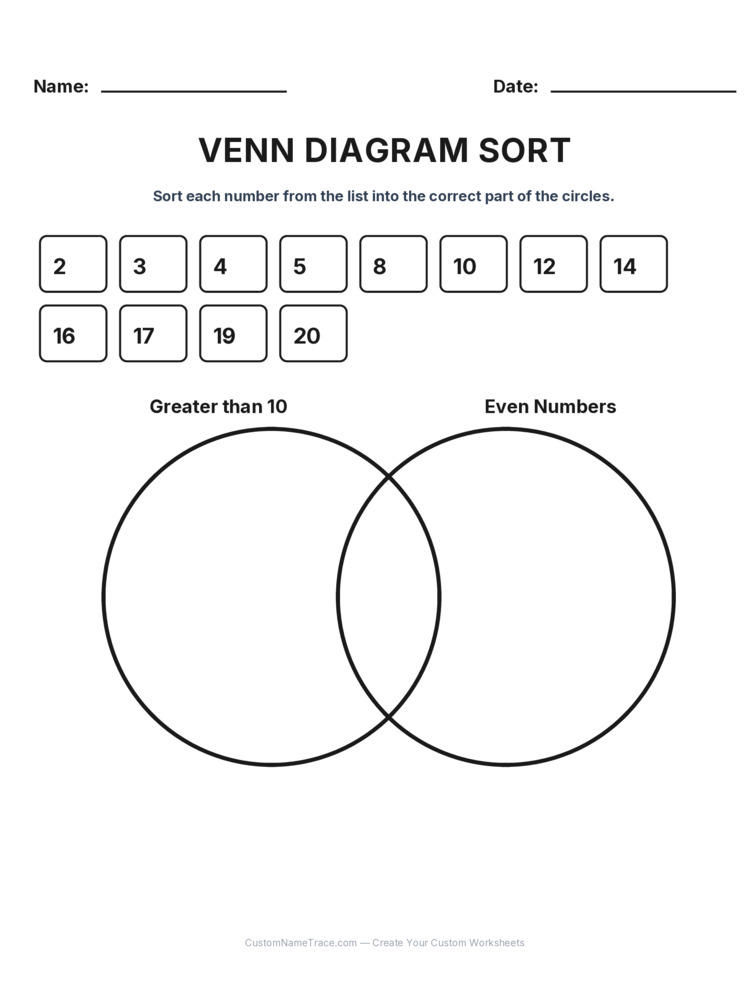
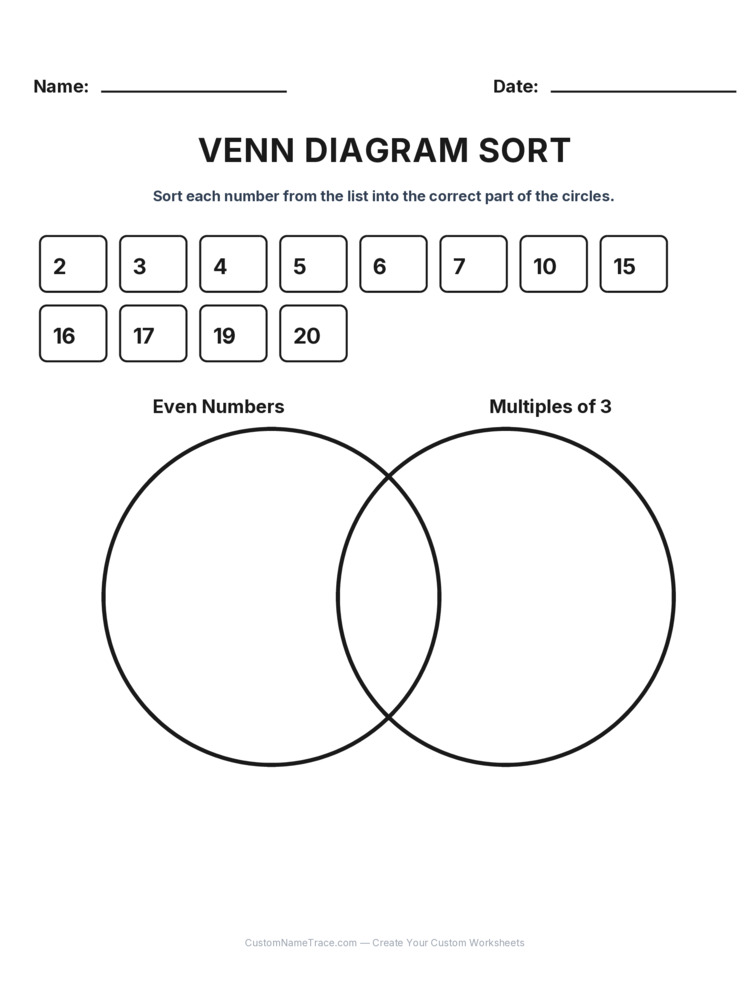
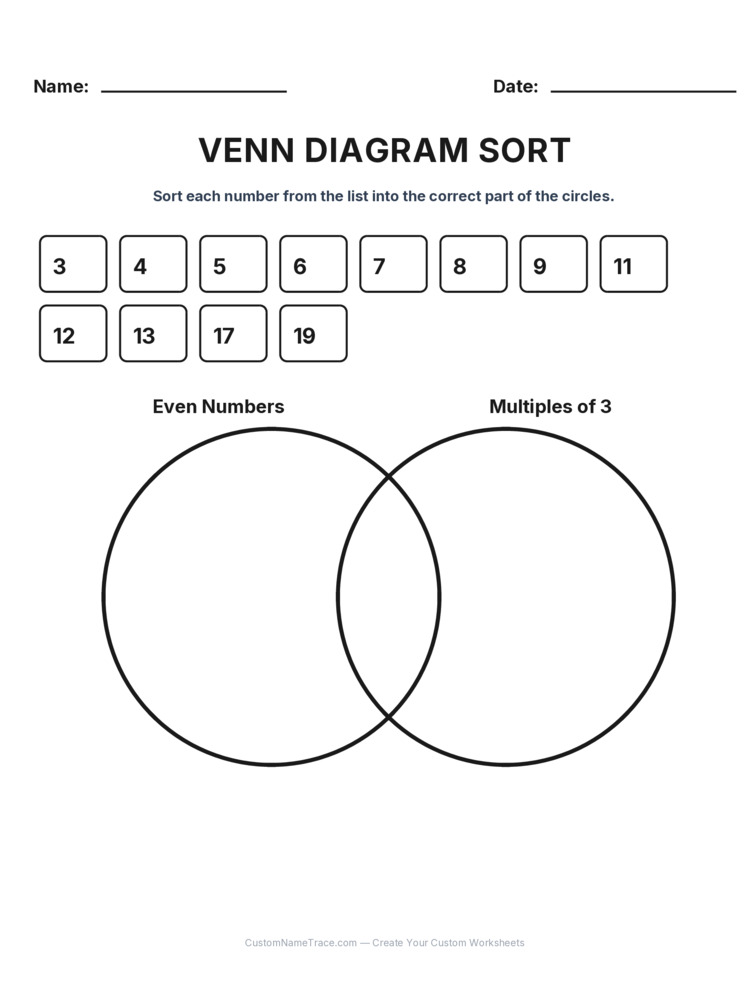
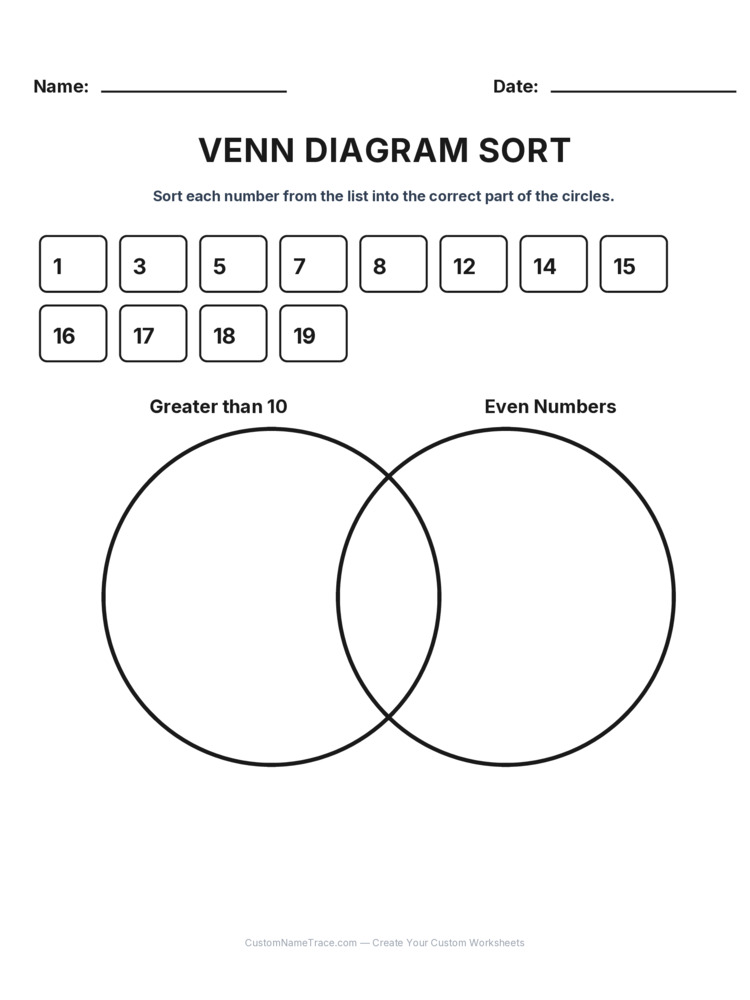
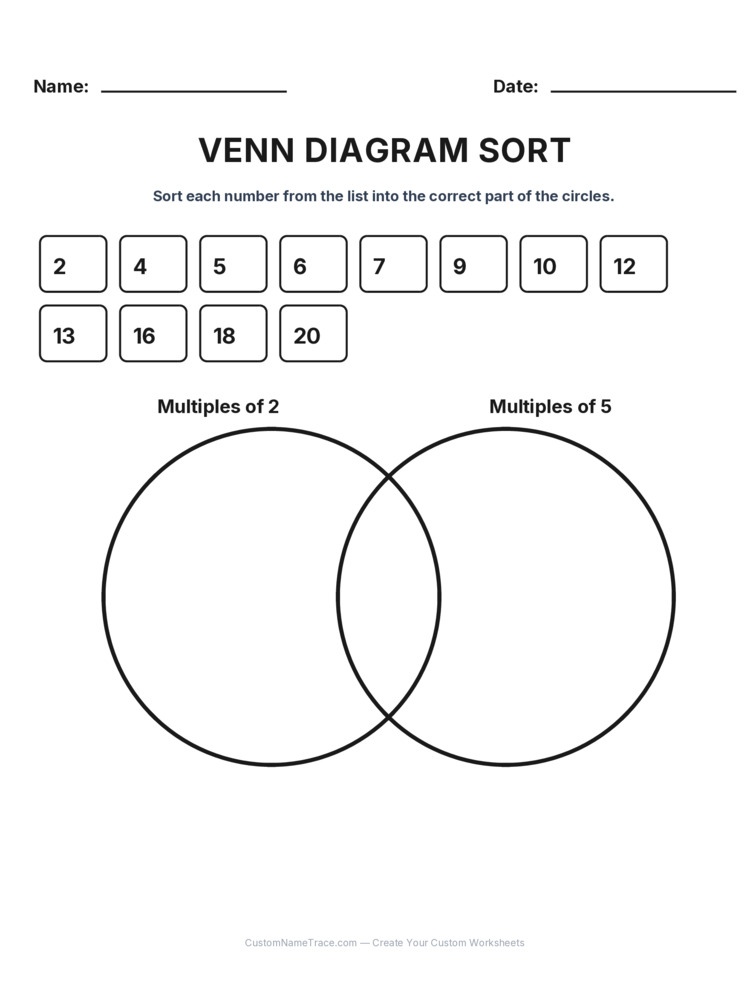
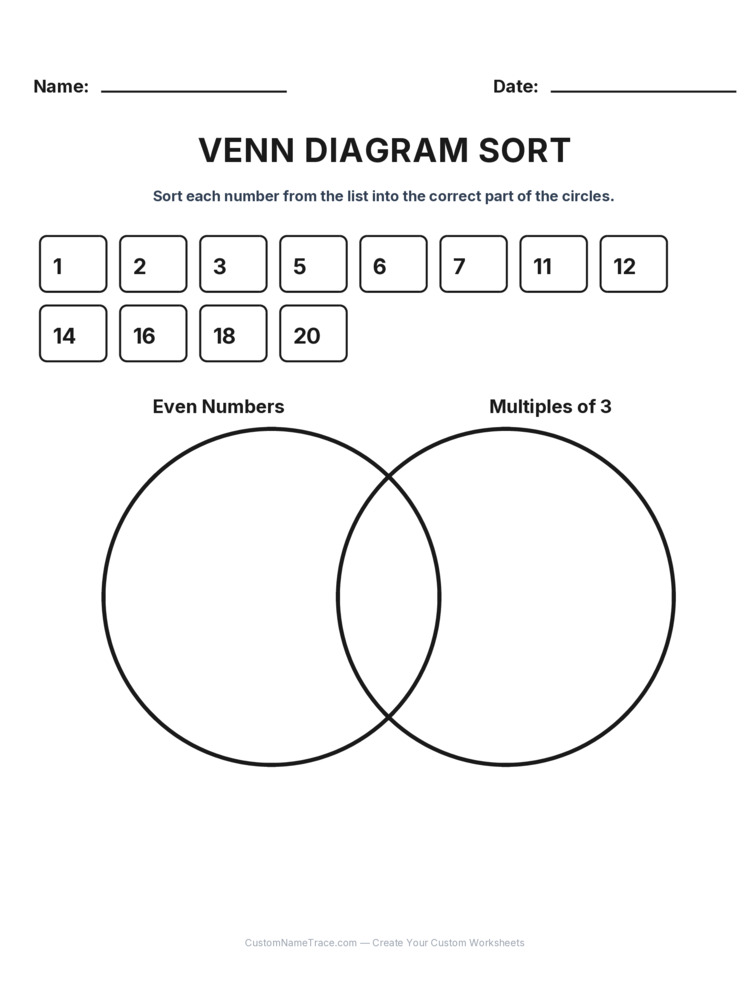
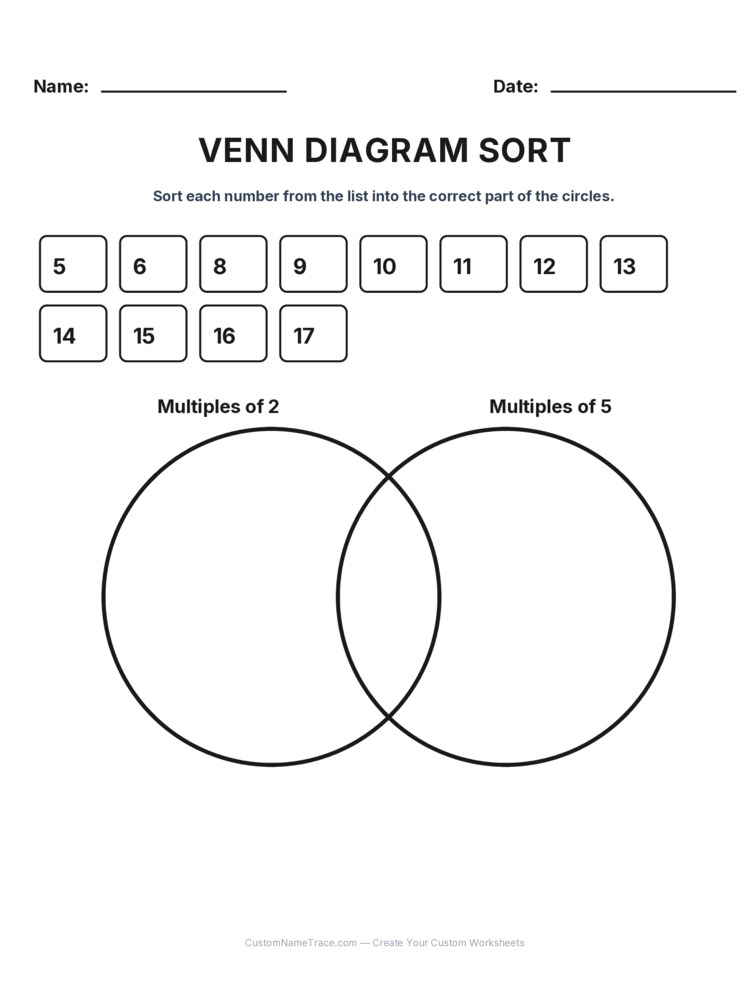
Two rules, four possible outcomes
Two overlapping circles are each labeled with a different number rule — for example, "Odd Numbers" in one circle and "Multiples of 5" in the other — and a word bank of numbers below has to be sorted into the correct region: one circle alone, the other circle alone, the overlapping middle for numbers that satisfy both rules at once, or entirely outside both circles for numbers that satisfy neither. That's four genuinely different outcomes to check for every single number, not a simple yes-or-no sort, which makes this the most complete test of multi-rule reasoning anywhere in this site's Logic Worksheets section.
Sorting a number that clearly fits only one rule, or clearly fits neither, is relatively straightforward. The genuine difficulty sits with numbers that satisfy both rules simultaneously — 15, for instance, is both odd and a multiple of 5 — and correctly recognizing that such a number belongs in the shared middle region, not in either circle alone, is exactly the skill this puzzle is built around. Missing the overlap is the single most common and most instructive mistake a child makes here.
Some numbers in the word bank satisfy neither rule and belong outside both circles entirely — genuinely part of the diagram, not a trick or leftover case to ignore. Recognizing when neither condition applies, and being confident placing a number outside both circles rather than forcing it into one because every number "has to go somewhere," is as much a part of correct sorting here as identifying the numbers that do fit one rule or the other.
A method that prevents the most common mistake
For every number in the word bank, checking it against both circle rules explicitly — "is it odd? is it a multiple of 5?" — before deciding where it goes prevents the overlap from being missed. A child who checks only the first rule and stops as soon as they find a match will correctly identify circle membership but will systematically miscategorize every number that belongs in the overlap, placing it in just one circle instead of the shared middle.
The habit that separates a correct sort from one that misses the overlap is continuing to check the second rule even after confirming the first one is satisfied — a child who stops checking as soon as they find one true condition will systematically place every overlap number into just one circle. Explicitly teaching "don't stop at the first yes, check the second question too, every time" is the single highest-leverage tip for this specific puzzle.
Building the concept step by step
For a child who's never sorted by two rules before, starting with a single circle and a single rule — sort the word bank into "in" or "out" of just one condition — before introducing the second overlapping circle isolates the sorting mechanic from the two-rule complexity, so each piece can be learned on its own before being combined. Once single-rule sorting feels automatic, adding the second circle back in tends to go far more smoothly than introducing both rules at once.
Two overlapping hula hoops or pieces of string on the floor, labeled with two simple rules (for example, "red things" and "round things"), and a pile of household objects to sort makes the overlap concept tangible in a way a printed circle sometimes isn't — a red ball physically has to be placed in the overlapping middle of both hoops, which is a harder spot to argue with than a line on paper. This hands-on version is worth trying before the printed worksheet for a child encountering the overlap idea for the first time.
The same overlapping-circles logic used here to sort numbers applies directly to sorting anything by two independent properties — students who play soccer versus students who play piano, animals that live in water versus animals that have fur. Pointing out a real, familiar example of an overlap (a student who does both soccer and piano) after finishing the numeric worksheet helps a child see the sorting skill as a general tool, not something that only applies to numbers on a page.
How these puzzles are built
The two number rules and the range of numbers in the word bank are matched to Grade 3's level — using number concepts (odd/even, multiples, ranges) already familiar at this stage, so the challenge sits entirely in the two-rule sorting logic itself rather than in unfamiliar math. As this puzzle appears at other points in this site's progression, the rules used become less immediately obvious, deepening the same sorting skill rather than introducing an unrelated one.
The two number rules used on any given Venn Diagram Sort worksheet are always chosen so that a genuinely interesting overlap exists — some numbers really do satisfy both conditions, and some really do satisfy neither — rather than picking two rules that happen to never intersect or always coincide. That deliberate design means a child working through this puzzle is always practicing the full four-outcome reasoning this page describes, never a simplified version where the overlap region turns out to be empty or the "neither" region never gets used.
The numbers a child sorts are always given as a fixed word bank rather than left open-ended, which keeps the exercise focused on classification rather than turning into a separate exercise in generating numbers that satisfy a rule. Every number in the bank is deliberately placed to land in one of the four possible regions — genuinely testing all four outcomes across the page — rather than being randomly chosen and possibly clustering into just one or two regions by chance, which would make the puzzle a much weaker test of the full sorting logic.
Every number in the word bank is used exactly once across the whole diagram — none are left over unused, and none need to be placed twice — so a completed sort should account for every single number given, which is a quick, reliable way to check a finished page is genuinely complete rather than partially done.
Where this leads
Grade 2's Complete the Pattern grid also combines two rules, but only ever has to satisfy both at once for a single missing cell. Venn Diagram Sort asks a child to apply the same two-rule checking across an entire list of numbers, correctly distinguishing all four possible outcomes for each one — a genuinely larger-scale version of the same underlying reasoning, appropriate for where it sits later in the grade progression.
Once a diagram is fully sorted, asking a child questions about the result — "how many numbers satisfy both rules?" "are there more numbers in this circle or that one?" — turns the completed sort into a second round of reasoning rather than treating the worksheet as finished the moment every number has a spot. That follow-up conversation is where the sorting logic actually gets reinforced, since producing an answer and reflecting on what it shows are two different, complementary skills.
A child who sorts a Venn diagram confidently, correctly placing numbers in the overlap and outside both circles without needing a reminder to check the second rule, has built the exact multi-constraint habit Mini Sudoku requires — just applied there across three overlapping constraints instead of two. That's the natural next step within Grade 3's own puzzle set once this one feels solid.
Every numbered variant uses a fresh pair of rules and a fresh word bank testing the identical sorting logic, so repeat practice always means genuinely re-sorting rather than remembering where numbers went on a previous attempt. Print at full size so the circle regions — especially the overlapping middle — stay large enough to write numbers into clearly.