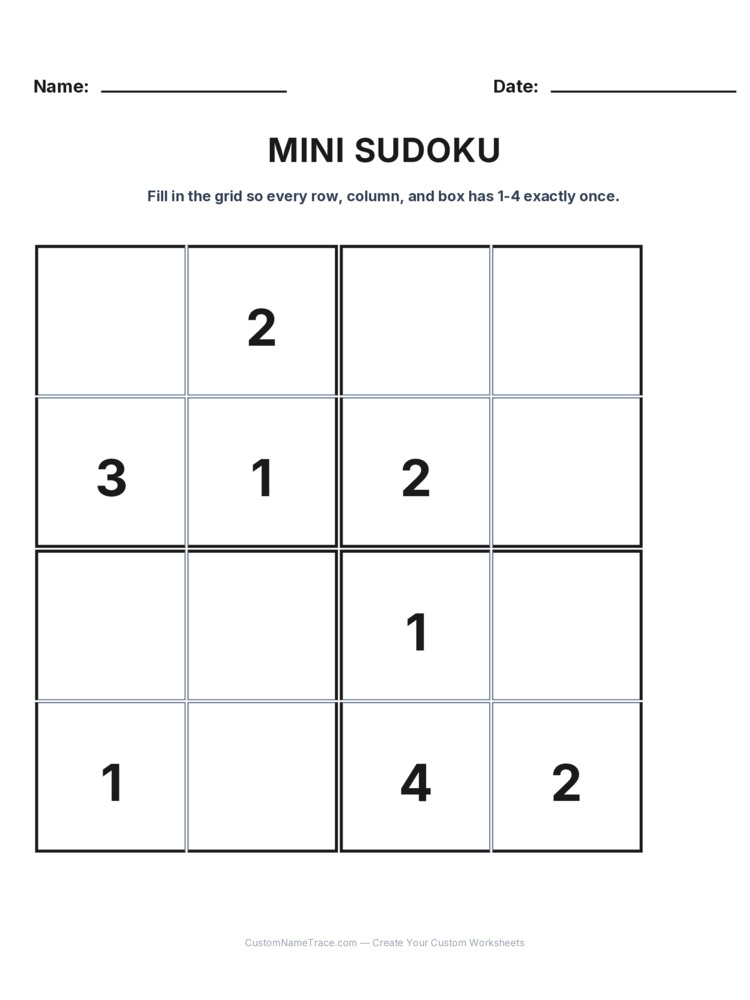
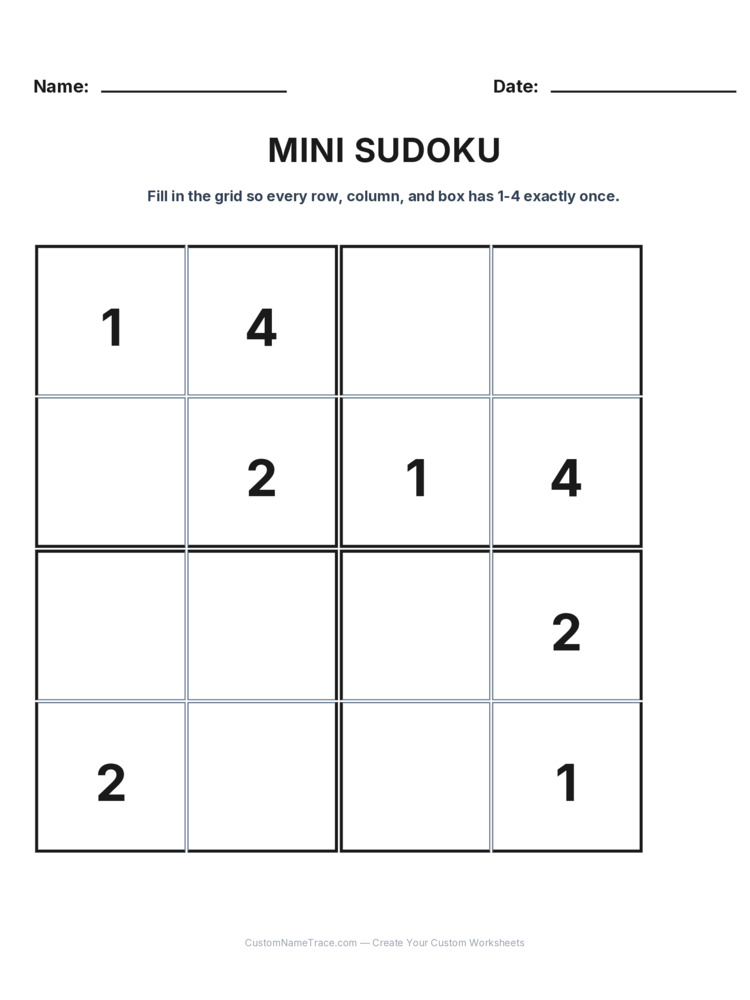
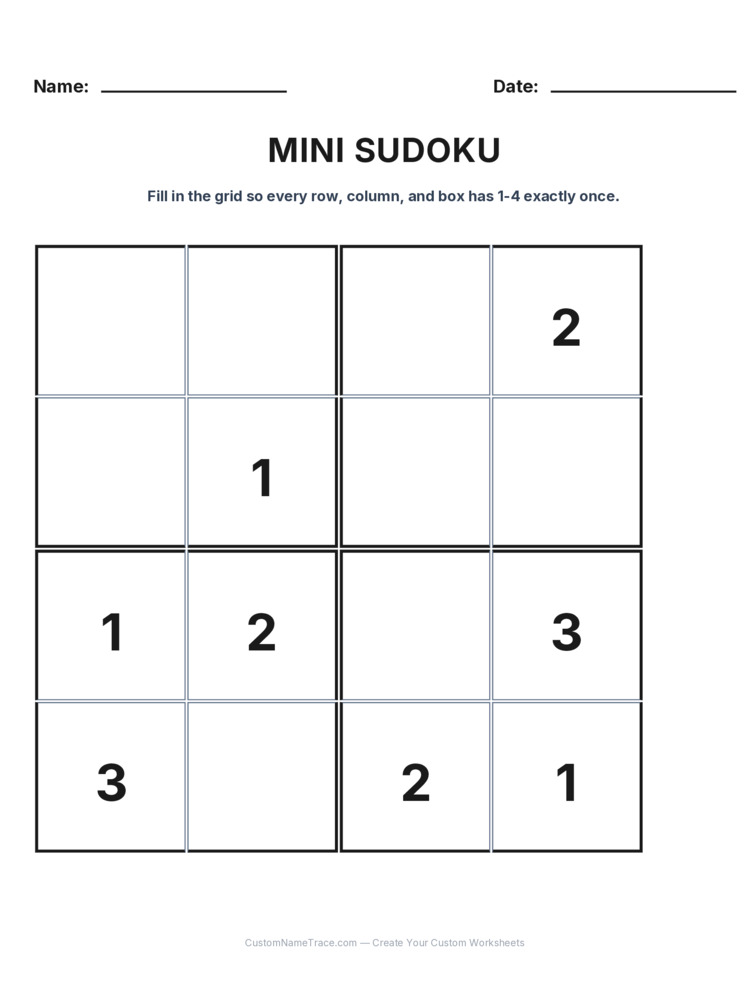
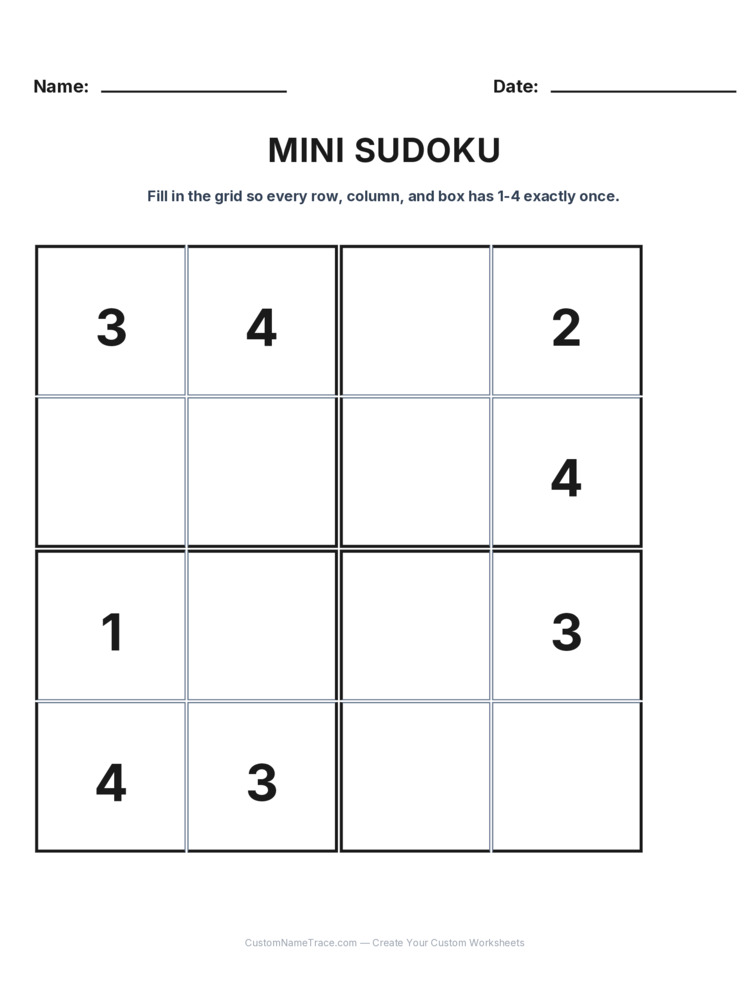
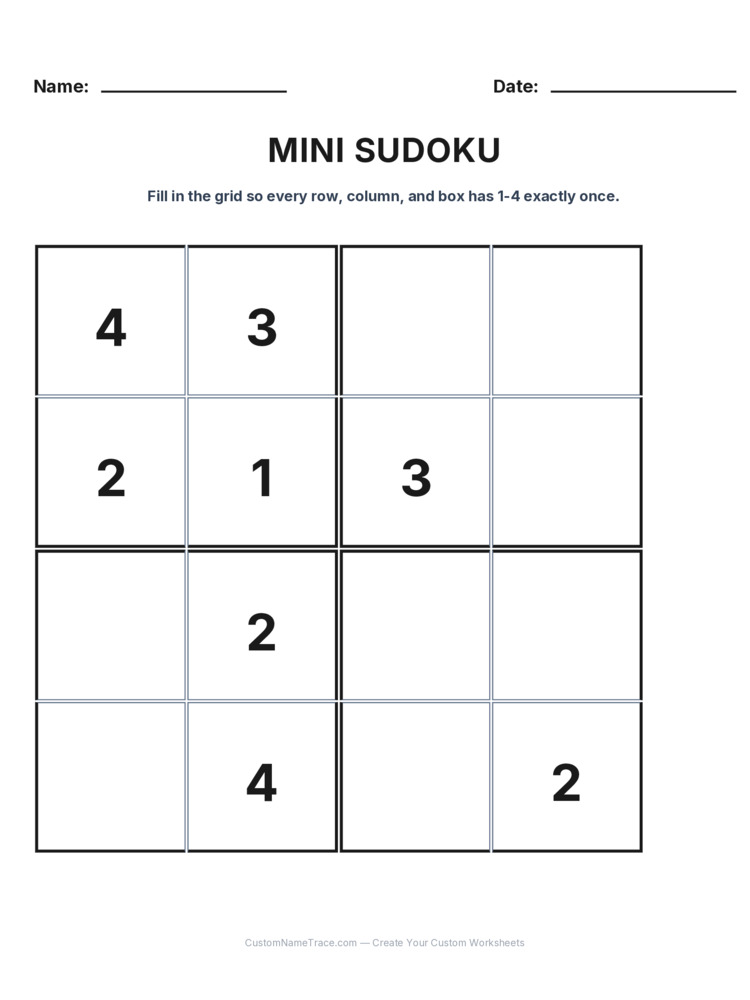
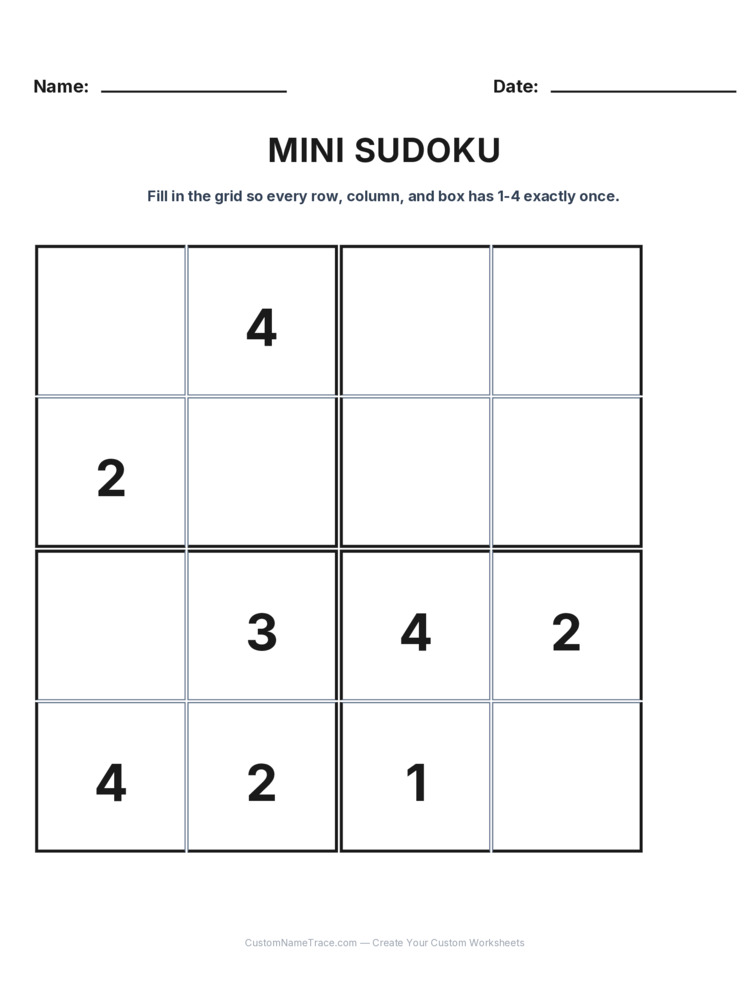
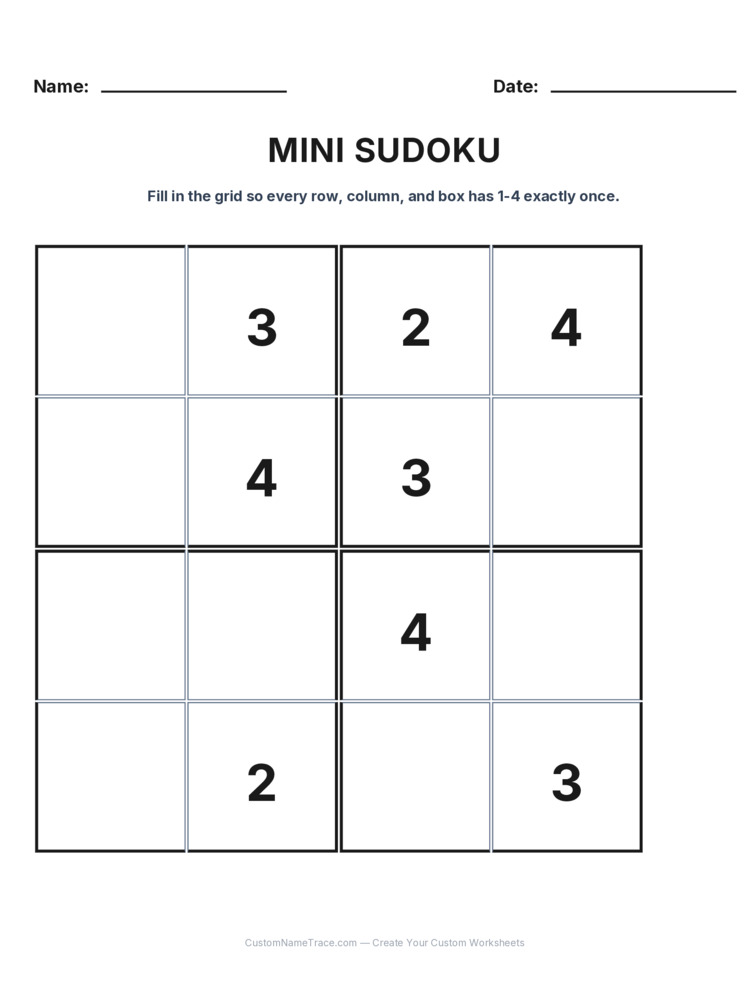
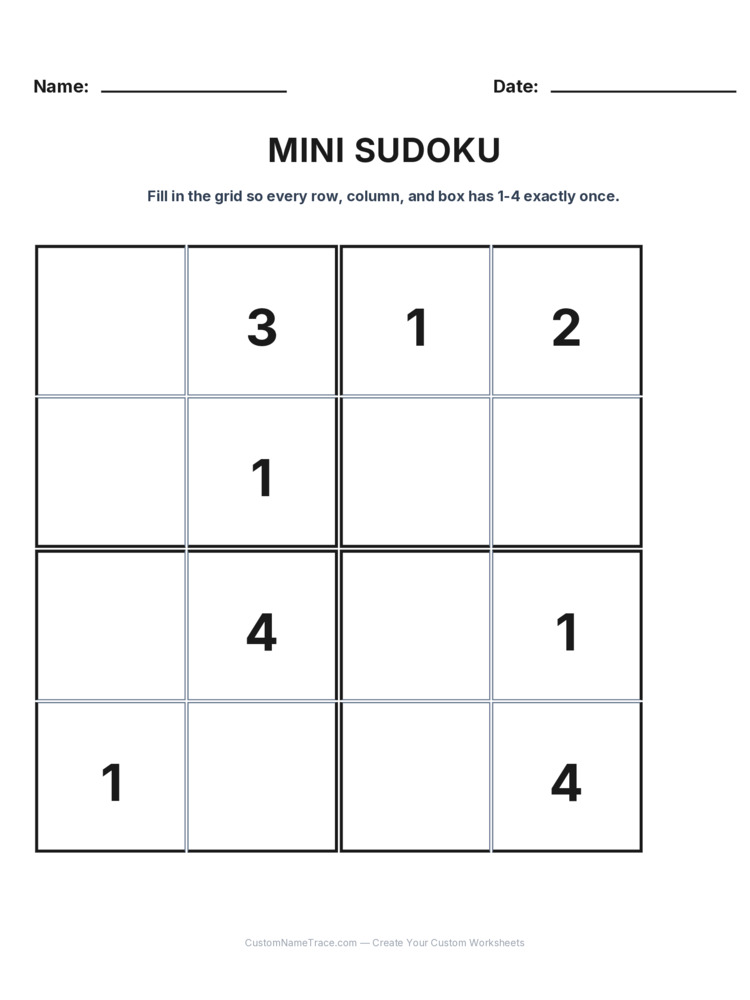
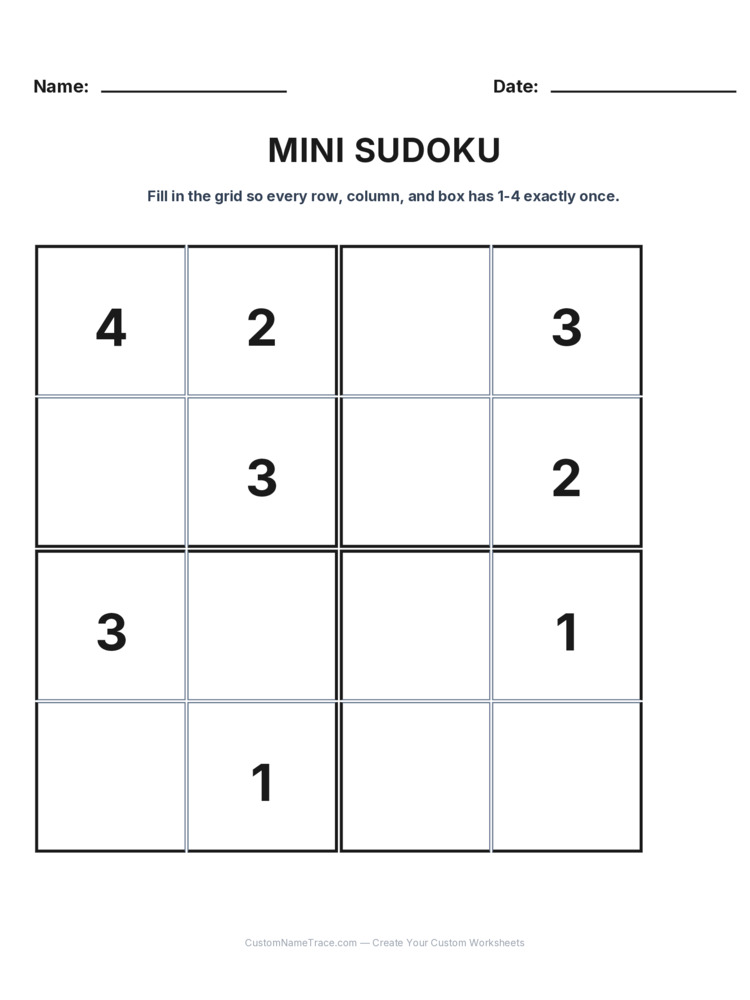
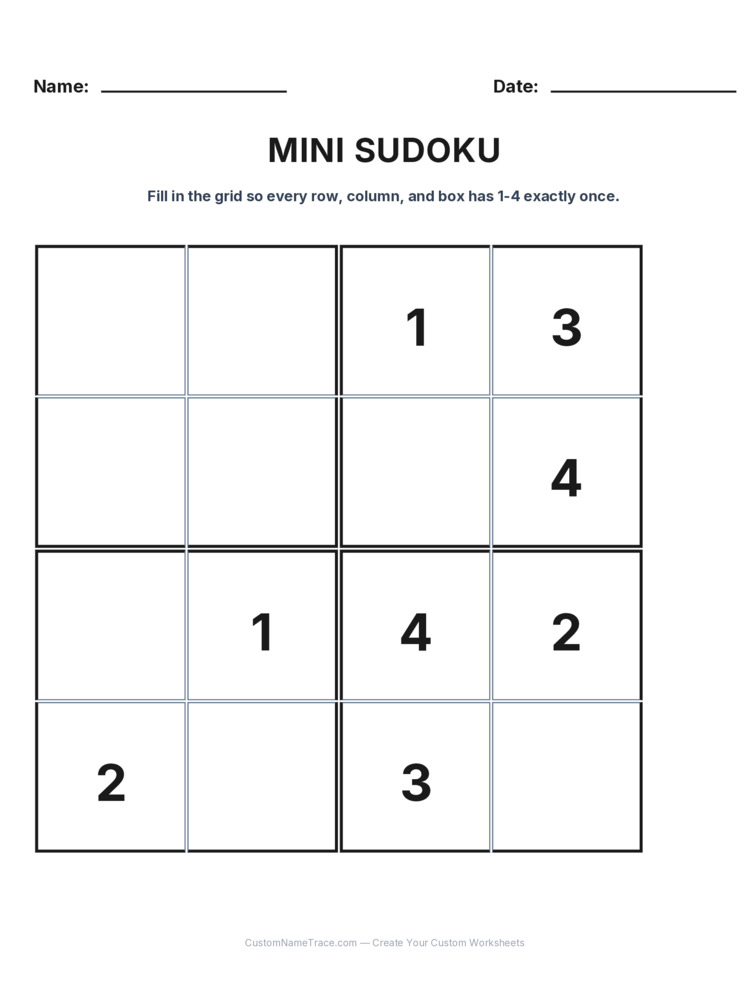
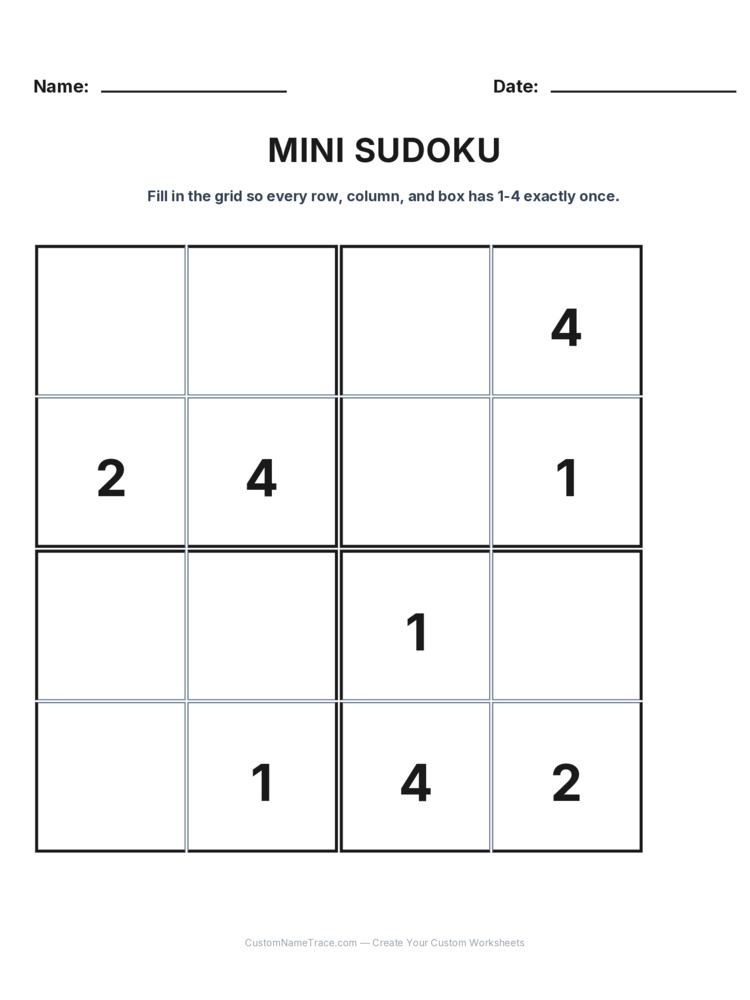
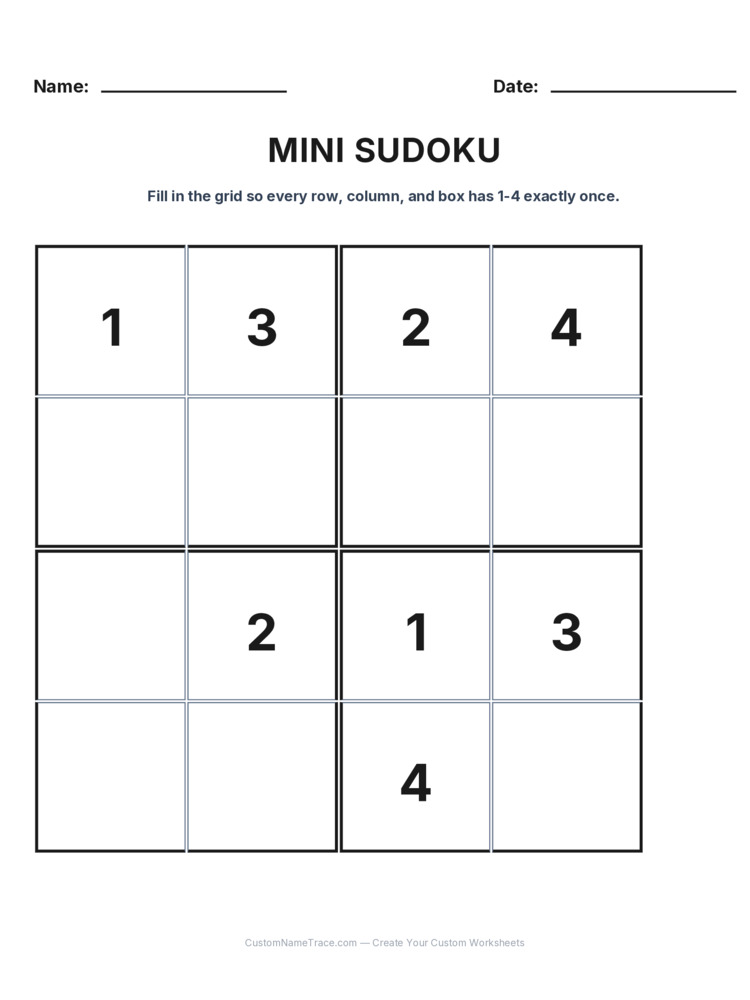
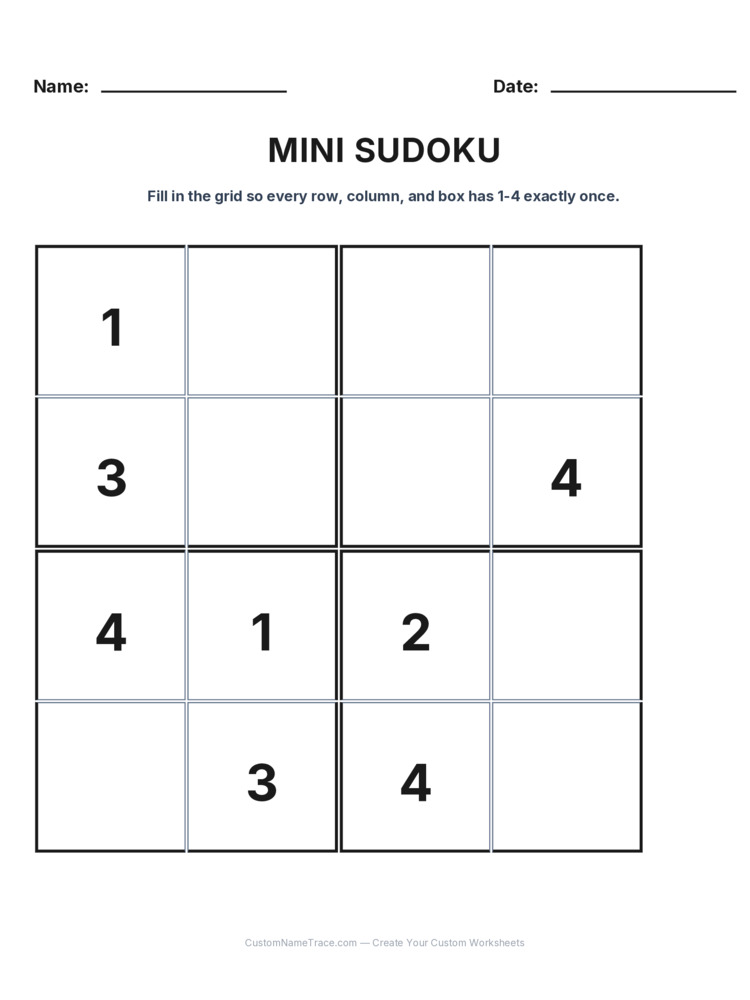
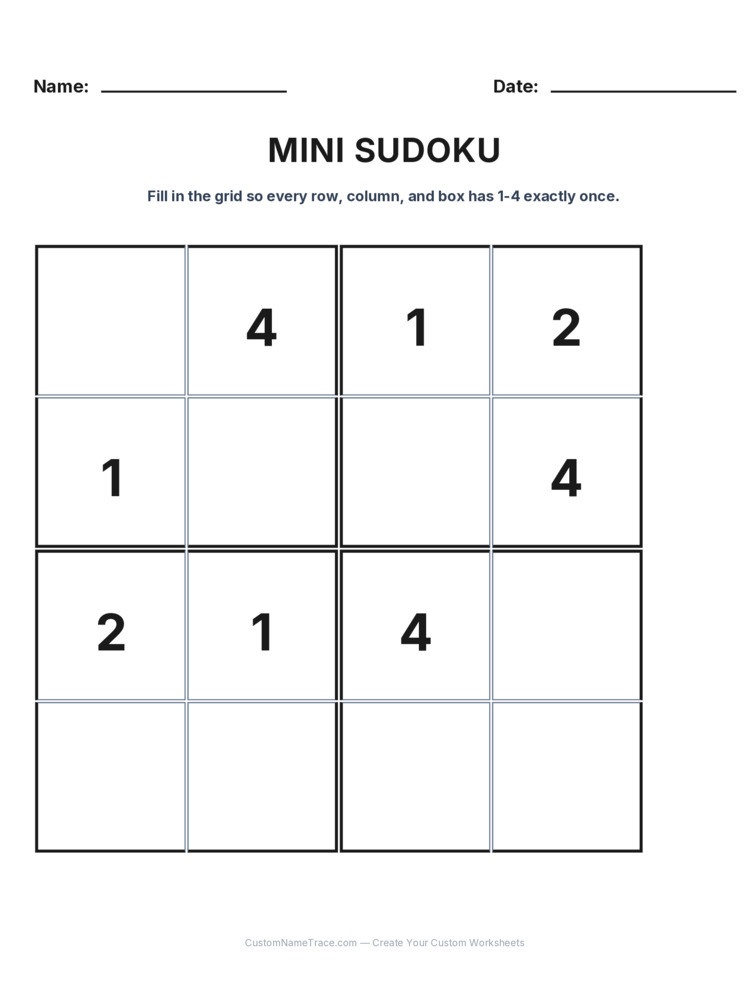
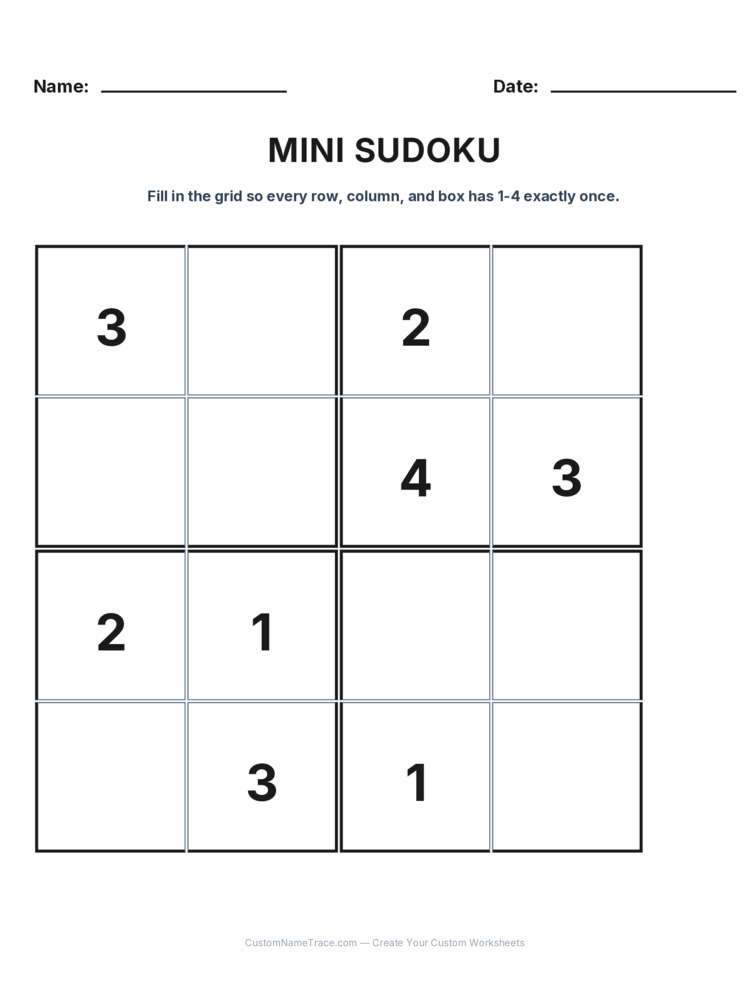
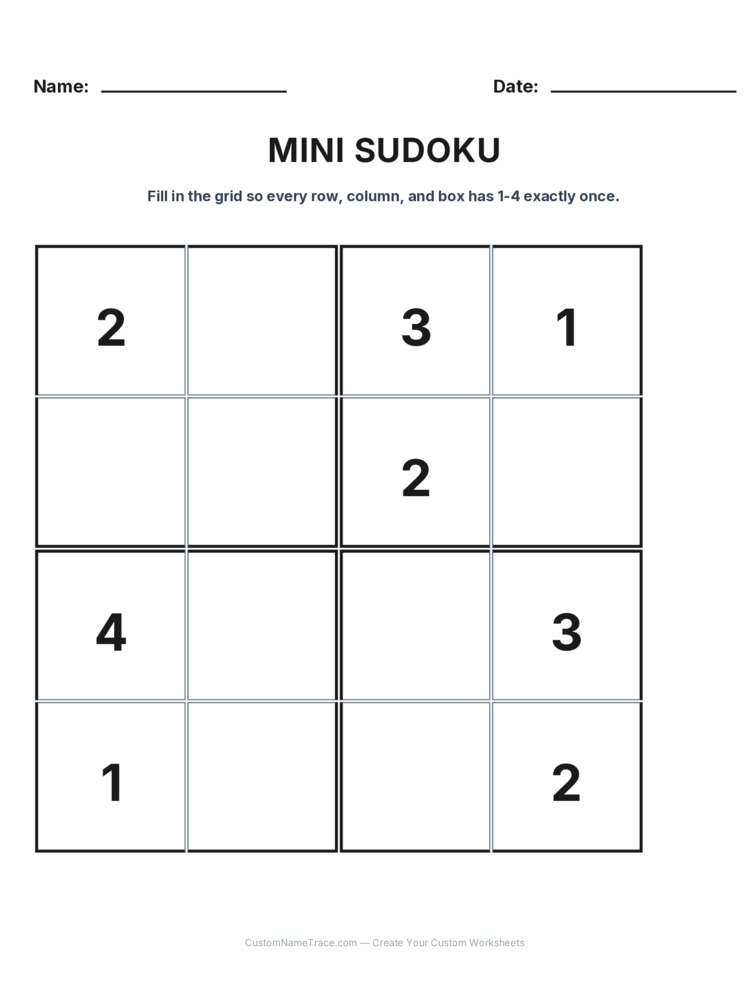
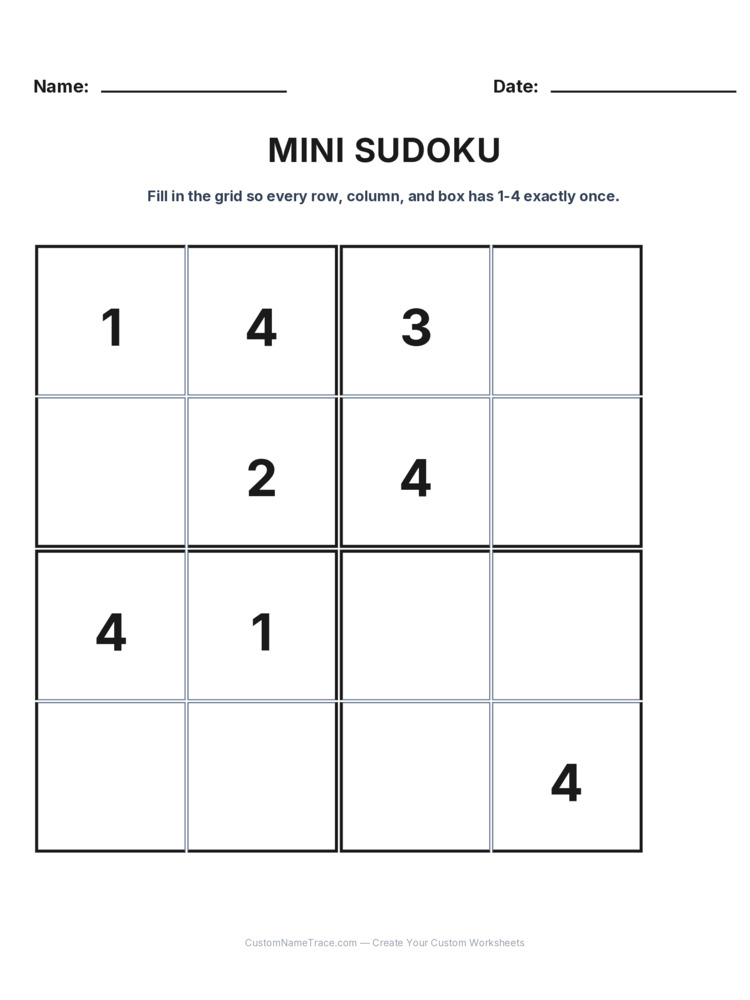
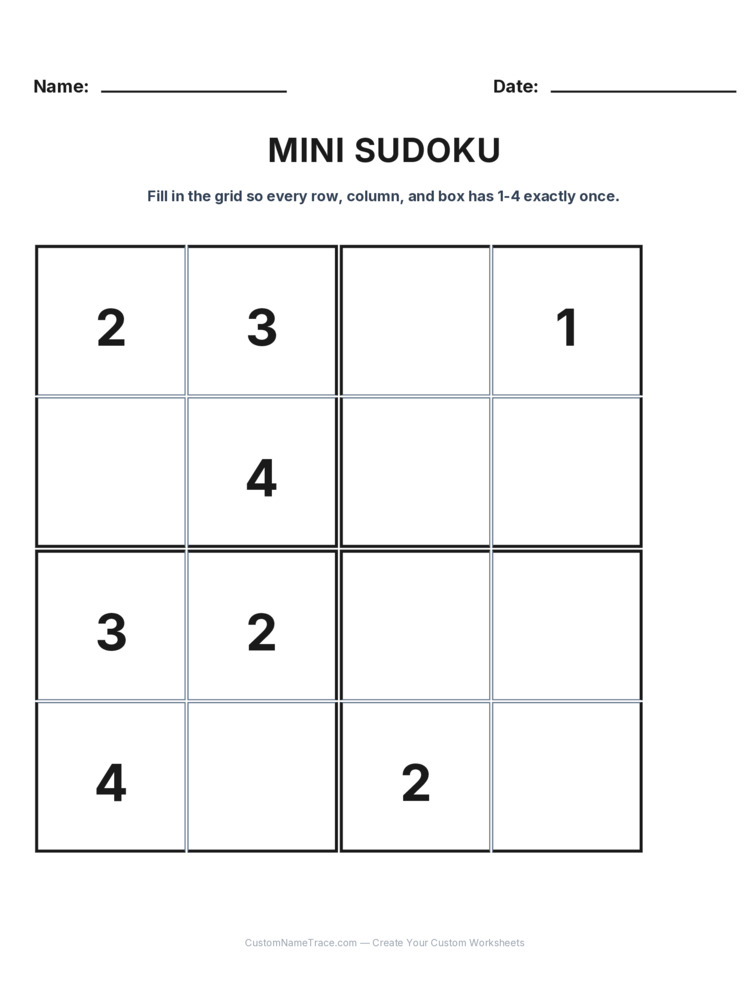
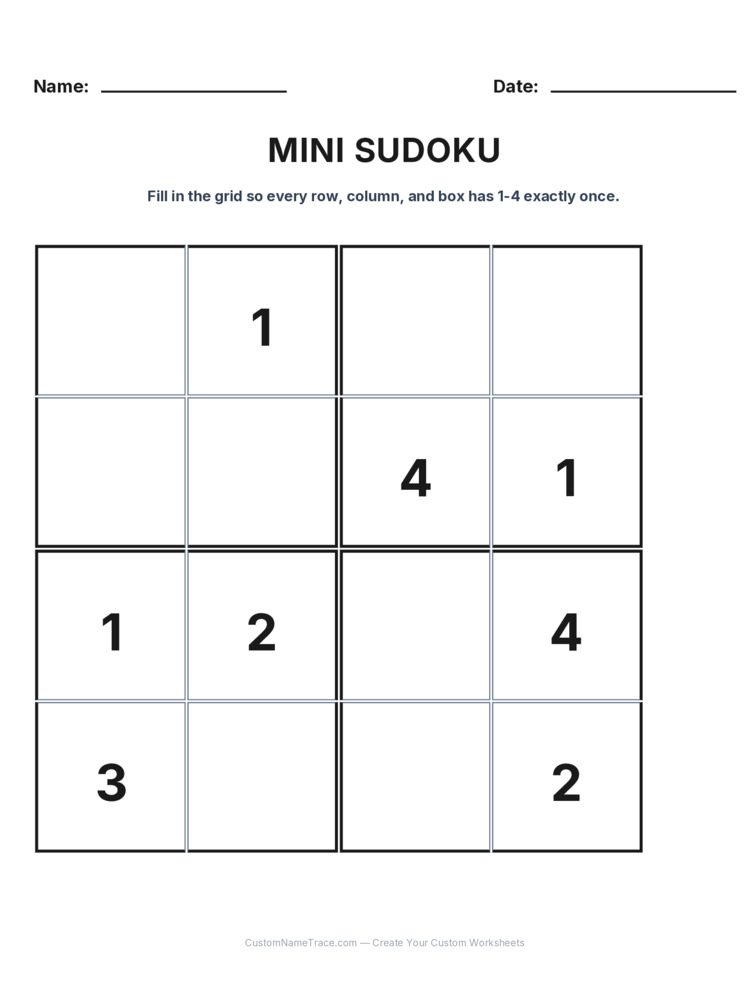
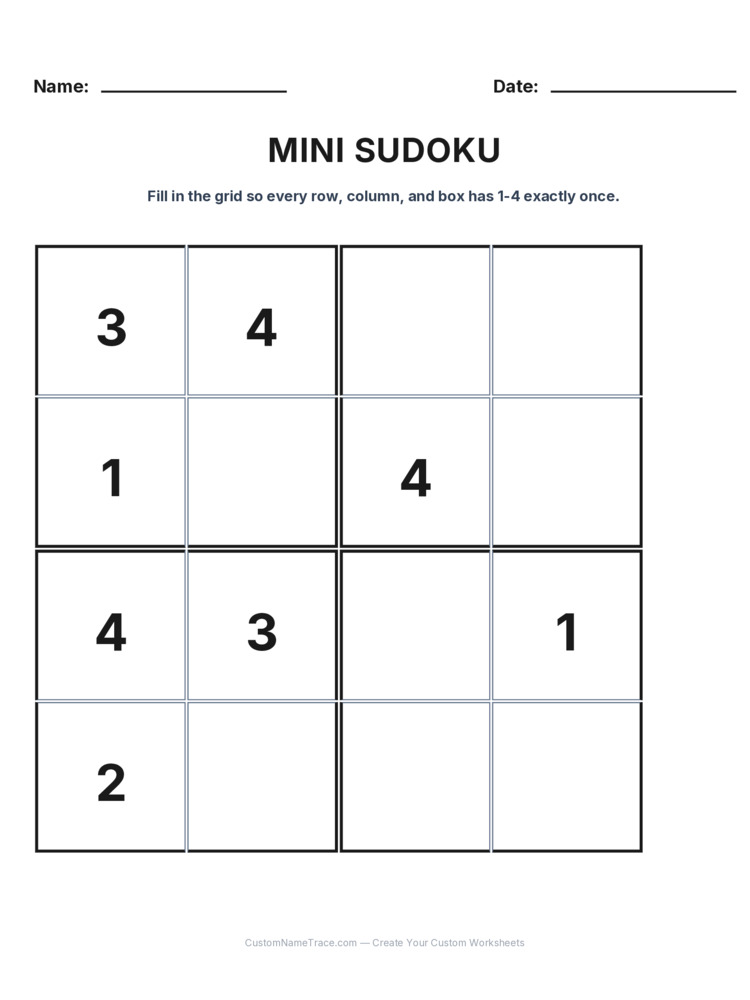
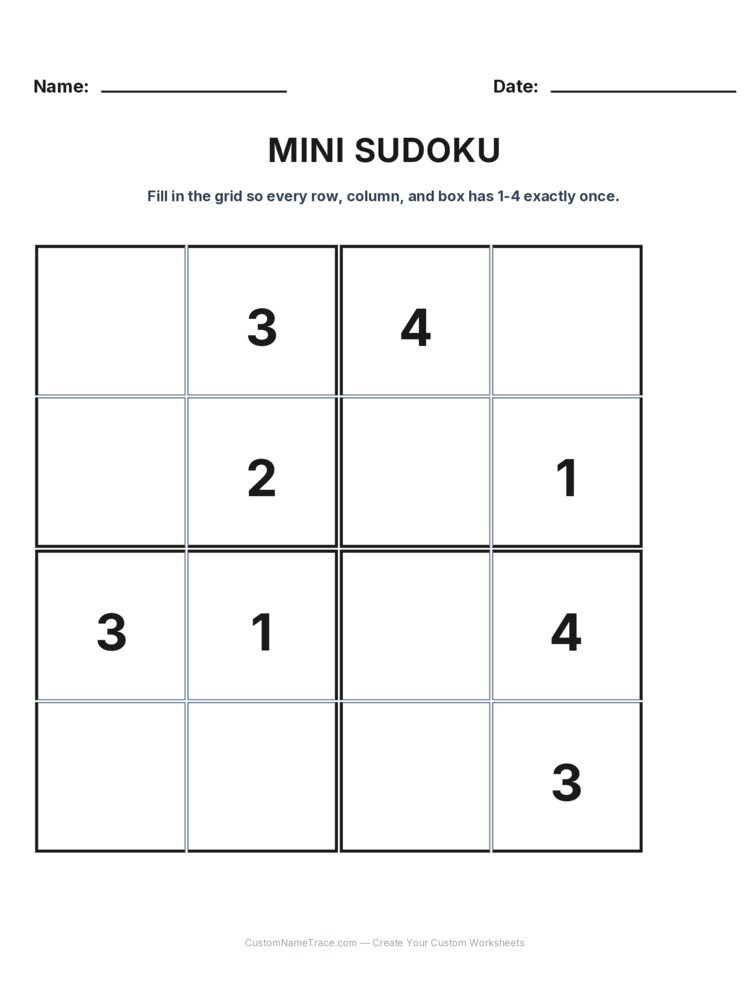
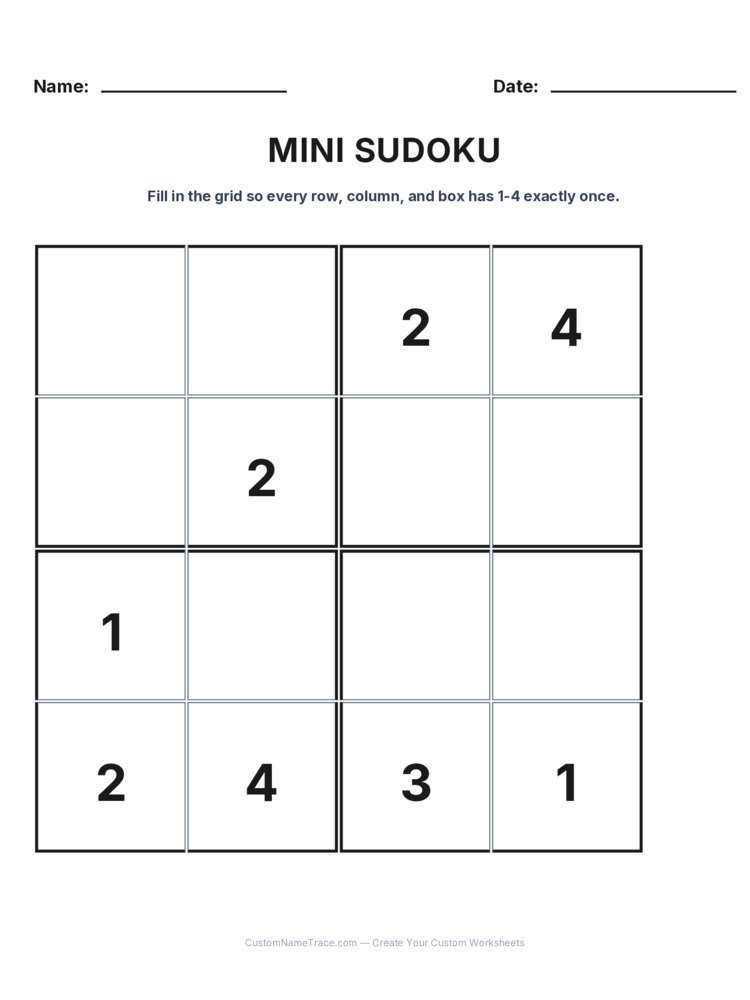
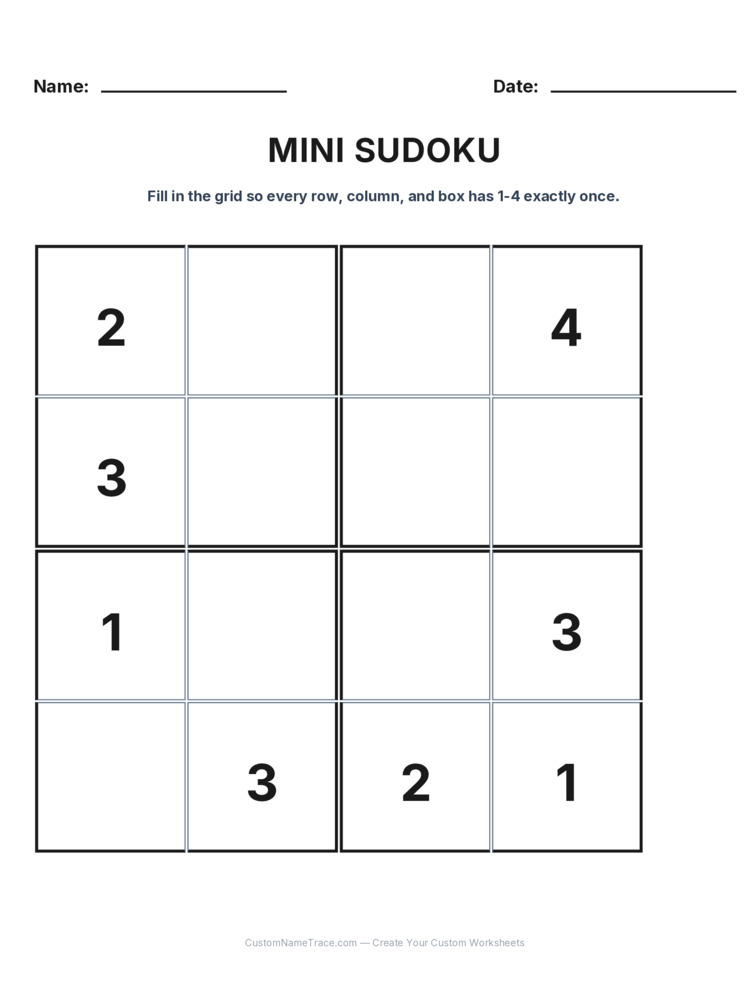
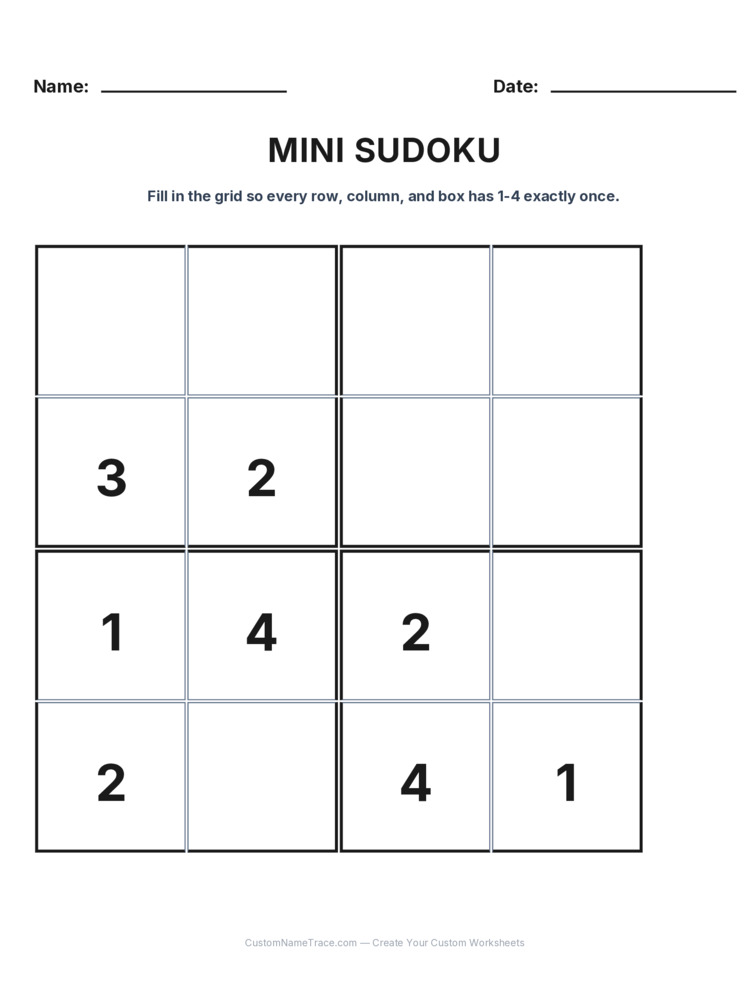
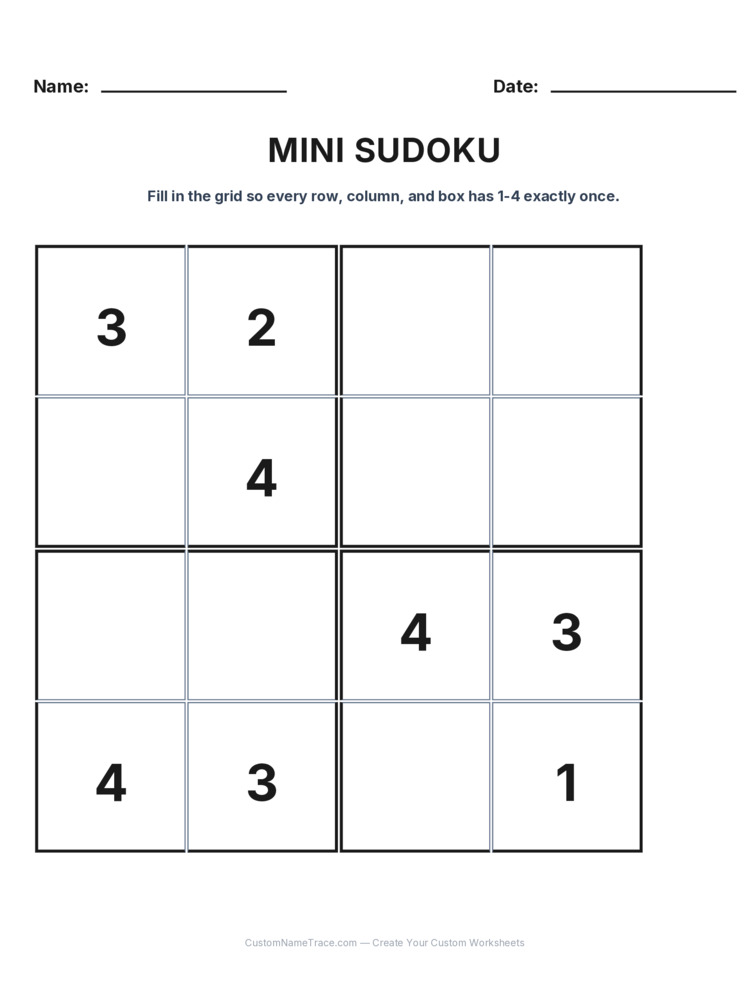
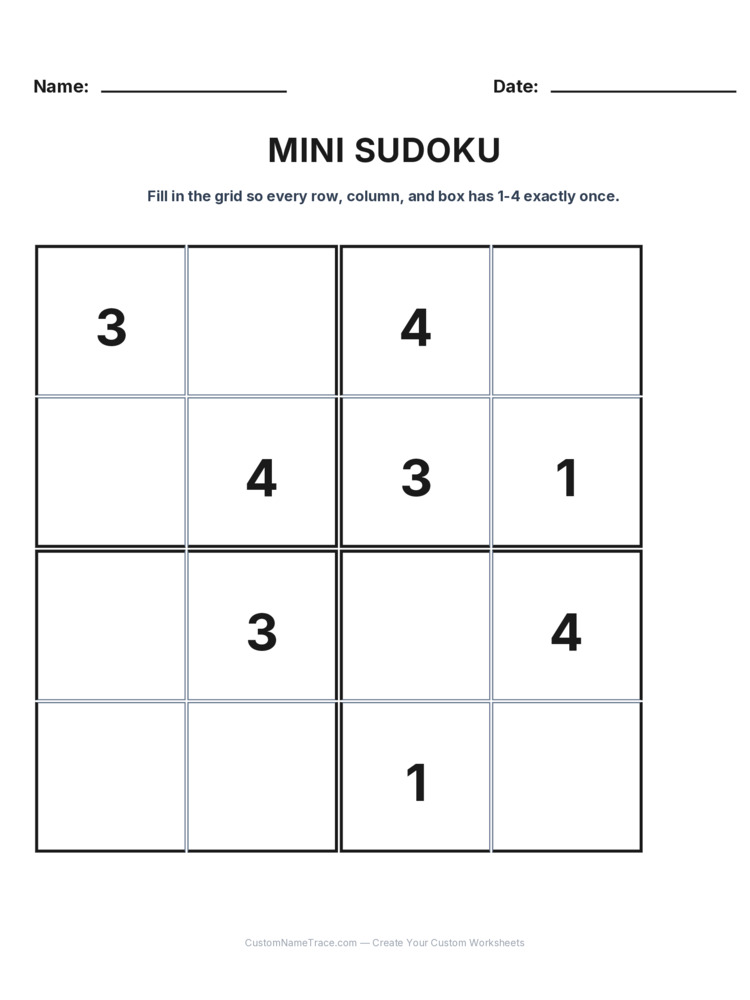
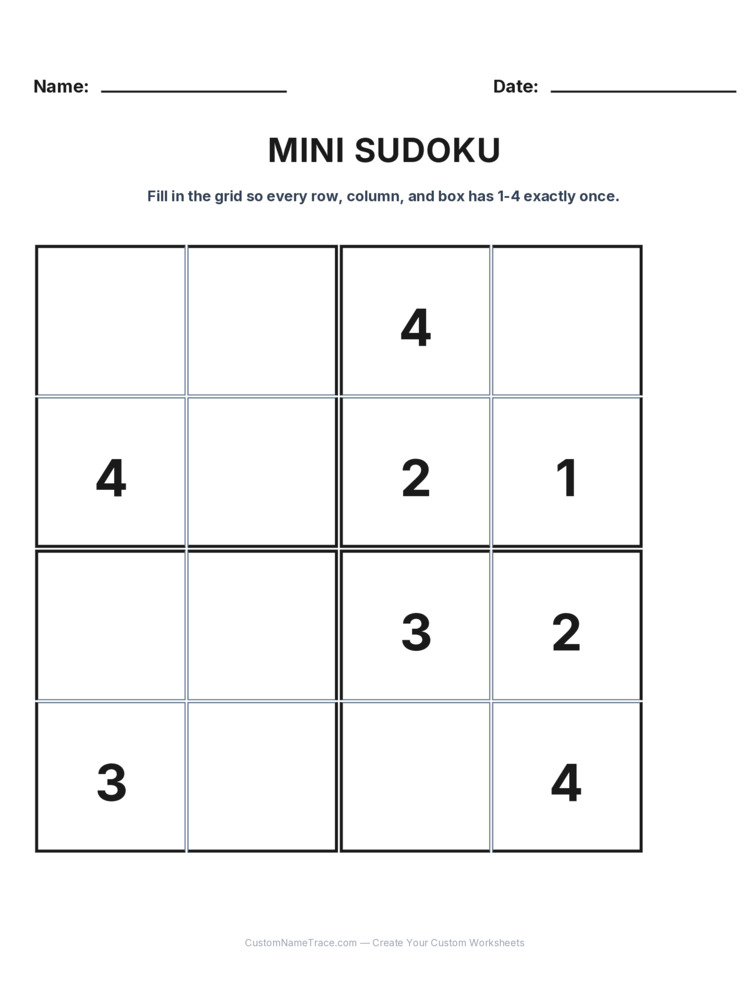
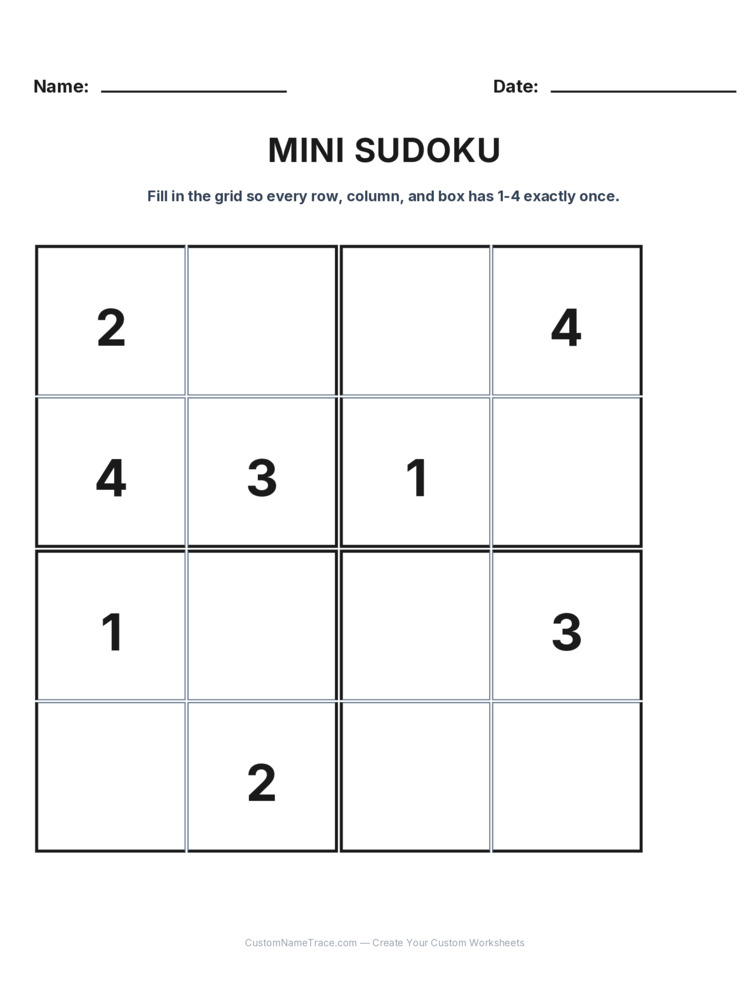
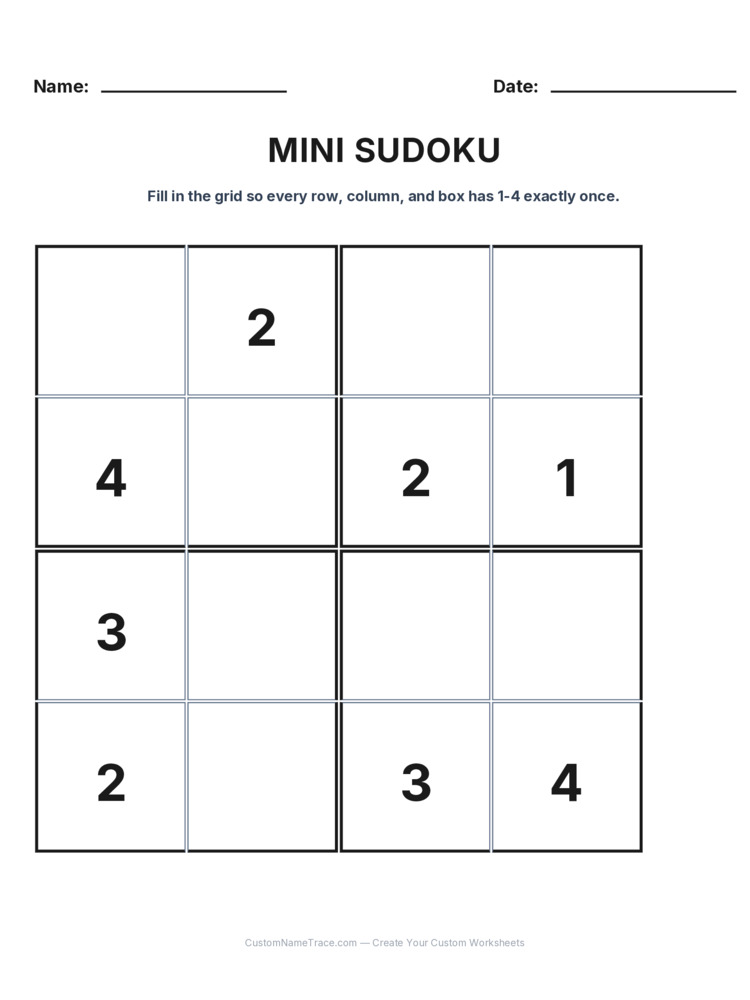
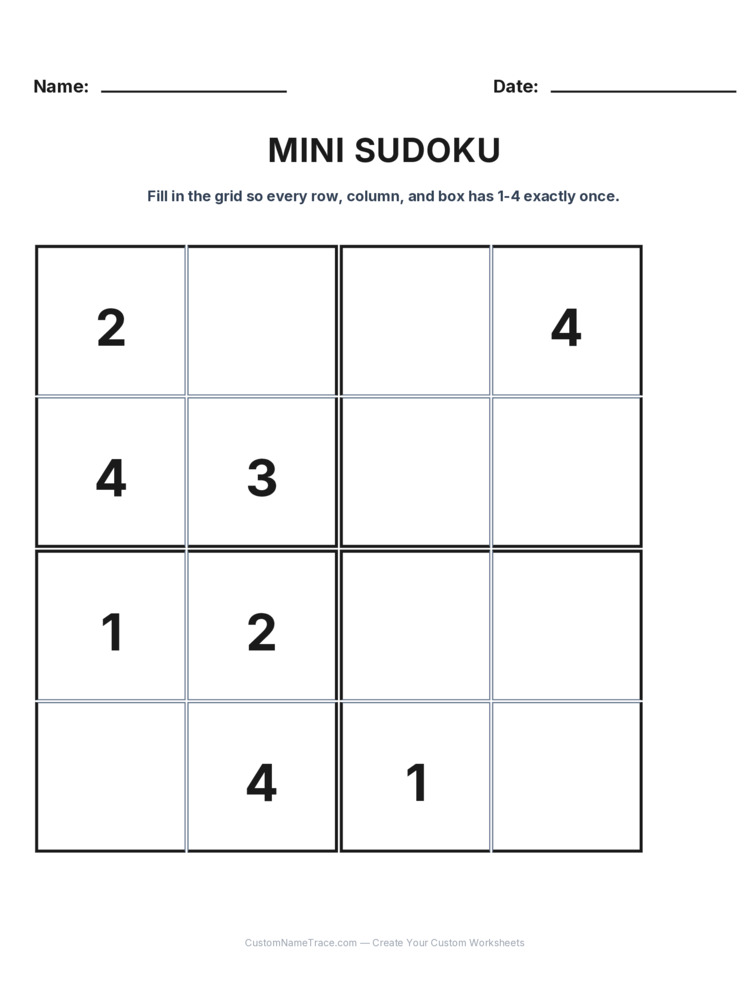
A real Sudoku, scaled to 4x4
This is a genuine Sudoku puzzle, not a simplified imitation — a 4x4 grid split into four 2x2 boxes, following the exact same core rule as the full 9x9 version: every row, every column, and every 2x2 box must contain the numbers 1 through 4 exactly once each. Scaling the grid down keeps the puzzle achievable for a child new to Sudoku-style reasoning, while the underlying logic — deduction through elimination across three overlapping constraints — is identical to the real thing.
Filling in any blank cell correctly requires checking it against three separate constraints at once — its row can't repeat a number, its column can't repeat a number, and its 2x2 box can't repeat a number — and the answer has to satisfy all three simultaneously, not just one. That's the puzzle's core difficulty and its core lesson: elimination, not guessing, is the path to a solution. A number that's ruled out by even one of the three rules can be crossed off as a possibility for that cell, immediately narrowing the search.
Every puzzle here starts from a complete, valid, fully solved 4x4 grid, has some cells removed to create the puzzle, and is then checked by computer to confirm that exactly one valid way to fill in the blanks still exists before it's ever published. That verification step matters: a hand-built or careless Sudoku grid can easily end up with more than one valid solution, which breaks the entire logic of the puzzle — every worksheet on this page is guaranteed to have one, and only one, correct completion.
It would be far simpler to generate a 4x4 grid, remove some numbers at random, and call it a puzzle — but a randomly emptied grid can easily end up with more than one valid way to fill it back in, which quietly breaks the entire point of Sudoku as a logic exercise. Every puzzle on this page goes through an extra verification step specifically to rule that out, confirming a unique solution exists before publishing, because a puzzle that technically has two right answers teaches a child the wrong lesson about what logical certainty actually means.
Solving by elimination, step by step
The most reliable strategy is to start with whichever row, column, or box already has the most numbers filled in, since fewer possibilities remain to check there. For each empty cell, working out which of the numbers 1 through 4 are already used in its row, its column, and its box — and eliminating those — often leaves only one number that can legally go in that spot. Repeating that process, one cell at a time, gradually fills the whole grid without ever needing to guess.
A common early mistake is treating the whole grid as one big puzzle to stare at rather than three separate, smaller checks per empty cell — its row, its column, its box. Explicitly separating those three checks out loud, one at a time, for a single cell before moving to the next empty one breaks the puzzle into a size that feels manageable, rather than letting a child try to hold the entire grid's constraints in mind simultaneously, which is genuinely more than this puzzle actually requires at any one moment.
Writing small candidate numbers in the corner of an empty cell — the possibilities not yet ruled out — rather than trying to hold them in memory turns Sudoku from a puzzle that depends on mental stamina into one that depends on careful bookkeeping, which is a far more teachable and reliable skill for a child new to this format. As cells around it get filled in, candidates can be crossed off one by one until only one remains — the visible, concrete version of the elimination process described earlier on this page.
Helping a stuck child
If a child is guessing rather than eliminating, pick one specific empty cell together and ask three separate questions out loud: "which numbers are already in this row? this column? this box?" Crossing off each used number from the four possibilities (1, 2, 3, 4) as they're named makes the elimination process visible and concrete, rather than asking a child to track it all mentally, which is often where the real difficulty lies at this stage — not the logic itself, but holding three lists in mind at once.
For a child who finds a 4x4 grid intimidating at first, drawing a simpler 3x3 or even 2x2 version on scratch paper — same rule, fewer numbers to track — can build initial confidence with the elimination process before returning to the full puzzle. This isn't a permanent substitute for the real 4x4 format, but a genuine stepping stone for a child who needs the concept broken down further before the printed worksheet's version stops feeling like too much at once.
What genuine progress looks like
The first few Mini Sudoku grids a child completes will likely take real time and include some backtracking — that's expected and productive, not a sign of struggling. Progress shows up as fewer guesses and more direct elimination over successive puzzles, not necessarily as faster completion times right away; a child who's slowly filling a grid through careful, correct elimination is doing exactly what this puzzle is meant to teach, even if it takes a while.
Mini Sudoku is one of the few puzzles on this site where a child's first attempt is genuinely unlikely to be fast or effortless, and that's worth saying plainly rather than letting a slow first try feel like failure. The elimination method described throughout this page is a learnable process, not an innate talent some children have and others don't — a child who sticks with it, using the candidate-number pencil habit consistently, reliably gets faster and more confident with practice, regardless of how the very first puzzle went.
Where this leads
Mini Sudoku sits at the end of this site's grade-by-grade logic progression on purpose — it draws directly on skills built earlier in the sequence: the rule-following habit from Find and Cross Out, the two-rule reasoning from Complete the Pattern and Venn Diagram Sort, and the careful, methodical step-by-step process from Cryptogram decoding. A child comfortable with Mini Sudoku has, in a real sense, practiced every reasoning skill this section is built around, combined into one puzzle.
The elimination logic practiced here — row, column, and box constraints working together to narrow down one correct answer — is identical to the reasoning a full 9x9 Sudoku requires, just at a smaller, more manageable scale. A child who's genuinely comfortable with 4x4 Mini Sudoku has already learned the core method a much larger, more complex puzzle uses; what changes later is only the size of the grid and the number of constraints to track, not the underlying logic itself.
Mini Sudoku is the last new puzzle format in this site's grade-by-grade Logic Worksheets progression, and a child who's genuinely comfortable with it — solving it through real elimination rather than guessing — has worked through every reasoning skill this section was built to teach, from simple picture comparison up through full three-constraint deduction. From here, the same underlying skills keep compounding in whatever comes next, whether that's a larger Sudoku grid or an entirely different kind of logic puzzle encountered outside this site.
What's matched to Grade 3's level is how many cells are already filled in when the puzzle starts — more given cells means fewer to deduce and an easier starting point — not the underlying rule, which stays the genuine three-constraint Sudoku logic throughout. A child working through this puzzle at any grade level is doing real Sudoku reasoning, just with a starting grid scoped to what's achievable at their stage.